
Steam lifts off a bowl of ramen at one of Hakata’s open-air yatai, the food stalls that set up for the evening, while a few blocks away a train pulls out of the station right on schedule. That mix of old habits and clockwork modernity runs through the whole country. Japan stretches from snowbound Hokkaido to the island of Okinawa, and it holds temples, gardens, castles, hot springs and some of the best eating a traveler will find anywhere.
Where is Japan and what is it like?
Japan is an island nation in East Asia, an archipelago of 14,125 islands strung along the Pacific coast of the continent. Five main islands carry most of the story. From north to south they are Hokkaido, Honshu, Shikoku, Kyushu and Okinawa, and Honshu, the largest, holds Tokyo, Kyoto, Osaka, Nara, Hiroshima and Kanazawa.
The country is divided into 47 prefectures, and its coastline is the sixth longest in the world, at 18,486 miles. Forest covers two thirds of the archipelago, which explains something you notice quickly: a city of enormous size can sit beside wooded hills, and a temple can hide behind a wall of cedar and maple just minutes from a shopping street.
Climate changes a great deal from one end of the country to the other. Japan has six principal climatic zones. Hokkaido has a humid continental climate with long, very cold winters and snowfalls measured in hundreds of inches around Sapporo and Asahikawa.
On the Sea of Japan side, the northwest wind of winter brings heavy snow, which south of Tohoku mostly melts before spring begins. The Central Highland is a true inland climate, with big swings between summer and winter and between day and night.
What kind of trip suits Japan? Almost any, as long as you enjoy walking and eating. Food lovers follow ramen, okonomiyaki and the stalls of Fukuoka. Culture seekers head for Kyoto’s machiya townhouses, Nara’s temples and Kanazawa’s gardens.
Travelers who want weather and wilderness go north to Hokkaido, and those who want a different rhythm go south to Okinawa. Many trips braid several of these together, and the rail network makes that natural.
Where to go in Japan
Tokyo
Tokyo is the capital and the most populous metropolitan area in the world, set on Tokyo Bay in the Kanto region of Honshu. It is less a single city than a collection of neighborhoods, each with its own character. Ginza, for example, is an upscale downtown area of high-end restaurants and luxury shops, and Nihonbashi sits beside it.
Tokyo suits travelers who like to move between worlds in a single day: a shrine in the morning, a department store food hall at lunch, a standing-room bar at night. It also works as a base for the rest of the country, since lines of Japan Railways, Tokyo Metro and the Toei Subway fan out from it, and a flight from here reaches Hokkaido.
Kyoto, Osaka and Nara in the Kansai region
Kyoto carries a cultural heritage built up over 1,200 years. Its traditions include machiya townhouses, the Gion Matsuri festival and the hanamachi districts where geishas live and work. Kyoto Station is served by the Tokaido Shinkansen, and the building itself holds a full floor of ramen restaurants, an Isetan department store, a theater and a Granvia hotel, so a first meal can happen before you leave the station.
Osaka feels different, a relaxed city known for food, entertainment and nightlife, with some history and culture to discover. Dotonbori and Shinsaibashi are the districts to aim for when you are hungry or want to shop, and the Midosuji Line runs there from Osaka and Umeda stations.
Nara lies east of Osaka and south of Kyoto, reached by train from both. The city has two main stations, JR Nara and Kintetsu Nara, and is known for its deer and temples.
Hiroshima and Miyajima
Hiroshima Prefecture pairs the Seto Inland Sea, wooded mountains and clear waters with peace-related sites, shrines and museums. In the city, the Peace Memorial Park and the Atomic Bomb Dome are the places where visitors stop and take their time. Okonomiyaki, the savory griddle pancake, is the local meal, and Hiroshima’s version is its own style.
Miyajima Island, an excursion from the city, is where the red torii gate of Itsukushima Shrine stands in the sea, and where deer wander near the floating shrine. On August 6, thousands of people write peace messages on lanterns, which are lit at sunset and floated along the river in front of the Atomic Bomb Dome.
Hokkaido
Hokkaido is the northernmost prefecture of Japan, and it is where nature, outdoor activities and local cuisine take the lead. The island divides into Sapporo and its surroundings, Asahikawa and northern Hokkaido, Hakodate and southern Hokkaido, and Kushiro and eastern Hokkaido.
It suits travelers who want space and weather, and who are curious about regional food. Winter here means long, cold months and a great deal of snow, while the maple leaves begin to change in eastern Hokkaido as early as mid-October. New Chitose Airport near Sapporo is the way in by air.
Okinawa
Okinawa is the southernmost of the five main islands, and Naha is its largest city, home to about a fifth of the main island’s residents. Naha has the only public rail network in Okinawa, the Okinawa Urban Monorail, known as Yui Rail.
A highlight on the main island is Okinawa Churaumi Aquarium, which recently welcomed a new female Japanese sawshark in an effort to breed the species. Okinawa suits travelers looking for beaches, island culture and time in Naha.
Kanazawa and Fukuoka
Kanazawa is the capital of Ishikawa Prefecture, on a narrow strip of land along the Sea of Japan on Honshu. In the Edo period it was one of the most important cultural and artistic centers in Japan, and it remains a destination for people who love art and craft. The city promotes evening illuminations at Kanazawa Castle Park and Kenrokuen Garden.
Fukuoka is a port city on the north coast of Kyushu, the third largest island of Japan, and it has the fastest population growth of any city in Japan. The city was chosen in the Food category of Lonely Planet’s Best In Travel 2023, and the yatai of Hakata were named in The New York Times’ 52 Places to Go in 2023. Both suit travelers who plan around meals.
Things to do in Japan
Walking through temples and shrines is the heart of many trips, and Kyoto and Nara are the obvious places for it. You pass under torii gates, hear the clap of hands at a shrine and smell incense at a temple hall. Shoes come off at many entrances, and a visit slows down on its own. Itsukushima Shrine near Hiroshima adds the odd, memorable sight of a gate standing in the water.
Gardens and castles
Kanazawa’s Kenrokuen Garden is the clearest example of what a Japanese garden does: paths, ponds, stones and carefully shaped trees arranged so that each turn gives a new view. Next to it, Kanazawa Castle Park is lit up in the evening, along with the garden. Gardens are also where the seasons are easiest to read, with maple leaves turning red in autumn and snow settling on branches in winter.
The color of the maples follows a calendar. In eastern Hokkaido it starts in mid-October, reaches Tohoku and eastern Hokuriku around November 20, and arrives in Kanto, Tokai, Chugoku, Shikoku and northern Kyushu around the end of the month.
The Pacific coasts of Kanto and Tokai, the Kinki region and southern Kyushu see it from early to mid December. Aomori’s maples usually turn around the middle of November, and Fukuoka’s around the start of December.
Eating your way across the country
Food is a reason to travel here, and it changes from city to city. Fukuoka’s yatai serve ramen and small plates outdoors in the evening. Osaka is known for food and nightlife, and its Dotonbori district is a good place to graze from one stall to the next. Hiroshima has okonomiyaki, and Hokkaido leans on its local cuisine. Kyoto Station itself holds a floor of ramen restaurants, handy for a quick bowl between trains.
Beyond these, Japan rewards simple curiosity. Department store food halls, small izakaya (casual pubs serving dishes to share), counters where a cook prepares a single dish in front of you and sweets shaped to the season all turn an ordinary lunch into something to remember.
Mount Fuji, snow and nature
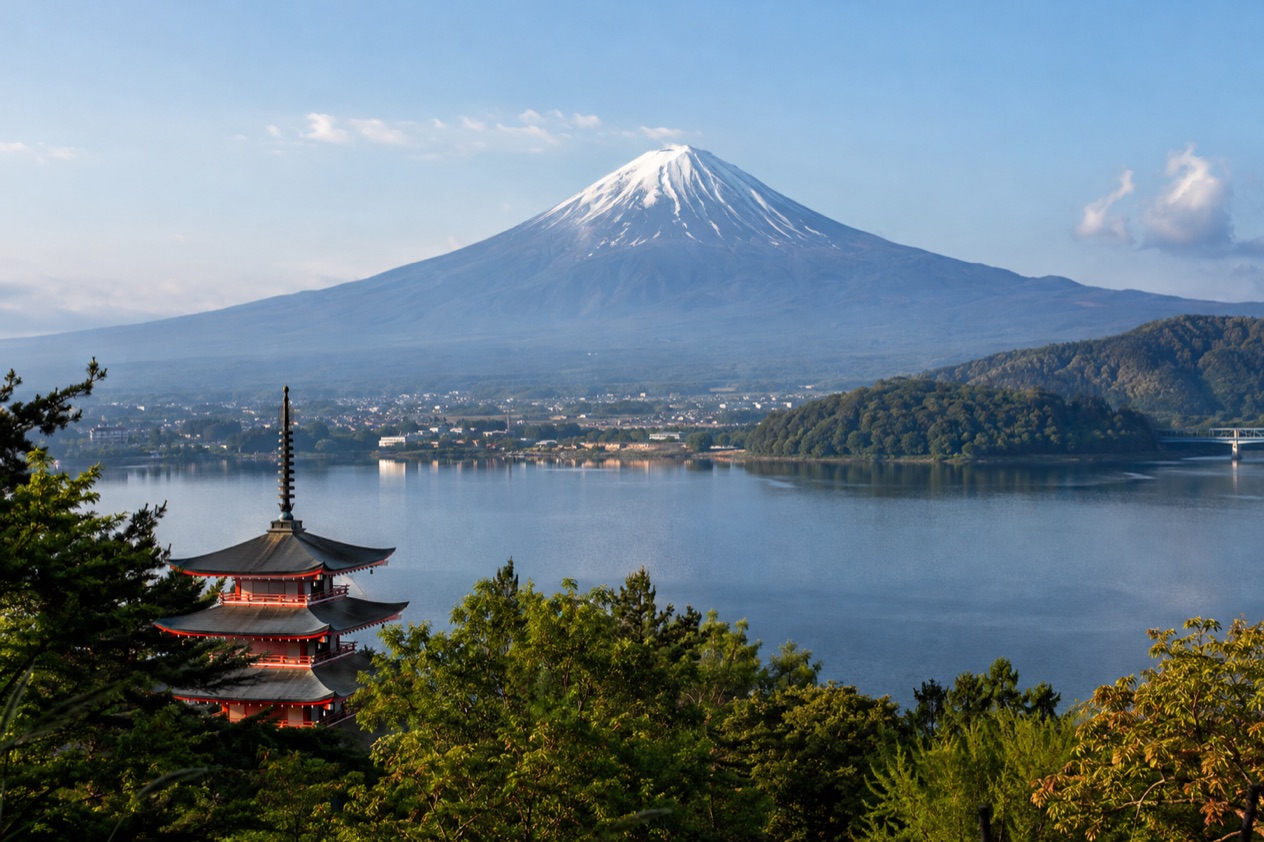
Mount Fuji is the highest mountain in Japan and a UNESCO World Heritage site. Mount Fuji is Japan’s highest mountain and a UNESCO World Heritage site. Hokkaido is the other big natural draw, with outdoor activities, long winters and large snowfalls around Sapporo and Asahikawa. The Sea of Japan coast also gets heavy winter snow.
Festivals, trains and ceremonies
Festivals give a trip a date to aim for. Kyoto’s Gion Matsuri is part of the city’s identity, and Hiroshima’s August 6 ceremony, with its floating lanterns, is a quiet and moving evening beside the river. Trains themselves are part of the experience, since Japanese trains have a reputation for being always on time, which lets you plan to the minute.
When to visit Japan
Autumn is a strong time to come, because the maple leaves move across the country from north to south over several weeks. It starts in eastern Hokkaido in mid-October and reaches the southern Kyushu and Kinki coasts by early to mid December. Planning a route that follows the color is part of the pleasure.
Winter splits the country in two. Hokkaido has long, very cold winters with heavy snow, and the Sea of Japan coast gets heavy snowfall from the northwest wind. Tokyo is much milder, with cold, bright days and only a dusting of snow on a few of them. April in Tokyo is mild and wetter than January.
Summer in Tokyo is hot and humid, with showers on many days and long, heavy evenings. October is the wettest of the four months in the table for Tokyo, but it is also mild, a comfortable time to be outside between rain spells. The Central Highland swings widely between day and night and between seasons, so pack for a gap between morning and afternoon there.
| Tokyo | Average high (°F) | Average low (°F) | Precipitation (inches) | Days with precipitation | Sunshine (hours) |
|---|---|---|---|---|---|
| January | 49.6 | 34.2 | 2.35 | 4.5 | 193 |
| April | 66.9 | 49.6 | 5.26 | 9.5 | 179 |
| July | 85.8 | 72.3 | 6.15 | 10.5 | 151 |
| October | 71.6 | 58.6 | 9.24 | 10.5 | 129 |
Think of these as Tokyo’s own numbers, a reference rather than a rule for the whole country. Hokkaido is colder and snowier in winter, and the mountains and the Sea of Japan coast have their own conditions. The seasons change the cities, too: January brings clear light and bare branches, and July brings the humid evenings that send people into air-conditioned food halls.
Getting around Japan
Trains are the backbone of travel here. Japanese trains have a reputation for being always on time, which means travelers can plan their days to the minute. In Tokyo, you will find Japan Railways trains, Tokyo Metro lines and Toei Subway lines, among others. In Kyoto, Kyoto Station is served by the Tokaido Shinkansen line.
From Tokyo, the Tokaido-Sanyo shinkansen runs to Shin-Osaka Station, and the journey takes about two and a half hours. In Osaka, the Midosuji Line connects Osaka and Umeda stations with Shinsaibashi, the stop for Shinsaibashi and Dotonbori. Nara has two main stations, JR Nara Station and Kintetsu Nara Station, and trains reach it from both Osaka and Kyoto.
By air, Hokkaido is reached through New Chitose Airport near Sapporo, and direct flights from Tokyo take about 1 hour 30 minutes. Nara’s closest airports are Osaka International Airport (Itami) and Kansai International Airport, both in Osaka Prefecture. From either, Nara is about one hour and fifteen minutes away by bus and train.
In Okinawa, Naha has the island’s only public rail network, the Okinawa Urban Monorail, known as Yui Rail. Traffic in Japan moves on the left side of the road, and if you do not read Japanese, road signs can be hard to understand.
Good to know before you go
The U.S. State Department rates Japan Level 1: Exercise Normal Precautions.
Electricity in Japan is 100 volts, with frequencies of 50 hertz and 60 hertz, so check your devices before you plug them in. The country runs on Japan Standard Time, UTC+09:00, and traffic keeps to the left.
Winter in Hokkaido and along the Sea of Japan coast means heavy snow, and autumn leaves arrive in the north first, so plan the route by season. As anywhere abroad, ordinary caution is wise, and a rail-based itinerary covers a lot of ground.
Sources
- Wikipedia, Climate of Japan (https://en.wikipedia.org/wiki/Climate_of_Japan), checked October 11, 2026
- Wikipedia, Japan (https://en.wikipedia.org/wiki/Japan), checked October 11, 2026
- Wikivoyage, Japan (https://en.wikivoyage.org/wiki/Japan), checked October 11, 2026
- Japan National Tourism Organization, Tokyo (https://www.japan.travel/en/destinations/kanto/tokyo/), checked October 11, 2026
- Japan National Tourism Organization, Kyoto (https://www.japan.travel/en/destinations/kansai/kyoto/), checked October 11, 2026
- Japan National Tourism Organization, Osaka (https://www.japan.travel/en/destinations/kansai/osaka/), checked October 11, 2026
- Japan National Tourism Organization, Hokkaido (https://www.japan.travel/en/destinations/hokkaido/hokkaido/), checked October 11, 2026
- Japan National Tourism Organization, Okinawa (https://www.japan.travel/en/destinations/okinawa/okinawa/naha-and-the-main-island/), checked October 11, 2026
- Okinawa Churaumi Aquarium (https://churaumi.okinawa/en/), checked October 11, 2026
- Japan National Tourism Organization, Hiroshima (https://www.japan.travel/en/destinations/chugoku/hiroshima/), checked October 11, 2026
- Japan National Tourism Organization, Mount Fuji guide (https://www.japan.travel/en/fuji-guide/), checked October 11, 2026
- Official website for Mt. Fuji climbing, about the climb (https://www.fujisan-climb.jp/en/about/), checked October 11, 2026
- Japan National Tourism Organization, Nara (https://www.japan.travel/en/destinations/kansai/nara/), checked October 11, 2026
- Japan National Tourism Organization, Kanazawa (https://www.japan.travel/en/destinations/hokuriku-shinetsu/ishikawa/kanazawa-and-around/), checked October 11, 2026
- Kanazawa Tourist Information Guide (https://www.kanazawa-tourism.com/), checked October 11, 2026
- Japan National Tourism Organization, Fukuoka (https://www.japan.travel/en/destinations/kyushu/fukuoka/fukuoka-city/), checked October 11, 2026
- Fukuoka City official tourist guide (https://yokanavi.com/en/), checked October 11, 2026
- U.S. Department of State, Japan travel advisory (https://travel.state.gov/content/travel/en/international-travel/International-Travel-Country-Information-Pages/Japan.html), checked October 11, 2026
- U.S. Department of State, Japan travel information, travel and transportation (https://travel.state.gov/content/travel/en/international-travel/International-Travel-Country-Information-Pages/Japan.html), checked October 11, 2026
- Japan National Tourism Organization, trains and buses (https://www.japan.travel/en/guide/how-to-travel-by-train-and-bus-in-japan/), checked October 11, 2026
- Japan Meteorological Agency, maple color-change dates 2025-2026 with difference from the 1991-2020 normal (https://www.data.jma.go.jp/sakura/data/phn_014.html), checked October 11, 2026
- Japan Meteorological Agency, kaede2020.pdf (https://www.data.jma.go.jp/sakura/data/kaede2020.pdf), checked October 11, 2026
- Japan Meteorological Agency (JMA), Normal values 1991-2020, monthly (https://www.data.jma.go.jp/stats/etrn/view/nml_sfc_ym.php?prec_no=44&block_no=47662), station Tokyo, elevation 25 m, checked October 11, 2026
All our pages
When to go
- Best Time to Visit Japan: Cherry Blossoms, Autumn Colors, Weather and Festivals
- Japan in January: Weather, Snow Country, New Year Traditions and Where to Go
- Japan in February: Sapporo Snow Festival, Plum Blossoms, Ski Season and Weather by Region
- Japan in March: Cherry Blossom Season, Hina Matsuri, Weather and Where to Go
- Japan in April: Cherry Blossoms, Weather by Region and What to Do
- Japan in May: Golden Week, Festivals, Fresh Green and Weather by Region
- Japan in June: Weather, Hydrangea and Iris Festivals, and Where to Go
- Japan in July: Gion Matsuri, Tanabata, Mount Fuji's Climbing Season and Where to Go
- Japan in August: Festivals, Heat by Region and Where to Go
- Japan in September: Weather by Region, Fireworks, Cosmos Flowers and Where to Go
- Japan in October: Weather by Region, Autumn Festivals and Where to Go
- Japan in November: Autumn Leaves, Weather by Region and Where to Go
- Japan in December: Winter Lights, Hokkaido Snow, Weather and Where to Go
- Scenic Trains in Japan: Hokkaido Norokko Trains, Sake and Seafood Cars, Monorails
- Sleeper Trains in Japan: The Sunrise Seto, Its Route, Berths and Fares
- Train Etiquette in Japan: Phones, Station Bento, Smoking and IC Cards
- Trains in Japan: Shinkansen, IC Cards and Train Types
Things to do
- Things to Do in Japan: Kyoto Temples, Onsen, Street Food and Day Trips
- 3 Days in Japan: Kyoto, Osaka, Nara and How to Get Around
- 10 Days in Japan: Itinerary for Tokyo, Hakone, Kyoto, Osaka and Hiroshima
- 14 Days in Japan: Itinerary Through Tokyo, Hakone, Kyoto, Osaka and Hiroshima
- 21 Days in Japan: Itinerary Through Tokyo, Kanazawa, Kyoto, Osaka and Hiroshima
- 21st Century Museum of Contemporary Art, Kanazawa: The SANAA Circle, Swimming Pool Illusion and Kenrokuen Next Door
- 5 Days in Japan: Itinerary for Tokyo, Kyoto, Nara and Osaka
- 7 Days in Japan: Itinerary: Tokyo, Hakone, Kyoto, Nara and Osaka
- Akihabara, Tokyo: Electric Town, Anime Shops, Maid Cafés and How to Get There
- Aman Kyoto: Kerry Hill Design, Where It Stands, Aman's Japan Retreats and Seasonal Stays
- Aman Tokyo: Otemachi Tower Location, Suites, Spa and Sushi at Musashi
- ANA All Nippon Airways Flights from the U.S.: Cities Served, Tokyo Airports and Booking Notes
- Aomori Travel Guide: Nebuta Festival, Sannai-Maruyama Site and Getting There
- Arashiyama Bamboo Grove: What You See, How to Get There and When to Go
- Arashiyama, Kyoto: Bamboo Grove, Monkey Park, Tenryu-ji and the Hozu River Cruise
- Arima Onsen: Gold and Silver Springs, Historic Ryokan and How to Get There
- Asahikawa Travel Guide: Asahiyama Zoo, Sake, Winter Festival and Day Trips
- Asahiyama Zoo: Polar Bears, Penguins, Seals and How to Get There
- Asakusa, Tokyo: Senso-ji, Nakamise, Sanja Matsuri and Where to Eat
Where to stay
- Where to Stay in Japan: Ryokan, Temple Stays, Capsule Hotels and the Best Cities to Base In
- Accommodation Taxes in Japan: Local Lodging Charges, Where You Pay and How They Show on the Bill
- Airbnb and Vacation Rentals in Japan: Minpaku Terms, House Rules and Booking Habits
- Business Hotels in Japan: Rooms, Capsule Cousins and Who They Suit
- Capsule Hotels in Japan: Origins, Who Stays and What to Know Before Booking
- Hotel Tips for Japan: Room Types, Check-In Habits and Booking Online
- Luxury Hotels in Japan: Aman, Hoshinoya, Park Hyatt Tokyo and Where to Find Them
- Temple Stays in Japan (Shukubo): Rooms, Vegetarian Meals, Morning Prayers and Where to Stay
- Staying Longer in Japan: the 90-Day Limit, Visa Options and What to Prepare
- Ryokan vs Hotel in Japan: Tatami Rooms, Kaiseki Dinners, Onsen Baths and Cost
Getting there
- Sending Luggage from the Airport in Japan: Hands-Free Travel, Hotel Delivery and Coin Lockers
- Atlanta to Tokyo: Delta Nonstop, Haneda vs. Narita and Getting Into the City
- Boston to Tokyo: Airlines, Haneda or Narita, and Getting Into the City
- Chicago to Tokyo: Airlines, Haneda or Narita, and Getting Into the City
- Chubu Centrair Airport (NGO): Airlines, Terminals and Getting to Nagoya
- Dallas to Tokyo: American Airlines Nonstop, Haneda and Narita, and Getting Into the City
- Denver to Tokyo: Airlines, Haneda or Narita, and Getting Into the City
- Detroit to Tokyo: Delta Nonstop, Haneda or Narita, and Getting Into the City
- Flights to Fukuoka: Airlines, Terminals and Getting into the City
- Flights to Japan: Airports, Airlines, Nonstop U.S. Cities and Stopovers
- Flights to Nagoya: Centrair Airport, Nonstop Routes from Honolulu and Getting into the City
- Flights to Okinawa: Naha Airport, Airlines and Getting to Your Hotel
- Flights to Osaka: Kansai and Itami Airports, Airlines from the U.S. and Getting to the City
- Flights to Sapporo: Airports, Domestic Routes and the Train into the City
- Flights to Tokyo: Haneda and Narita, U.S. Airlines and How to Choose
- Haneda Airport (HND): Terminals, Airlines and Getting to Tokyo
- Honolulu to Osaka: Hawaiian Airlines, Kansai Airport and Connecting Options
- Honolulu to Tokyo: Airlines, Haneda and Narita, and What to Sort Out Before You Fly
Practical
- Know Before You Go to Japan: Entry, Money, Etiquette and Getting Around
- Is Japan Safe for Tourists? Crime, Nightlife Scams, Earthquakes and Typhoon Warnings
- Japan on a Budget: Rail Passes, Night Buses, Low-Cost Flights and Tax-Free Shopping
- How Much Does a Trip to Japan Cost?: Transport, Lodging, Food and Ways to Save
- Japan Currency: The Yen, Bills and Coins, ATMs and Cards
- Japan Travel Tips for First-Timers: Entry Basics, Etiquette, Electricity and Planning
- Spring vs autumn: Cherry Blossoms, Maple Leaves, Weather and Food in Japan
- What to Pack for Japan in Fall: Layers, a Hokkaido Coat and Foliage-Season Extras
- What to Pack for Japan: Layers, Rain Gear and What to Leave at Home
- What to Pack for Japan in Spring: Layers, Pollen Gear and Mountain Extras
- What to Pack for Japan in Summer: Humid Weather, Festival Nights and Mount Fuji Season
- What to Pack for Japan in Winter: Layers, Snow Gear and New Year Plans
- Japan Rail Pass Price: Pass Lengths, Regional Alternatives and Where to Buy
- Tipping in Japan: Why You Don't Tip, Kokorozuke and Service Charges
- Do Americans Need a Visa for Japan? Visa-Free Stays, Passport Rules and What Happens at Immigration
- The Japan Rail Pass vs individual tickets: Coverage, Regional Passes and Which Trip Fits
- Narita vs Haneda: Location, Airlines, Terminals and Which to Choose
- Universal Studios Japan vs Tokyo Disney Resort: Rides, Food, Seasons and Which to Pick
Places
- Tokyo Travel Guide: Districts, Festivals, Seasons and Where to Stay
- Kyoto Travel Guide: Temples, Festivals, Where to Stay and When to Go
- Osaka Travel Guide: Food, Dotonbori, Osaka Castle and Day Trips in Kansai
- Japan Cruises: Kobe and Yokohama Ports, Home-Port Lines and Summer Sailings
- Okinawa Travel Guide: Naha, Churaumi Aquarium, Beaches and the Kerama Islands
- Sapporo Travel Guide: Snow Festival, Ramen, Beer and Odori Park
- Fukuoka Travel Guide: Yatai Food Stalls, Hakata Ramen, Festivals and the Best Time to Visit
- Hakone Travel Guide: Hot Springs, Lake Ashi, Owakudani and the Hakone Freepass
- Hiroshima Travel Guide: Peace Park, Miyajima, Okonomiyaki and When to Go
- Nagoya Travel Guide: Castle, Atsuta Shrine, Toyota Museum and Nagoya Food
- Kobe Travel Guide: Kobe Beef, Arima Onsen, Mount Rokko and When to Go
- Nara Travel Guide: Deer, Todai-ji, Nara Park and When to Go
- Kanazawa Travel Guide: Kenroku-en, Crafts, Day Trips and Getting There
- Takayama Travel Guide: Old Town Streets, the Festivals, Hida Beef and Snowy Winters
- Yokohama Travel Guide: Chinatown, Minato Mirai, Sankei-en and Getting There from Tokyo
- Mount Fuji and Lake Kawaguchi Travel Guide: Climbing Season, Lakeside Views and the Weather by Season
- Nikko Travel Guide: Toshogu Shrine, Lake Chuzenji, Kinugawa Onsen and Day Trips
- Niseko Travel Guide: Powder Snow, Four Resorts, Getting There and When to Go