
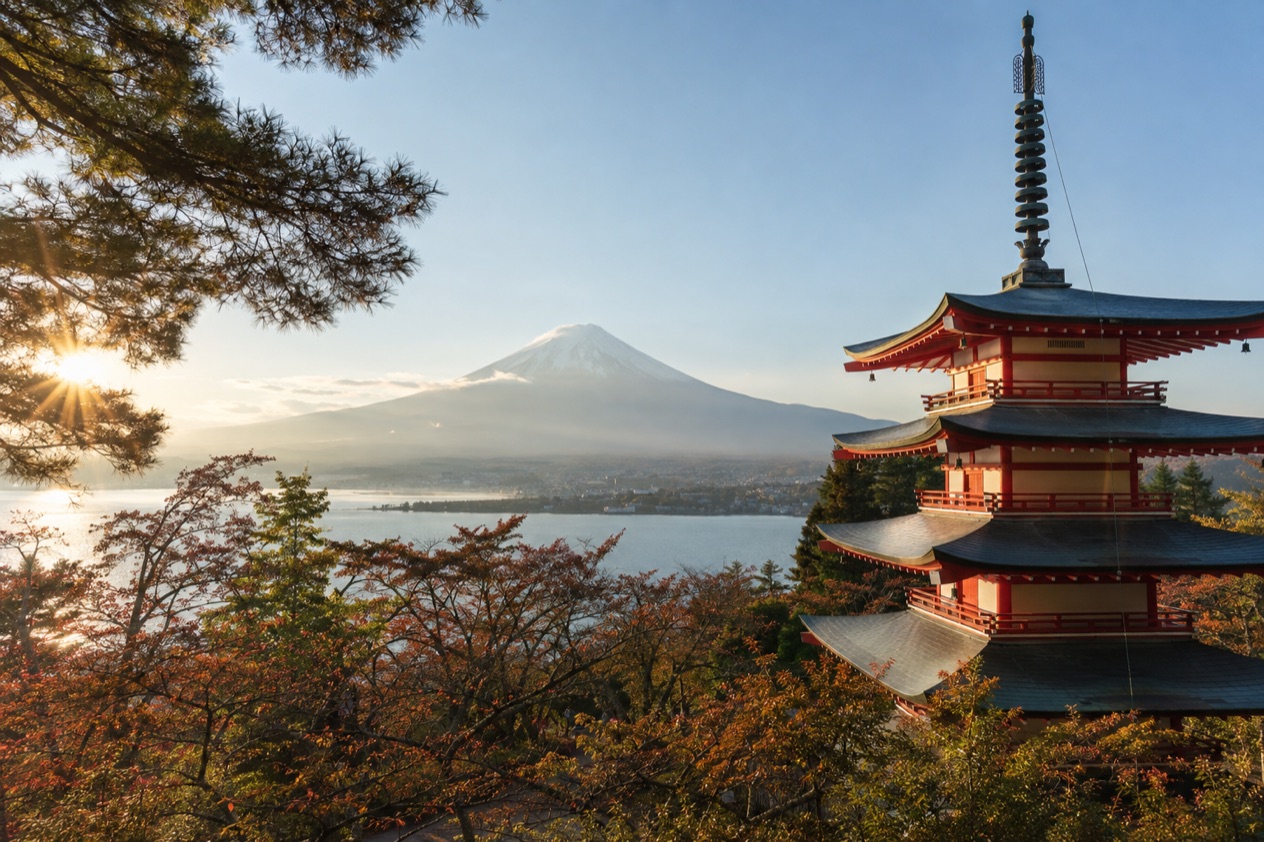
Halfway through the trip, you step out of your shoes at the entrance of a Hakone ryokan, slide into the indoor slippers waiting on the step, and walk across tatami to a room that smells faintly of straw and tea. Outside, hot spring steam drifts over the hillside. This is a route that moves from the towers of Tokyo to the hot springs of Hakone, then on to the temples of Kyoto and Nara, the street food of Osaka and the island shrine near Hiroshima, timed for the season when the air cools and the maples start to turn.
Is 10 Days enough for Japan?
Ten days is enough for a first trip that follows one long line down the main island of Honshu, and it suits travelers who are happy to see a few places well rather than the whole country thinly. The route here links the big city, a night in the mountains, the old capital and its neighbors, Osaka’s food district and the city of Hiroshima, using trains for nearly every move.
Tokyo comes first because it is where the trip starts and because it is the capital and the most populous metropolitan area in the world, a place that rewards a few unhurried days. Hakone follows for a night of hot springs, a change of pace after the city.
Then the route turns toward the Kansai region, where Kyoto, Nara and Osaka sit close enough to one another to share a base. The trip ends in Hiroshima, with a morning on Miyajima Island.
What it leaves out is a good deal. Hokkaido and its fall color in the east, Okinawa, Kyushu and Shikoku all need a separate trip. Kanazawa on the Sea of Japan side, with its garden and its Edo-period artistic past, is a natural swap if you would rather see a smaller city than Hiroshima, and it appears again further down as an alternative. Nikko, Kobe and Nagoya also stay for another visit.
Fall shapes the plan in a particular way. The color change of maple leaves moves across the country over several weeks, reaching the Tohoku region around the third week of November, the Kanto and Chugoku regions around the end of that month, and the Kinki region, which includes Kyoto, Nara and Osaka, in early to mid December.
In other words, an October or early November trip in these cities is about pleasant autumn air, and the bright reds arrive later. The dates shift from one year to the next, so treat them as a rough guide.
The route also keeps the days balanced. Cities with long walks alternate with a single night in the hills, and the longest rail ride is placed early so it does not eat into the days that follow. If a day goes slowly because you linger over a bowl of ramen or a temple garden, nothing in the plan breaks. Each stage below can be trimmed by a morning without losing its point.
The itinerary stage by stage
The plan below follows the order a first-time visitor would travel, starting in the east and finishing in the west, and each stage names the kind of area where it makes sense to sleep.
Days 1 to 3: Tokyo
Arrive and settle in on day 1, then use the evening for a first walk. Ginza, an upscale downtown district of high-end restaurants and luxury shops, makes a polished introduction, with lit shop windows and a long dinner.
Staying around Ginza or Nihonbashi puts you close to several rail and subway lines. Tokyo is served by Japan Railways (JR) trains, Tokyo Metro lines and Toei Subway lines, among others, so a rechargeable IC card saves you from working out each operator’s fare.
Day 2 can go to the shrines and temples. Meiji Jingu sits in a wooded park, and Senso-ji draws you through its gate and along a market street of snacks and souvenirs. Day 3 turns to the districts built for evenings.
From Shibuya Station, Roppongi and Akasaka are about 10 minutes away by train, and between them they hold restaurants, museums and late-night bars. A day of this kind leaves a free hour for a department store food hall or a neighborhood ramen counter.
Day 4: Hakone
Day 4 is the mountain night. Hakone lies in the western part of Kanagawa Prefecture, within the Fuji-Hakone-Izu National Park, and it is known for its natural hot springs and for views of Mount Fuji. Whether the mountain shows itself on a given day is a matter of luck and cloud, so plan the day around the baths and the scenery rather than around one view.
Hakone-Yumoto, known for its many restaurants and gift shops, is the town where you can stop for lunch and browse. The Hakone Freepass covers unlimited rides on eight kinds of transport there, including the Hakone Tozan Train, the Hakone Ropeway and the Hakone Sightseeing Cruise, which turns the day into a loop of train, cable car and boat across the hills and the lake. Sleep in a ryokan, eat the multi-course dinner, and soak in the hot spring before bed.
Days 5 to 7: Kyoto and Nara
Day 5 is for moving to Kyoto by rail. Kyoto Station is served by the Tokaido Shinkansen, and the station building itself holds a full floor of ramen restaurants, an Isetan department store, a theater and a Granvia hotel, so a first meal needs no searching.
Kyoto’s cultural heritage has developed over 1,200 years, and the city served as Japan’s capital and the emperor’s residence for over a thousand. Sleep in central Kyoto or near the station, in a hotel or a machiya townhouse.
Day 6 is Kyoto proper. Nijo Castle, built in 1603 by Tokugawa Ieyasu, the first shogun of the Edo period, is a good anchor for the morning in the central district. Spend the afternoon wandering the hanamachi districts where geishas live and work, then eat dinner in the lanes nearby. Gion Matsuri is a Kyoto tradition of its own, but it belongs to another season, so fall here is about gardens and temple grounds.
Day 7 goes to Nara, which lies south of Kyoto and east of Osaka and is reached by train from either. The city has two main stations, JR Nara and Kintetsu Nara. Nara Park sits at the foot of Mount Wakakusa, where tame deer wander among visitors and take crackers sold along the roadside. Return to Kyoto for the night, or carry on to Osaka if you want a head start on the next day.
Day 8: Osaka
Osaka is a charming and relaxed city known for its food, entertainment and nightlife, with some history and culture to discover. From Osaka or Umeda Station, the Midosuji Line takes you to Shinsaibashi Station, the stop for both Shinsaibashi and Dotonbori. Shinsaibashi is a shopping district and Dotonbori is the canal-side strip of restaurants and bright signs where street food is the point: takoyaki, okonomiyaki and skewers eaten standing up.
If you want a change from the neon, Osaka Bay can be reached from Osaka or Umeda stations via the JR Loop Line and the Chuo subway line. Sleep near Umeda or Shinsaibashi, so both the evening and the next morning start on the same subway line.
Days 9 and 10: Hiroshima, Miyajima and the way home
Day 9 is the move west by rail to Hiroshima. The Peace Memorial Park and the Atomic Bomb Dome are the center of the visit. The dome cannot be entered and is viewed from the outside, and the park beside it holds the museums and monuments that tell the city’s story. In the evening, find the local version of okonomiyaki, which Hiroshima builds in layers on the griddle.
Day 10 takes you to Miyajima Island, where Itsukushima Shrine has a red torii gate standing in the sea. The shrine was registered as a World Heritage Site in 1996, and the island’s deer share the paths with visitors.
Hiroshima Prefecture also has the Seto Inland Sea, wooded mountains and clear waters, so the boat crossing is part of the pleasure. Afterward, return by rail toward Osaka and Kansai International Airport for the flight out.
Getting between stops
| Leg | How | Time |
|---|---|---|
| Shibuya Station to Roppongi and Akasaka | By train | About 10 minutes |
| Tokyo to Shin-Osaka Station | Tokaido-Sanyo shinkansen | About 2 hours 30 minutes |
| Tokyo to Kanazawa | Hokuriku Shinkansen | Around 2 hours 30 minutes |
| Osaka airports (Itami or Kansai International) to Nara | Bus and train | About 1 hour 15 minutes |
Rail does nearly all the work on this route. Tokyo to Kyoto runs on the Tokaido Shinkansen, since Kyoto Station is served by that line, and the Tokyo to Shin-Osaka figure above shows how the same corridor reaches Osaka.
The legs from Tokyo to Hakone, from Kyoto to Nara and Osaka, and from Osaka to Hiroshima are all made by rail, and the sections within each city use local subway lines or JR trains. Japanese trains have a reputation for being always on time, which lets you plan to the minute, and public transport in general, including the shinkansen and regional trains, is extremely punctual.
Knowing the train types helps in the cities. Local trains stop at every station, which suits short distances. Rapid trains skip smaller stations and require no supplement, while express trains serve fewer stops, and a supplement may apply.
In Tokyo you will meet JR, Tokyo Metro and Toei Subway lines, and in Osaka there are JR, Hankyu Railway, Hanshin Electric Railway and Keihan Railway, among others. Most regions have their own IC cards, but these can be used throughout Japan, and they work on trains, buses and boats.
Driving is a different matter. Traffic moves on the left, road signs are hard to read if you do not know Japanese, highway tolls can be very high and city traffic is often very congested. On a route that links big cities by rail, the train is the mode this itinerary is built around, and the flight home leaves from Kansai, so there is no reason to return anywhere by road.
What to book before your 10 Days in Japan
The first thing to settle is how you will pay for transport inside the cities, and the simplest answer is an IC card. Most require a 500 yen deposit at purchase, and they work on trains, buses and boats, as well as in vending machines, convenience stores and some taxis. Because the cards can be used throughout Japan, one card can follow you from Tokyo to Osaka and Hiroshima.
For Hakone, the Hakone Freepass is the pass tied to that day, with unlimited rides on eight kinds of transport. A version called the Hako Ticket Plus combines the digital Freepass with unlimited use of applicable art museums, hot springs and activity facilities, and it is valid for 2 days or 3 days. Since the route spends one night there, the shorter option is the one that matches the plan.
The last choice is lodging, and it shapes the rest. A ryokan in Hakone gives the shoes-off, tatami-floor night the itinerary is built around.
In the cities, areas such as Ginza and Nihonbashi in Tokyo, the station area in Kyoto and the Shinsaibashi and Umeda districts in Osaka sit on the lines used in the plan. Leave the other days loose, since the temples, markets and food streets named here do not need a timetable of their own.
Adapting the route
Shorter versions drop the ends. Without Hiroshima, the trip finishes in Osaka a day or two sooner, and the Miyajima morning goes with it. Without Hakone, the night in the mountains becomes a third night in Kyoto, which gives more room for gardens and for Nara. Either cut keeps the Tokyo, Kyoto and Osaka core that makes the route work.
A longer trip has a clear addition in Kanazawa. The Hokuriku Shinkansen links it with Tokyo in around 2 1/2 hours, and the city was one of the most important cultural and artistic centers of Japan during the Edo period.
Kenrokuen Garden has free admission, and both Kanazawa Castle Park and Kenrokuen are illuminated at night, which makes an evening visit worthwhile. Kanazawa sits on a narrow strip of land along the Sea of Japan on Honshu.
Fall weather in Tokyo is mild but not dry. October brings pleasant afternoons and cool nights, and rain comes on about ten days of the month, often as gray, damp spells rather than a single downpour. Carry a light layer for the evening and a compact umbrella, and keep an indoor option such as a museum, a department store or a ramen floor ready for the wet days.
| Tokyo in October | Value |
|---|---|
| Average high | 71.6°F |
| Average low | 58.6°F |
| Precipitation | 9.24 inches |
| Days with at least 0.04 inch of precipitation | 10.5 |
| Hours of sunshine | 129 |
The leaf calendar moves the plan too. Since the color change reaches Kanto and Chugoku around the end of November and the Kinki region in early to mid December, a late-fall trip leans toward the second half of the route, while an early-fall trip is better spent on food, temples and hot springs than on bright maples. Hokkaido’s color begins in mid-October in the east, but that is a separate journey.
A slower trip suits families and anyone who does not want to pack every day. Stay two nights in each of Tokyo, Kyoto and Osaka, and treat Nara’s deer and their crackers as a morning of its own. Dropping Hakone and Hiroshima this way gives fewer train days and more time for a long lunch, a bath or a stroll along a canal.
Good to know before you go
A few habits make the days smoother. Shoes come off at the entrance of a building, indoor slippers go on, and inside a ryokan the slippers come off again on tatami and in the bathroom, where a separate pair is often waiting.
Smoking while walking or dropping cigarette butts on the street is prohibited and can bring a fine, and designated outdoor smoking areas are limited. Trains are punctual enough to plan by the minute, and an IC card smooths the small purchases between stations.
Sources
- U.S. Department of State, Japan travel information, travel and transportation (https://travel.state.gov/content/travel/en/international-travel/International-Travel-Country-Information-Pages/Japan.html), checked October 11, 2026
- Japan National Tourism Organization, trains and buses (https://www.japan.travel/en/guide/how-to-travel-by-train-and-bus-in-japan/), checked October 11, 2026
- Japan National Tourism Organization, traveling by rail (https://www.japan.travel/en/guide/traveling-by-rail/), checked October 11, 2026
- Japan National Tourism Organization, manners, etiquette, shoes, bowing, chopsticks, public behavior (https://www.japan.travel/en/guide/understanding-and-mastering-japanese-manners-and-etiquette/), checked October 11, 2026
- Japan National Tourism Organization, getting around Japan: trains, subways, buses, taxis (https://www.japan.travel/en/plan/getting-around/), checked October 11, 2026
- Japan National Tourism Organization, IC cards, Suica, Pasmo, ICOCA, how to use (https://www.japan.travel/en/plan/ic-card/), checked October 11, 2026
- Japan National Tourism Organization, Tokyo (https://www.japan.travel/en/destinations/kanto/tokyo/), checked October 11, 2026
- Japan National Tourism Organization, Kyoto (https://www.japan.travel/en/destinations/kansai/kyoto/), checked October 11, 2026
- Japan National Tourism Organization, Osaka (https://www.japan.travel/en/destinations/kansai/osaka/), checked October 11, 2026
- Japan National Tourism Organization, Hiroshima (https://www.japan.travel/en/destinations/chugoku/hiroshima/), checked October 11, 2026
- Visit Hiroshima, the official guide (https://visithiroshima.net/), checked October 11, 2026
- Japan National Tourism Organization, Nara (https://www.japan.travel/en/destinations/kansai/nara/), checked October 11, 2026
- Japan National Tourism Organization, Hakone (https://www.japan.travel/en/destinations/kanto/kanagawa/hakone-and-around/), checked October 11, 2026
- Hakone Tourist Information (https://www.hakonenavi.jp/international/en/), checked October 11, 2026
- Japan National Tourism Organization, Kanazawa (https://www.japan.travel/en/destinations/hokuriku-shinetsu/ishikawa/kanazawa-and-around/), checked October 11, 2026
- Kanazawa Tourist Information Guide (https://www.kanazawa-tourism.com/), checked October 11, 2026
- Wikipedia, Kanazawa, Ishikawa (https://en.wikipedia.org/wiki/Kanazawa,_Ishikawa), checked October 11, 2026
- Japan Meteorological Agency, maple color-change dates 2025-2026 with difference from the 1991-2020 normal (https://www.data.jma.go.jp/sakura/data/phn_014.html), checked October 11, 2026
- Japan Meteorological Agency, kaede2020.pdf (https://www.data.jma.go.jp/sakura/data/kaede2020.pdf), checked October 11, 2026
- Japan Meteorological Agency (JMA), Normal values 1991-2020, monthly (https://www.data.jma.go.jp/stats/etrn/view/nml_sfc_ym.php?prec_no=44&block_no=47662), station Tokyo, elevation 25 m, checked October 11, 2026
- Plan de the (duree choisie by the redaction)
To plan your stay
- Best Time to Visit Japan: Cherry Blossoms, Autumn Colors, Weather and Festivals
- Where to Stay in Japan: Ryokan, Temple Stays, Capsule Hotels and the Best Cities to Base In
- Sending Luggage from the Airport in Japan: Hands-Free Travel, Hotel Delivery and Coin Lockers
- Know Before You Go to Japan: Entry, Money, Etiquette and Getting Around