
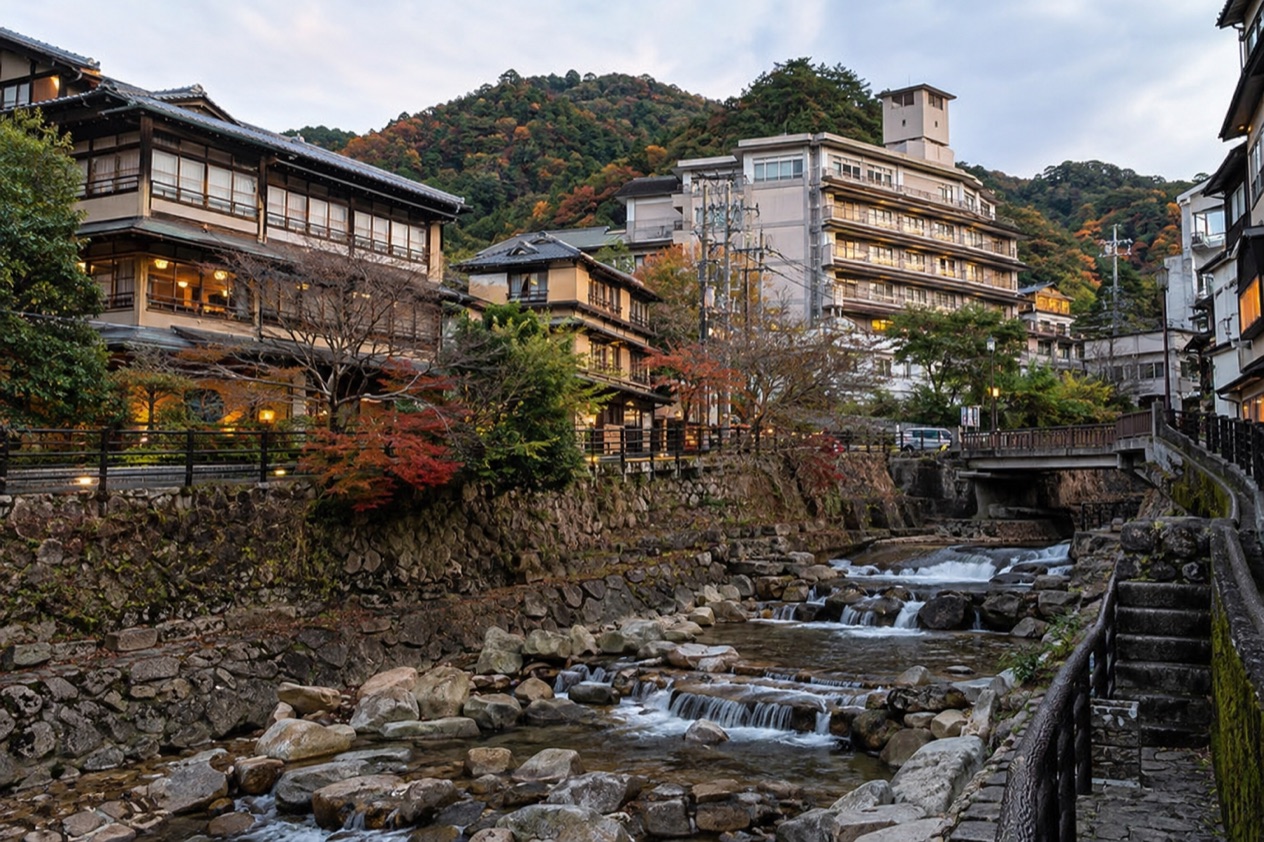
Steam drifts up from the old wooden bathhouses of Arima Onsen, and the water that runs through the town’s little channels is the color of strong tea. Narrow lanes wind between ryokan, sweet shops and small shrines on the slopes of Mount Rokkō, in the Kita ward of Kobe. It is a hot spring visit for anyone who wants a soak, a stroll and a meal in a town with a long reputation.
Is visiting Arima Onsen worth it?
Yes, if you like the idea of a hot spring town with real history, and especially if you are already in the Kansai region and want a change from city sightseeing. Arima Onsen sits in Kobe’s Kita ward near Mount Rokkō, yet it feels like a different world from the port and the shopping streets below.
What sets it apart from other hot spring towns is its pedigree. It was named in the Heian-period Pillow Book as one of the three famous springs of Japan, and in the Edo period it was selected as the most prestigious hot spring.
It also counts among Japan’s oldest, alongside Dogo Onsen in Ehime Prefecture and Nanki-Shirahama Onsen in Wakayama Prefecture. That lineage shows in the town’s character, with historic inns and a municipal museum devoted to its past.
The water itself is the other draw. Two kinds of spring rise here, one rust-colored and one clear, and they feel and look nothing alike.
Many Japanese visitors come because the town is so easy to reach from Osaka and Kobe, and that makes it a natural fit for travelers who want an onsen without crossing the country. Come for a soak, a walk through the lanes and a meal, and you will have understood why the town has kept its name for so long.
What to see at Arima Onsen
The gold spring and the silver spring
The first thing to understand about Arima is that it has two kinds of water. Kinsen, the gold spring, is yellow-brown, colored by iron and salt, and it is the water that stains the town’s channels and the stones around the baths a deep rusty orange. Ginsen, the silver spring, is colorless and holds radium and carbonate.
Seeing both is part of the pleasure. The gold water looks like something out of a potter’s studio, while the silver looks like ordinary water and surprises you with its different feel on the skin.
Taiko-no-yudonokan, the municipal museum
Arima’s municipal museum is called Taiko-no-yudonokan, a name that points to Toyotomi Hideyoshi, the warlord known as Taiko, who is remembered for his fondness for the town’s baths. Taiko-no-yudonokan is Arima Onsen’s municipal museum.
Go in with an eye for the details of old bathing culture, the way the springs shaped the town and how visitors came to take the waters. It also gives context to the lanes outside, which make more sense once you know how long people have been coming here.
Tosen Goshobo and the historic ryokan
Tosen Goshobo is a historic ryokan in Arima Onsen, a Japanese inn of the kind that gives the town its atmosphere. A ryokan visit follows a familiar rhythm: shoes come off at the entrance, tatami floors replace chairs, a yukata (a light cotton robe) takes the place of everyday clothes, and a multi-course meal arrives in the evening.
Even if you only walk past, the wooden facades and the quiet entrances tell you what Arima has been for centuries. Staying overnight gives you more time to enjoy the town.
The lanes of the town
Beyond the baths and the museum, the pleasure of Arima is wandering. The lanes climb and bend along the mountainside, past inns, small shops and the channels carrying the rust-colored water. Hot spring towns in Japan are made for this kind of unhurried walking, with a stop for a snack or a cup of tea whenever something catches your eye.
Mount Rokkō rises behind the town, and its presence gives Arima its setting among the hills of Kobe rather than on the plain of the city. A walk here fits easily around a bath, before or after.
How to get to Arima Onsen
Arima Onsen is in Kita-ku, Kobe, and the cities of the Kansai area, Osaka and Kobe above all, are the bases from which visitors come. The town draws many Japanese precisely because of that easy access from the busy cities of the region.
Kobe lies across the bay from Osaka and is the capital of Hyogo Prefecture. If you are coming from farther away, Kobe is directly connected to Tokyo by the JR Tokaido/Sanyo Shinkansen, and the journey from Tokyo to Shin-Kobe Station takes between 2 hours 40 minutes and 3 hours 15 minutes. Shin-Kobe is the bullet train station of the city, and from there you continue to the hot spring town in Kita ward.
A trip to Arima therefore fits naturally into a Kansai itinerary based in Osaka or Kobe, with Kobe itself serving as the gateway. Plan the last stretch from the city to the town with a current route search on the day, since the details of the local connection are best confirmed close to your travel date.
When to visit Arima Onsen
A hot spring suits almost any month, and what changes is what you do around the bath. The air figures here are those of Kobe, measured in the city, so they describe the lowlands rather than the slopes of Mount Rokkō, where it can feel different.
Winter is the classic season for a soak. In January Kobe’s highs reach the upper 40s and lows sit in the upper 30s, with some snow or sleet recorded, so stepping from a hot bath into cold air is part of the experience. Spring is milder, with April highs in the mid-60s, more rain days and more hours of sun than winter.
July is hot and humid in Kobe, with highs in the mid-80s and warm nights, which makes a hot bath a matter of taste. Rain is frequent enough that the museum can be a useful option on a gray afternoon.
| Month | Average high (°F) | Average low (°F) | Precipitation (in) | Days with rain |
|---|---|---|---|---|
| January | 48.9 | 37.6 | 1.51 | 4.7 |
| April | 66.0 | 52.5 | 3.96 | 9.0 |
| July | 86.7 | 76.5 | 7.40 | 10.0 |
| October | 73.8 | 62.1 | 4.65 | 7.8 |
Tips for your visit
Because the town has both a gold and a silver spring, a stay that includes more than one bath lets you compare them.
At a ryokan, expect the habits of the genre: shoes off at the entrance, a yukata to wear, an evening meal served in the room or a dining hall, and baths taken before and after. These are customs of the setting rather than rules for every inn, so follow the lead of your host.
Combine Arima with a day in Kobe or Osaka. Kobe, the sixth largest city in Japan according to the national tourism organization, offers its port and the area around Shin-Kobe Station, and the town works well as a calm end to a busy Kansai day. Pair the museum with a soak and a slow walk, and keep the lanes for the end of the afternoon.
For families and anyone with limited mobility, the town’s hillside setting means the lanes rise and fall, so allow time and choose your route accordingly.
Good to know before you go
Carry some yen for small purchases in the lanes and for the shops around the baths. On a wet day, consider visiting the museum earlier. Bathing customs follow the setting, so watch what others do and take your cue from the staff at each bathhouse or inn.
Sources
- Wikipedia, Arima Onsen (https://en.wikipedia.org/wiki/Arima_Onsen), checked October 11, 2026
- Japan National Tourism Organization, Kobe (https://www.japan.travel/en/destinations/kansai/hyogo/kobe-and-around/), checked October 11, 2026
- Visit Kobe, the official travel guide (https://www.feel-kobe.jp/en/), checked October 11, 2026
- Wikipedia, Kobe (https://en.wikipedia.org/wiki/Kobe), checked October 11, 2026
- Japan Meteorological Agency (JMA), Normal values 1991-2020, monthly (https://www.data.jma.go.jp/stats/etrn/view/nml_sfc_ym.php?prec_no=63&block_no=47770), station Kobe, elevation 5 m, checked October 11, 2026
To plan your stay
- Best Time to Visit Japan: Cherry Blossoms, Autumn Colors, Weather and Festivals
- Where to Stay in Japan: Ryokan, Temple Stays, Capsule Hotels and the Best Cities to Base In
- Sending Luggage from the Airport in Japan: Hands-Free Travel, Hotel Delivery and Coin Lockers
- Know Before You Go to Japan: Entry, Money, Etiquette and Getting Around