
At a departure gate in Los Angeles or Seattle, the screen says Tokyo, and the real question is which Tokyo: Haneda or Narita? Japan has airports from Hokkaido to Okinawa, and the choice at the other end shapes the first day of the trip. American travelers can fly nonstop from a good handful of U.S. cities into Tokyo, and from there reach Kyoto, Osaka and the rest.
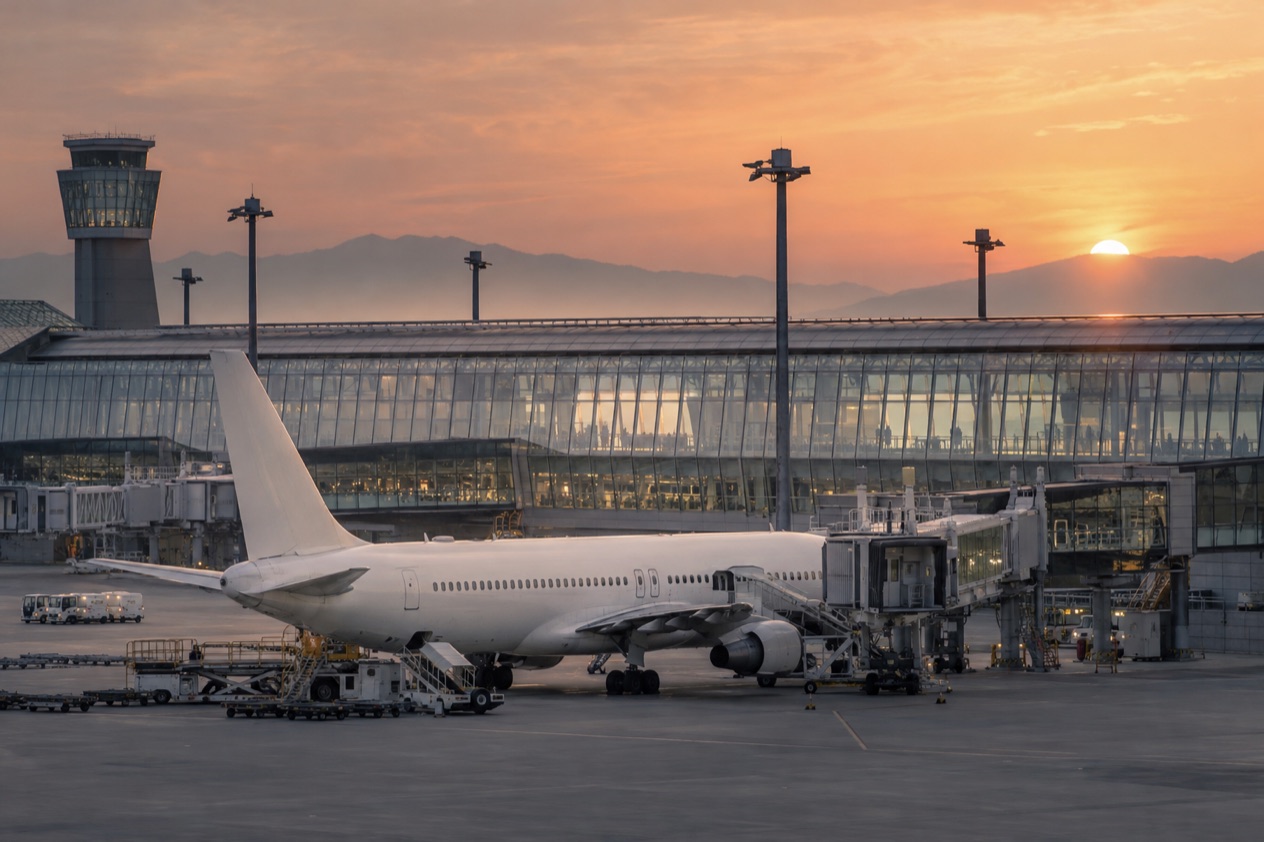
Which airports do you fly into in Japan?
Most visitors land at one of three gateways: Haneda or Narita for Tokyo, and Kansai International for Kyoto, Osaka and Nara. Japan’s network of domestic and international airports stretches from Hokkaido in the north to Okinawa in the south, and international flights also land at Fukuoka, Naha on Okinawa Island and Nagoya in central Honshu.
Narita, in Chiba Prefecture
Narita Airport sits in Chiba Prefecture, and an express train links it to central Tokyo in 1 hour. It handles most major international destinations along with many domestic airports, so it works as both an arrival point and a jumping-off point for the rest of the country.
From Narita, nonstop domestic flights run to Nagoya, Osaka–Itami and Sapporo–Chitose on ANA and JAL, and budget carriers such as Jetstar Japan and Peach add a long list of smaller cities. Hakodate, Hiroshima, Fukuoka, Naha and Ishigaki all appear on those departure boards.
Haneda, the Tokyo airport with the U.S. routes
Haneda is the airport where Delta, American and United all land from the United States, which is why so many itineraries from Atlanta, Dallas, New York, Chicago or San Francisco end there. The same departure hall also serves domestic carriers such as Skymark, Solaseed, Air Do and StarFlyer.
Those domestic airlines open up the south and the far north. From Haneda you can fly to Sapporo–Chitose, Hakodate, Fukuoka, Kagoshima, Kumamoto, Nagasaki and Naha, and StarFlyer connects Haneda with Osaka–Kansai and Kitakyushu.
Kansai International, the gateway to western Japan
Kansai International Airport (KIX) serves Kyoto, Osaka, Nara and Wakayama. It lies about 50 minutes from Shin-Osaka, the high-speed train station, and about 1 hour 15 minutes from Kyoto Station. Travelers who plan to spend most of the trip in the Kansai region can start here and skip Tokyo altogether.
Hawaiian Airlines flies nonstop from Kansai to Honolulu, and StarFlyer flies nonstop to Tokyo–Haneda. JAL treats Kansai and Osaka’s Itami airport as secondary hubs behind its two Tokyo airports.
Arriving by ferry from Korea or China
A few travelers reach Japan by sea. High-speed ferries link Busan with Hakata in 3 hours 40 minutes, at about 16,000 yen. Slower Kampu ferries reach Osaka in 12 hours for less than 10,000 yen, and ticket prices follow the length of the crossing.
From Shanghai, a ferry sails once a week and takes about three days to reach the Japanese ports of Osaka, Kobe, Nagasaki and Fukuoka. For anyone coming from the United States, these crossings only matter as an add-on to a trip through Korea or China.
Which airlines fly to Japan from the United States?
Both Japanese and American airlines fly the route: ANA and JAL on the Japanese side, and Delta, American and United on the U.S. side, with Zipair Tokyo and Hawaiian Airlines adding more choices. Competition among airlines is fierce, and ticket prices to Japan have kept decreasing.
All Nippon Airways (ANA)
ANA is headquartered in Minato, Tokyo, and serves over 100 domestic and international destinations. It is a Star Alliance member, so United miles and other partner programs fit naturally with an ANA ticket. Its first scheduled international passenger flight left Tokyo for Guam on March 3, 1986, and Los Angeles and Washington, D.C. were added before that year ended.
On board, the inflight magazine is called Wingspan and also exists as a free iPad app named Virtual Airport. ANA offers women’s-only lavatories on international flights. Its only remaining resort routes run from Haneda and Narita to Honolulu.
Japan Airlines (JAL)
JAL is headquartered in Shinagawa, Tokyo, with Narita and Haneda as its main hubs and Kansai and Itami as secondary ones. It belongs to the Oneworld alliance, which matters for anyone collecting American Airlines miles. It serves 39 international destinations and 60 domestic ones, not counting codeshares.
On its Boeing 777-300ER aircraft, Business Class has Sky Suite seats in a staggered 2-3-2 layout, each with direct aisle access. The airline and its subsidiaries together run over 4,500 international flights a month, plus a large domestic schedule that picks up where your long-haul flight lands.
Delta, American and United
Three U.S. carriers fly nonstop into Haneda. Delta comes from Atlanta, Detroit, Honolulu, Los Angeles, Minneapolis/St. Paul and Seattle/Tacoma. American flies from Dallas/Fort Worth, Los Angeles and New York–JFK. United flies from Chicago–O’Hare, Los Angeles, Newark, San Francisco and Washington–Dulles, and also from Guam and Honolulu-bound routes on its own network.
Zipair Tokyo and Hawaiian Airlines
Zipair Tokyo flies from Narita to Honolulu, Houston–Intercontinental, Los Angeles, San Francisco and San Jose, California, with charter flights to Orlando. Hawaiian Airlines connects Honolulu with Kansai nonstop, a useful option for a trip that starts in the Osaka and Kyoto area.
Which U.S. cities have nonstop flights?
Nonstop flights to Tokyo leave from Atlanta, Chicago, Dallas/Fort Worth, Detroit, Houston, Los Angeles, Minneapolis/St. Paul, New York, Newark, San Francisco, San Jose, Seattle/Tacoma, Washington and Honolulu, depending on the airline. Each carrier flies its own list.
| Airline | Tokyo airport | U.S. cities with nonstop flights |
|---|---|---|
| Delta Air Lines | Haneda | Atlanta, Detroit, Honolulu, Los Angeles, Minneapolis/St. Paul, Seattle/Tacoma |
| American Airlines | Haneda | Dallas/Fort Worth, Los Angeles, New York–JFK |
| United Airlines | Haneda | Chicago–O’Hare, Guam, Los Angeles, Newark, San Francisco, Washington–Dulles |
| All Nippon Airways | Narita | Chicago–O’Hare, Honolulu, Los Angeles, San Francisco |
| Zipair Tokyo | Narita | Honolulu, Houston–Intercontinental, Los Angeles, San Francisco, San Jose (CA) |
What ANA’s daily flights add
ANA gives a sense of how often some of these routes run. Los Angeles has 3 daily nonstop flights to Tokyo, split between Haneda and Narita. New York has 2 daily to Haneda, as do San Francisco and Chicago, which are shared between both airports.
Seattle, Houston and Washington, D.C. each have a daily nonstop to Haneda. Honolulu has 2 daily flights to Haneda and Narita, plus seasonal service on top of that.
Hawaii, Guam and Vancouver
Honolulu is the most connected island stop, with Delta, ANA, Zipair and Hawaiian all flying out of it toward Japan. Guam links to Haneda on United. ANA also flies seasonally from Narita to Vancouver, which suits travelers starting in Canada rather than the United States. If your home airport is not on the list, the trip begins with a connection to one of these cities, and your final ticket is the one that counts for the long leg across the Pacific.
What do you need before you board?
Before boarding, you need three decisions made: where you land, which airline you fly, and whether the ticket lets you add a stopover on the way. Each shapes the rest of the trip.
Match the airport to the itinerary
A trip centered on Tokyo points to Haneda or Narita, and the express train from Narita covers the run into town in 1 hour. A trip centered on Kyoto, Osaka and Nara points to Kansai, which is the gateway to western Japan. Hiroshima, Fukuoka, Sapporo or Okinawa are reached by a connecting domestic flight from one of these airports.
Japan’s domestic flight network is dense. Skymark, Solaseed, Air Do, StarFlyer, Jetstar Japan, Peach and Spring Japan all fly from the Tokyo airports to cities well beyond the capital, so a second flight is a normal part of a longer itinerary.
Use a stopover
ANA allows travelers to use a stopover to explore over 40 destinations within Japan. That lets you land in Tokyo, spend time in another city, and continue home from a different gateway if the ticket is built that way.
Think about miles
Airline loyalty plays a part in the choice. ANA is part of Star Alliance, and JAL is part of Oneworld, so miles from United, American or their partners may fit one or the other. The ANA CARD U.S.A. Plus gives 5,000 bonus miles after the first purchase made with the card.
Good to know before you go
The U.S. State Department rates Japan Level 1: Exercise Normal Precautions.
Prices in Japan are in yen, and ferry fares between Korea and Osaka or Hakata are quoted in that currency. Because competition has pushed airfares to Japan down, it is worth comparing several airlines and both Tokyo airports for the same dates. Haneda and Narita sit in different parts of the Tokyo area, so the airport you pick also decides your first train.
Sources
- Japan National Tourism Organization, how to get to Japan, airports, airlines (https://www.japan.travel/en/plan/getting-to-japan/), checked October 11, 2026
- Wikipedia, All Nippon Airways (https://en.wikipedia.org/wiki/All_Nippon_Airways), checked October 11, 2026
- Wikipedia, Haneda Airport, airlines and destinations (https://en.wikipedia.org/wiki/Tokyo_International_Airport#Airlines_and_destinations), checked October 11, 2026
- Wikipedia, Japan Airlines (https://en.wikipedia.org/wiki/Japan_Airlines), checked October 11, 2026
- Wikipedia, Kansai International Airport, airlines and destinations (https://en.wikipedia.org/wiki/Kansai_International_Airport#Airlines_and_destinations), checked October 11, 2026
- Wikipedia, Narita International Airport, airlines and destinations (https://en.wikipedia.org/wiki/Narita_International_Airport#Airlines_and_destinations), checked October 11, 2026
- ANA, flights to Tokyo (https://www.ana.co.jp/en/us/), checked October 11, 2026
- U.S. Department of State, Japan travel advisory (https://travel.state.gov/content/travel/en/traveladvisories/traveladvisories/japan-travel-advisory.html)
To plan your stay
- Best Time to Visit Japan: Cherry Blossoms, Autumn Colors, Weather and Festivals
- Things to Do in Japan: Kyoto Temples, Onsen, Street Food and Day Trips
- Where to Stay in Japan: Ryokan, Temple Stays, Capsule Hotels and the Best Cities to Base In
- Know Before You Go to Japan: Entry, Money, Etiquette and Getting Around