
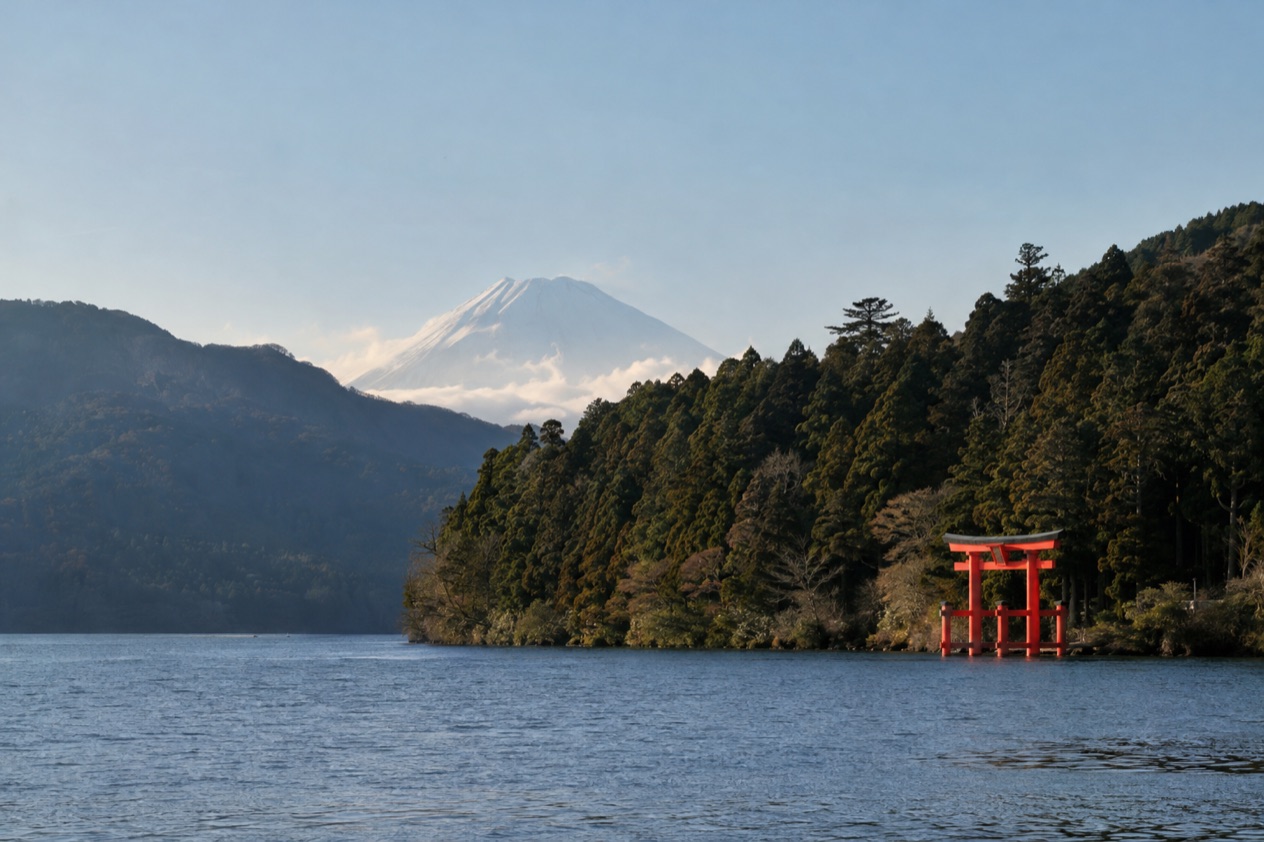
Steam drifts up from the sulphur vents of Owakudani, the smell of hot stone and eggs hangs in the air, and below the ropeway cabins a lake opens out with Mount Fuji sometimes standing over it. Hakone is a mountain resort of hot springs, art museums and ferry rides, built for people who come to soak, look and slow down. It suits travelers from Tokyo who want a change of scene, and anyone who likes a day shaped by water, steam and views.
Where is Hakone and what is it like?
Hakone sits in the western part of Kanagawa Prefecture, a mountainous area west of Tokyo, and most of it lies inside Fuji-Hakone-Izu National Park. The landscape is volcanic, centered on Lake Ashi, a crater lake, with hot springs bubbling up in the valleys around it. It is a resort region rather than a single town, spread over several small settlements, each with its own mood.
Hakone-Yumoto is known for its many restaurants and gift shops, and it is where the mountain railway begins. Sengokuhara is filled with art museums, and the Hakone Open-Air Museum, Japan’s first, shows sculpture in the open air. Around the lake, the pace turns to boat rides, shoreline views and the hope of Mount Fuji appearing over the water.
The place rewards people who like to move between small pleasures: a bath, a museum, a cable car, a plate of something local. It is extremely popular among tourists for its closeness to Tokyo and its views of Fuji, so it has the feel of a well-visited resort. Travelers who want a single big monument or a lively nightlife scene may find it quieter in spirit than they expect, and those who enjoy a soak and a view tend to love it.
The mountains also shape the weather. The air at the foot of Hakone is mild, while the mountain side catches far more rain, so a day can start in sun by the coast and turn gray higher up. Layers and a flexible plan serve you better than a fixed schedule.
What is there to do in Hakone?
Hakone offers four big reasons to come: the hot springs, the loop of ropeway, lake and railway, the art museums, and the views of Fuji. What sets it apart is that these things fit together in one connected circuit, each reached by a different kind of vehicle.
Hot springs
Hakone is renowned for its natural hot springs and counts 17 types of them, so the water in one bath can differ from the next. You can bathe at a public bath or settle into a ryokan, a traditional inn, where the soak is part of an evening that also includes dinner and a night on tatami floors.
The Hakone Freepass “Hako Ticket” Plus, which combines transport with the Hako Ticket, grants use of applicable art museums, hot springs and activity facilities, which makes it one way to sample a bath without planning a whole stay around it. Visitors pair a morning of sightseeing with a long soak in the afternoon.
Owakudani, the ropeway and Lake Ashi
Owakudani is a volcanic valley with active sulphur vents and hot springs. The Hakone Ropeway links Sounzan and Togendai via Owakudani, so you glide over the steaming slopes and can step off to taste the black eggs said to prolong life. They are boiled in the hot spring water, which turns the shells dark.
At the end of the line you reach Lake Ashi, where the Hakone Sightseeing Cruise crosses the water with views of Mount Fuji. During scheduled maintenance, a replacement bus service operates on sections of the ropeway, so the route can change on the day. The last cable car from Mt. Komagatake leaves at 16:50, which matters if you plan to go up the mountain late.
Art museums
The Hakone Open-Air Museum opened in 1969 and is Japan’s first open-air museum. Sculptures stand on lawns and hillsides, so the visit is as much a walk as a gallery trip. Sengokuhara, filled with art museums, gives you more to see in a single district.
Rain does not ruin this part of Hakone, since museums give you somewhere to go when the mountain turns misty. The Hako Ticket offers discounts on entrance fees at around 70 tourist spots, which covers many of these stops.
How many days do you need in Hakone?
Two days, with one night, fits Hakone well, and a third day lets you slow down. The Hakone Freepass “Hako Ticket” Plus is valid for 2 days or 3 days, which matches that rhythm.
In a short stay, you can ride the Hakone Tozan Railway up from Hakone-Yumoto, take the ropeway over Owakudani, cross Lake Ashi by cruise, and finish with a bath at your inn. The next morning leaves room for one or two museums in Sengokuhara, including the Open-Air Museum.
With a third day, you can spread things out: a slow morning in Hakone-Yumoto among its restaurants and gift shops, a second museum or two, a longer soak, or a trip up Mt. Komagatake by cable car, keeping in mind that the last one down leaves at 16:50. Weather in the mountains changes quickly, so a spare day lets you wait for a clear view of Fuji.
Hakone also works as a day trip from Tokyo, but the loop of transport, museums and baths is easy to cut short that way. Visitors staying at a traditional ryokan should plan to arrive at least one day after landing in Tokyo to avoid missing dinner or being locked out at curfew time.
Where to stay in Hakone
Hakone-Yumoto is the practical base for a first visit, known for its many restaurants and gift shops and located where the Odakyu Line meets the Hakone Tozan Railway. It suits people who like having places to eat and browse close to the station, and who plan to head up the mountain by rail.
Sengokuhara suits travelers who care most about art, since it is filled with art museums. Staying there puts the galleries within reach and gives the evening a different feel from the town below.
The area around Lake Ashi suits those who want the water and the views of Mount Fuji close to hand, with the cruise and the ropeway terminal at Togendai nearby. Across all these areas, a ryokan is the stay people come for, with a hot spring bath and a meal at the inn. Because dinner is served at set times, arriving in good time matters more than it would at an ordinary hotel.
Whichever area you choose, think about how you will move around. The Freepass covers the railway, cable car, ropeway, cruise and several buses, so staying near one of these lines keeps your days simple.
How do you get to Hakone and get around?
From Shinjuku Station in Tokyo, the Odakyu Line runs to Hakone-Yumoto Station in about 1 hour and 30 minutes, and the Romancecar limited express also runs between Shinjuku and Hakone-Yumoto. The Romancecar adult surcharge one way from Shinjuku to Hakone-Yumoto is 1,200 yen.
From Tokyo Station, you can take the JR Tokaido Shinkansen to Odawara Station, then transfer to the Hakone Tozan Railway to Hakone-Yumoto Station, taking about 55 minutes total. Once in Hakone, the Digital Hakone Freepass allows unlimited rides on the Hakone Tozan Line, Hakone Tozan Bus in designated areas, Hakone Tozan Cable Car, Hakone Ropeway, Hakone Sightseeing Cruise, Odakyu Highway Bus in designated areas, Tokai Bus in designated areas and the Kanko Shisetsu-Meguri Bus. That adds up to eight kinds of transport.
The Freepass can be bought at Shinjuku Station, Odawara Station and other stations along the Odakyu Odawara Line and Hakone Tozan Line. A 2-day pass departing from Shinjuku costs 7,100 yen for adults and 1,600 yen for children, and the version with an Odakyu Line ticket includes one return trip between the departure station and Odawara Station.
| Pass | Departing from | Adult | Child |
|---|---|---|---|
| 2-day Hakone Freepass | Shinjuku, Tokyo | 7,100 yen | 1,600 yen |
When is the best time to visit Hakone?
October is a fine month for Hakone, and April is another, since both bring mild air at the foot of the mountain. In October, Odawara has highs around 72°F and lows in the high 50s, which suits a day of boats, cable cars and walking between museums. It is also a wet month, with the mountain side receiving far more rain than the coast, so a gray, misty day is possible.
April has highs around 66°F at Odawara and about 177 hours of sunshine, a comfortable mix for outdoor sightseeing. The mountain side is wetter, so it helps to carry a light waterproof layer.
Summer is the heavy end of the year. July at Odawara brings highs in the mid-80s and warm nights, and the mountain side collects a great deal of rain. September is the wettest month overall. Winter is cool, and January at Odawara has highs around 51°F and lows just above freezing, with about 180 hours of sunshine, a bright month for a hot spring soak.
Hakone is extremely popular among tourists because of its closeness to Tokyo and views of Mount Fuji, so any month can bring visitors. The air figures here describe Odawara, at the foot of Hakone, so expect cooler and wetter conditions higher up.
Good to know before you go
Hakone has a humid subtropical climate with warm summers and cool winters, and September is its wettest month, so a rain jacket belongs in the bag for much of the year. Plans in the mountains can shift, since the ropeway sometimes runs replacement buses during maintenance and the last cable car from Mt. Komagatake leaves at 16:50.
Passes are priced in yen and can be bought at several stations along the Odakyu and Hakone Tozan lines. A ryokan stay brings its own rhythm of dinner and curfew, so give yourself time to arrive.
Sources
- Japan National Tourism Organization, Hakone (https://www.japan.travel/en/destinations/kanto/kanagawa/hakone-and-around/), checked October 11, 2026
- Hakone Tourist Information (https://www.hakonenavi.jp/international/en/), checked October 11, 2026
- Wikipedia, Hakone, Kanagawa (https://en.wikipedia.org/wiki/Hakone,_Kanagawa), checked October 11, 2026
- Wikivoyage, Hakone (https://en.wikivoyage.org/wiki/Hakone), checked October 11, 2026
- Wikipedia, Hakone Open-Air Museum (https://en.wikipedia.org/wiki/Hakone_Open-Air_Museum), checked October 11, 2026
- Wikipedia, Hakone Ropeway (https://en.wikipedia.org/wiki/Hakone_Ropeway), checked October 11, 2026
- Wikipedia, Ōwakudani (https://en.wikipedia.org/wiki/%C5%8Cwakudani), checked October 11, 2026
- Wikipedia, Lake Ashi (https://en.wikipedia.org/wiki/Lake_Ashi), checked October 11, 2026
- Odakyu Electric Railway, Hakone Freepass (https://www.odakyu.jp/english/passes/hakone/), checked October 11, 2026
- Odakyu Electric Railway, Romancecar (https://www.odakyu.jp/english/romancecar/), checked October 11, 2026
- Wikipedia, Hakone Tozan Railway (https://en.wikipedia.org/wiki/Hakone_Tozan_Railway), checked October 11, 2026
- Japan Meteorological Agency (JMA), Normal values 1991-2020, monthly (https://www.data.jma.go.jp/stats/etrn/view/nml_amd_ym.php?prec_no=46&block_no=1008), station Odawara, elevation 14 m, checked October 11, 2026
All our pages
When to go
- Best Time to Visit Hakone: Autumn Leaves, Rainy Season, Weather by Month and Festivals
- Hakone in January: Weather, Hot Springs, Lake Ashi and a Two-Day Plan
- Hakone in February: Hot Springs, Setsubun, Plum Blossoms and Weather
- Hakone in March: Weather, Onsen, Lake Ashi and What to Do
- Hakone in April: Weather, Hot Springs and Lake Ashinoko
- Hakone in May: Weather, Lake Ashi, Owakudani and Hot Springs
- Hakone in June: Weather, Hot Springs, Lake Ashi and a Two-Day Plan
- Hakone in July: Weather, Lake Ashi, Owakudani and a Two-Day Plan
- Hakone in August: Weather, Hot Springs and Lake Ashinoko Outings
- Hakone in September: Weather, Hot Springs, Lake Ashi and a Two-Day Plan
- Hakone in October: Weather, Hot Springs, Lake Ashinoko and Owakudani
- Hakone in November: Autumn Weather, Hot Springs and Lake Ashi
- Hakone in December: Weather, Hot Springs, Lake Ashinoko and a Two-Day Plan
Things to do
- Things to Do in Hakone: Lake Ashi, Owakudani, Open-Air Museum and Hot Springs
- Day Trips from Hakone: Kamakura, Tokyo, Mount Fuji and the Lake Ashinoko Circuit
- Hakone Free Pass: Prices, What It Covers and How to Use the Digital Ticket
- Hakone Loop: Ropeway, Lake Ashi Cruise, Owakudani and the Freepass
- Hakone Onsen: Hot Springs, Owakudani, Lake Ashi and the Hakone Freepass
- Hakone Open-Air Museum: Sculpture Park, Picasso Pavilion, Footbath and Getting There
- Hakone Ropeway and Owakudani: Volcanic Valley, Black Eggs and Mount Fuji Views
- Hakone Ryokan: Hot Spring Inns, Kaiseki Dinners and What to Know Before You Book