
When the lights change at Shibuya Crossing, people step off every curb at once and weave through one another without a collision. A few stops away in Shinjuku, the same evening continues in alleys hung with paper lanterns, where bars seat a handful of people and the skyscrapers glitter overhead. Tokyo is a vast capital built from distinct neighborhoods, each with its own pace, and it suits travelers who like to wander, eat well and move between old temples and neon streets in a single day.
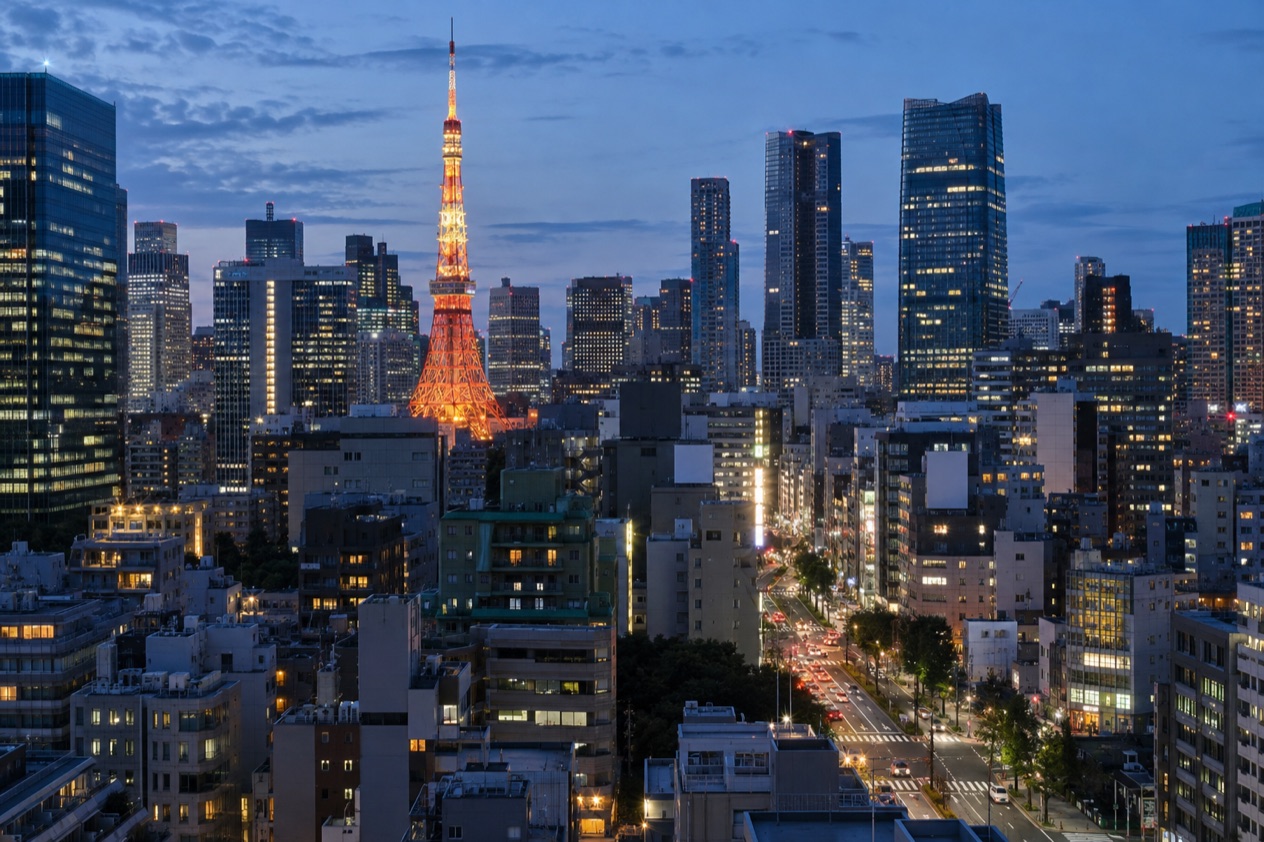
Where is Tokyo and what is it like?
Tokyo sits on Tokyo Bay, in the Kanto region of Honshu, the largest island of Japan. It is the capital of the country and the most populous metropolitan area in the world, and that scale shapes everything about a visit. There is no single center. Instead, Tokyo works like a necklace of districts, each with its own station, its own streets and its own personality.
Central Tokyo gathers Ginza, Akihabara, Tokyo Station and Marunouchi, Nihonbashi, Tsukiji, Kanda and Jimbocho, Kagurazaka, Akasaka and Hamamatsucho. Western Tokyo holds Shinjuku, Shibuya, Harajuku, Aoyama and Omotesando, Shimokitazawa, Daikanyama, Kichijoji, Koenji and more. Eastern Tokyo is where you find Asakusa, Ryogoku, the Skytree area, Toyosu and Fukagawa. Beyond the dense core, the Tama Area reaches toward Mt. Takao and Okutama, and the Izu and Ogasawara Islands belong to Tokyo too, strung out across the sea.
The character of the city comes from the contrast between those districts. Ginza is an upscale downtown of high-end restaurants and luxury shops, while Nihonbashi carries a rich heritage and is the main financial district of Japan. Harajuku and Shibuya are the trendy shopping districts, and Shinjuku pairs towers with tiny bars. Moving from one to another feels like changing cities without leaving the rail map.
It may feel overwhelming to anyone who wants one compact resort-style base with a single main street. The city asks you to choose a few districts and let the rest go, and travelers who do that tend to enjoy it most.
Tokyo is nine hours ahead of GMT and does not use daylight saving time, so the clock stays the same all year. That matters for jet lag, but also for the rhythm of the seasons: the evenings change with the calendar rather than with a clock shift.
What is there to do in Tokyo?
The reasons to come fall into four broad groups: temples and shrines, shopping and fashion, evenings out, and the views over the skyline. What sets Tokyo apart from other Japanese cities is that all four sit within the same urban network, so a single day can touch every one.
Temples and shrines
Senso-ji in Asakusa is the oldest temple in Tokyo, a Buddhist temple in the eastern part of the city. Walking up to it means passing through the lanes around it, where stalls sell sweets and souvenirs, and arriving at a hall that has anchored the neighborhood for centuries. Asakusa suits anyone who wants to feel the older side of the city before heading to the glass towers.
Meiji Shrine, in Shibuya, is a Shinto shrine dedicated to the deified spirits of Emperor Meiji and Empress Shoken. It sits next to Harajuku, which makes it easy to pair a visit with a stroll through the fashion streets nearby. In April, Nezu-jinja Shrine adds an azalea garden with a 300-year-old history, and the festival season brings stalls and music to many other shrine grounds across the city.
Shopping and fashion
Tokyo is known for fashion, and the trendy shopping districts of Harajuku and Shibuya are where young styles appear first. Harajuku has its side streets of small boutiques, while Shibuya stacks its stores in tall buildings around the station. Aoyama and Omotesando lie between them and add a more polished stretch of design shops and cafes.
Ginza takes a different tone, with luxury flagship stores and high-end restaurants. The main shopping district is right behind Ginza Station, so you step out of the metro and into the stores. Akihabara, in central Tokyo, is the district for electronics, games and anime goods, and Kanda and Jimbocho round out the center with their own neighborhood character.
Evenings in Shinjuku and Roppongi
Shinjuku is a thriving business district that combines glittering skyscrapers with lively alleys filled with tiny bars. By day it is a place of offices and department stores, and after dark the narrow lanes fill with the sound of conversation and the smell of grilled skewers. The mix of towers above and lanterns below is one of the clearest pictures of how Tokyo layers old habits onto new buildings.
Roppongi and Akasaka make another evening option. The name Roppongi, meaning six trees, was given to the district in the 1660s, and today the area hosts Japan’s largest film festival. Shibuya Station is about 10 minutes away by train, so an evening can easily move from the crossing to the bars and restaurants of Roppongi.
Towers and the skyline
Tokyo Skytree stands in Sumida, in eastern Tokyo, and Tokyo Tower is a communications and observation tower in the Shiba-koen district of Minato. Between them they give two very different views of the city: one over the eastern districts and the other near the center. Shibuya Crossing, a scramble crossing near Shibuya Station, is another place where Tokyo shows its scale, simply by how people use it at once.
Seasonal events add to the list. Early April brings the Chiyoda Cherry Blossom Festival along the Chidorigafuchi walkway on the west side of the Imperial Palace, the Ueno Sakura Matsuri in Ueno Park and the Sumida Park Sakura Festival. August has its own set of matsuri, which the season section describes.
How many days do you need in Tokyo?
A long weekend is enough to taste the city, and a week lets you move at a more natural pace and start to see how the districts differ. Tokyo does not reward trying to see everything.
With a short stay, build your days around clusters. One day can belong to the east: Asakusa and Senso-ji, then the Skytree area and perhaps Ryogoku or Fukagawa. Another can run through the west: Meiji Shrine, Harajuku, Shibuya and an evening in Shinjuku. A third can stay in the center with Ginza, Tokyo Station and Marunouchi, Nihonbashi and Akihabara. That already gives you temples, shopping, a skyline and the bar alleys.
With more time, you can slow down and add the neighborhoods that are less obvious on a first visit. Shimokitazawa, Daikanyama, Kichijoji, Koenji and Nakano each have their own streets of independent shops, cafes and small restaurants. Kagurazaka, in central Tokyo, adds another side of the city. Tsukiji and Toyosu bring food and the bay into the picture, and Kiyosumi Shirakawa is another corner of the eastern districts to explore.
For a day away from the dense core, the Tama Area opens up a different Tokyo. Mt. Takao and Okutama are named parts of it, and Mitaka, Kichijoji, Chofu, Tachikawa, Machida and Hachioji are among its towns.
Farther out still, the Izu and Ogasawara Islands include Oshima, Toshima, Niijima, Shikinejima, Kozushima, Miyakejima, Mikurajima, Hachijojima, Aogashima, Chichijima and Hahajima. They are all part of Tokyo, and they suit those who want to spend part of a longer trip somewhere that feels nothing like the city.
Where to stay in Tokyo
The best base is the district whose evenings you want to live in, because the rail network connects them all. Shinjuku suits travelers who want the towers and the bar alleys at the door. Shibuya and Harajuku suit those who come for fashion, the crossing and Meiji Shrine. Both sit in Western Tokyo, along with Shimokitazawa, Daikanyama, Kichijoji and Koenji for a more neighborhood feel.
Ginza and Nihonbashi suit those who prefer an upscale downtown with high-end restaurants and luxury shops. Ginza Station is served by the Tokyo Metro Hibiya, Marunouchi and Ginza lines, so a hotel here has several lines within reach. Tokyo Station and Marunouchi, also in central Tokyo, are another choice for travelers who want to be near the main rail hub.
Roppongi and Akasaka suit travelers who want evenings out and a link to the film world. Roppongi Station is served by the Tokyo Metro Hibiya Line and the Toei Oedo Line, Nogizaka Station by the Chiyoda Line and Roppongi-Itchome Station by the Namboku Line. Asakusa and the Skytree area, in Eastern Tokyo, make sense for those who want to wake up near Senso-ji and the older neighborhoods of the east.
If this is a first visit, Shinjuku, Shibuya, Ginza or Asakusa are all reasonable anchors, each giving a different flavor of the city. A longer stay can split between two districts, for example one in the west and one in the east, which makes it possible to experience the contrast without much planning.
How do you get to Tokyo and get around?
Visitors arrive by air, through Haneda Airport, officially Tokyo International Airport, or Narita Airport, Japan’s largest international airport. These are the two airports nearest to Tokyo, and the choice between them usually comes down to which flight suits you.
Once in the city, the rail and metro network is how Tokyo works. Stations anchor every district, and many areas are described by the stations that serve them.
Ginza Station is served by three Tokyo Metro lines, Roppongi by the Hibiya and Oedo lines, and the district of Roppongi and Akasaka can be reached from Shibuya Station in about 10 minutes by train. JR stations such as Asagaya, which serves the Asagaya Tanabata Matsuri, connect other parts of western Tokyo.
On foot, you will do a lot of the actual discovering. The main shopping district of Ginza is right behind its station, and the lanes around Senso-ji, the streets of Harajuku and the alleys of Shinjuku are all places to wander once you arrive. The best approach is to ride to a district and then explore it on foot, rather than trying to cross the city on the surface.
Power matters for your devices. The voltage in Japan is 100V, with a frequency of 50-60 Hz, and the socket is type A with two flat holes. Bring plug adapters for anything with a different plug.
When is the best time to visit Tokyo?
April and October are the months to aim for. In April, highs reach the upper 60s and lows hover near 50, which suits a day outdoors with a light layer, though windy days happen and a scarf or light parka is useful.
It is the month of the cherry blossom festivals: the Chiyoda Cherry Blossom Festival along Chidorigafuchi, the Ueno Sakura Matsuri and the Sumida Park Sakura Festival, all held in early April. Rain falls on roughly nine or ten days, so a compact umbrella earns its place.
October is mild too, with highs in the low 70s and lows in the upper 50s, a comfortable range for long days of walking. It is also a wet month, with rain on about ten days and the heaviest total of the four months for which we have figures here, so expect gray spells mixed with brighter ones. Sunshine is lower than in winter or spring.
July brings heat and humidity, with highs in the mid-80s, lows in the low 70s and humidity in the mid-70s percent. Rain falls on about ten days. Summer evenings stay light until around 19:30, which gives long days for sightseeing, but the weather asks for slower pacing and indoor breaks.
August carries the festival season: the Asagaya Tanabata Matsuri in early August covers the Pearl Center shopping arcade in bamboo decorations and papier-mache sculptures that change each time. The Fukagawa Hachiman Festival is nicknamed the water-splashing festival because spectators splash water on the mikoshi carriers. Bon-odori dances are typically held from mid- to late August in shrines and parks, and the Koenji Awa-odori Dance fills a late-August weekend with around 10,000 dancers and a million spectators.
January is cold but bright, with highs near 50 and lows just above freezing, and around 193 hours of sunshine for the month. Winter nights draw in around 17:00, so evenings arrive early, which suits a trip built around warm restaurants and lit streets.
Good to know before you go
A few small practical points help. Tokyo has no daylight saving time, so the clock does not change with the seasons, and summer evenings stay light until around 19:30 while winter nights fall around 17:00. Sockets are type A at 100V, so check your chargers and adapters before you leave. Layers work in most seasons, with a scarf and light parka in windy April and an umbrella in the wetter months.
Sources
- Japan National Tourism Organization, Tokyo (https://www.japan.travel/en/destinations/kanto/tokyo/), checked October 11, 2026
- GO TOKYO, the official Tokyo travel guide (https://www.gotokyo.org/en/), checked October 11, 2026
- GO TOKYO, getting around (https://www.gotokyo.org/en/plan/index.html), checked October 11, 2026
- GO TOKYO, spots (https://www.gotokyo.org/en/spot/index.html), checked October 11, 2026
- GO TOKYO, best things to do and see in Tokyo in April (https://www.gotokyo.org/en/story/guide/april/index.html), checked October 11, 2026
- GO TOKYO, best things to do and see in Tokyo in August (https://www.gotokyo.org/en/story/guide/august/index.html), checked October 11, 2026
- Asakusa Kannon Sensoji (https://www.senso-ji.jp/english/), checked October 11, 2026
- Wikipedia, Sensō-ji (https://en.wikipedia.org/wiki/Sens%C5%8D-ji), checked October 11, 2026
- Wikipedia, Meiji Shrine (https://en.wikipedia.org/wiki/Meiji_Shrine), checked October 11, 2026
- Tokyo Skytree, official site (https://www.tokyo-skytree.jp/en/), checked October 11, 2026
- Wikipedia, Tokyo Skytree (https://en.wikipedia.org/wiki/Tokyo_Skytree), checked October 11, 2026
- Wikipedia, Tokyo Tower (https://en.wikipedia.org/wiki/Tokyo_Tower), checked October 11, 2026
- Wikipedia, Shibuya Crossing (https://en.wikipedia.org/wiki/Shibuya_Crossing), checked October 11, 2026
- Japan Meteorological Agency (JMA), Normal values 1991-2020, monthly (https://www.data.jma.go.jp/stats/etrn/view/nml_sfc_ym.php?prec_no=44&block_no=47662), station Tokyo, elevation 25 m, checked October 11, 2026
All our pages
When to go
- Best Time to Visit Tokyo: Cherry Blossoms, Autumn Leaves, Weather by Month and Festivals
- Tokyo in January: Hatsumode, Winter Weather and What to Do
- Tokyo in February: Setsubun, Plum Blossoms, Weather and What to Do
- Tokyo in March: Hina Matsuri, Cherry Blossoms, Weather and a Two-Day Plan
- Tokyo in April: Cherry Blossom Festivals, Weather and What to Do
- Tokyo in May: Weather, Golden Week, Festivals and What to Do
- Tokyo in June: Hydrangea and Iris Festivals, Beer Gardens and Humid Weather
- Tokyo in July: Weather, Tanabata, Hozuki-ichi and What to Do
- Tokyo in August: Summer Festivals, Heat and Humidity, and a Two-Day Plan
- Tokyo in September: Weather, Moon Viewing, Fireworks and Cosmos Gardens
- Tokyo in October: Autumn Festivals, Weather and What to Do
- Tokyo in November: Ginkgo Avenues, Maple Color, Dream Yosacoy and Weather
- Tokyo in December: Winter Illuminations, Weather and Things to Do
- Tokyo Train and Subway Map: Yamanote Loop, Metro and Toei Lines, Airport Links
Things to do
- Things to Do in Tokyo: Temples, Towers, Markets and Day Trips
- Day Trips from Tokyo: Nikko, Kamakura, Hakone, Yokohama and Mount Fuji
- 3 Days in Tokyo: Shibuya, Asakusa, Ginza and a Slower Day Across the City
- Tokyo Disneyland: Seven Themed Lands, Getting There by Train and When to Go
- Tokyo DisneySea: Ports of Call, Fantasy Springs, Exclusive Rides and Planning
- Koishikawa Korakuen Garden: Tokyo Dome, Edo-Period Ponds and Seasonal Color
- 7 Days in Japan: Itinerary Through Tokyo, Hakone and Kyoto
- 5 Days in Japan: Itinerary from Tokyo to Kyoto, Nara Deer and IC Cards
- 7 Days in Japan: Itinerary: Tokyo, Kyoto, Osaka and a Day in Nara
- Tokyo National Museum: Collections, Buildings, Getting There and When to Go
- Onsen in Tokyo: Bathing Etiquette, Tattoo Policies and Where to Soak
- Tokyo Ryokan: Where to Find One, Which Areas Suit a Stay and What to Know Before Booking
- Tokyo Skytree: Observation Decks, Glass Floor, Hours and How to Get There
- Tokyo Subway Guide: Two Systems, Ticket Options and Airport Connections
- Tokyo Subway Ticket: Prices, 24, 48 and 72 Hour Validity and Where to Buy
- Sumo Tournaments in Tokyo: Ryogoku Kokugikan, Tournament Months and Chankonabe
- Tokyo Tower: Observation Decks, Lighting, Hours and Visiting Tips
Where to stay
- Where to Stay in Tokyo: Shinjuku, Shibuya, Asakusa, Ginza and Roppongi
- Capsule Hotels in Tokyo: Where They Are, What a Capsule Is Like and What to Know Before Booking
- Where to Stay in Akihabara: Electric Town, Station Side, Ginza and Roppongi
- Where to Stay in Asakusa: Areas Around Sensō-ji, the Station and the Sumida River
- Where to Stay in Ginza: Best Areas, Subway Stations and How to Choose a Hotel
- Where to Stay in Ikebukuro: Station Area, Sunshine City, Sugamo and Minami-Ikebukuro
- Where to Stay in Roppongi: Station Area, Roppongi-itchome, Nogizaka and Akasaka
- Where to Stay in Shibuya: Station Area, Roppongi and Akasaka, Ginza and How to Choose
- Where to Stay in Shinjuku: Kabukicho, Nishi-Shinjuku, Shinjuku Gyo-en and Hotel Types
- Where to Stay in Tokyo Station: Marunouchi, Ginza, Nihonbashi and Roppongi
- Where to Stay in Ueno: Station Side, Ueno Park, Old Shitamachi Streets and How to Choose
Getting there
- Tokyo from the airport: Narita and Haneda, the Skyliner, Local Trains and Taxis
- Tokyo Airport Guide: Haneda, Narita, Airlines from the U.S. and How to Choose
- Haneda Airport to Shibuya: Trains, Buses, Taxis and the Terminals You Arrive In
- Haneda Airport to Shinjuku: Trains, Buses, Taxis and What to Know on Arrival
- Haneda Airport to Tokyo Station: Monorail, Taxis, Terminals and Getting Into the City
- Narita Airport to Tokyo Disney Resort: Rail Lines, Terminals and Stations in Tokyo
- Narita Airport to Haneda Airport: Rail Lines Out of Narita, Terminals and Late-Night Hours
- Narita Airport to Shibuya: Narita Express, Rail Lines and Terminal Walks
- Narita Airport to Shinjuku: Narita Express, Skyliner and Terminal Walks
- Narita Airport to Tokyo: Skyliner, Narita Express, Travel Times and Terminals
- Tokyo to Fukuoka: Rail, Flights, Hakata Station and Arrival
- Tokyo to Hakone: Odakyu Trains, the Romancecar and Hakone Freepass Prices
- Tokyo to Hakuba: Hokuriku Shinkansen, Nagano Station and Train Choices
- Tokyo to Hiroshima: Shinkansen Journey, Nozomi Trains and What Awaits on Arrival
- Tokyo to Kamakura: JR Lines, the Odakyu and Enoden Route, and What to Know Before You Go
- Tokyo to Kanazawa: The Hokuriku Shinkansen, Train Types and the Hokuriku Area Pass
- Tokyo to Karuizawa: Hokuriku Shinkansen, Local Rail Options and What to Know
- Tokyo to Kawaguchiko: the Fuji Excursion, the Fujikyuko Line, Tickets and Passes
- Tokyo to Kusatsu Onsen: Bus Routes, Rail Connections and the Baths at the End
- Tokyo to Kyoto: Shinkansen Trains, Nozomi vs. Hikari and Kodama, and Arriving at Kyoto Station
- Tokyo to Matsumoto: the Azusa Limited Express, Journey Time and What to Expect
- Tokyo to Mount Fuji: The Fuji Excursion Train, the Fujikyuko Line and Rail Passes
- Tokyo to Nagano: Hokuriku Shinkansen Trains, Options and What to Know
- Tokyo to Nagoya: Shinkansen Services, Rail Pass Rules and Luggage
- Tokyo to Niigata: Joetsu Shinkansen, Express Bus and How to Choose
- Tokyo to Nikko: Tobu Limited Express, Asakusa and Shinjuku Departures, and Other Ways In
- Tokyo to Nozawa Onsen: Trains, Airports, Driving and the Village at the Foot of the Slopes
- Tokyo to Okinawa: Flying to Naha, Choosing Airports and Getting Around on Arrival
- Tokyo to Osaka: Shinkansen Trains, Nozomi vs. Hikari and Arriving at Shin-Osaka
- Tokyo to Sapporo: Shinkansen Through the Seikan Tunnel, Services and Winter Notes
- Tokyo to Sendai: Shinkansen, Long-Distance Buses, Rail Passes and Arriving in Sendai
- Tokyo to Yokohama: Trains, Shin-Yokohama Station and the Haneda Link