
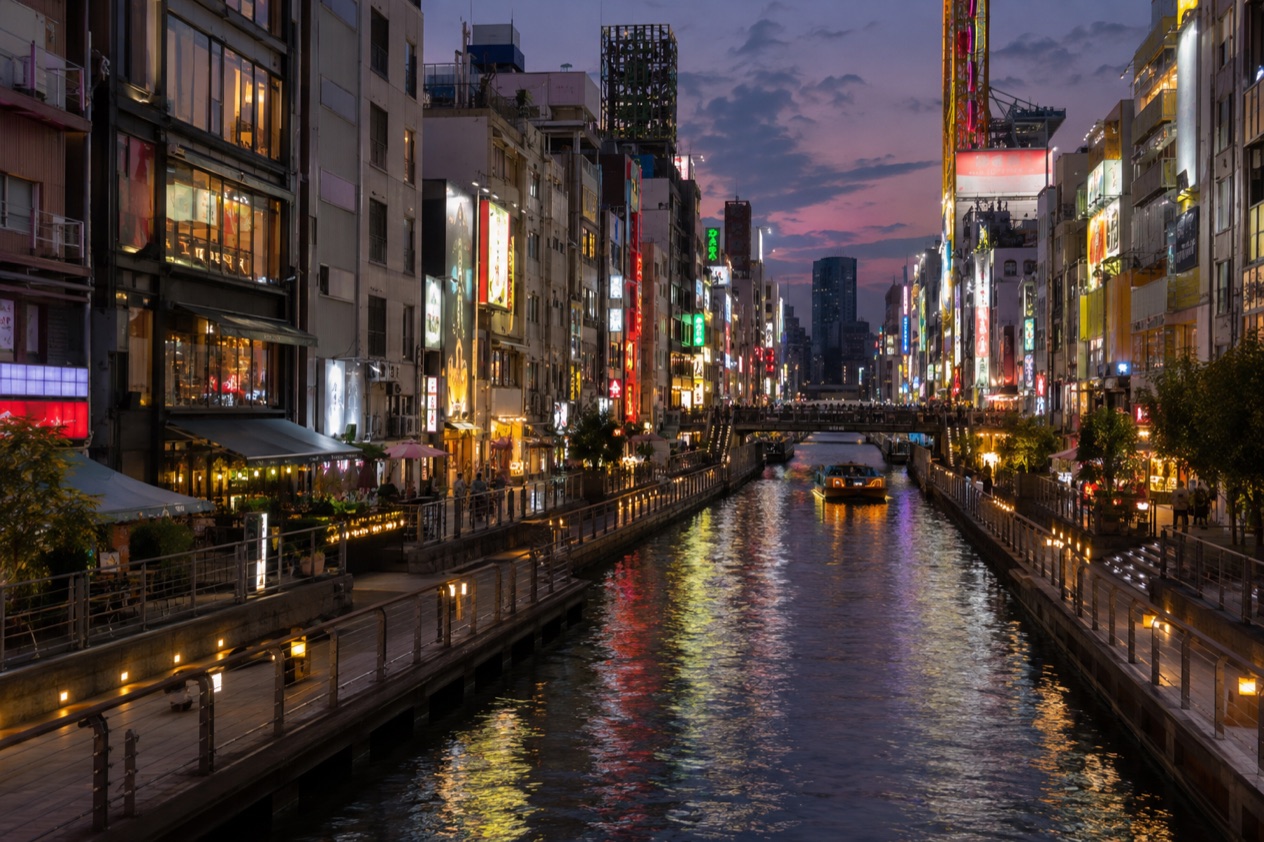
Along the Dotonbori canal, the neon signs flicker on, the steam rises from takoyaki griddles, and the whole street smells of grilled batter and sweet sauce. People lean over the railing of the bridge for photos, then dive back into the crowd in search of the next snack. Osaka is a city that likes to eat, to joke and to stay out late, and it suits travelers who prefer appetite and energy to hushed temples.
Where is Osaka and what is it like?
Osaka sits in the center of Honshu, Japan’s main island, and serves as the central city of western Japan and the hub of the Kansai region. Kyoto, Nara, Kobe and Wakayama all lie within one hour by train of its central stations. The bay on its edge gives the city a port-town side, with a waterfront given over to entertainment.
The character of the place is relaxed and a little cheeky. Osaka is known for its food, its entertainment and its nightlife, and history sits alongside all of that rather than in front of it.
People come to eat standing at a counter, to wander a covered shopping arcade, and to watch a castle rise above a park. The city has long been an economic and cultural center, and its skyscrapers and commercial buildings show it.
Four areas give the city its shape. Kita, around Osaka and Umeda stations, is modern and lined with shopping malls, department stores and office buildings, and a short walk leads to Nakanoshima, with its retro architecture and waterfront scenery.
Minami is the energetic downtown, where tradition and fashion intersect and the gourmet food is packed in tight. Tennoji and Abeno holds the tallest skyscraper in Japan, Abeno Harukas, along with a zoo, temples and shrines. The Bay Area is the beachfront entertainment hub, with theme parks, aquariums, Ferris wheels and sports facilities.
Osaka rewards travelers who like to graze through a day of snacks, pick a neighborhood by mood and take the evening seriously. If you want a hushed, temple-by-temple trip, Kyoto and Nara next door may suit you better, and Osaka works well as the lively counterpart to them.
What is there to do in Osaka?
Osaka offers four big reasons to come: the street life of Dotonbori and Shinsaibashi, the castle and its parks, the bay with its theme park and aquarium, and the towers and temples of Tennoji and Abeno. What sets it apart from its neighbors is that the draw here is appetite and fun, where Kyoto and Nara lean toward temples and gardens.
Dotonbori and Shinsaibashi
Dotonbori runs along a canal that is 400 years old, from Dotonboribashi Bridge to Nipponbashi Bridge in the Namba district. Its walls are covered in giant signs, and the food stalls and restaurants along the water are the reason people end up here after dark. Walking the length of it is an evening in itself, with a snack in hand and a stop on each bridge.
The Shinsaibashi shopping arcade is nearly 1.2 miles long and stretches from Shinsaibashi Station to Dotonbori, so shopping and eating lead naturally into each other. It is the place for fashion, department stores and browsing in the rain under the roof. From Osaka or Umeda Station, the Midosuji Line takes you to Shinsaibashi Station, and staying on to Namba Station also reaches Dotonbori.
Osaka Castle and its parks
Osaka Castle stands in Chuo ward, surrounded by parkland. The original was built between 1583 and 1598 by Toyotomi Hideyoshi, and it was set on fire in 1615, when the last of the Toyotomi line died there. The castle you see today is a reconstruction of the one built by the Tokugawa shogunate, and inside, the Osaka Castle Museum is a symbol of the city, with five floors outside and eight stories within.
From Osaka or Umeda Station, the JR Osaka Loop Line goes to Morinomiya Station, right next to Osaka Castle Park. The grounds make a good counterweight to the neon of Minami, with lawns and moats around the keep.
The bay: Universal Studios Japan and Kaiyukan
Universal Studios Japan opened in 2001 and features attractions like the Wizarding World of Harry Potter. Super Nintendo World recreates the worlds of Nintendo games at the northern end of the park, west of the Harry Potter area, with remarkable quality and scale. It is the obvious pick for families and game fans.
The Kaiyukan Aquarium, in Minato ward near the bay, is one of the largest aquariums in the world, with whale sharks and penguins in multi-story tanks and soft drifting jellyfish. Next door, Tempozan Market Place has a large Ferris wheel and many restaurants. The bay is reached from Osaka or Umeda stations by the JR Loop Line and the Chuo subway line.
Tennoji and Abeno
Tsutenkaku Tower, known as the Eiffel Tower of Osaka, is a symbol of the Naniwa area and gives the southern districts a retro landmark. Nearby, Abeno Harukas towers as the tallest skyscraper in Japan.
How many days do you need in Osaka?
A long weekend of three days covers the best of Osaka, and a week lets you pair it with the rest of Kansai.
With two or three days, the city divides neatly. Give one evening to Dotonbori and the Shinsaibashi arcade, one morning to the castle and its park, and one day to the bay for the aquarium and the Ferris wheel at Tempozan.
Add a full day if Universal Studios Japan is on your list, since the park with Super Nintendo World and the Wizarding World of Harry Potter is a day in its own right. Families and game fans often build the whole trip around it.
With more time, Osaka becomes a base. Kyoto, Nara, Kobe and Wakayama are each within one hour by train of central Osaka stations, so each can be a day trip with the evening back in the city’s restaurants.
Kyoto brings temples and gardens, Nara its great temple and park, Kobe a port-city change of scene. Four or five days lets you mix city days with one or two of these, and a week allows three or four outings without rushing. If rain arrives, the covered Shinsaibashi arcade, the aquarium and the museum inside the castle keep the day going.
Where to stay in Osaka
Pick the area that matches your trip, because the four districts feel quite different. Kita, around Osaka and Umeda stations, is modern, with malls, department stores and office buildings, and Nakanoshima’s waterfront is a short walk away. It suits travelers who want the main stations close, with the Kansai day trips leaving from the north of the city.
Minami, around Namba, Shinsaibashi and Dotonbori, is the energetic downtown, packed with food, fashion and traditional culture. It suits anyone who wants to step out the door into restaurants and late-night streets, and it sits on the Midosuji Line, which also links to Kita. Expect it to stay lively into the evening.
Tennoji and Abeno, in the south, offer Abeno Harukas, Tsutenkaku Tower, a zoo, temples and shrines, and the Nankai and JR lines from Kansai International Airport reach Tennoji and Namba stations. It makes a handy base for arrivals by air and for travelers who like a mix of old and new.
The Bay Area is the choice for visitors centered on Universal Studios Japan, the aquarium and the Ferris wheel. It is a leisure district with theme parks, sports facilities and waterfront, and it connects to the center by the JR Loop Line and the Chuo subway line.
How do you get to Osaka and get around?
Osaka has two airports: Kansai International Airport (KIX) and Osaka International Airport, known as Itami. From KIX, the Nankai and JR lines run to Tennoji and Namba stations, with the JR Kansai Airport Rapid and limousine buses also serving the city, and the trip takes approximately 40 to 60 minutes. Itami is closer to the city and can be reached in about 30 minutes by monorail, train or limousine bus.
From Tokyo, the Tokaido-Sanyo shinkansen reaches Shin-Osaka Station in about two and a half hours, and the Nozomi service takes the same time. From Shin-Osaka, a JR local line goes to Osaka Station. JAL and ANA also fly to Osaka frequently from Tokyo’s Haneda and Narita airports.
Inside the city, the Osaka Metro and the JR Loop Line link the main districts. The Midosuji Line joins Osaka and Umeda to Shinsaibashi and Namba, and the JR Osaka Loop Line reaches Morinomiya for the castle. Osaka Convention & Tourism Bureau runs three tourist information centers, at JR Osaka Station in Umeda, in Namba and at Shin-Osaka, with staff who speak English and other languages.
Two passes cover local transport. The Osaka e-Pass gives free admission to more than 25 tourist spots with one QR code, but does not include transportation.
| Pass | Adults | Children |
|---|---|---|
| Enjoy Eco Card, one day (weekdays) | 820 yen | 310 yen |
| Enjoy Eco Card, one day (weekends and holidays) | 620 yen | 310 yen |
| Kaisuken card (includes 3,300 yen of travel for adults, 1,650 yen for children) | 3,000 yen | 1,500 yen |
The Enjoy Eco Card gives unlimited travel on Osaka Metro and Osaka City Bus lines, and the Kaisuken card has no expiration date. Neither covers buses to Universal Studios Japan, airport buses or on-demand buses, and both also exclude buses to IKEA Tsuruhama.
When is the best time to visit Osaka?
October is one of the pleasant months in Osaka, and April sits alongside it. In October, highs average in the mid-70s, nights drop to around 60, and the month brings about eight rainy days with a fair amount of sunshine. It is comfortable for walking from Dotonbori to the castle park and for eating outside in the evening.
April is mild too, with highs near 68 and lows in the low 50s. Rain falls on about nine days, usually in showers, so a light jacket and a compact umbrella fit the month. It is a good time for the castle grounds and for day trips to Kyoto and Nara.
July is the hard month. Highs reach the high 80s and nights stay in the mid-70s, with humidity around 70 percent and rain on about ten days, so the arcades and aquarium help with the heat and the streets feel heavy by afternoon.
January is cold, with highs near 50 and lows in the high 30s, and a few days of snow or sleet can appear. The tradeoff is clear air and sunshine of about 146 hours, plus warm bowls of food at every corner.
Good to know before you go
Osaka runs on a mix of cards and cash, and the metro passes above are worth comparing against how many rides you expect to take. Summer brings heat and humidity, and the typhoon season in late summer and autumn can bring heavy rain and wind, so keep plans flexible in those months. Pack comfortable shoes, since a day in Osaka usually means walking the arcades and canal sides.
Sources
- Japan National Tourism Organization, Osaka (https://www.japan.travel/en/destinations/kansai/osaka/), checked October 11, 2026
- Osaka official tourism guide, basic guide (https://www.osaka-info.jp/en/osaka/basic/), checked October 11, 2026
- Osaka official tourism guide, FAQ (https://www.osaka-info.jp/en/information/osaka-faq/), checked October 11, 2026
- Osaka official tourism guide, travel passes (https://www.osaka-info.jp/en/information/ticket/travel-passes/), checked October 11, 2026
- Wikipedia, Osaka Castle (https://en.wikipedia.org/wiki/Osaka_Castle), checked October 11, 2026
- Wikipedia, Dōtonbori (https://en.wikipedia.org/wiki/D%C5%8Dtonbori), checked October 11, 2026
- Wikipedia, Universal Studios Japan (https://en.wikipedia.org/wiki/Universal_Studios_Japan), checked October 11, 2026
- Wikipedia, Super Nintendo World (https://en.wikipedia.org/wiki/Super_Nintendo_World), checked October 11, 2026
- Wikipedia, Osaka Aquarium Kaiyukan (https://en.wikipedia.org/wiki/Osaka_Aquarium_Kaiyukan), checked October 11, 2026
- Japan Meteorological Agency (JMA), Normal values 1991-2020, monthly (https://www.data.jma.go.jp/stats/etrn/view/nml_sfc_ym.php?prec_no=62&block_no=47772), station Osaka, elevation 23 m, checked October 11, 2026
All our pages
When to go
- Best Time to Visit Osaka: Cherry Blossoms, Autumn Color, Weather and Festivals
- Osaka in January: Weather, New Year Traditions, Winter Food and a Two-Day Plan
- Osaka in February: Setsubun, Plum Season, Winter Weather and Street Food
- Osaka in March: Early Cherry Blossoms, Street Food, Weather and a Two-Day Plan
- Osaka in April: Cherry Blossoms, Weather, What to Do and a Two-Day Plan
- Osaka in May: Weather, Golden Week Holidays, Osaka Castle and Dotonbori Food
- Osaka in June: Humid Weather, Castle Parks, Street Food and a Two-Day Plan
- Osaka in July: Tenjin Matsuri, Humid Heat, Street Food and a Two-Day Plan
- Osaka in August: Heat, Obon, Street Food and What to Do
- Osaka in September: Late-Summer Heat, Street Food and Things to Do
- Osaka in October: Autumn Weather, Food and Things to Do
- Osaka in November: Autumn Weather, Dotonbori Food and a Two-Day Plan
- Osaka in December: Weather, Maple Leaves, Winter Food and a Two-Day Plan
Things to do
- Things to Do in Osaka: Osaka Castle, Dotonbori Street Food, Universal Studios Japan and Day Trips
- Day Trips from Osaka: Nara's Deer, Himeji Castle, Kobe, Kyoto and Mount Koya
- 3 Days in Osaka: Dotonbori, Osaka Castle, Kaiyukan and a Day Trip
- Osaka Amazing Pass: Osaka Metro, Interchange Stations and Whether It Fits Your Days
- Osaka Aquarium Kaiyukan: Whale Sharks, the Pacific Ocean Tank and How to Get There
- Osaka Castle: The Main Keep, the Moat, Cherry Blossoms and How to Get There
- Osaka Metro Guide: Interchange Stations, Accessibility, Tickets and Onboard Rules
- Osaka Street Food: Dotonbori, Takoyaki, Okonomiyaki and When to Go
Where to stay
- Where to Stay in Osaka: Kita, Minami, Tennoji, the Castle Area and the Bay
- Where to Stay in Namba: Station Area, Dotonbori, Shinsaibashi and Osaka Bay
- Where to Stay in Umeda: Osaka Station City, Kita, Shin-Osaka and the Midosuji Line
Getting there
- Osaka from Tokyo: Shinkansen Services, Shin-Osaka Station and Where to Go on Arrival
- Itami Airport to Osaka: Monorail, Bus and Car Into the City
- Kansai Airport to Osaka: Terminals, Shuttle Buses and Rail Connections into the City
- Osaka to Himeji: Local Trains, the Kansai Area Pass and the Castle at the End of the Line
- Osaka to Hiroshima: Shinkansen Route, Your Options and What Waits on Arrival
- Osaka to Kinosaki Onsen: The Kounotori Train, Other Ways There and What Awaits in Town
- Osaka to Kobe: JR Trains, the Shinkansen to Shin-Kobe and Which Station to Pick
- Osaka to Koyasan: Nankai Koya Line, Train Options and Mountain Know-How
- Osaka to Kyoto: Hankyu and Keihan Lines, Where They Start and Stop, and What to Know
- Osaka to Nara: Kintetsu and JR Trains, the Kansai Area Pass and Where You Arrive
- Osaka to Tokyo: Tokaido Shinkansen, Nozomi, Hikari and Kodama, and Airport Connections