
From the United States the answer is no, because no airline flies nonstop from Fukuoka Airport to any U.S. city. You arrive by connecting, and the airport itself sits so close to the city that the last leg of the trip is the part you will think about least.
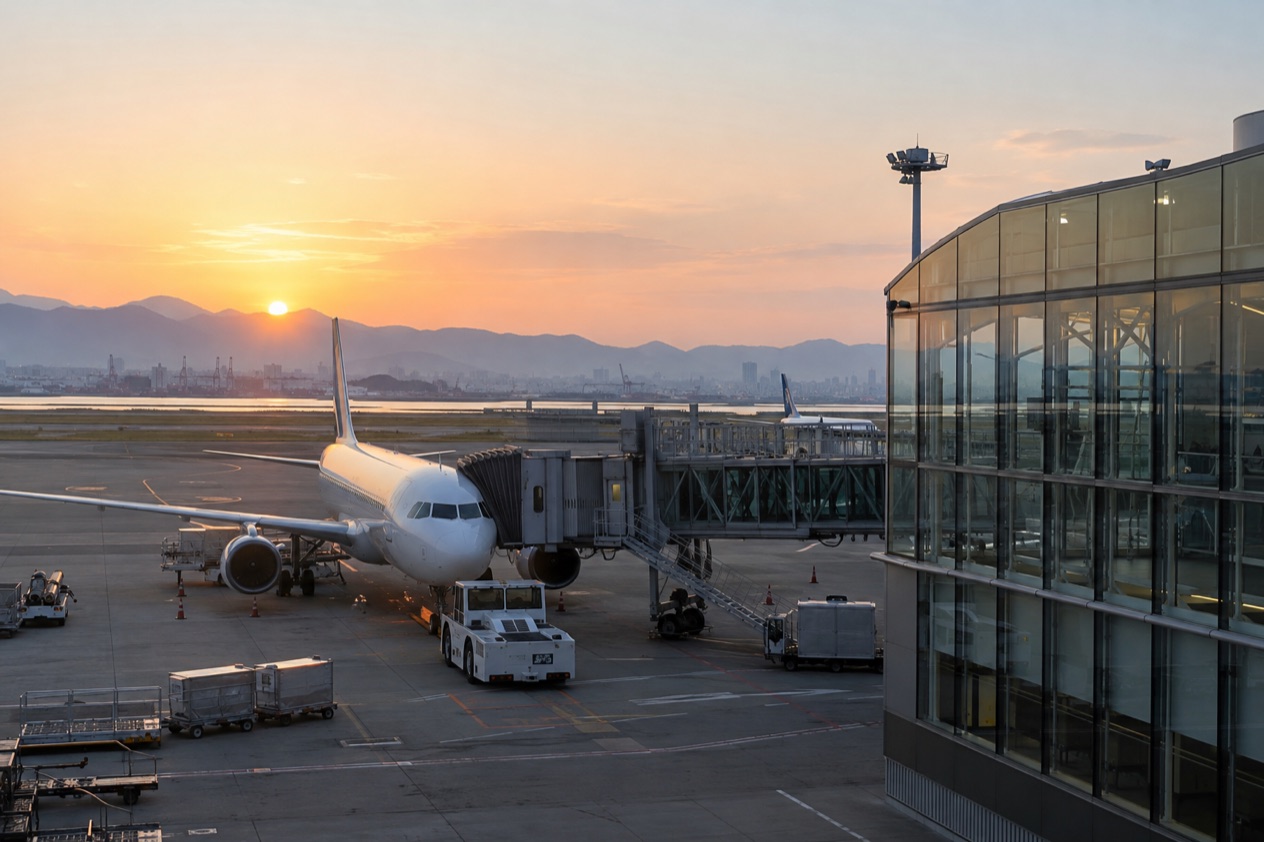
How do you fly to Fukuoka?
You fly to Fukuoka by reaching Japan or another Asian hub first and then taking a connecting flight into Fukuoka Airport, since the airport has no nonstop service to any U.S. city, Honolulu included. The destinations it does list are all in Asia, and within Japan the network is dense enough that several routes lead to it.
That shapes how you search. Instead of typing your home airport and Fukuoka into one box, it helps to think in two pieces: the long flight that lands you in Japan, and the domestic hop that finishes the journey to Kyushu, the southern island where Fukuoka sits.
Connecting through Japan
The domestic airlines serving Fukuoka connect it with the big gateways. All Nippon Airways and Japan Airlines both fly nonstop between Fukuoka and Tokyo-Haneda, and Skymark Airlines and StarFlyer do the same. Peach and Jetstar Japan fly to Tokyo-Narita, while Jetstar Japan and Peach also serve Osaka-Kansai. Nagoya-Centrair is reached nonstop by ANA, ANA Wings, Jetstar Japan and StarFlyer.
In practice that means a traveler landing at Haneda, Narita or Kansai from across the Pacific can be on a second flight to Fukuoka without leaving the country’s air network. Which gateway suits you depends on where your long-haul flight lands, so look at the arrival airport first and the Fukuoka leg second.
Terminals, runways and the curfew
Fukuoka Airport has a domestic terminal and a separate international terminal. Work to double the size of the international passenger terminal was completed in March 2025, so the building you use for flights from other Asian cities is a larger one than it used to be. The cargo terminal stands next to it.
A second runway officially opened on March 20, 2025. It is used only for international departures, and because it lies so close to the first runway, the two cannot be used at the same time. For a passenger the point is simple: the airport runs on one runway at a time, and that is part of how a busy field stays orderly.
There is also a mandatory late-night curfew, from 22:00 every night until 07:00 the next morning, set at the request of local residents. When you pick a connecting flight, a late evening arrival deserves a second look, because a delayed plane has a hard limit on when it can land.
If Fukuoka is full or your plans change
Kitakyushu Airport is the alternative nearby. It lies 38 miles from Fukuoka Airport and is open 24 hours a day, which sets it apart from Fukuoka’s curfew. It is a different city’s airport, so it suits a traveler who is happy to start in northern Kyushu rather than in Fukuoka itself.
Fukuoka Airport has been open since 1944 and served 25 million passengers in 2018, making it the fourth busiest passenger airport in Japan. It also appears at number 26 in Skytrax’s list of the world’s top 100 airports for 2024.
Which airlines serve Fukuoka Airport?
Fukuoka Airport is served by a mix of Japan’s full-service and low-cost carriers, flying nonstop to cities across Japan and to Asian destinations, but not to the United States. The domestic airlines below each have their own list of nonstop destinations from Fukuoka.
| Airline | Nonstop destinations from Fukuoka |
|---|---|
| All Nippon Airways (ANA) | Nagoya-Centrair, Naha, Sapporo-Chitose, Tokyo-Haneda |
| ANA Wings | Fukue, Komatsu, Miyazaki, Nagoya-Centrair, Naha, Osaka-Itami, Sapporo-Chitose, Tokyo-Haneda, Tsushima |
| Japan Airlines (JAL) | Izumo, Kagoshima, Kochi, Matsuyama, Miyazaki, Sapporo-Chitose, Tokushima, Tokyo-Haneda |
| Skymark Airlines | Ibaraki, Naha, Sapporo-Chitose, Shimojishima, Tokyo-Haneda |
| StarFlyer | Nagoya-Centrair, Sendai, Tokyo-Haneda |
| Fuji Dream Airlines | Hanamaki, Matsumoto, Nagoya-Komaki, Niigata, Sapporo-Chitose, Sendai, Shizuoka |
| Peach | Ishigaki, Naha, Osaka-Kansai, Sapporo-Chitose, Tokyo-Narita |
| Jetstar Japan | Nagoya-Centrair, Osaka-Kansai, Tokyo-Narita |
| Air Do | Sapporo-Chitose |
The big two and their regional partner
ANA and JAL are the two names travelers know, and both link Fukuoka to Tokyo-Haneda. ANA adds Nagoya-Centrair, Naha on Okinawa and Sapporo-Chitose on Hokkaido. JAL’s list leans toward cities on Kyushu, Shikoku and western Honshu: Izumo, Kagoshima, Kochi, Matsuyama, Miyazaki and Tokushima, plus Sapporo-Chitose and Haneda.
ANA Wings has the longest list of the group. Along with the big-city routes it reaches Fukue and Tsushima, island airports, as well as Komatsu, Miyazaki and Osaka-Itami. If your plans take you to a smaller town after Fukuoka, or you want to see how far the network stretches, this is the carrier whose map is worth reading.
Low-cost and smaller carriers
Peach flies from Fukuoka to Ishigaki, Naha, Osaka-Kansai, Sapporo-Chitose and Tokyo-Narita, while Jetstar Japan serves Nagoya-Centrair, Osaka-Kansai and Tokyo-Narita. For a traveler arriving on a long-haul flight at Narita or Kansai, those two carriers are the ones that leave Fukuoka without a change of airport city.
Skymark Airlines connects Fukuoka with Ibaraki, Naha, Sapporo-Chitose, Shimojishima and Tokyo-Haneda. StarFlyer flies to Nagoya-Centrair, Sendai and Tokyo-Haneda. Fuji Dream Airlines has a more varied list, with Hanamaki, Matsumoto, Nagoya-Komaki, Niigata, Sapporo-Chitose, Sendai and Shizuoka. Air Do rounds out the group with its nonstop to Sapporo-Chitose.
Reading the destination list
Two things stand out. First, nearly every airline flies to Sapporo-Chitose and to Tokyo, so those are the routes where you have the most choice of carrier and of departure time.
Some airports on the list are served by only one airline, such as Izumo, Fukue or Hanamaki. If a trip includes one of them, that carrier’s schedule decides your day, so look at it before you fix the rest of the itinerary. Names that look alike, such as Tokyo-Haneda and Tokyo-Narita, or Nagoya-Centrair and Nagoya-Komaki, are separate airports, and it is worth reading the airport name on a booking and not just the city.
How do you get from the airport to the city?
You get from Fukuoka Airport to the city by subway from the domestic terminal, or by bus from the international terminal, and the airport is close enough to the center that either way you are in town quickly. It lies about 1.8 miles east of Hakata Station in Hakata-ku.
From the domestic terminal
The domestic terminal is connected to the city by the Fukuoka City Subway. A ride to the business district takes about ten minutes, which is why Fukuoka is often described as a city with its airport practically at its door. If you landed on a connecting flight from Tokyo, Osaka or Nagoya, this is the terminal where you arrive.
The subway means you do not depend on road traffic, and it takes you to Hakata Station, the rail hub of the city, and to the Tenjin area, the main shopping and dining district. From the stations there, you can continue on foot, by taxi or by train to wherever you are staying.
From the international terminal
The international terminal is reached only by road. There is no subway station at its door. Scheduled buses run between the two terminals, and they carry you to the domestic terminal and its subway station. A shuttle bus connects the two terminals, so a traveler who lands on an international flight can transfer to the subway that way.
Scheduled buses also run from the international terminal straight to Hakata Station and to the Tenjin area. If your hotel is near either one, that direct bus saves you a change. The airport lists subway, bus, rental cars, taxis and the inter-terminal shuttle as its transport options, so those are the choices to weigh once you are through customs.
Taxis, rental cars and the rest of Kyushu
Taxis and rental cars are among the options listed at the airport. A taxi is the way to go door to door with luggage when the hotel is not next to a station, and a rental car is the choice for someone who wants to drive on to other parts of Kyushu without returning to the city first.
From Fukuoka Airport travelers can reach all of Kyushu, which is why many itineraries use the city as a starting point: Nagasaki, Kumamoto, Beppu and the island’s hot spring towns are all part of the same region. For the Fukuoka stay itself, Hakata Station and Tenjin are the two places visitors need to reach first.
Good to know before you go
The U.S. State Department rates Japan Level 1: Exercise Normal Precautions.
Plan your arrival with the airport’s night hours in mind, since a flight that cannot land before the curfew may be diverted or delayed to the next morning. Keep your hotel’s address in Japanese on your phone, which helps a taxi driver, and carry some yen for the bus or the subway ticket machines. Outside the airport, Fukuoka is a city where you walk, ride the subway and sit down to a bowl of ramen without much fuss.
Sources
- Wikipedia, Fukuoka Airport (https://en.wikipedia.org/wiki/Fukuoka_Airport), checked October 11, 2026
- Fukuoka Airport, Access (https://www.fukuoka-airport.jp/en/access/), checked October 11, 2026
- U.S. Department of State, Japan travel advisory (https://travel.state.gov/content/travel/en/traveladvisories/traveladvisories/japan-travel-advisory.html)
To plan your stay
- Best Time to Visit Japan: Cherry Blossoms, Autumn Colors, Weather and Festivals
- Things to Do in Japan: Kyoto Temples, Onsen, Street Food and Day Trips
- Where to Stay in Japan: Ryokan, Temple Stays, Capsule Hotels and the Best Cities to Base In
- Know Before You Go to Japan: Entry, Money, Etiquette and Getting Around