
PORTUGAL · THE COMPLETE FIRST-TIMER’S GUIDE · 38.7° N
Portugal is the Europe trip that over-delivers. It’s compact enough to mix a capital, a wine valley and an ocean coast in one week. It’s the continent’s west-facing balcony, so every evening ends in Atlantic light. And it still costs noticeably less than its famous neighbors. Americans have caught on (Portugal keeps climbing the charts of favorite European destinations), but the country absorbs it with grace, mostly because there’s far more of it than the postcard suggests.
THE ESSENTIALS · PORTUGAL FOR US TRAVELERS
A week gives you Lisbon plus one other Portugal: the Douro, the Algarve or Porto. Ten days gives you two. The country rewards the traveler who picks fewer bases and stays longer at each.
BEST MONTHS: MAY–JUNE & SEPTEMBER–OCTOBER · CURRENCY: EURO · LANGUAGE: PORTUGUESE (ENGLISH WIDESPREAD IN TOURISM)
Go for: walkable historic cities, the world’s oldest demarcated wine region, cliff-backed beaches, and the best value-for-money in Western Europe.
Think twice if: you want a warm-ocean swimming vacation — that’s the Caribbean’s job, not the Atlantic’s.
Entry: State Dept & EU rules · Advisory: travel.state.gov · full sources at the end of this guide
On this page
- First visit, want the greatest hitsLisbon + Sintra
- Food, wine and fewer tourists per caféPorto & the North
- The single most beautiful overnightThe Douro Valley
- Beach chapter, warmest seaThe Algarve
- Road trip, empty roads, big skiesThe Alentejo
- Islands, levadas or volcanoesMadeira / Azores
- Just hand me the route10 days, north to south, day by day
- Torn between the two citiesLisbon vs Porto, settled properly
Where to go in Portugal: the five Portugals, and which is yours
Two companion pages answer the questions this section raises: what to actually do, region by region, and which bases deserve a bed rather than a day trip.
Lisbon and its day-trip belt
The capital earns three or four days on its own (Alfama’s lanes, Belém’s monuments, the miradouro circuit, the food halls) and then multiplies: Sintra’s hilltop palaces, the beach towns of Cascais and Estoril, and the Arrábida coast with its Setúbal wine cellars are all within an hour. The metro runs straight from the airport. You won’t want a car until the day you leave. We’ve compared the neighborhoods worth sleeping in, and if your dates are flexible, what each month does to the city is half the decision.
Best for: first-timers, food lovers, city walkers · Nights: 3–5 · Car: no
Porto and the North
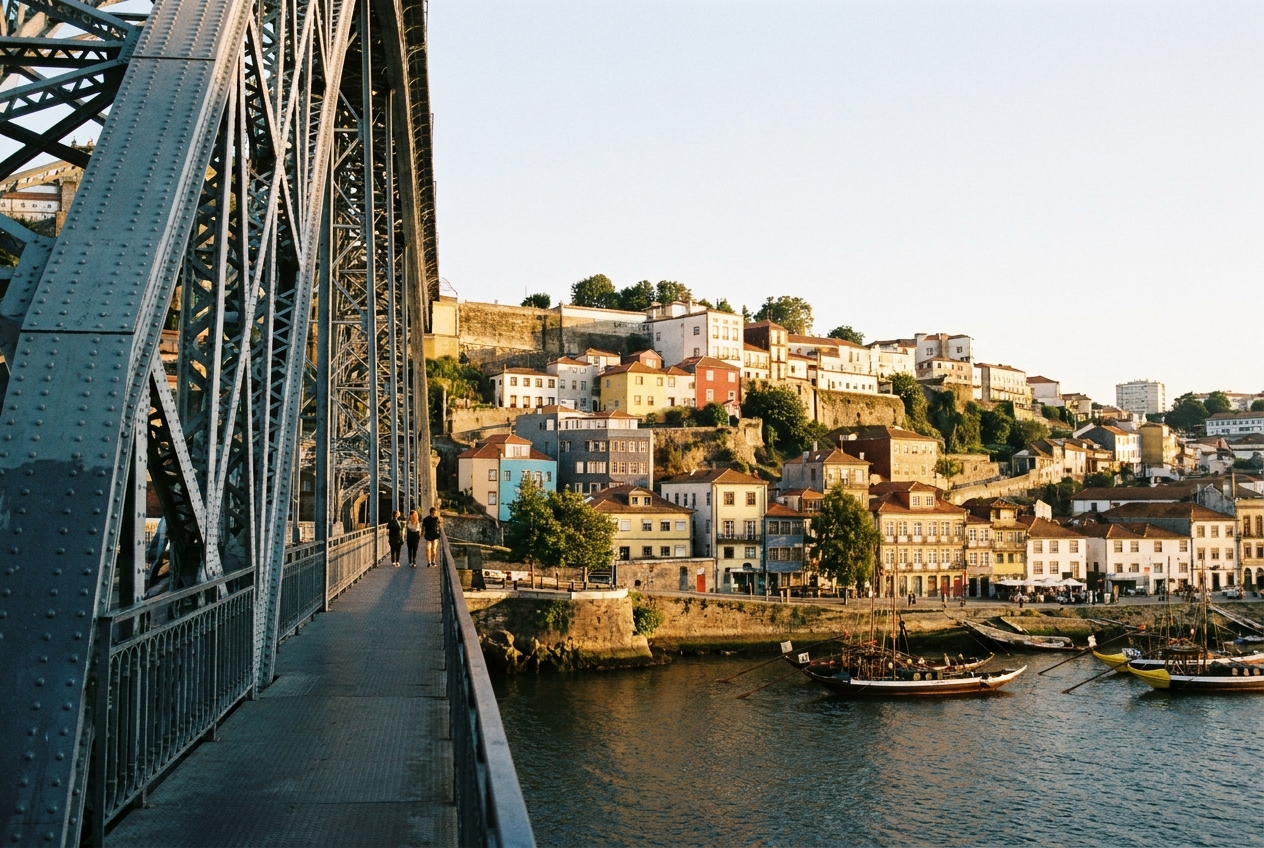
Portugal’s second city is grittier, cheaper and, many visitors whisper, more charming: the Ribeira riverfront stacked over the Douro, the port-wine lodges of Vila Nova de Gaia across the iron bridge, the Livraria Lello’s staircase, azulejo-covered churches at every turn. Braga and Guimarães, the country’s birthplace, make easy rail day trips. It’s greener and wetter up here. That’s the price of those hills. The full regional guide, with the five bases and what each one gives you, is Porto and the North.
Best for: repeat visitors, wine people, atmosphere hunters · Nights: 2–3 · Car: no
The Douro Valley
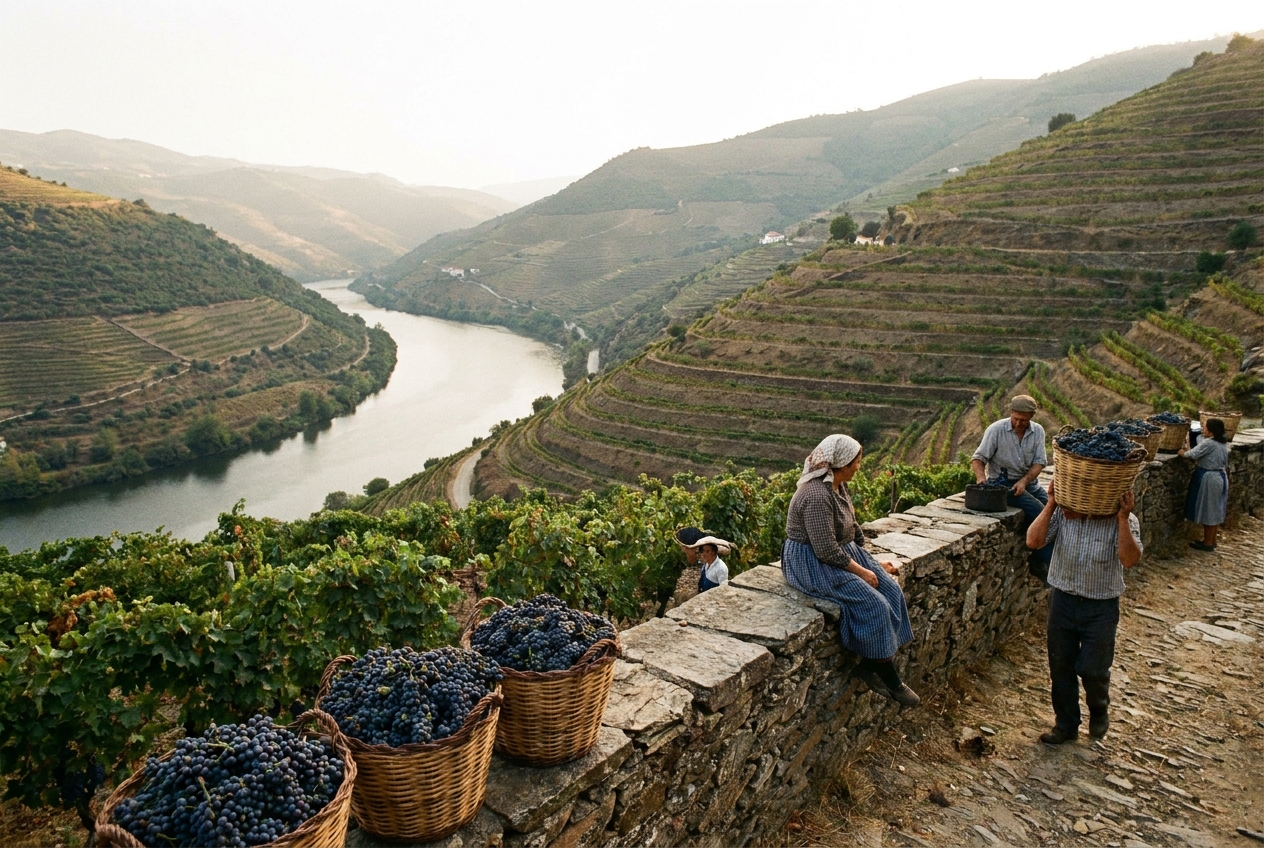
Ninety minutes inland from Porto, the world’s oldest demarcated wine region (1756): terraced vineyards stacked above a winding river, quintas that pour tastings on their own verandas, and, in September–October, the vindimas, when the harvest turns the valley into a working spectacle. The scenic Linha do Douro train hugs the river to Pinhão if you’d rather not drive. Doable as a Porto day trip; unforgettable as an overnight. Where to sleep, how to get there and how many nights it deserves are in the Douro Valley guide.
Best for: couples, wine pilgrims, photographers · Nights: 1–2 · Car: optional (train to Pinhão)
The Algarve
The southern coast: golden cliffs and sea caves around Lagos, the warm lagoon islands of the Ria Formosa in the east, surf beaches on the wild Costa Vicentina. The warmest sea and the most sunshine in the country, and two genuinely different coasts to choose between, which is exactly the decision our region guide is built around.
Best for: beach chapters, families (east), surfers (west) · Nights: 3–5 · Car: helpful
The Alentejo
The empty quarter between Lisbon and the Algarve: cork-oak plains, whitewashed hill towns like Évora (whose Roman temple and bone chapel anchor a UNESCO old town) and tiny Monsaraz above the Alqueva lake, serious wine at country prices, and some of Europe’s darkest certified night skies. Portugal’s best road-trip country, full stop: see renting a car in Portugal first. The region’s bases, from Évora to a herdade out in the plain, are in the Alentejo guide.
Best for: road-trippers, slow travelers, wine + stars · Nights: 2–3 · Car: essential
Madeira and the Azores, briefly
The pitch: subtropical cliffs, levada walks, year-round spring: the island of eternal hiking weather.
Logistics: its own flights (direct from the US East Coast in season), 4–5 nights minimum. A separate trip, not an add-on.
The pitch: volcanic crater lakes, whales, hot springs: Europe’s answer to Hawaii, at a fraction of the crowds.
Logistics: direct from the US East Coast to Ponta Delgada. Plan 5+ nights, weather humility required.
How many days do you need in Portugal?
| Days | What honestly fits | The shape |
|---|---|---|
| 4–5 | One Portugal, done well | Lisbon + Sintra, or an Algarve base (nothing else) |
| 7 | The classic | Lisbon (4) + Porto/Douro (3), or Lisbon (4) + Algarve (3) |
| 10 | Two Portugals, breathing | Add the Alentejo road-trip day(s) or a second Algarve coast |
| 14 | The full sweep | North + center + south, or swap a week for Madeira/Azores |
The realistic minimum for “I saw Portugal” is a week. For “I get why people move here,” it’s ten days. Below five days, don’t tour — pick one city and live in it.
When to visit Portugal
The short version: May, June, September and early October hit the sweet spot of summer weather without August’s crowds and prices, and fall adds the grape harvest. August is peak everything (12.6 million lodging nights nationally). Winter runs at a third of that, mild and rainy, with the almond blossom lighting up the Douro in February. The full month-by-month matrix, with temperatures, rain days and the real crowd curve: Best Time to Visit Portugal.
Getting to Portugal, getting in, getting around
Getting there: Lisbon is one of Europe’s easiest doors from the US East Coast: nonstop flights from the New York area, Boston, Miami and other gateways make it an overnight hop, with Porto holding its own transatlantic links in season. The Algarve’s Faro airport connects through the big European hubs. The move worth planning around: fly open-jaw (into Lisbon, home from Porto or Faro), which most airlines price fairly and which deletes the backtrack day from every itinerary below. West Coast travelers connect through the East Coast or a European hub either way. Check both: the fares trade places often.
Entry is simple: US citizens travel visa-free under the Schengen rules (up to 90 days in any 180-day window), with a passport valid at least three months beyond your departure from the Schengen area. The five-minute check, ETIAS status included, lives in the entry guide. Portugal sits at Level 1, the lowest tier of the State Department’s advisory scale, and the safety page gives that verdict its sources, plus the one real hazard (the ocean). And the packing list settles the suitcase in one screen: shoes, layers, rain shell.
Between cities, take the train: Lisbon–Porto runs in about three hours on the Alfa Pendular, city center to city center. For the Douro, the Alentejo and the Algarve’s corners, rent a car: Portugal’s highways are excellent and empty, your US license works for tourist stays, and the one genuine trap (boothless electronic tolls) is solved with a transponder from the rental desk. The whole toolbox (trains, coaches, metros, when each wins) is laid out in Getting Around Portugal. The car’s full rulebook, including why you must reserve an automatic explicitly, lives in Renting a Car in Portugal as an American.
Within Lisbon and Porto, walk and ride: both metros are clean and simple, and Lisbon’s Vermelha line runs direct from the airport into town.
Money, language and tipping in Portugal
Portugal uses the euro. Cards are the norm in cities and tourist areas. Keep some cash for small cafés and country markets. Tipping is modest: rounding up or a euro or two at a restaurant reads as generous, not stingy.
English is widely spoken in the tourism economy, and the Portuguese switch to it graciously. A bom dia and obrigado still open doors. One heads-up for drivers staying central: Lisbon’s downtown runs a low-emission zone and near-impossible parking. Collect the rental when you leave the city, not when you land.
Portugal for couples, families, foodies, hikers and savers
Couples. Lisbon’s miradouro sunsets and fado cellars, a Douro quinta with a river view, and the cliff coves west of Lagos. If the trip is an anniversary, spend the splurge night in the Douro, not the capital: it’s where Portugal slows down. The full couple’s file (regions by budget, the four months that carry the trip) lives in Portugal Honeymoon.
Families. Lisbon works surprisingly well (the Oceanário in Parque das Nações is one of Europe’s great aquariums, trams are a ride in themselves), then head south: the Ria Formosa’s shallow, warm lagoon beaches off Tavira are the country’s most child-friendly sand. The full family file (ages, strollers, the week that works) lives in Portugal with Kids.
Food-first travelers. Come hungry: pastéis de nata eaten warm in Belém, grilled sardines in Alfama in summer, bacalhau in its proverbial 365 preparations, Porto’s gloriously excessive francesinha, percebes and clams down south, and two wine cultures (port in Gaia’s lodges, crisp vinho verde up north) for less than half the price of their French equivalents. The Time Out Market in Lisbon is the efficient sampler; the tascas around it are the real course. The full eating map, room types included, is in food and drink in Portugal.
Outdoors people. The Rota Vicentina’s coastal trails in the southwest, surf from Ericeira to Sagres, granite peaks and stone villages in the Peneda-Gerês national park up north. Portugal packs four terrains into a country smaller than Indiana.
Budget travelers. Portugal remains Western Europe’s best-value classic: honest restaurant meals, café culture and city transit all run noticeably below French or Italian equivalents, and the gap shows up at every till. It’s the destination where a mid-range budget buys upper-range days.
What things cost in Portugal
Think in three relative tiers. Lean: guesthouses and tascas, transit everywhere. Portugal is one of Western Europe’s friendliest countries to travel this way. Middle: boutique hotels, one serious restaurant a day, a shared rental car. This is the tier where Portugal over-delivers hardest.
High: the Avenida da Liberdade five-stars and the Douro wine hotels. A real ceiling, still below equivalent rooms in Paris or Rome.
The biggest price lever isn’t the tier, it’s the calendar: coastal rooms in August can run around double their shoulder-season rate, one more argument for May, June and September. (Tiers are relative signals, not quotes.)
Portugal travel tips: the small things that change the trip
- Eat the pastel de nata warm or not at all. The difference between a bakery-case one and one straight from the oven (Belém, or Manteigaria in Chiado) is the difference between a snack and a religion.
- The couvert isn’t free. The bread, olives and cheese that land unasked on your table go on the bill if you touch them. Wave them off guilt-free if you don’t want them. The rest of the table lessons, from dinner hours to the shoes the calçada demands, are collected in Things to Know Before Going to Portugal.
- Coffee has its own grammar. Order um café (espresso, the default), uma meia de leite (half milk) or, in Lisbon, um galão in a glass. Asking for “a latte” marks you faster than the camera does.
- Sunset is an event with a start time. The miradouro crowd assembles half an hour early. In October that means 6:15, not 8:15. Check the hour when you land: it moves fast through the year.
- Mondays close museums, Sundays close shops. Plan the Gulbenkian and friends around it; plan the Alentejo villages knowing Sunday afternoon is genuinely, beautifully dead.
- Book the night train… no — book the early train. The Lisbon–Porto Alfa Pendular at breakfast hour turns a transfer into a rolling café com leite with river views.
Mistakes to avoid on a first trip to Portugal
- Overpacking the itinerary. Lisbon + Porto + Douro + Algarve in one week means living in transit. Pick two Portugals and save the rest for the return trip you’ll already be planning.
- Driving into old Lisbon. The center is a low-emission zone with near-zero parking: collect the car on your way out of the city (our car guide explains the boothless toll trap too).
- Skipping reservations for the famous fado houses, Sintra’s Pena Palace and Belém’s headliners in high season: the lines are the one place Portugal stops being relaxed.
- Treating the Atlantic like the Mediterranean. The waves and currents are real. Swim on flagged beaches, and read our month-by-month guide before promising anyone a swimming vacation.
- Underestimating the hills. Lisbon is a workout in cute disguise: pack actual walking shoes, not just sandals, and treat the funiculars as transport, not attractions.
Choosing between them. the Algarve or Lisbon sets the two side by side on the points that decide it — the season, the cost of getting there and what each one closes off.
Choosing between them. Madeira or the Azores sets the two side by side on the points that decide it — the season, the cost of getting there and what each one closes off.
Choosing between them. Douro Valley or Alentejo sets the two side by side on the points that decide it — the season, the cost of getting there and what each one closes off.
Choosing between them. Sintra or Cascais sets the two side by side on the points that decide it — the season, the cost of getting there and what each one closes off.
A one-week Portugal itinerary, sketched
| Day | Base | The day |
|---|---|---|
| 1 | Lisbon | Alfama’s lanes, the castle hill, first miradouro sunset |
| 2 | Lisbon | Belém morning (monastery, tower, pastéis warm), riverfront MAAT |
| 3 | Lisbon | Baixa–Chiado–Príncipe Real axis, Time Out Market, fado night |
| 4 | Lisbon | Sintra day trip: Pena early, Regaleira after, train both ways |
| 5 | Porto | Morning train north (~3h), evening on the Ribeira |
| 6 | Porto | Gaia’s port lodges, azulejo churches, Livraria Lello |
| 7 | Porto | Douro Valley day (Linha do Douro train), fly home from Porto |
The coast variant: keep days 1–4, then swap the north for three Algarve nights (Lagos for the cliffs or Tavira for the lagoon) and fly home from Faro. Either way, the move is the same: fly into one city, out of another, and skip the backtrack.
Portugal month by month. Each month has its own page with the station normals, the sea temperature, the daylight and how busy the month runs: January · February · March · April · May · June · July · August · September · October · November · December.
The Algarve’s A22 has been toll-free since 2025. Driving in Portugal: speed limits, tolls and roundabouts.
The EN2 runs 738 km from Chaves to Faro. the best road trips in Portugal, from the EN2 to the Algarve and how to get from Lisbon, Porto and Faro airports into town.
Sources & data for this guide
- Entry rules for US citizens · Schengen 90/180 and passport validity · europa.eu and travel.state.gov · checked Aug 31, 2026
- Travel advisory Level 1 · State Department advisories · checked Aug 31, 2026
- Crowd seasonality · Eurostat monthly nights, Portugal · checked Aug 31, 2026
- Driving and license rules · US Embassy Portugal · checked Aug 31, 2026
- Douro demarcation (1756), harvest tourism · Turismo de Portugal · checked Aug 31, 2026
All our pages
When to go
- Best Time to Visit Portugal in 2027: Weather, Crowds and the Sea, Month by Month
- Portugal in January 2027: Weather, Crowds at 31% and the Cities at Their Cheapest
- Portugal in February 2027: Weather, 35% Crowds and Almond Blossom in the Douro
- Portugal in March 2027: Weather, 47% Crowds and the Algarve Hiking Window
- Portugal in April 2027: Weather, the Easter Bump and Four Different Springs
- Portugal in May: Weather, the 62°F Sea and Crowds Before the June Rush
- Portugal in June: Saints' Festivals, a 66°F Sea and Crowds at 69% of Peak
- Portugal in July: Weather, Crowds at 84% of Peak, and the Coast-Interior Split
- Portugal in August: Weather, Peak Crowds and the Cooler West Coast
- Portugal in September: Weather, Crowds and the 64°F Sea, Region by Region
- Portugal in October: Harvest Season, the Warmest Sea, and Four Different Months
- Portugal in November: Weather, São Martinho and Off-Season City Prices
- Portugal in December 2026: Weather, Christmas Markets and Prices Around New Year's Eve
Things to do
- Things to Do in Portugal: Regions, Big Days, Free Sights and What to Skip
- 10 Days in Portugal Itinerary: Porto, Lisbon and the Algarve, Day by Day
- 2 Weeks in Portugal Itinerary: The Full North-to-South Route, Day by Day
- 7 Days in Portugal Itinerary: Porto and Lisbon, Day by Day
- Douro Harvest 2026 and 2027: When to Go, How to Join the Picking, and Where to Tread Grapes
- Driving in Portugal: Speed Limits, US License Rules, Tolls and Roundabouts
- Portugal Entry Requirements 2027: Do You Need a Visa, Passport Rules and ETIAS
- Food and Drink in Portugal: What to Eat, What to Order and Where to Find It
- Portugal Honeymoon: Lisbon, the Douro, Alentejo Nights and a Budget Matrix
- Renting a Car in Portugal as an American: License, Tolls and Insurance
- Portugal Road Trip: Lisbon to Porto, the Douro Valley, the EN2 and the Algarve, With Tolls and Rental Tips
- Portugal with Kids: Best Beaches, Cities, Ages Guide and Family Logistics
Where to stay
Getting there
- Getting Around Portugal: Trains, Buses, Airports and When to Rent a Car
- Portugal Airport Transfers: Lisbon Airport Metro, Porto Airport Metro Line E, Faro and Taxis
- Flights to Portugal from the US: Nonstop Cities, Airlines, Flight Times and When to Book
- What to Pack for Portugal: Essentials by Season, and What to Leave Home
Practical
- Things to Know Before Going to Portugal: Couvert Charges, Dinner Hours and Calçada Shoes
- Is Portugal Safe or Dangerous? Advisory Level, Pickpockets and Ocean Risks
- Is Portugal Expensive in 2027? Trip Cost, Daily Budgets and the Cheapest Months
Places
- Lisbon Travel Guide: Neighborhoods, Things to Do, Day Trips and How Many Days
- Madeira: Best Time to Visit, Levada Booking Fees and Funchal Cable Car Prices
- The Algarve: Beaches, Towns and the Two Coasts of Portugal's South
- The Azores: Best Time to Visit, Whale Watching Months and São Miguel's Crater Lakes
- Porto Travel Guide: The Ribeira, the Two-Deck Bridge, Gaia's Cellars and How Many Days
- The Douro Valley: Quintas, River Towns and Where to Stay in Portugal's Wine Country
- The Alentejo: Évora, Monsaraz and the Cork-Oak Plains Between Lisbon and the Algarve
- Porto and the North: Bases, Port Cellars and Portugal's Green Northwest
- Sintra, Portugal: Pena, Regaleira, Tickets and the One-Day Plan
- Albufeira, Portugal: The Three Zones, the Beaches and the Old Town Hill
- Benagil Cave: The 2025 Rules, How to Get Inside and Why Nobody Lands on the Sand
- Braga, Portugal: the Bom Jesus Stairway, the Cathedral and Where to Stay
- Carvoeiro, Portugal: the Cove, Algar Seco and the Seven Hanging Valleys Trailhead
- Cascais, Portugal: the Town Beaches, Guincho and Where to Stay
- Coimbra, Portugal: the University on the Hill, Fado de Coimbra and the Two Stations
- Ericeira, Portugal: the Surf Reserve, the Beaches by Level and Where to Stay
- Évora, Portugal: the Roman Temple, the Walled Center and the Train from Lisbon
- Faro, Portugal: The Old Town, the Lagoon Boats and the Airport Night
- Guimarães, Portugal: the Castle, the Ducal Palace and Whether to Stay the Night
- Lagos, Algarve: The Walled Town, the Beaches and Getting Around Without a Car
- Nazaré, Portugal: the Big-Wave Cliff, the Town Beach and Where to Stay
- Óbidos, Portugal: the Walled Village, the Wall Walk and Where to Stay
- Ponta da Piedade: Cliff Walkways, Grotto Boats and the Best Time of Day
- Sagres, Portugal: Wind, the Beaches on Both Sides and Cabo de São Vicente
- Tavira, Portugal: the Island Ferry, the Old Town and Where to Stay