
In Hakone, steam drifts out of the volcanic valley of Owakudani, a paper bag of black eggs changes hands at the ropeway stop, and a sightseeing boat crosses Lake Ashi while the evening bath at a ryokan is still ahead. At Kawaguchiko, the day turns on a single sight: Mount Fuji standing over a lake, there when the clouds lift and gone behind them when they do not. Both are a trip out of Tokyo, but they offer very different weekends, and the choice comes down to whether you want a mountain resort or one great view.
Which is better, Hakone or Kawaguchiko?
Hakone suits travelers who want a full program of hot springs, art museums and rides on trains, cable cars, a ropeway and a boat, while Kawaguchiko suits those who want to spend their time in front of Mount Fuji and the lakes around its base. Neither one is better in general, only better for a particular kind of trip.
Hakone has the longer list of things to do and the more developed spa tradition. Kawaguchiko has the bigger sense of open sky, a high lake basin, and the mountain itself as the main event. The table sets the two side by side.
| Category | Hakone | Kawaguchiko |
|---|---|---|
| Setting | Mountain spa area in western Kanagawa Prefecture, inside Fuji-Hakone-Izu National Park, centered on Lake Ashi | Lake in the Fuji Five Lakes area at the base of Mount Fuji, Yamanashi Prefecture, about 3,300 feet above sea level |
| Sights | Owakudani, Lake Ashi, the Open-Air Museum, Sengokuhara art museums | Lake Kawaguchi, Mount Fuji, Aokigahara forest, Arakurayama Sengen Park |
| Vibe | Resort town of ryokan, museums and transport loops | Lakeside area built around the view of the mountain |
| Things to do | Hot springs, boat on Lake Ashi, ropeway, cable car, museums | Lake views, walks around the Five Lakes, cherry trees in spring, Fuji trails in season |
| Food | Black eggs at Owakudani, restaurants and gift shops in Hakone-Yumoto, ryokan dinners | Local noodle stews and lakeside cafés |
| Weather | Humid subtropical, warm summers, cool winters, heavy rain on the mountain in summer | Highland lake climate, snow in winter, humid summers |
| Getting around | Hakone Freepass covers eight kinds of transport | Fuji Five Lakes area around the lake |
| Best for | Spa lovers, art fans, travelers who like a varied day | Travelers who want Mount Fuji and lake scenery as the focus |
Sights and food
Hakone is built from a string of different places. Lake Ashi sits in a crater and offers views of Mount Fuji, Owakudani is a volcanic valley with active sulphur vents and hot springs, and the Hakone Open-Air Museum, which opened in 1969 as Japan’s first open-air museum, scatters sculpture across a hillside.
In Sengokuhara, art museums fill the district, so a rainy afternoon has somewhere to go. Hakone-Yumoto, the town at the foot of the mountain, is known for its many restaurants and gift shops.
Food in Hakone follows the route. At Owakudani you taste the black eggs, boiled in the hot spring water, which are said to prolong life, and the joke is usually that each one adds a few years.
In Hakone-Yumoto you can sit down to a long lunch and then browse the shops for souvenirs. Staying in a ryokan brings the other great Hakone meal, a multicourse dinner served in your room or a dining hall after you have bathed and changed into a yukata, the light cotton robe.
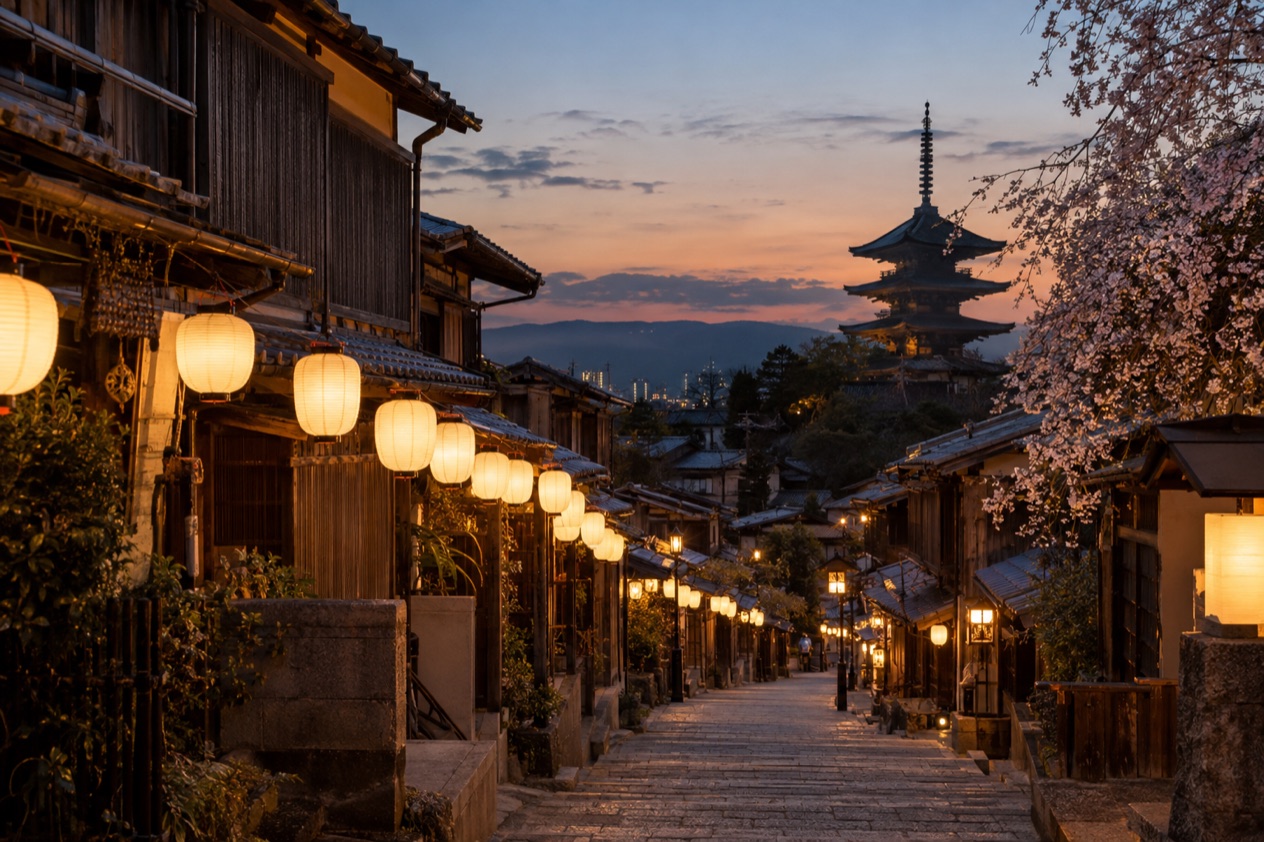
Kawaguchiko has fewer separate attractions and they work in a different way. The lake is the stage, with Mount Fuji as the backdrop that anchors every photograph. The Fuji Five Lakes were created by earlier eruptions of the mountain, and the Aokigahara forest is another point of interest in the area. At Arakurayama Sengen Park, about 650 cherry trees flower in spring, and a pagoda gives the viewpoint a frame for the mountain behind it.
Food around the lake leans on the cooking of Yamanashi Prefecture, above all hoto, a hearty stew of wide, flat wheat noodles simmered with pumpkin and vegetables in a miso broth. It is a warming bowl after a cold lakeside walk, and it makes a good counterpart to the black eggs of Hakone, which are a snack and not a meal.
For sheer variety, Hakone wins: museums, hot springs, a volcanic valley and a lake in one area, with food tied to each stop.
Things to do
Hakone is a place of rides and soaks. You can bathe in one of Japan’s best hot springs, and the area has 17 types of hot spring, so a ryokan bath and a public bath can feel quite different.
The Hakone Ropeway links Sounzan and Togendai by way of Owakudani, and the Hakone Sightseeing Cruise crosses Lake Ashi. Between the cable car, the mountain railway and the buses, a day can be a loop of different vehicles, each with its own view of the valley or the lake.
Maintenance can change that plan. During scheduled maintenance, a replacement bus runs on sections of the Hakone Ropeway, so the ride across the valley sometimes happens on the road. The cable car on Mt. Komagatake has a firm end to its day, which matters if you like to watch the light from the top.
| Site | Last cable car |
|---|---|
| Mt. Komagatake cable car, Hakone | 16:50 |
Art is the other half of Hakone. Beyond the open-air sculpture and the museums of Sengokuhara, the Hakone Freepass Hako Ticket Plus adds discounts on entrance fees at around 70 tourist spots. Evenings are quiet and centered on the ryokan, where the day ends with a bath and a long dinner.
Kawaguchiko is for walking, looking and lingering. You follow the lake shore, wander the Fuji Five Lakes area, visit the Aokigahara forest, and climb to the viewpoint at Arakurayama Sengen Park for the cherry trees and the mountain beyond. There is little in the way of a nightlife scene to describe here, and the evenings are for dinner by the lake.
Climbing Mount Fuji itself is a seasonal activity with strict limits. The Yoshida and Subashiri trails are among the hiking routes, and the climbing season ends on September 10th.
Outside the season, climbing is extremely dangerous, since first-aid centers and mountain huts close, cell phone service is lost and the weather turns severe, and climbing from October to May is discouraged. Right now, in October, the mountain is for looking at, not for climbing. The official Mt. Fuji climbing website carries the latest information for anyone planning a hike in season.
As for day trips, Hakone gives you Odawara at its foot, while Kawaguchiko opens onto the other four lakes. In both places, the best plan is to pick two or three stops and let the rest of the day float.
Weather and the best time to go
Hakone has a humid subtropical climate, with warm summers and cool winters, and September is its wettest month. Kawaguchiko sits in a high basin where winter brings snow and July is humid, so the two places feel different even in the same month.
| Measure | January |
|---|---|
| Odawara, foot of Hakone: average high (°F) | 51.1 |
| Odawara, foot of Hakone: average low (°F) | 33.1 |
| Odawara, foot of Hakone: precipitation (inches) | 3.30 |
| Odawara, foot of Hakone: hours of sunshine | 180 |
| Mountain side of Hakone, 855 m: precipitation (inches) | 5.03 |
| Kawaguchiko, Lake Kawaguchi: days with precipitation | 4.9 |
| Kawaguchiko, Lake Kawaguchi: relative humidity (%) | 62 |
| Kawaguchiko, Lake Kawaguchi: snowfall (inches) | 14.6 |
| Kawaguchiko, Lake Kawaguchi: days of snow or sleet | 8.8 |
In winter, Hakone at the foot of the mountain has cool days and cold nights, with plenty of sunshine, which makes January a good month for a hot spring because the contrast is the pleasure. On the mountain side the precipitation is higher than in town, so a trip up to the lake can be wetter than the weather at the bottom suggests. At Kawaguchiko, January is the month of snow, with flakes falling on a good share of the days, and the air is dry enough for the lake to look sharp when the sky clears.
July reverses the picture. Odawara is hot, and the mountain side of Hakone gets a great deal of rain, so a day of boats, ropeways and views can end up inside cloud. Kawaguchiko is humid, with showers on a fair number of days. In both places summer rewards flexibility, a plan with museums and baths that does not depend on a clear view of Mount Fuji.
The seasons in between, spring and autumn, sit between those two pictures. Hakone’s wettest month is September, so early autumn is a gamble for views, while spring brings the cherry trees at Arakurayama Sengen Park above Kawaguchiko. Winter suits Hakone’s baths, and any season suits Kawaguchiko as long as you accept that the mountain decides when it appears.
Getting there and getting around
From Tokyo, Hakone can be reached by train in roughly an hour to an hour and a half. From Shinjuku Station the Odakyu Line runs to Hakone-Yumoto, and the Romancecar limited express runs on the same route and takes about 80 minutes.
From Tokyo Station you can take the JR Tokaido Shinkansen to Odawara, then transfer to the Hakone Tozan Railway to Hakone-Yumoto, for about the same total time. The Romancecar needs both a limited express ticket and a regular fare ticket, and carries a one-way surcharge from Shinjuku to Hakone-Yumoto.
| Item | Adult | Child |
|---|---|---|
| Romancecar surcharge, Shinjuku to Hakone-Yumoto, one way | 1,200 yen | 600 yen |
| Hakone Freepass, 2 days, from Shinjuku | 7,100 yen | 1,600 yen |
| Hakone Freepass, 3 days, from Shinjuku | 7,500 yen | 1,850 yen |
| Hakone Freepass, 2 days, from Odawara (Hakone area only) | 6,000 yen | 1,500 yen |
| Hakone Freepass, 3 days, from Odawara (Hakone area only) | 6,400 yen | 1,750 yen |
Once in Hakone, the Hakone Freepass is the tool for moving around. It offers unlimited rides on eight kinds of transport, including the Hakone Tozan Line, the Hakone Tozan Cable Car, the Hakone Ropeway and the Hakone Sightseeing Cruise, along with Hakone Tozan Bus, Odakyu Highway Bus and Tokai Bus in designated areas and the Kanko Shisetsu-Meguri Bus. It can be bought at Shinjuku Station, Odawara Station and other stations along the Odakyu Odawara Line and the Hakone Tozan Line.
The Hako Ticket Plus version goes further, pairing the Digital Hakone Freepass with unlimited use of applicable art museums, hot springs and activity facilities. It is valid for 2 days or 3 days, and the version with an Odakyu Line ticket includes one return trip between the departure station and Odawara Station.
Kawaguchiko sits in the Fuji Five Lakes area, at the base of Mount Fuji in Yamanashi Prefecture, and the area is made up of lakes with Aokigahara forest among its points of interest. Once there, the trip is organized around the lake and the viewpoints, with Arakurayama Sengen Park as one of the places to head for. Hakone, by contrast, has a transport system you plan around, and the two destinations ask for different kinds of planning.
Who should choose which
Choose Hakone if you want a trip with a rhythm of baths, museums and rides. It suits couples and friends who want a ryokan stay, art lovers drawn to the Open-Air Museum and the museums of Sengokuhara, and anyone who enjoys changing vehicles along the way. It also suits a rainy day better than Kawaguchiko, because so much of the program is indoors or under water.
Choose Kawaguchiko if Mount Fuji is the reason for the trip. It suits photographers, walkers who like a lake shore, and travelers who like to spend a day watching light change over a mountain. The cherry trees of Arakurayama Sengen Park give it a spring season of its own, and a bowl of hoto noodles gives it a winter one.
Because they are different in character, they do not repeat each other, and the result is a trip that has both the hot spring and the mountain. A shorter trip is better served by one of them done well.
Visitors staying at a traditional ryokan in Hakone should plan to arrive at least one day after landing in Tokyo, to avoid missing dinner or being locked out at curfew time.
Good to know before you go
Prices in both places are in yen, and the pass fares above are the ones to plan around. In a ryokan, shoes come off at the entrance and the bath is a place to wash first and soak after.
Because rain on the mountain side of Hakone and snow around Kawaguchiko both shape the day, keep a flexible plan and let the weather choose between the museum and the lakeshore. If a rainy or typhoon season falls in your travel dates, the forecast the day before is what matters for ropeway and boat rides.
Sources
- Japan National Tourism Organization, Hakone (https://www.japan.travel/en/destinations/kanto/kanagawa/hakone-and-around/), checked October 11, 2026
- Hakone Tourist Information (https://www.hakonenavi.jp/international/en/), checked October 11, 2026
- Wikipedia, Hakone, Kanagawa (https://en.wikipedia.org/wiki/Hakone,_Kanagawa), checked October 11, 2026
- Wikivoyage, Hakone (https://en.wikivoyage.org/wiki/Hakone), checked October 11, 2026
- Japan Meteorological Agency (JMA), Normal values 1991-2020, monthly (https://www.data.jma.go.jp/stats/etrn/view/nml_amd_ym.php?prec_no=46&block_no=1008), station Odawara, elevation 14 m, checked October 11, 2026
- Wikipedia, Hakone Open-Air Museum (https://en.wikipedia.org/wiki/Hakone_Open-Air_Museum), checked October 11, 2026
- Wikipedia, Hakone Ropeway (https://en.wikipedia.org/wiki/Hakone_Ropeway), checked October 11, 2026
- Wikipedia, Ōwakudani (https://en.wikipedia.org/wiki/%C5%8Cwakudani), checked October 11, 2026
- Wikipedia, Lake Ashi (https://en.wikipedia.org/wiki/Lake_Ashi), checked October 11, 2026
- Japan National Tourism Organization, Mount Fuji guide (https://www.japan.travel/en/fuji-guide/), checked October 11, 2026
- Official website for Mt. Fuji climbing, about the climb (https://www.fujisan-climb.jp/en/about/), checked October 11, 2026
- Official website for Mt. Fuji climbing, information (https://www.fujisan-climb.jp/en/info/), checked October 11, 2026
- Wikipedia, Mount Fuji (https://en.wikipedia.org/wiki/Mount_Fuji), checked October 11, 2026
- Japan Meteorological Agency (JMA), Normal values 1991-2020, monthly (https://www.data.jma.go.jp/stats/etrn/view/nml_sfc_ym.php?prec_no=49&block_no=47640), station Kawaguchiko, elevation 860 m, checked October 11, 2026
- Japan Meteorological Agency (JMA), Normal values 1991-2020, monthly (https://www.data.jma.go.jp/stats/etrn/view/nml_sfc_ym.php?prec_no=49&block_no=47639), station Fujisan, elevation 3,775 m, checked October 11, 2026
- Wikipedia, Arakurayama Sengen Park (https://en.wikipedia.org/wiki/Arakurayama_Sengen_Park), checked October 11, 2026
- Odakyu Electric Railway, Hakone Freepass (https://www.odakyu.jp/english/passes/hakone/), checked October 11, 2026
- Odakyu Electric Railway, Romancecar (https://www.odakyu.jp/english/romancecar/), checked October 11, 2026
- Wikipedia, Fuji Five Lakes (https://en.wikipedia.org/wiki/Fuji_Five_Lakes), checked October 11, 2026
To plan your stay
- Best Time to Visit Hakone: Autumn Leaves, Rainy Season, Weather by Month and Festivals
- Things to Do in Hakone: Lake Ashi, Owakudani, Open-Air Museum and Hot Springs
- Where to Stay in Hakone: Hakone-Yumoto, Lake Ashi, Sengokuhara and Ryokan Stays
- Hakone from Tokyo: Romancecar, Shinkansen, Local Trains and the Hakone Freepass