
On the summer solstice in Fairbanks, a baseball game is played under a sky that never gets dark, and the crowd only notices the hour when the game ends. In Anchorage, a moose may stroll past a bike path while the mountains stand over the rooftops. Alaska is a land of rainforest coast, glaciers and wide interior, and it looks completely different depending on the month you arrive.
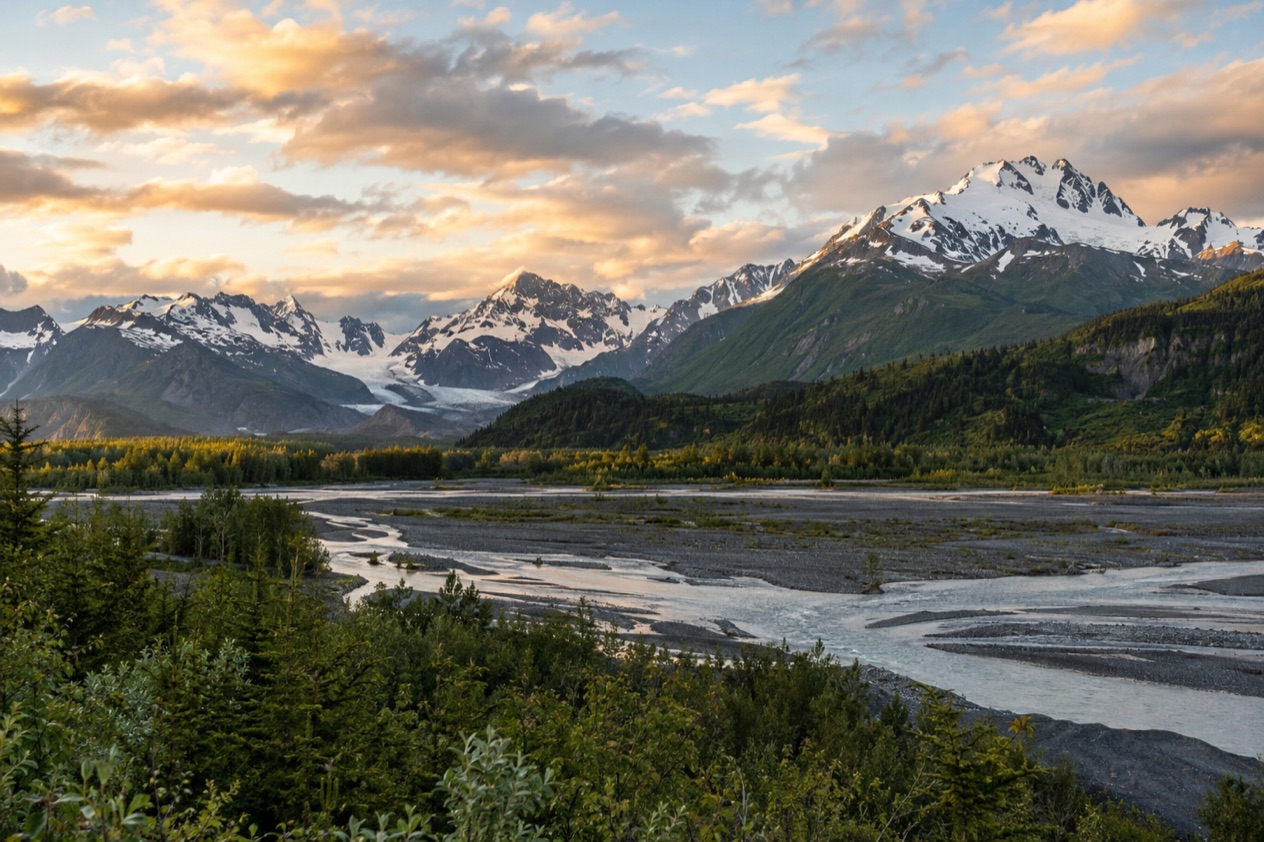
Where is Alaska and what is it like?
Alaska is the largest state in the country, with 586,000 square miles of coast, islands, mountain ranges and tundra, and very few people to fill them. Much of it has no roads at all.
The capital, Juneau, is not connected by road to the rest of the North American highway system, and in the Southeast only Haines, Hyder and Skagway have a direct road link to it. The other panhandle communities rely on the Alaska Marine Highway ferries.
The state is really several landscapes. Southeast Alaska lies inside the Tongass National Forest, the largest national forest in the country, a temperate rainforest of spruce, hemlock and fjords. It is a wet place: Juneau averages over 50 inches of precipitation a year, and some parts of the Southeast receive as much as 275 inches. Around Valdez, snow can pile up to 300 inches in a winter.
Farther inland the Alaska Range rises, and with it Denali, the highest mountain in North America at 20,310 feet. The range divides Denali National Park into two climates, a milder and wetter maritime one on the south side and a drier interior one on the other. Utqiaġvik, the northernmost city in the country, sits at the top of the state, where the seasons run to extremes of light and dark.
People have lived here for a very long time. Alaska Natives include the Iñupiat, Aleut, Yupik, Eyak, Tlingit, Haida, Tsimshian and several Northern Athabaskan peoples, and Anchorage stands on the traditional homelands of the Dena’ina Athabascan people. Around Denali, people have made their homes for perhaps 12,000 years.
Russian Orthodox congregations, many of them mostly Alaska Native, are a reminder of the Russian era that ended when the United States bought Alaska for $7.2 million in 1867, a deal mocked at the time as Seward’s Folly. Statehood came in 1959, making Alaska the 49th state.
The place suits travelers who like big scenery, wildlife and weather that makes the day’s plan. It is a state where you think in regions rather than in a single trip, and its size is a good reason to think about your budget before you go.
Where to go in Alaska
Anchorage
Anchorage is an urban enclave surrounded by wilderness, with modern comforts on one side and mountains on the other. The municipality covers 1,961 square miles, so the city’s edge is quickly the wild. It holds the Ted Stevens Anchorage International Airport, the main airport hub of the region, which makes it the natural first stop for many trips.
Hiking, glacier viewing and wildlife watching start close to town. People plan at least three days here, and the city suits those who want hotels, restaurants and tours within reach of the wilderness.
Denali National Park
Denali National Park and Preserve holds 6 million acres of wild land and one road, the Denali Park Road, which is closed to all traffic at Mile 43 because of the Pretty Rocks landslide. The park is home to 39 species of mammals and 169 species of birds, and it was the first national park created to protect wildlife. Seeing the mountain itself is never guaranteed, since clouds often hide it.
From Anchorage the drive takes about five and a half hours, from Fairbanks about two and a half. Near the entrance, the Denali Visitor Center, the Morino Grill (the only sit-down restaurant inside the park) and the free summer shuttles make a base for a day or two. It suits travelers who like long days in big country, and the park is open year-round.
Fairbanks
Fairbanks is the gateway to Alaska’s Interior and Arctic regions, and a base for adventure all year, from the Chena River in summer to the aurora in winter. In the middle of summer the sun shines nearly around the clock, and the downtown fills for the Midnight Sun Festival. In December the Winter Solstice Celebration adds fireworks you cannot see in summer, because the sky is too bright.
Local businesses help visitors reach remote areas, guide them through town, plan adventures or supply equipment. Lodging runs from bed and breakfasts among the birch trees to cabins, hostels and lodges, and some lodges lie inside Denali National Park. It suits people who want to chase either extreme of daylight.
Seward
Seward sits between the Kenai Mountains and the waters of Kenai Fjords National Park, with Mt. Marathon rising steeply behind the town. It is a place shaped by glaciers, and the harbor, a certified Alaska Clean Harbor, is where boat days begin. The Alaska SeaLife Center is the state’s only public aquarium and a good rainy-day stop.
The drive from Anchorage takes about two and a half hours, and the Alaska Railroad’s Coastal Classic also runs between the two. Seward suits travelers who want a glacier-and-ocean outing from a small town without going far from the big city.
Homer
Homer sits at the end of the road on Kachemak Bay, at the terminus of the Sterling Highway. It calls itself the Halibut Fishing Capital of the World and the City of Peonies, and it is the gateway to bear viewing, the closest town to Katmai National Park and Preserve and Lake Clark National Preserve. Brown bears gather on coastal sedge flats and streams there from June through September.
Across the bay, Kachemak Bay State Park covers over 400,000 acres and has more than 80 miles of trails, among them the hike to Grewingk Glacier and its lake. Homer is roughly a 4.5 hour drive from Anchorage, and it suits anglers, hikers and anyone who likes a town with the water at its door.
Juneau and Ketchikan
Juneau lies on Gastineau Channel in the Inside Passage, inside the Tongass National Forest. It was named after the gold prospector Joe Juneau and became the capital in 1906. Mendenhall Glacier is 13 miles from downtown and close to the airport, and visitors can drive directly to it.
Seattle is Juneau’s only nonstop departure city in the Lower 48, and Anchorage is a 90-minute flight away. Ketchikan, an island community surrounded by rainforest and sea, began as a seasonal Tlingit fish camp and grew into the Canned Salmon Capital of the World. Cruise ships dock downtown or at Ward Cove, and the town’s Tlingit, Haida and Tsimshian cultures are part of its streets.
Things to do in Alaska
Glaciers come first for visitors. Mendenhall Glacier near Juneau can be reached by car, Seward is the base for the Kenai Fjords, and Homer’s Grewingk Glacier is a hike across the bay. From Homer there are also helicopter glacier landings for those who want a different view.
Wildlife, birds and fish
Anchorage offers wildlife viewing as close as moose in the city, plus flights to see bears fishing and day cruises for whales, puffins and otters. Salmon fill nearby rivers and streams all summer, and millions of birds pass through on their annual migrations. Around Juneau you are likely to see bears, bald eagles or humpback whales, especially from April through November.
Bear viewing from Homer runs June through September. Sightings are chances rather than promises, but the setting, a coast of sedge and tidal streams, is worth the trip by itself. In Denali the animals include many of the park’s 39 mammal species, and a free sled dog demonstration lets you meet the park’s Alaskan huskies in a half-hour program with rangers.
Northern lights and winter
Viewing is possible even after sundown, in town or farther out. Winter in Anchorage also means skiing, skating, snow biking and flightseeing over the Chugach Mountains and the Alaska Range.
Dog sledding in Anchorage typically runs October through March, and summer dog sledding is available as well. A ski resort is a short drive from downtown Anchorage, and Homer’s cross-country trails at Baycrest, Lookout Mountain and McNeil/Eveline are maintained by the Kachemak Nordic Ski Club.
Festivals and culture
Anchorage Fur Rendezvous, known as Fur Rondy, is Alaska’s largest and oldest winter festival, which began in 1936 as a three-day sporting event. The Iditarod Trail Sled Dog Race traditionally starts in Anchorage on the first Saturday of March. In Fairbanks, the Midnight Sun Festival falls on the Saturday closest to June 21, and the Midnight Sun Baseball Game is a tradition under the solstice sun.
The World Eskimo-Indian Olympics in Fairbanks gather Indigenous athletes for games such as the high kick, the blanket toss and the four-man carry. In Juneau, the Áak’w Kwáan and T’aakú Kwáan, Tlingit peoples, share cultures formed by their closeness to the natural world, and the Haida and Tsimshian do the same.
Parks and trails
At Denali there are two ways to hike, on a marked trail or off-trail in nearly any direction, and most marked trails sit near the entrance. Discovery Hikes begin in mid-June and run one a day through late summer. Backcountry permits are free and required for overnight trips. Outside the park, the Denali Highway passes through the Alaska Range and gives a close look at some of the lower peaks.
When to visit Alaska
The best time for most trips is summer, from May 10 to September 15, when temperatures run through the 60s to the low 70s and daylight lasts 16 to 24 hours. The very height of the season, warm and dry, is June 15 to July 15. That is also when the Denali bus tours and the other summer services are in full swing, and when visitors arrive in the greatest numbers.
| Month | Average high (°F) | Average low (°F) | Precipitation (in) | Days with precipitation | Snowfall (in) |
|---|---|---|---|---|---|
| January | 22.7 | 11.0 | 0.75 | 2.7 | 12.4 |
| April | 45.1 | 29.9 | 0.43 | 1.4 | 4.0 |
| July | 66.2 | 52.9 | 1.82 | 5.1 | 0.0 |
| October | 42.0 | 30.7 | 1.82 | 5.2 | 5.6 |
Spring and fall are the quieter edges. In Anchorage, April is cold but dry, with the last snow melting, while October is gray and chilly with the first snow falling.
At Denali, spring runs from early or mid-April until May 19, and fall lasts from mid-September until snow accumulates, typically between late September and late October. Bus service generally runs only in summer, so the shoulder months are for people who prefer to see the park by foot or from the park road when it is open.
Fairbanks has its own calendar. The Midnight Sun Season runs from April 22 to August 20, and the stretch of true 24-hour daylight lasts from May 17 to July 27. Once the nights return, the aurora season opens. Juneau summer highs generally reach the low-to-mid 60s, and winter temperatures average 29 degrees. Southeast Alaska is rainy in every season, so rain gear matters more than the month.
Winter is a real season to visit, not just a quiet one. Denali’s winter lasts from late September until early May, with the Murie Science and Learning Center as the winter visitor center. Dog sledding, skiing and the aurora fill the cold months, and Fur Rondy and the Iditarod start in February and March.
Getting around Alaska
Distances in Alaska are measured in flights, not just miles. More than 240 flights arrive daily at the Anchorage airport, and Fairbanks has air service to and around the area. Juneau is reached by air or sea. Flightseeing tours depart from Anchorage year-round, and Alaska has about six times as many pilots per capita as the rest of the United States, which says something about how people move here.
Roads and driving
Travelers from the contiguous states can drive to Alaska on the Alaska Highway through Canada, which is paved and maintained year-round. Within the state, the George Parks Highway crosses the Alaska Range through Windy Pass between Anchorage and Fairbanks, the Richardson Highway crosses at Isabel Pass between Valdez and Fairbanks, and the Tok Cut-Off crosses at Mentasta Pass between Gulkana Junction and Tok.
Many rental car companies prohibit their vehicles on the Dalton, Denali, Steese and Cassiar Highways and the Nabesna and McCarthy Roads, and insurance may not cover damage there. Denali has a single road, the Denali Park Road, and it may close at Mountain Vista (Mile 13) or at Park Headquarters (Mile 3) at any time because of winter weather.
Trains and ferries
The Alaska Railroad connects Anchorage with Fairbanks on the Denali Star and with Seward on the Coastal Classic, and both routes have GoldStar Service. The train from Anchorage takes 8 hours to reach Denali National Park. In winter months, the Hurricane Turn Train makes the round trip to Hurricane starting from Anchorage.
The Alaska Marine Highway covers 3,500 miles of coastline and serves over 30 communities, from Bellingham, Washington, to Dutch Harbor in the Aleutian Chain. For the Southeast towns without road links, it is the way in. Passengers without vehicles check in two hours before departure in Bellingham and Juneau, and one hour before at all the other ports.
Inside Denali
Inside the park, bus service runs only in summer, generally from May 20 through mid-September. Three free shuttles serve the entrance area in summer: the Savage River Shuttle, the Riley Creek Loop Shuttle and the Sled Dog Demonstration Shuttle, all wheelchair accessible. Cell phone coverage exists only close to the park entrance, and emergencies are handled by dialing 9-1-1.
Good to know before you go
Alaska observes all federal holidays except Columbus Day, and adds Seward’s Day on the last Monday in March and Alaska Day on October 18. Denali charges an entrance fee year-round for visitors 16 and older, and no refunds are given because of bad weather.
| Fee | Amount | Who pays |
|---|---|---|
| Denali Standard Pass (valid 7 days) | $15.00 | Visitors ages 16 and up |
| Denali Annual Pass (covers up to four adults) | $45.00 | Visitors ages 16 and up |
Sources
- Wikipedia, Alaska (https://en.wikipedia.org/wiki/Alaska), checked October 11, 2026
- Wikivoyage, Alaska (https://en.wikivoyage.org/wiki/Alaska), checked October 11, 2026
- Wikipedia, History of Alaska (https://en.wikipedia.org/wiki/History_of_Alaska), checked October 11, 2026
- Wikipedia, Climate of Alaska (https://en.wikipedia.org/wiki/Climate_of_Alaska), checked October 11, 2026
- Visit Anchorage (https://www.anchorage.net/), checked October 11, 2026
- Alaska.org, dest anchorage (https://www.alaska.org/destination/anchorage), checked October 11, 2026
- Explore Fairbanks (https://www.explorefairbanks.com/), checked October 11, 2026
- Alaska.org, dest fairbanks (https://www.alaska.org/destination/fairbanks), checked October 11, 2026
- Travel Juneau (https://www.traveljuneau.com/), checked October 11, 2026
- Visit Ketchikan (https://www.visit-ketchikan.com/), checked October 11, 2026
- Visit Seward (https://www.seward.com/), checked October 11, 2026
- Seward, cruise ship terminal (https://www.seward.com/maritime/dock-facilities/seward-cruise-ship-terminal/), checked October 11, 2026
- Seward, boat harbor (https://www.seward.com/maritime/dock-facilities/seward-boat-harbor/), checked October 11, 2026
- Alaska.org, dest seward (https://www.alaska.org/destination/seward), checked October 11, 2026
- National Park Service, Denali National Park & Preserve, plan your visit: backcountry (https://www.nps.gov/dena/planyourvisit/backcountry.htm), checked October 11, 2026
- National Park Service, Denali National Park & Preserve, plan your visit: basicinfo (https://www.nps.gov/dena/planyourvisit/basicinfo.htm), checked October 11, 2026
- National Park Service, Denali National Park & Preserve, plan your visit: calendar (https://www.nps.gov/dena/planyourvisit/calendar.htm), checked October 11, 2026
- National Park Service, Denali National Park & Preserve, plan your visit: campgrounds (https://www.nps.gov/dena/planyourvisit/campgrounds.htm), checked October 11, 2026
- National Park Service, Denali National Park & Preserve, plan your visit: conditions (https://www.nps.gov/dena/planyourvisit/conditions.htm), checked October 11, 2026
- National Park Service, Denali National Park & Preserve, plan your visit: courtesy shuttle buses (https://www.nps.gov/dena/planyourvisit/courtesy-shuttle-buses.htm), checked October 11, 2026
- National Park Service, Denali National Park & Preserve, plan your visit: dayhiking (https://www.nps.gov/dena/planyourvisit/dayhiking.htm), checked October 11, 2026
- National Park Service, Denali National Park & Preserve, plan your visit: directions (https://www.nps.gov/dena/planyourvisit/directions.htm), checked October 11, 2026
- National Park Service, Denali National Park & Preserve, plan your visit: discovery hikes (https://www.nps.gov/dena/planyourvisit/discovery-hikes.htm), checked October 11, 2026
- National Park Service, Denali National Park & Preserve, plan your visit: eatingsleeping (https://www.nps.gov/dena/planyourvisit/eatingsleeping.htm), checked October 11, 2026
- National Park Service, Denali National Park & Preserve, plan your visit: fees (https://www.nps.gov/dena/planyourvisit/fees.htm), checked October 11, 2026
- National Park Service, Denali National Park & Preserve, plan your visit: kennels (https://www.nps.gov/dena/planyourvisit/kennels.htm), checked October 11, 2026
- National Park Service, Denali weather and climate (https://www.nps.gov/dena/learn/nature/climate.htm), checked October 11, 2026
- National Park Service, Denali history and culture (https://www.nps.gov/dena/learn/historyculture/index.htm), checked October 11, 2026
- National Park Service, Denali nature (https://www.nps.gov/dena/learn/nature/index.htm), checked October 11, 2026
- National Park Service, Denali wildlife (https://www.nps.gov/dena/learn/nature/wildlife.htm), checked October 11, 2026
- National Park Service, Denali National Park & Preserve, plan your visit: maps (https://www.nps.gov/dena/planyourvisit/maps.htm), checked October 11, 2026
- National Park Service, Denali National Park & Preserve, plan your visit: placestogo (https://www.nps.gov/dena/planyourvisit/placestogo.htm), checked October 11, 2026
- National Park Service, Denali National Park & Preserve, plan your visit: ranger programs (https://www.nps.gov/dena/planyourvisit/ranger-programs.htm), checked October 11, 2026
- National Park Service, Denali National Park & Preserve, plan your visit: safety (https://www.nps.gov/dena/planyourvisit/safety.htm), checked October 11, 2026
- National Park Service, Denali National Park & Preserve, plan your visit: savage river area (https://www.nps.gov/dena/planyourvisit/savage-river-area.htm), checked October 11, 2026
- National Park Service, Denali National Park & Preserve, plan your visit: shoulder season (https://www.nps.gov/dena/planyourvisit/shoulder-season.htm), checked October 11, 2026
- National Park Service, Denali National Park & Preserve, plan your visit: sled dog demonstrations (https://www.nps.gov/dena/planyourvisit/sled-dog-demonstrations.htm), checked October 11, 2026
- National Park Service, Denali National Park & Preserve, plan your visit: the denali visitor center (https://www.nps.gov/dena/planyourvisit/the-denali-visitor-center.htm), checked October 11, 2026
- National Park Service, Denali National Park & Preserve, plan your visit: things2do (https://www.nps.gov/dena/planyourvisit/things2do.htm), checked October 11, 2026
- National Park Service, Denali National Park & Preserve, plan your visit: visiting denali (https://www.nps.gov/dena/planyourvisit/visiting-denali.htm), checked October 11, 2026
- National Park Service, Denali National Park & Preserve, plan your visit: winter activities (https://www.nps.gov/dena/planyourvisit/winter-activities.htm), checked October 11, 2026
- Alaska.org, dest denali national park (https://www.alaska.org/destination/denali-national-park), checked October 11, 2026
- Homer Chamber of Commerce (https://www.homeralaska.org/), checked October 11, 2026
- Homer, attractions (https://www.homeralaska.org/things-to-do/attractions/), checked October 11, 2026
- Homer, bear viewing (https://www.homeralaska.org/things-to-do/outdoors-and-recreation/bear-viewing/), checked October 11, 2026
- Homer, fishing (https://www.homeralaska.org/fishing/), checked October 11, 2026
- Homer, glaciers (https://www.homeralaska.org/things-to-do/outdoors-and-recreation/glaciers/), checked October 11, 2026
- Homer, hiking and trails (https://www.homeralaska.org/things-to-do/outdoors-and-recreation/hiking-and-trails/), checked October 11, 2026
- Homer, outdoors and recreation (https://www.homeralaska.org/things-to-do/outdoors-and-recreation/), checked October 11, 2026
- Homer, things to do (https://www.homeralaska.org/things-to-do/), checked October 11, 2026
- Homer, winter activities (https://www.homeralaska.org/things-to-do/winter-activities/), checked October 11, 2026
- Alaska.org, dest homer (https://www.alaska.org/destination/homer), checked October 11, 2026
- Alaska.org, first trip (https://www.alaska.org/expert-advice/first-trip-to-alaska), checked October 11, 2026
- Alaska.org, best time (https://www.alaska.org/advice/best-time-to-visit-alaska), checked October 11, 2026
- Alaska.org, how many days (https://www.alaska.org/advice/how-many-days-you-need), checked October 11, 2026
- NOAA NCEI, U.S. Climate Normals 1991-2020, monthly (https://www.ncei.noaa.gov/access/services/data/v1?dataset=normals-monthly-1991-2020&stations=USW00026451), station Anchorage Intl Ap, elevation 120 feet, checked October 11, 2026
- Alaska Department of Transportation, Alaska Marine Highway System, Alaska Marine Highway System (https://dot.alaska.gov/amhs/index.shtml), checked October 11, 2026
- Alaska Railroad, Our trains (https://www.alaskarailroad.com/ride-a-train/our-trains), checked October 11, 2026
All our pages
When to go
- Best Time to Visit Alaska: Midnight Sun, Northern Lights, Weather and Seasons
- Alaska in January: Northern Lights, Dog Sledding, Weather and Where to Go
- Alaska in February: Fur Rondy, Ice Art, Aurora and Winter Weather
- Alaska in March: Iditarod Start, Fur Rondy, Northern Lights and Weather by Region
- Alaska in April: Last Northern Lights, Nenana Ice Classic, Spring Thaw and Where to Go
- Alaska in May: Weather by Region, Denali's Opening Season, Whales and Where to Go
- Alaska in June: Midnight Sun, Weather by Region and What to Do
- Alaska in July: Weather, Midnight Sun, Glaciers and What to Do
- Alaska in August: Weather, the State Fair, Glaciers and Where to Go
- Alaska in September: Weather, Fat Bear Week, Northern Lights and Where to Go
- Alaska in October: Weather, Northern Lights, Fat Bear Week and Where to Go
- Alaska in November: Weather by Region, Northern Lights and Winter Things to Do
- Alaska in December: Winter Solstice, Northern Lights and Where to Go
- Alaska Railroad Fares: Adult and Child Prices, Adventure Class vs. GoldStar, Baggage and Booking
- Aurora Winter Train: Route, Weekend Schedule, Baggage and Aurora Season
- Best Time to See the Northern Lights in Alaska: Fairbanks Season, Best Hours and the Midnight Sun
- Coastal Classic Train: Anchorage to Seward Route, 2027 Schedule and Booking Details
- Glacier Discovery Train: Route, Spencer Glacier, Whittier and 2027 Season Dates
- Hurricane Turn Train: Talkeetna Flagstops, Summer Schedule and Winter Runs
Things to do
- Things to Do in Alaska: Glaciers, Denali, Wildlife and the Northern Lights
- 3 Days in Alaska: Anchorage, Seward, Flightseeing and Northern Lights
- 10 Days in Alaska: Itinerary Through Anchorage, Seward, Denali and Fairbanks
- 14 Days in Alaska: Itinerary with Anchorage, Seward, Denali, Fairbanks and Juneau
- 5 Days in Alaska: Itinerary: Anchorage, Seward, Denali and Getting Around
- 7 Days in Alaska: Itinerary Through Anchorage, Seward, Denali and Fairbanks
- Accessible Travel in Alaska: Parks, Trains, Ferries and Planning Your Route
- Alaska Airlines Flights to Alaska: Anchorage and Sitka, Lower 48 Hubs, Ravn Alaska and Airport ID
- Arctic Alaska Travel Guide: Utqiagvik, the Dalton Highway, Wilderness Parks and the Midnight Sun
- Crossing the Canada-Alaska Border: Documents, Highway Crossings and Coming Back into the U.S.
- What Is the Capital of Alaska? Juneau, Why Not Anchorage and How to Get There
- Alaska Facts: Size, Climate, Holidays and What the State Is Known For
- Alaska in the Fall: Denali's Open Road, Fat Bear Week, Aurora Nights and Moose Season
- The Alaska Highway: Route, Dawson Creek to Delta Junction, and What to Know Before Driving
- Alaska History: Russian Purchase, Native Peoples, Gold Rush Trails and Historic Sites
- The Alaska Marine Highway Ferry: Ports, Vessels, Sailing Times and Booking Rules
- Alaska National Parks: Denali, Kenai Fjords, Katmai and How to Choose
- Alaska Native Cultures: Peoples, Cultural Centers and Respectful Visiting
- Alaska Native Heritage Center: Village Sites, Hall of Cultures and Visitor Information
- Alaska Holidays and Festivals: Alaska Day, Fur Rondy, the State Fair and the Nenana Ice Classic
- The Alaska Purchase: 1867 Treaty, the Sitka Transfer and Alaska Day
- The Alaska Railroad: Routes, Seasons, Fares and Baggage Rules
- Alaska Raptor Center: Eagles, Rehabilitation Work and How to Reach It from Sitka
Where to stay
- Where to Stay in Alaska: Anchorage, Girdwood, Fairbanks and Denali Lodges
- Camping in Alaska: Denali Campgrounds, State Park Cabins, Backcountry Permits and Bear Rules
Getting there
- Alaska Airports: Anchorage, Fairbanks, Juneau, Sitka and Bush Flying
- Alaska Car Rental: Where You Can Drive, the Dalton and Denali Highways, and Road Conditions
- Alaska Ferry from Seattle: Bellingham Terminal, Routes North and Other Ways by Sea
- Alaska Ferry Schedule: Sailing Calendar, Summer Routes and Where to Check Sailings
- Atlanta to Anchorage: Airlines, Ted Stevens Airport and What You Need to Fly
- Bellingham to Alaska by Ferry: Route, Ports of Call and Planning
- Alaska Bush Planes and Air Taxis: Where They Fly, How Bush Flying Began and What to Know Before Booking
- Chicago to Anchorage: Nonstop Flights, Airport Terminals and What to Carry
- Dallas to Anchorage: Airlines, Airport Terminals and ID for the Flight
- Denver to Anchorage: Airlines, Airport Terminals and ID for the Flight
- Driving to Alaska: The Alaska Highway, Canadian Roads and Border Documents
- The Alaska ferry vs an Alaska cruise: Scenery, Things to Do, Getting There and Who Each Suits
- Flights to Alaska: Airports, Airlines, Bush Flights and ID at the Checkpoint
- Flights to Anchorage: Airlines, Nonstop Cities and Arriving at Ted Stevens
- Flights to Fairbanks: Airlines, Cities You Can Fly From and What Happens on Arrival
- Flights to Juneau: Airlines, Departure Cities, Why There Is No Road and What to Bring
- Flightseeing in Alaska: Denali, Kenai Fjords, Talkeetna and the Bush Plane Tradition
- Getting Around Alaska: Roads, Trains, Ferries and Bush Planes
- Los Angeles to Anchorage: Airlines, Airport Arrival and ID for the Flight
- Minneapolis to Anchorage: Airlines, Airport Terminals and ID for the Flight
- New York to Anchorage: Airlines, Ted Stevens Airport and the ID You Need
- Portland to Anchorage: Airlines, Ted Stevens Airport and ID for the Flight
- San Francisco to Anchorage: Airlines, Landing at Ted Stevens and ID for the Flight
Practical
- Know Before You Go to Alaska: Layers, Bears, Road Conditions and Time Zone
- An Alaska cruise vs an Alaska land tour: Glaciers, Denali, Cruisetours and Getting Around
- Alaska vs Canada: Glaciers, Yukon Wilderness, the Rockies and Getting There
- Alaska vs Hawaii: Scenery, Weather, Getting There and Who Each Suits
- Alaska vs Iceland: Scenery, Wildlife, Weather and Getting Around
- Alaska vs Norway: Glaciers, Fjords, Midnight Sun and Getting Around
- Bear Safety in Alaska: Food Storage, Denali Distances, Bear Spray and Where Bears Live
- Alaska on a Budget: Cruises, Trains, Ferries and State Park Cabins
- Alaska Health and Safety for Visitors: Bears, Cold, Hospitals and What to Carry
- The Inside Passage vs the Gulf of Alaska: Glaciers, Ports and Getting There
- Is Alaska Safe?: Bears, Moose, Earthquakes and Denali Park Rules
- Moose in Alaska: Safety, Where to See Them and How to Watch Them
- What to Pack for Alaska: Layers, Rain Gear, Bug Repellent and What to Leave Home
- Seattle vs Vancouver: Alaska Cruise Ports, Scenery, Things to Do and Getting There
Places
- Anchorage Travel Guide: Museums, Wildlife, Chugach Trails and When to Go
- Alaska Cruises: Cruise Lines, Season, Departure Ports and Ports of Call
- Denali National Park Travel Guide: the Park Road, Bus Rides, Sled Dogs and When to Go
- Juneau Travel Guide: Mendenhall Glacier, Mount Roberts Tram, Wildlife and When to Go
- Fairbanks Travel Guide: Midnight Sun, Northern Lights, Chena Hot Springs and Things to Do
- Seward Travel Guide: Resurrection Bay, Kenai Fjords, Exit Glacier and the Seward Highway
- Homer Travel Guide: Kachemak Bay, the Spit, Bear Flights and Glacier Hikes
- Ketchikan Travel Guide: Totem Poles, Creek Street, Misty Fjords and the Cruise Season
- Kenai and Soldotna Travel Guide: Kenai River Salmon, Old Town Kenai and Getting There
- Sitka Travel Guide: Russian History, Totem Poles, Raptors and Rain Gear
- Skagway Travel Guide: Gold Rush History, the White Pass Railway and the Chilkoot Trail
- Talkeetna Travel Guide: Denali Views, Hurricane Turn Train, Rivers and Friday Evenings
- Kodiak Travel Guide: Brown Bears, Ferry and Flights, and the Best Months to Go
- Valdez Travel Guide: Glaciers, Prince William Sound and the Richardson Highway
- Wasilla and Palmer Travel Guide: Hatcher Pass, the Alaska State Fair, Iditarod Country and Glacier Day Trips
- Utqiagvik Travel Guide: Midnight Sun, Polar Night, Iñupiat Culture and How to Get There
- Girdwood Travel Guide: Alyeska Resort, Winner Creek Trail and Turnagain Arm
- Whittier Travel Guide: Tunnel Access, Glacier Cruises, Hiking and Getting There
- Haines Travel Guide: Bald Eagles, Fort Seward, the Haines Highway and When to Go