
In September, cosmos sway in the wind at Showa Kinen Park in Tokyo, and fireworks still burst over the riverbanks on warm, damp evenings. Farther north in Hokkaido the air starts to turn crisp, The sea near Naha is very warm, which makes the coast the point of a trip here. September in Japan is the month when summer loosens its grip unevenly, region by region, and autumn begins to show in the flowers, the food and the festivals.
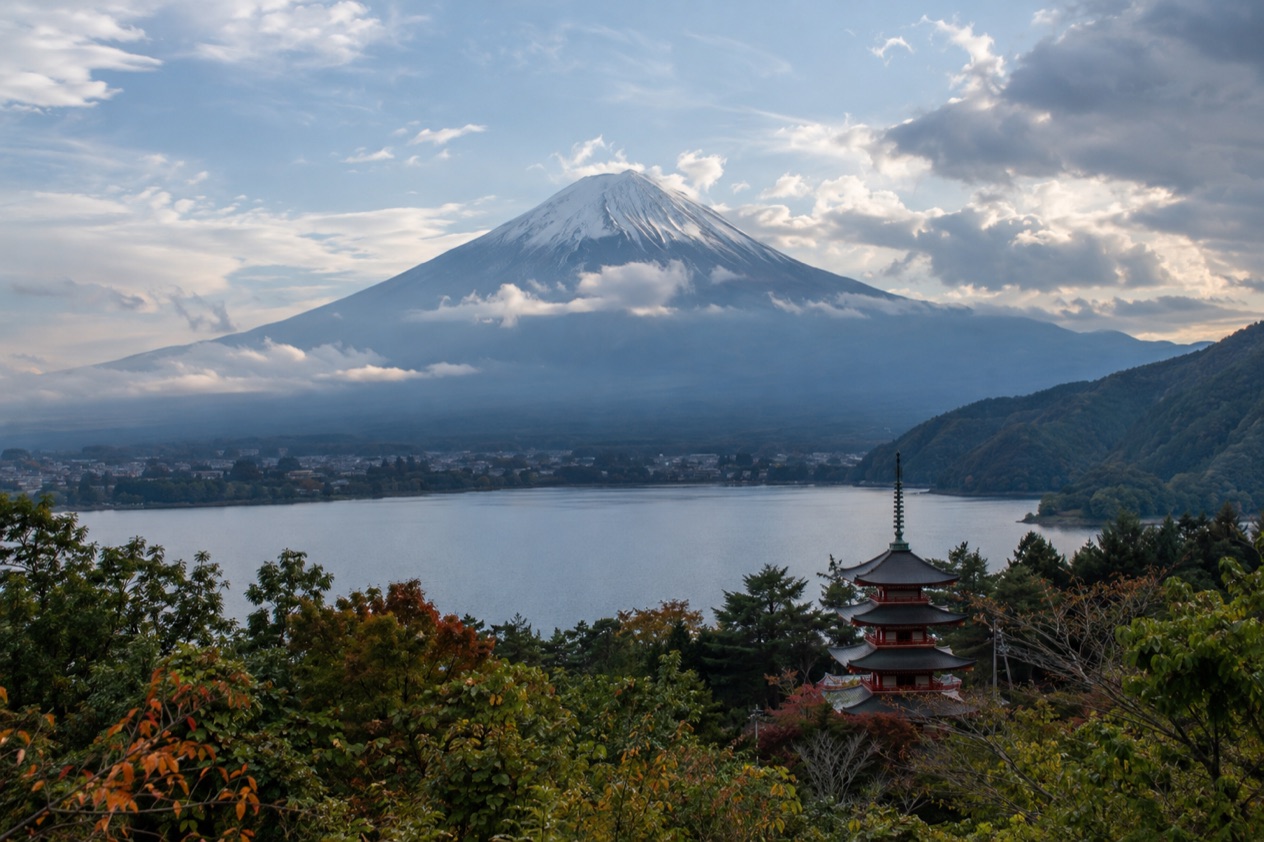
What is the weather like in Japan in September?
September is still warm to hot across most of Japan, noticeably cooler in Sapporo, and hottest and wettest in Okinawa. The islands of Honshu and Kyushu are known for hot, sultry summers, and the first half of September often feels like a continuation of them, with the relief arriving slowly through the month.
| Place | Average high (°F) | Average low (°F) | Precipitation (in) | Daylight on the 15th (hours and minutes) |
|---|---|---|---|---|
| Tokyo | 81.5 | 68.5 | 8.85 | 12 h 27 min |
| Kyoto | 84.6 | 69.3 | 7.03 | 12 h 27 min |
| Osaka | 85.1 | 71.4 | 6.02 | 12 h 27 min |
| Sapporo | 73.0 | 58.6 | 5.60 | 12 h 34 min |
| Okinawa (Naha) | 87.1 | 78.4 | 10.83 | 12 h 21 min |
| Fukuoka | 83.5 | 70.9 | 6.89 | 12 h 26 min |
| Kanazawa | 81.0 | 67.8 | 9.13 | 12 h 28 min |
| Hiroshima | 84.4 | 70.0 | 6.41 | 12 h 26 min |
Tokyo and Kanazawa sit in the low 80s by day, and nights stay mild enough to eat outside in a short-sleeved shirt. Tokyo is also the damp one of the group, with rain on about eleven days and fewer hours of sun than Kyoto or Osaka, so a gray, humid afternoon is as likely as a bright one. Kanazawa, on the Sea of Japan side, sees rain on about twelve days.
Kyoto, Osaka, Hiroshima and Fukuoka run warmer, with highs in the mid-80s and overnight lows that barely let the heat go. Osaka gets plenty of sun, and Hiroshima has the fewest rainy days of the eight places.
Sapporo is the relief: highs in the low 70s and cool evenings. Okinawa is a different climate altogether, hot day and night, with the most rain of all and the sunniest skies between showers. Near Naha, the average daily maximum sea-surface temperature is 86.1°F in September.
Where to go in Japan in September
Japan stretches from Hokkaido in the north to the subtropical islands of Okinawa, and in September that length matters. Cities of western Honshu and Kyushu, such as Hiroshima, Fukuoka and Kanazawa, are still in full summer mode, with rain on only some days. Pick your region by the temperature you want to walk in.
Tokyo and the Kanto region
Tokyo in September is a city of parks and gardens that finally invite you to linger. The heat is still real and the air is humid, but the gardens fill with the first flowers of autumn, and fireworks nights bring people out to the rivers.
This is a good month for a Tokyo that revolves around green space and evening events: cosmos at Showa Kinen Park, a tunnel of bush clover at Mukojima-Hyakkaen Garden, and Noh drama under the trees at Shinjuku Gyoen. Evenings suit an izakaya (a casual Japanese pub) with grilled skewers and cold beer, and the cooler nights make a late walk pleasant.
Kyoto and the Kansai region
Kyoto and Osaka are hot and fairly sunny, and the plan that works is to fold your sightseeing around the weather. Temples such as Kiyomizu-dera and the torii-lined paths of Fushimi Inari are the draw, and a stroll between gates and halls is a good way to see the city while the leaves are still green.
Osaka, with warmer nights than Kyoto, is a city to eat in: takoyaki (octopus dumplings), okonomiyaki (savory griddle pancakes) and kushikatsu (fried skewers), washed down with something cold. Nara and its Todai-ji complex round out a Kansai loop for anyone who likes to pack temples, gardens and street food into one trip.
Hokkaido
Sapporo is where September feels like a first breath of fall. Days are comfortably cool, evenings call for a light sweater, and Hokkaido’s long, very cold winters are still a few months off. The leaves have not turned yet, since the color change begins in mid-October in the east of the island, but the gentler air is a relief after a hot Honshu.
Hokkaido suits travelers who prefer to eat their way through a trip. Sapporo is known for miso ramen and soup curry, and the island’s seafood and dairy show up on every menu. It is the region to choose if you want the first cool air of the season instead of another hot, humid week.
Okinawa
Okinawa in September is hot, sunny between showers and very wet by Japanese standards. Naha is the base, with Kokusai-dori, the long main street of shops and small restaurants, and markets that sell the island’s produce. The sea near Naha is at its warmest, which makes the coast the point of a trip here.
The local table is distinct from the mainland: Okinawa soba in a pork broth, goya champuru (a stir-fry of bitter melon, egg and tofu) and awamori, the island’s rice spirit. Expect wet spells and plan loosely, because rain in Okinawa can change a day quickly.
What to do in Japan in September
The big stories of September are fireworks, flowers and Noh theater in the Tokyo area, with the autumn colors still ahead. Mount Fuji’s climbing season typically runs from the beginning of July to about the first week of September, so the season is just ending at the start of the month. Maple leaves change later: the color begins in mid-October in eastern Hokkaido and reaches the Kanto region around the end of November.
Fireworks on the rivers
Chofu’s Autumn Fireworks festival is built around rapid-fire shows of 50 large fireworks in succession, a music-and-fireworks display called Hanabillusion, and Takumi no Hanabi, a showcase of craft. It is the kind of evening that ends in a crowd of people walking home with the glow still in their eyes.
The Kita City Fireworks Festival takes place along the Arakawa River, with paid reserved seats on the Akabane side for international tourists. Fireworks nights are a Japanese summer ritual that stretches into September, and they pair with food stalls and sometimes a yukata (a light cotton robe) for the evening.
Cosmos and bush clover
The Cosmos Festival at Showa Kinen Park runs from September through October and brings around four million cosmos flowers. Pink, white and orange blooms spread over the park’s open fields, and the effect is more of a moving carpet of color than a garden bed.
At Mukojima-Hyakkaen Garden, hagi (bush clover) is trained over a long bamboo frame to make a Hagi tunnel in September. Walking through it, you pass beneath arching branches of small purple-pink flowers, a quiet seasonal image that Japanese poets have loved for centuries.
Noh by firelight in Shinjuku Gyoen
Shinjuku Gyoen National Garden hosts the annual Mori no Takigi Noh sometime between September and October. Noh drama and kyogen, the comic interludes, are staged by firelight among the trees, so the masks and slow gestures seem to float in the dark.
It suits travelers who want something more atmospheric than a museum visit, and the garden setting gives the performance its character. Around the same time, tsukimi (moon-viewing) is a tradition in autumn, when rice dumplings and pampas grass are set out to honor the full moon.
Is Japan busy in September?
September carries events more than one national rush, and what draws people depends on where you are. In the Tokyo area the Cosmos Festival at Showa Kinen Park runs through the month and into October, and fireworks nights along the Arakawa River and in Chofu bring crowds to the riverbanks and parks for an evening.
Elsewhere the draw is the weather itself. The foliage season that fills Kyoto’s temples comes later, as the color change moves south through November and into December, and Mount Fuji’s climbing season is just closing at the start of the month. Hokkaido is cooling off, and Okinawa has sunshine and a very warm sea. Taken together, September is a month of local events more than a single peak, so it rewards choosing an area and a festival rather than trying to see everything.
What to pack for Japan in September
Packing depends on the region. Honshu and Kyushu call for light, breathable clothes and rain gear, Sapporo needs a layer for cool evenings, and Okinawa needs sun protection and swimwear. Snow gear stays at home this month.
- Light, breathable shirts, because Tokyo, Kyoto and Osaka stay warm and humid
- A compact umbrella or rain jacket, since showers fall on roughly ten days in most cities
- A hat and sunscreen for the sunny stretches in Osaka, Hiroshima and Okinawa
- A sweater or light jacket for Sapporo, where evenings turn cool
- Swimwear for Okinawa, where the sea near Naha is very warm
- Comfortable walking shoes for gardens, temple paths and festival grounds
Good to know before you go
September is a rainy month across much of Japan, and Okinawa and Tokyo see the heaviest totals, so it pays to leave room in an itinerary for a gray day. Daylight lasts about twelve and a half hours in most cities, a little longer in Sapporo and a little shorter in Okinawa, which gives evenings enough time for fireworks and garden strolls. The Japan Meteorological Agency launched its Emergency Warning System on August 30, 2013, to alert people to the likelihood of catastrophes caused by natural phenomena of extraordinary magnitude, and the Japan National Tourism Organization runs a Japan Safe Travel Information page with safety tips and government information for travelers.
Is September a good time to visit Japan?
September is a good month for travelers who like fireworks, flowers and food, and who can handle the tail end of summer heat. Hokkaido is the best fit for anyone who wants cool air and a break from humidity, while the Tokyo area offers the richest list of events, from the cosmos fields to the Noh performances in Shinjuku Gyoen. Okinawa suits beach-minded travelers who accept the rain.
Compared with August, the month is a step down in heat. Kyoto, which reaches the low 90s in August, is in the mid-80s now, and Sapporo falls from the upper 70s to the low 70s. October is cooler again, with Tokyo highs in the low 70s and Sapporo in the low 60s, which brings the first autumn colors in Hokkaido but is also a different, crisper season.
What marks September is that it sits between seasons: the last fireworks of summer, the first cosmos and bush clover of autumn, and a moon-viewing tradition that celebrates the new season by lamplight.
Sources
- Japan Meteorological Agency (JMA), Normal values 1991-2020, monthly (https://www.data.jma.go.jp/stats/etrn/view/nml_sfc_ym.php?prec_no=44&block_no=47662), station Tokyo, elevation 25 m, checked October 11, 2026
- Computed from the date and the latitude of the place (sunrise equation, solar elevation -0.833 degrees), October 11, 2026
- Japan Meteorological Agency (JMA), Normal values 1991-2020, monthly (https://www.data.jma.go.jp/stats/etrn/view/nml_sfc_ym.php?prec_no=61&block_no=47759), station Kyoto, elevation 41 m, checked October 11, 2026
- Japan Meteorological Agency (JMA), Normal values 1991-2020, monthly (https://www.data.jma.go.jp/stats/etrn/view/nml_sfc_ym.php?prec_no=62&block_no=47772), station Osaka, elevation 23 m, checked October 11, 2026
- Japan Meteorological Agency (JMA), Normal values 1991-2020, monthly (https://www.data.jma.go.jp/stats/etrn/view/nml_sfc_ym.php?prec_no=14&block_no=47412), station Sapporo, elevation 17 m, checked October 11, 2026
- Japan Meteorological Agency (JMA), Normal values 1991-2020, monthly (https://www.data.jma.go.jp/stats/etrn/view/nml_sfc_ym.php?prec_no=91&block_no=47936), station Naha, elevation 28 m, checked October 11, 2026
- Open-Meteo Marine API, average 2015-2024, checked October 11, 2026
- Japan Meteorological Agency (JMA), Normal values 1991-2020, monthly (https://www.data.jma.go.jp/stats/etrn/view/nml_sfc_ym.php?prec_no=82&block_no=47807), station Fukuoka, elevation 2 m, checked October 11, 2026
- Japan Meteorological Agency (JMA), Normal values 1991-2020, monthly (https://www.data.jma.go.jp/stats/etrn/view/nml_sfc_ym.php?prec_no=56&block_no=47605), station Kanazawa, elevation 6 m, checked October 11, 2026
- Japan Meteorological Agency (JMA), Normal values 1991-2020, monthly (https://www.data.jma.go.jp/stats/etrn/view/nml_sfc_ym.php?prec_no=67&block_no=47765), station Hiroshima, elevation 4 m, checked October 11, 2026
- Japan Meteorological Agency, Emergency Warnings (https://www.jma.go.jp/jma/en/Emergency_Warning/ew_index.html), checked October 11, 2026
- Japan National Tourism Organization, safety information (https://www.japan.travel/en/japan-safe-travel-information/), checked October 11, 2026
- Japan National Tourism Organization, weather and seasons in Japan (https://www.japan.travel/en/plan/weather/), checked October 11, 2026
- Japan National Tourism Organization, summer in Japan (https://www.japan.travel/en/guide/summer-guide/), checked October 11, 2026
- Wikipedia, Climate of Japan (https://en.wikipedia.org/wiki/Climate_of_Japan), checked October 11, 2026
- Japan Meteorological Agency, maple color-change dates 2025-2026 with difference from the 1991-2020 normal (https://www.data.jma.go.jp/sakura/data/phn_014.html), checked October 11, 2026
- Japan Meteorological Agency, kaede2020.pdf (https://www.data.jma.go.jp/sakura/data/kaede2020.pdf), checked October 11, 2026
- Japan National Tourism Organization, autumn in Japan (https://www.japan.travel/en/guide/autumn-guide/), checked October 11, 2026
- Japan National Tourism Organization, spring in Japan (https://www.japan.travel/en/guide/spring-guide/), checked October 11, 2026
- GO TOKYO, best things to do and see in Tokyo in September (https://www.gotokyo.org/en/story/guide/september/index.html), checked October 11, 2026
- Wikipedia, Japan (https://en.wikipedia.org/wiki/Japan), checked October 11, 2026
To plan your stay
- Things to Do in Japan: Kyoto Temples, Onsen, Street Food and Day Trips
- Where to Stay in Japan: Ryokan, Temple Stays, Capsule Hotels and the Best Cities to Base In
- Sending Luggage from the Airport in Japan: Hands-Free Travel, Hotel Delivery and Coin Lockers
- Know Before You Go to Japan: Entry, Money, Etiquette and Getting Around