
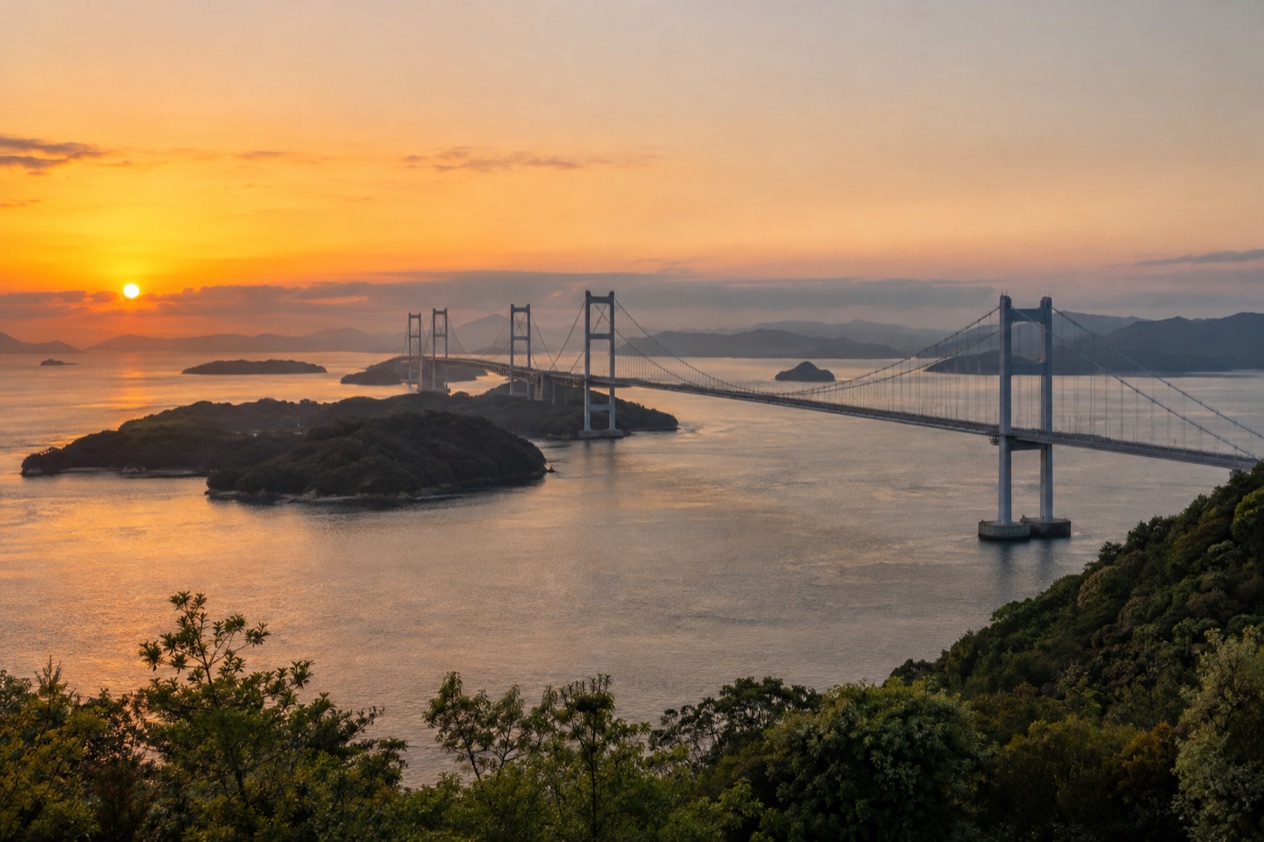
From the deck of a boat on the Seto Inland Sea, islands slide past one after another, some holding a single fishing village, some wrapped in terraces of olives and citrus. A bridge rises behind a headland, a shrine gate stands in the water, and the surface stays a soft, silvery blue. This is the sea between Honshu, Shikoku and Kyushu, and it suits travelers who like to move slowly from shore to shore, from art islands to castle towns to bike routes across the water.
Where is the Seto Inland Sea and what is it like?
The Seto Inland Sea is the body of water that separates Honshu, Shikoku and Kyushu, three of Japan’s four main islands. It stretches about 280 miles from east to west, and its width varies from a narrow strait to a broad bay.
Almost 3,000 islands dot it, though the count changes depending on how you define an island, and over 170 of them are inhabited. Around its shores lie Hiroshima, Okayama, Kurashiki, Takamatsu and Matsuyama, each with its own character.
The feel of the place is gentle and spread out rather than concentrated in one resort. The islands have a mild climate, clean beaches and sparkling blue water, and they work as short getaways from Okayama, Takamatsu, Hiroshima and Kobe.
The whole surrounding area was designated one of the first National Parks of Japan in 1934, which tells you how long people have admired this landscape. Days here run to the rhythm of boat crossings, long lunches of local seafood and walks through hillside villages.
The Seto Inland Sea rewards people who enjoy wandering without a rigid plan: cyclists, art lovers, gardeners, food-minded travelers and anyone who likes a view of water between every two stops. It is less suited to a traveler who wants a single base with everything around the corner, since the pleasures are scattered across many shores and islands. Each island has its own pace and personality, so the region reads more like a collection of small trips than one big one.
Shodoshima is the island of olives, and its groves give the shoreline a Mediterranean look that surprises first-time visitors. Naoshima is devoted to contemporary art.
On the Hiroshima side, wooded mountains meet clear water, and the prefecture adds shrines, museums and sites tied to peace. Taken together, these shores give the region a variety that neighboring parts of western Japan, which lean toward either big cities or mountain scenery, do not offer in the same way.
What is there to do in the Seto Inland Sea?
The big reasons to come are contemporary art on the islands, a long bike route over the bridges, the shrine and city of Hiroshima, and the gardens and old quarters of the castle towns. What separates this region from its neighbors is that you move across water to reach most of them, so the sea is part of every day rather than a backdrop.
Art on Naoshima
Naoshima is an island in Kagawa Prefecture, best known for its many contemporary art installations and museums. The art is spread across the island rather than gathered in one building, so a visit becomes a slow circuit between galleries, outdoor works and quiet stretches of shoreline where the sea is always in sight.
It suits visitors who like to look at one thing for a long time and then walk to the next. Okayama and Takamatsu are the mainland cities from which the islands of the Setouchi archipelago are described as short getaways, so Naoshima fits naturally into a trip that also includes a city stay.
Cycling the Shimanami Kaido
The Shimanami Kaido Bikeway runs 43 miles from Onomichi on Honshu to Imabari on Shikoku. Along the way it crosses six islands and seven bridges, so the ride alternates between island roads, citrus slopes and long spans high above the strait, with ships passing below.
The bikeway shares its corridor with the Nishiseto Expressway, which links Onomichi in Hiroshima Prefecture with Imabari in Ehime and passes through nine of the Geiyo Islands. This route suits cyclists who like to turn a crossing between two islands into the trip itself, with the sea as the constant companion.
Hiroshima and Miyajima
Hiroshima City holds the Peace Memorial Park and the Atomic Bomb Dome, and its local version of okonomiyaki, the layered savory pancake cooked on a griddle, is the dish to try at lunch. On August 6, thousands of people write peace messages on lanterns that are lit at sunset and floated along the river in front of the Dome.
An excursion from the city leads to Miyajima Island, known for its deer and its floating shrine. The prefecture also offers wooded mountains, clear waters, shrines and museums for travelers who want more than a single day.
Castles, gardens and old quarters
Okayama, the capital and largest city of its prefecture, faces Shikoku across the water. Okayama Castle is known as the Crow Castle because of its black walls, and Korakuen, beside it, is counted among the top three traditional gardens in Japan. Together they make an easy pairing of a fortress and a landscaped garden in one city.
Across the sea in Takamatsu, Ritsurin Garden is a Japanese garden designated a Special Place of Scenic Beauty by the government, and it is spectacular in spring during cherry blossom season and in autumn with its vivid colors. Kurashiki, where the Takahashi River flows through to the sea, completes the circuit of towns worth a day each.
How many days do you need in the Seto Inland Sea?
A long weekend is enough to taste one corner of the Seto Inland Sea, and about a week lets you link several shores without rushing. Because the region is a chain of separate places rather than a single destination, the right length depends on how many of those places you want to join.
With three or four days, choose one hub and treat the rest as day trips. Base yourself in Okayama and add Kurashiki, which sits 30 minutes west by the Sanyo Line, plus a day on Naoshima. Or base yourself in Hiroshima for the Peace Memorial Park, the Atomic Bomb Dome, okonomiyaki and an excursion to Miyajima. Either plan keeps the sea in view without long transfers.
With five to seven days, link two sides of the sea. A typical sequence starts in Hiroshima, moves through Okayama and Kurashiki, and continues to Takamatsu for Ritsurin Garden.
A longer stay can reach Matsuyama on Shikoku, the prefectural capital of Ehime and the largest city on the island. It makes a good final stop, since the airport there connects the region to Tokyo. With more time still, spend a night on an island instead of returning to the mainland, so the evenings belong to the harbor and the hills.
Where to stay in the Seto Inland Sea
The best base is a mainland city on the water, with the islands reached as outings. Its position on the coast, facing Shikoku across the water, makes it a natural hub for the east side of the sea.
Kurashiki, with the Takahashi River flowing through it to the sea, is a smaller base for people who prefer a lower-key evening and want to treat Okayama as the day trip. Hiroshima suits travelers focused on the Peace Memorial Park and Miyajima, and it adds a food scene built on okonomiyaki and local seafood.
On Shikoku, Takamatsu is the capital of Kagawa Prefecture in the north of the island and is the city to choose for Ritsurin Garden and for crossings to the islands. Its udon shops are a reason in themselves to stay overnight. Matsuyama, the largest city on Shikoku, suits those who plan to cover the Ehime side or arrive by air.
Cyclists on the Shimanami Kaido often spend a night at either end of the bikeway, in Onomichi or Imabari, or on an island along the route. Staying on an island such as Naoshima or Shodoshima trades city comforts for quiet evenings, and in a region of this size the choice between a city base and an island base shapes the whole trip.
How do you get to the Seto Inland Sea and get around?
You reach the Seto Inland Sea by flying to an airport on its shores or by rail to one of its cities. Matsuyama Airport on Shikoku is connected to Tokyo, and a flight from Haneda takes about 1 hour 30 minutes. Hiroshima, Okayama and Takamatsu are the other main gateways, each a city on the coast.
Around the mainland shores, trains link the cities. Visitors can take the Sanyo Line from Okayama Station to Kurashiki Station, a trip of 30 minutes that is covered by the Japan Rail Pass.
To go from one island to the next, you cross the water. Many of the Setouchi islands are described as short getaways from Okayama, Takamatsu, Hiroshima and Kobe, which places the harbors of those cities at the start of most island trips. On the Shimanami Kaido, the bikeway itself is the way across, with bridges linking Honshu and Shikoku through the islands between.
Inside each city, the sights named here are the ones to build a day around: the Peace Memorial Park and Atomic Bomb Dome in Hiroshima, the castle and garden in Okayama, Ritsurin Garden in Takamatsu. Moving between the cities and then out to the islands gives the trip its rhythm of rail, crossing and walk.
When is the best time to visit the Seto Inland Sea?
Spring and autumn are the seasons that the region’s gardens are known for. Ritsurin Garden in Takamatsu is spectacular in spring during cherry blossom season and in autumn with its vivid colors, so April and the late autumn months are natural choices if you want the gardens at their showiest. The islands have a mild climate, which keeps boat days and island walks pleasant across much of the year.
Summer brings the sea itself into play, since the islands are known for clean beaches and sparkling blue waters. Kurashiki has a humid subtropical climate, and September is its wettest month, so a trip in that month calls for a flexible plan and a rain jacket. On days of steady rain, the museums of Naoshima, the covered shopping arcades of the cities and the indoor sites of Hiroshima make good fallbacks.
The most moving date in the calendar is August 6 in Hiroshima, when thousands of people write peace messages on lanterns that are lit at sunset and floated along the river in front of the Atomic Bomb Dome. Visitors who are in the city then will find it a solemn day shaped by that ceremony. Outside it, the rest of the year offers the quieter pleasures of a coastal region with a mild climate.
Good to know before you go
Many of the best moments here happen outdoors, on a boat, a bike or a garden path, so a light rain layer and comfortable shoes serve you better than a heavy bag. Shoes come off at the entrance of temples with tatami floors and of any ryokan, the Japanese-style inn, so slip-on pairs are handy.
Islands are small and quiet in the evening, which makes it worth planning where you will eat before you cross.
Sources
- Wikipedia, Seto Inland Sea (https://en.wikipedia.org/wiki/Seto_Inland_Sea), checked October 11, 2026
- Wikivoyage, Seto Inland Sea (https://en.wikivoyage.org/wiki/Seto_Inland_Sea), checked October 11, 2026
- Japan National Tourism Organization, cycling (https://www.japan.travel/en/sports/cycling/), checked October 11, 2026
- Wikipedia, Nishiseto Expressway (https://en.wikipedia.org/wiki/Nishiseto_Expressway), checked October 11, 2026
- Wikivoyage, Cycling in Japan (https://en.wikivoyage.org/wiki/Cycling_in_Japan), checked October 11, 2026
- Japan National Tourism Organization, Hiroshima (https://www.japan.travel/en/destinations/chugoku/hiroshima/), checked October 11, 2026
- Japan National Tourism Organization, Okayama (https://www.japan.travel/en/destinations/chugoku/okayama/okayama-and-around/), checked October 11, 2026
- Wikipedia, Okayama (https://en.wikipedia.org/wiki/Okayama), checked October 11, 2026
- Japan National Tourism Organization, Naoshima (https://www.japan.travel/en/destinations/shikoku/kagawa/setouchi-islands/), checked October 11, 2026
- Wikipedia, Naoshima (https://en.wikipedia.org/wiki/Naoshima), checked October 11, 2026
- Japan National Tourism Organization, Kurashiki (https://www.japan.travel/en/destinations/chugoku/okayama/kurashiki/), checked October 11, 2026
- Wikipedia, Kurashiki (https://en.wikipedia.org/wiki/Kurashiki), checked October 11, 2026
- Japan National Tourism Organization, Takamatsu (https://www.japan.travel/en/destinations/shikoku/kagawa/takamatsu-area/), checked October 11, 2026
- Wikipedia, Takamatsu, Kagawa (https://en.wikipedia.org/wiki/Takamatsu,_Kagawa), checked October 11, 2026
- Japan National Tourism Organization, Matsuyama (https://www.japan.travel/en/destinations/shikoku/ehime/matsuyama-and-around/), checked October 11, 2026
- Wikipedia, Matsuyama, Ehime (https://en.wikipedia.org/wiki/Matsuyama,_Ehime), checked October 11, 2026
To plan your stay
- Best Time to Visit Japan: Cherry Blossoms, Autumn Colors, Weather and Festivals
- Where to Stay in Japan: Ryokan, Temple Stays, Capsule Hotels and the Best Cities to Base In
- Sending Luggage from the Airport in Japan: Hands-Free Travel, Hotel Delivery and Coin Lockers
- Know Before You Go to Japan: Entry, Money, Etiquette and Getting Around