
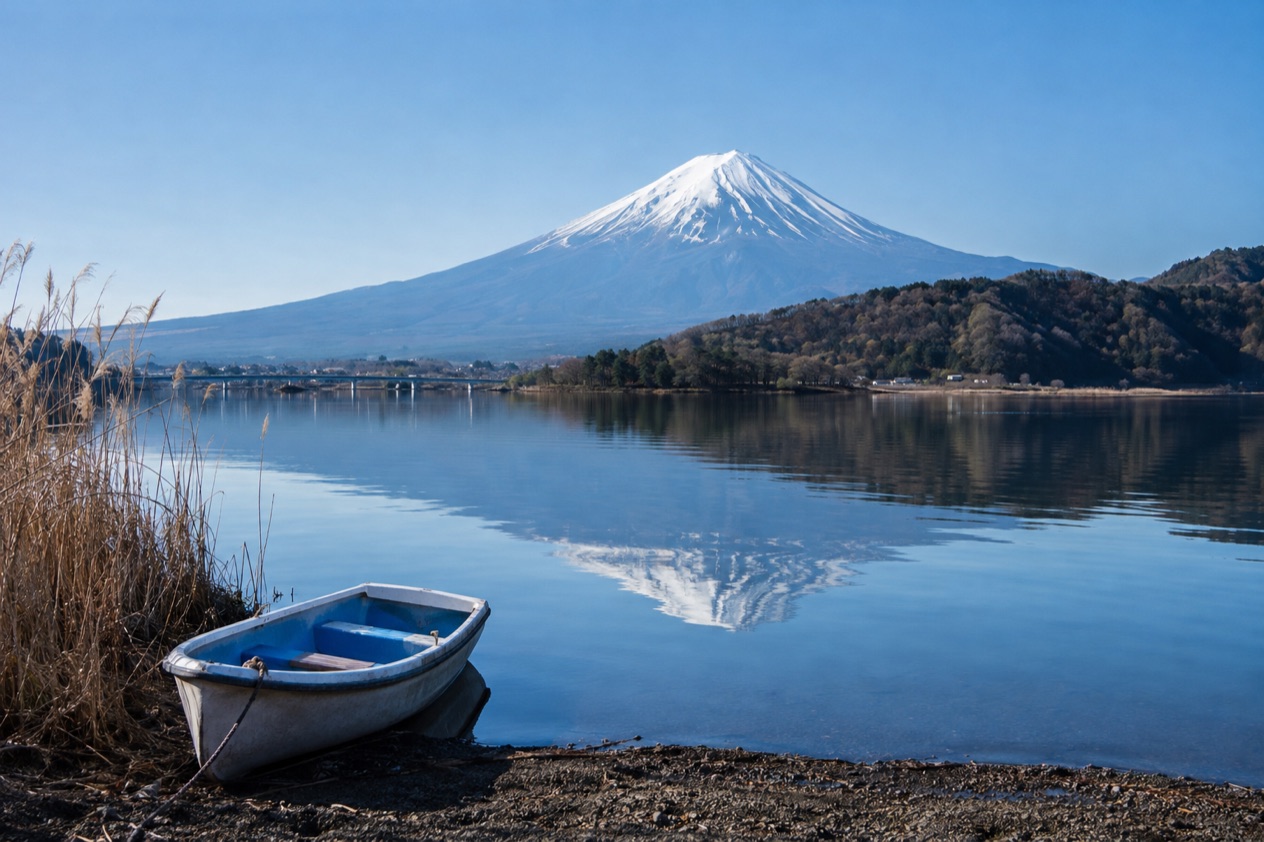
On a clear morning the cone of Fuji floats above the water of Lake Kawaguchi, and the whole shoreline seems to turn toward it, with people stopping on the path, phones raised, just to look. Then a cloud slides in and the mountain is gone as if it had never been there, which is part of the game here. This is a lake-and-mountain corner of Honshu, a place for slow gazing, hiking, hot baths and bowls of thick noodle stew.
Where is Mount Fuji and Lake Kawaguchi and what is it like?
Mount Fuji rises about 62 miles southwest of Tokyo on Honshu, on the border between Shizuoka and Yamanashi prefectures, and Lake Kawaguchi is one of the Fuji Five Lakes (Fuji-goko) spread around its base on the Yamanashi side. It is a mountain region rather than a single town: a lakeshore, a few small cities nearby such as Fujiyoshida, and a national park, Fuji-Hakone-Izu, that wraps around the volcano.
The character of the place is set by the mountain itself. Fuji is the highest peak in Japan, a UNESCO World Heritage site since 2013, listed as a sacred place and a source of artistic inspiration. You feel that second part as soon as you arrive. Painters and print makers such as Hokusai turned the cone into one of the most reproduced shapes in Japanese art, and the lake villages still organize their days around whether the summit is showing.
The pace is unhurried. People walk the lake path, rent a bicycle, sit in a café with a window facing the peak, or soak in a hot spring and look at the same view through steam. Cool air comes with the altitude, so the region feels a step apart from the capital even though Fuji can be seen from Tokyo on clear days.
It suits travelers who like landscape, short outdoor walks and a quiet evening more than nightlife or a long list of museums. Climbers come in summer for the trails. Families come for the amusement park. People who want shopping streets, big restaurants and late nights will find the lakeside plain by comparison, and a day of cloud can hide the very thing they came for.
What is there to do in Mount Fuji and Lake Kawaguchi?
The big reasons to come are the climb, the views from the lakes and the parks, the amusement park beside the mountain, and the slow comforts of the area, from hot baths to regional food. What sets this region apart from other mountain areas in Japan is that everything points at one object. Even a rainy day is organized around waiting for it to appear.
Climbing Mount Fuji in the official season
The official climbing season runs from early July to early September, with exact dates varying slightly by year and trail, and it ends on September 10th. July and August are the most popular period, when the mountain huts and facilities are operating and the weather is warmest. Several routes lead up, among them the Yoshida, Subashiri, Gotemba and Fujinomiya trails, and each starts from a station partway up the slope.
Warm is relative. At the summit in July the average high is only in the mid-40s Fahrenheit, so the climb ends in a very different climate from the lakeshore.
Visitors are strongly advised to check the Official Website for Mt. Fuji Climbing before planning, which shares information for all climbers so they can go up and return safely. Climbing from October to May is discouraged because of the cold and several high-profile deaths, and closed huts and lost cell service add to the danger.
Looking at Fuji from the lakes and the parks
Visitors never climb, and the lakes are where the mountain is best enjoyed at ground level. Lake Kawaguchi is one of the Fuji Five Lakes, and its edge gives you the mountain as a backdrop to water, boats and bare winter branches or autumn color.
Arakurayama Sengen Park, in Fujiyoshida, is another viewing spot built around the mountain. Plan for a clear-sky chance rather than a promise, because Fuji hides behind cloud often enough that a second try on another day is part of the routine. A flexible schedule helps more than any single viewpoint.
Fuji-Q Highland and the thrill rides
For travelers who want screams instead of silence, Fuji-Q Highland has been open since 2 March 1968 and sits in the shadow of the mountain. It is an amusement park known for its roller coasters, and part of the fun is riding with the volcano looming over the track.
It suits teenagers, groups of friends and families with children who need something beyond scenery. It also makes a good wet-weather alternative on days when the cone disappears, since the rides do not depend on the view.
Hot springs and regional food
A bath in an onsen (a hot spring) is the traditional answer to a day of walking or climbing, and many lakeside inns advertise baths with a view of the mountain. Shoes come off at the entrance, and bathers wash before entering the shared water.
At the table, the dish of Yamanashi is hoto, a hearty stew of flat wheat noodles simmered with pumpkin and vegetables in a miso broth. It is the kind of meal made for a cold evening at the lake, and it tastes best after hours outdoors.
How many days do you need in Mount Fuji and Lake Kawaguchi?
A night or two is the natural span for a first visit, and a long weekend is enough to see the lakes, the parks and perhaps a ride or two. One night gives you an evening and a morning, which matters here because the view changes with the weather and a second look can look completely different from the first.
With two nights you can leave room for the weather. Spend one day on the lakeshore and in Fujiyoshida, including Arakurayama Sengen Park, and keep another for Fuji-Q Highland or a long soak at an onsen. If the first morning is cloudy, you still have another chance to see the cone, and the trip does not hinge on one lucky hour.
Climbers need to think differently. The Yoshida trail is closed to hikers between 4 p.m. and 3 a.m., except for guests in mountain lodges, and it carries a daily limit of 4,000 hikers. That structure shapes the whole outing, from where you sleep to when you start. People build the climb into a longer trip, with a rest day before and a lakeside day after.
With more time, the region extends toward the neighboring areas of Fuji-Hakone-Izu National Park, which is the park that contains the mountain. Hakone, with its own hot springs and lake views, is part of that wider region and works as a follow-up stop when your days at Fuji are done. Tokyo, about 62 miles away, remains the base for travelers who choose to treat the mountain as a day outing instead of an overnight stay.
Where to stay in Mount Fuji and Lake Kawaguchi
The lakeshore at Lake Kawaguchi is the most natural place to sleep if the goal is the view. Inns and hotels here are set around the water, and the best rooms look across it toward the mountain.
It suits couples, photographers and anyone who wants the mountain to be the first thing seen in the morning. Hot-spring inns, called ryokan, often add a bath and a multi-course dinner, a traditional rhythm of the evening.
Fujiyoshida, near the foot of the mountain, suits travelers who want to be closer to the Yoshida trailhead and to Arakurayama Sengen Park. It has the feel of an ordinary working town instead of a resort, with everyday restaurants and shops, which some visitors prefer to the lakeside setting.
Climbers have one more choice, the mountain huts on the trails. Facilities and huts operate during the official season, and guests in mountain lodges are the exception to the nighttime closure on the Yoshida trail. A night in a hut is a short, basic stay built around the climb rather than a vacation lodging in the usual sense, and it falls outside the season once the huts close.
Families heading to Fuji-Q Highland tend to look for rooms near the park, while others split the stay between a lake inn and a night elsewhere in Fuji-Hakone-Izu National Park. Whichever area you choose, a window facing the mountain is worth asking for when you reserve, because the view is the reason people come.
How do you get to Mount Fuji and Lake Kawaguchi and get around?
The mountain stands about 62 miles southwest of Tokyo, and on clear days it can be seen from the capital, a useful way to picture the distance. Lake Kawaguchi lies at the base of the volcano, in the Fuji Five Lakes area of Yamanashi Prefecture, while the mountain itself straddles Yamanashi and Shizuoka.
Once you are in the area, the geography does the organizing. The lakes and Fujiyoshida are on the Yamanashi side, and the trails climb the slopes from stations on the mountain. The Yoshida trail and the Subashiri trail are two of the routes, with the Gotemba and Fujinomiya trails completing the main set.
During the climbing season the trails have their own rules. The Yoshida trail has a daily limit of 4,000 hikers and is closed between 4 p.m. and 3 a.m. except for guests in mountain lodges. On-the-Day Nature Guided Tours are available on the Yoshida trail for those who want to go with a guide.
In winter the trails close at the upper end. The Yoshida, Subashiri and Gotemba trails are closed from the 5th station to the summit, and the Fujinomiya trail is closed from the 6th station to the summit.
The summit rim trail, Ohachimeguri, is closed from July 1st to 10th for hikers on the Yoshida and Subashiri trails. For up-to-date information on any route, the official climbing website is the place the sources point to.
When is the best time to visit Mount Fuji and Lake Kawaguchi?
July and August are the months to come if the goal is to climb, since that is when the huts and facilities operate and the weather is warmest, and the season ends on September 10th. At Kawaguchiko, at Lake Kawaguchi, July brings a high in the low 80s and a humid, often cloudy feel, with rain on more than eleven days, so the lakeside can be gray even when the climbing season is in full swing.
For lakeside viewing and walking, April and the cool, dry stretch of winter are worth considering. April highs reach the low 60s with showers on about eight days, and a little snow still falls.
January is cold, with highs in the low 40s and snow on several days, yet it brings about 212 hours of sunshine, which is generous for a month when the air is crisp and the sky often open. That sunshine is why people think of winter as the season of the clearest mountain.
October, now underway, is the wettest of the four months we can describe, with about nine inches of rain, humidity above 80 percent and little sun, so the cone is often hidden in cloud. Highs in the mid-60s still make walks pleasant between showers. Climbing is discouraged from October to May, and at the summit the October high stays near freezing, which is the reason.
Good to know before you go
Pack for two climates. The lakeshore can be mild while the mountain above it is near or below freezing, and a rain layer helps in any of the wetter months. Climbing outside the official season is extremely dangerous, since first-aid centers and mountain huts close, cell phone service is lost and the weather turns severe.
If you plan to climb, check the Official Website for Mt. Fuji Climbing before you go, because trail rules and dates are published there. For everyone else, the best plan is a loose one, with a day to spare in case the mountain is hidden when you first arrive.
Sources
- Japan National Tourism Organization, Mount Fuji guide (https://www.japan.travel/en/fuji-guide/), checked October 11, 2026
- Official website for Mt. Fuji climbing, about the climb (https://www.fujisan-climb.jp/en/about/), checked October 11, 2026
- Official website for Mt. Fuji climbing, information (https://www.fujisan-climb.jp/en/info/), checked October 11, 2026
- Wikipedia, Mount Fuji (https://en.wikipedia.org/wiki/Mount_Fuji), checked October 11, 2026
- Wikivoyage, Mount Fuji (https://en.wikivoyage.org/wiki/Mount_Fuji), checked October 11, 2026
- Wikipedia, Arakurayama Sengen Park (https://en.wikipedia.org/wiki/Arakurayama_Sengen_Park), checked October 11, 2026
- Wikipedia, Fuji Five Lakes (https://en.wikipedia.org/wiki/Fuji_Five_Lakes), checked October 11, 2026
- Wikipedia, Fuji-Q Highland (https://en.wikipedia.org/wiki/Fuji-Q_Highland), checked October 11, 2026
- Japan Meteorological Agency (JMA), Normal values 1991-2020, monthly (https://www.data.jma.go.jp/stats/etrn/view/nml_sfc_ym.php?prec_no=49&block_no=47640), station Kawaguchiko, elevation 860 m, checked October 11, 2026
- Japan Meteorological Agency (JMA), Normal values 1991-2020, monthly (https://www.data.jma.go.jp/stats/etrn/view/nml_sfc_ym.php?prec_no=49&block_no=47639), station Fujisan, elevation 3,775 m, checked October 11, 2026
All our pages
When to go
- Best Time to Visit Mount Fuji and Lake Kawaguchi: Weather, Seasons, Autumn Leaves and Snow
- Mount Fuji and Lake Kawaguchi in January: Winter Weather, New Year Traditions and What to Do
- Mount Fuji and Lake Kawaguchi in February: Snow, Setsubun, Hoto Noodles and Winter Weather
- Mount Fuji and Lake Kawaguchi in March: Weather, Late Snow and What to Do
- Mount Fuji and Lake Kawaguchi in April: Weather, Cherry Blossoms and What to Do
- Mount Fuji and Lake Kawaguchi in May: Weather, Golden Week and What to Do
- Mount Fuji and Lake Kawaguchi in June: Rainy-Season Weather, Lakeside Walks and the Climbing Season to Come
- Mount Fuji and Lake Kawaguchi in July: Climbing Season, Weather and Lakeside Days
- Mount Fuji and Lake Kawaguchi in August: Weather, Climbing Season, Obon and What to Do
- Mount Fuji and Lake Kawaguchi in September: Weather, the End of the Climbing Season and What to Do
- Mount Fuji and Lake Kawaguchi in October: Weather, Autumn Mood and What to Do
- Mount Fuji and Lake Kawaguchi in November: Weather, Autumn Color and What to Do
- Mount Fuji and Lake Kawaguchi in December: Weather, Winter Snow and What to Do
Things to do
- Things to Do in Mount Fuji and Lake Kawaguchi: Lakeside Views, Fuji-Q Highland, Hiking Season and Local Food
- Best Views of Mount Fuji: Five Lakes, Fifth Station Promenades and When to Go