
On the shinkansen, the platform fills with the smell of ekiben, the boxed lunches people carry aboard, and the long white nose of the train slides in with barely a sound. In the air, the morning begins at a check-in counter at Haneda, with a cabin of passengers watching the coast tilt away beneath the wing.
Both ways cross the country, but they give you very different days.
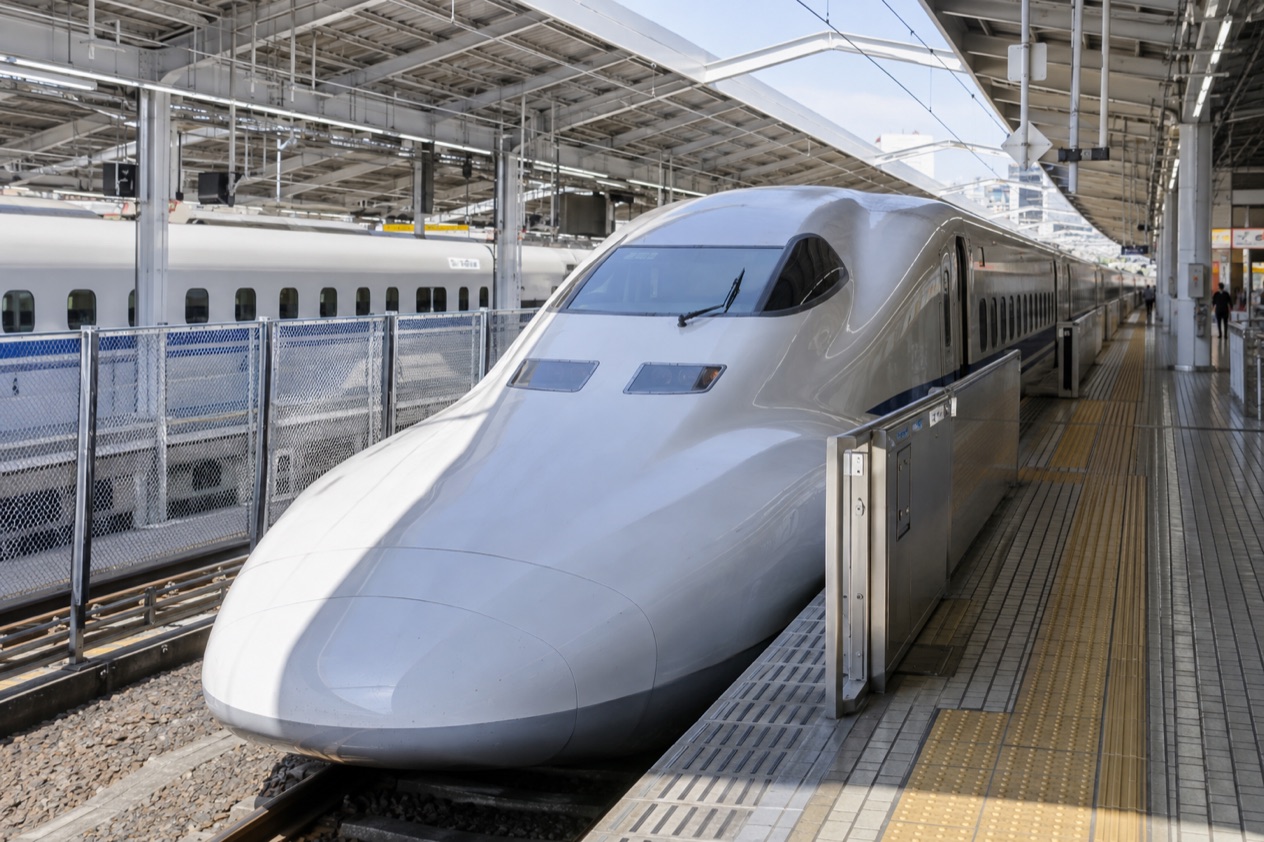
Which is better, the shinkansen or a domestic flight?
The shinkansen suits travelers who want the journey to be part of the trip, between cities on Honshu and Kyushu, while a domestic flight suits those heading to places the rails do not reach. Neither one wins every time. It depends on where you are going, how much luggage you carry and whether you want to watch the countryside roll past. The table compares the character of the two journeys.
| Category | The shinkansen | A domestic flight |
|---|---|---|
| Sights | Rice fields, towns and mountains passing by the window, with city stations as starting points | Coastlines and clouds from the air, with the city sights waiting at the other end |
| Vibe | Station platforms, lunch boxes, reserved seats and a steady rhythm | Airport terminals, boarding gates and a cabin routine |
| Things to do | Stop in a city along the line and explore it on foot | Reach the far ends of the country and begin there |
| Food | Ekiben and regional snacks bought at the station | Airport meals and what you carry aboard |
| Weather | Seen through the window as it changes from region to region | Felt on the ground at departure and arrival |
| Getting there | Central stations in cities, on lines such as the Tokaido Shinkansen | Airports such as Narita, Haneda, Kansai and Itami |
| Best for | Travelers linking cities on Honshu and Kyushu, including as far as Hakodate on Hokkaido | Travelers with ground to cover beyond the rail lines, or who prefer to fly |
Sights and food
The shinkansen puts the sights in the window. The Tokaido Shinkansen links Tokyo, Yokohama, Nagoya and Osaka, and the line to the north reaches Hakodate on Hokkaido.
Between the stops you see the working landscape of the country: rice paddies, river valleys, small towns with tiled roofs and the outlines of mountains.
A flight shows you less on the way and more on arrival. You step out in a different region, often with the whole trip planned around one place, whether that is Osaka’s food streets, a Kyushu city or a northern island.
From the window you may glimpse the coast or a cloud-covered peak, but the experience belongs to the destination rather than the passage. JAL and ANA, the two airlines with their headquarters in Tokyo, are the names travelers meet at the gate.
Food is where the train has a clear charm. Ekiben are boxed meals sold at stations, often built around a local specialty, such as grilled fish, rice with seasonal toppings, pickles and a neat arrangement of small side dishes. Eating one while the scenery moves past is a small ritual in itself. Stations also sell sweets, tea and regional snacks, so you can sample a bit of each place you pass through.
In an airport, the food is a more varied kind of fare. Terminals carry noodle counters, curry shops, sushi and coffee, and you can buy gifts for the trip home. It is satisfying, but it tends to be the same wherever you are. For food and sights along the way, the shinkansen wins. For making a faraway destination the focus of the trip, flying has its own appeal.
Things to do
On the rail side, the things to do come in the form of stopovers. Break a trip between Tokyo and Osaka at Nagoya, walk the streets of Yokohama or step off at a smaller station and see a castle town.
The Tokaido line has three kinds of service, the super-express Nozomi, the express Hikari and the all-stop Kodama, so the pattern of stops differs depending on which train you board. That lets you plan where to get off, if you want to.
Day trips are the strength of the rails. From a base in a big city, a morning train can carry you to a temple town, a garden, a hot spring village or a castle, and an evening train brings you back. Nightlife works the same way. Izakaya, the casual pubs with small plates and drinks, cluster around stations in Tokyo and Osaka, and the lanes near the platform are often where the evening begins.
A flight changes the question. You think less about stops and more about the end point. Kyushu and Hokkaido, for example, are places where you might build a whole trip, with hot springs, local cuisine and regional festivals as the focus. With an airline such as ANA, serving over 100 domestic and international destinations, the map opens up beyond what a single rail line offers.
Once you land, the things to do are the same as for anyone in that city: markets, shrines, museums, parks and evening dining. The difference is that the flight removes the in-between part. If you have a short window and a clear target, you spend your energy on the place itself. If you enjoy watching the country between major cities, the shinkansen makes the journey part of the trip.
Weather and the best time to go
Seasons shape both choices, though in different ways. On the shinkansen, you see the seasons change from region to region through the window. From the train, the landscape changes from region to region through the window. The train carries you through all of it, so the seasonal show is part of the ride.
For a flight, the weather matters mostly at the two ends. You feel it at the airport doors rather than across the miles in between. A warm, humid arrival in a southern city feels very different from a cold one in the north, and the cabin makes that contrast more sudden. The contrast can feel sudden, so your clothes need to suit where you land.
Spring and autumn are the seasons travelers have in mind when they plan a trip, because the scenery is at its colorful best and the days feel comfortable for walking between sights. On the rails, that timing rewards a window seat. In the air, it rewards good views at takeoff and landing, and it gives you pleasant weather for the exploring that follows.
Summer and winter have their own pull. Summer is the season of matsuri, the local festivals with drums, lanterns and street food, and winter is the season of hot springs and northern snow.
Whichever season you choose, the Tokaido Shinkansen runs its line at a maximum of 177 mph, and trains in Japan have a reputation for being on time, which lets you plan a day to the minute. For a flight, the season mostly decides what you pack.
Getting there and getting around
The Tokaido Shinkansen runs between Tokyo and Shin-Osaka. The Tokaido line runs 320.3 miles between Tokyo and Shin-Osaka, operated by JR Central since 1987, and it opened in 1964 as the first line of its kind. On the wider network, services reach most major cities on Honshu and Kyushu and extend to Hakodate on Hokkaido.
Once you arrive by train, getting around the city continues on the rails. In Tokyo you will find Japan Railways trains, Tokyo Metro lines and Toei Subway lines, among others. In Osaka, there are JR, Hankyu Railway, Hanshin Electric Railway and Keihan Railway, to name a few. Apps such as Japan Travel by NAVITIME, Japan Transit Planner by Jorudan and Google Maps can find routes and calculate fares.
Local trains stop at every station, which suits short distances. Rapid trains skip smaller stations and need no supplement. Express trains serve fewer stops, and a supplement may apply. Limited Express and Special Express trains have reserved seats, offer faster intercity travel and typically require a supplement. These tiers matter when you step off the shinkansen and keep moving by rail.
A flight brings you through an airport instead. JAL has its main hubs at Tokyo’s Narita and Haneda airports, with secondary hubs at Osaka’s Kansai and Itami airports, and the airline belongs to the Oneworld alliance. ANA, a Star Alliance member since October 1999, is the other airline with its headquarters in Tokyo. From the airport, you continue into the city on whatever rail or road link serves it.
Who should choose which
Choose the shinkansen if you like to see the country as you cross it, if you plan to stop in more than one city, or if you enjoy the small pleasures of train travel, the lunch box, the window and the platform routine. It suits a trip built around cities on Honshu and Kyushu, and it ties in naturally with the subway and rail systems you will use in town. If you like to wander, it gives you room to add a stop.
Choose a domestic flight if your destination lies beyond the reach of the rails, if you want to land in a region and start there, or if you simply like flying and the loyalty programs that come with the airlines. ANA and JAL give you a wide network and links to the Star Alliance and Oneworld. It fits a trip with one clear goal at the far end, whether that is a southern island or a northern snowfield.
Many trips use both. You might ride the Tokaido line between Tokyo and Osaka, taking a stopover in Nagoya or Yokohama, and then fly onward to a region the rails do not serve. Or you might fly into Haneda or Kansai at the start, ride the rails through the heart of the country and fly home from a different airport. Mixing the two lets each one do what it does well.
One last way to choose is by mood. If the idea of a window seat, a boxed lunch and a countryside slowly turning from city to field appeals to you, take the train. If you picture yourself stepping off a plane into a new region and heading straight to the first meal, take the flight. Both are perfectly good ways to cross Japan, and both lead to places worth the trip.
Good to know before you go
Japan runs on yen, and a journey by rail or air is paid in that currency, so keep a little handy for station kiosks, lunch boxes and snacks. Train etiquette is simple and quiet: people keep their voices low, take their rubbish with them and let others off the train before they step on.
Sources
- Japan National Tourism Organization, trains and buses (https://www.japan.travel/en/guide/how-to-travel-by-train-and-bus-in-japan/), checked October 11, 2026
- Japan National Tourism Organization, traveling by rail (https://www.japan.travel/en/guide/traveling-by-rail/), checked October 11, 2026
- Wikipedia, All Nippon Airways (https://en.wikipedia.org/wiki/All_Nippon_Airways), checked October 11, 2026
- Wikipedia, Japan Airlines (https://en.wikipedia.org/wiki/Japan_Airlines), checked October 11, 2026
- Wikipedia, Shinkansen (https://en.wikipedia.org/wiki/Shinkansen), checked October 11, 2026
- Wikipedia, Tōkaidō Shinkansen (https://en.wikipedia.org/wiki/T%C5%8Dkaid%C5%8D_Shinkansen), checked October 11, 2026
To plan your stay
- Best Time to Visit Japan: Cherry Blossoms, Autumn Colors, Weather and Festivals
- Things to Do in Japan: Kyoto Temples, Onsen, Street Food and Day Trips
- Where to Stay in Japan: Ryokan, Temple Stays, Capsule Hotels and the Best Cities to Base In
- Know Before You Go to Japan: Entry, Money, Etiquette and Getting Around