
At the Fish Fry on Arawak Cay in Nassau, someone is always cracking a conch for salad while a cook lifts a whole fried snapper out of the oil. Music drifts from one shack to the next, and the sea breeze carries the smell of lime and hot pepper.
That scene is the Bahamas in miniature: an island nation of turquoise shallows, small settlements and a table that begins with the sea. This is a country for beach lovers, boaters, food-minded travelers and anyone who wants to choose an island that suits their pace.
Where is the Bahamas and what is it like?
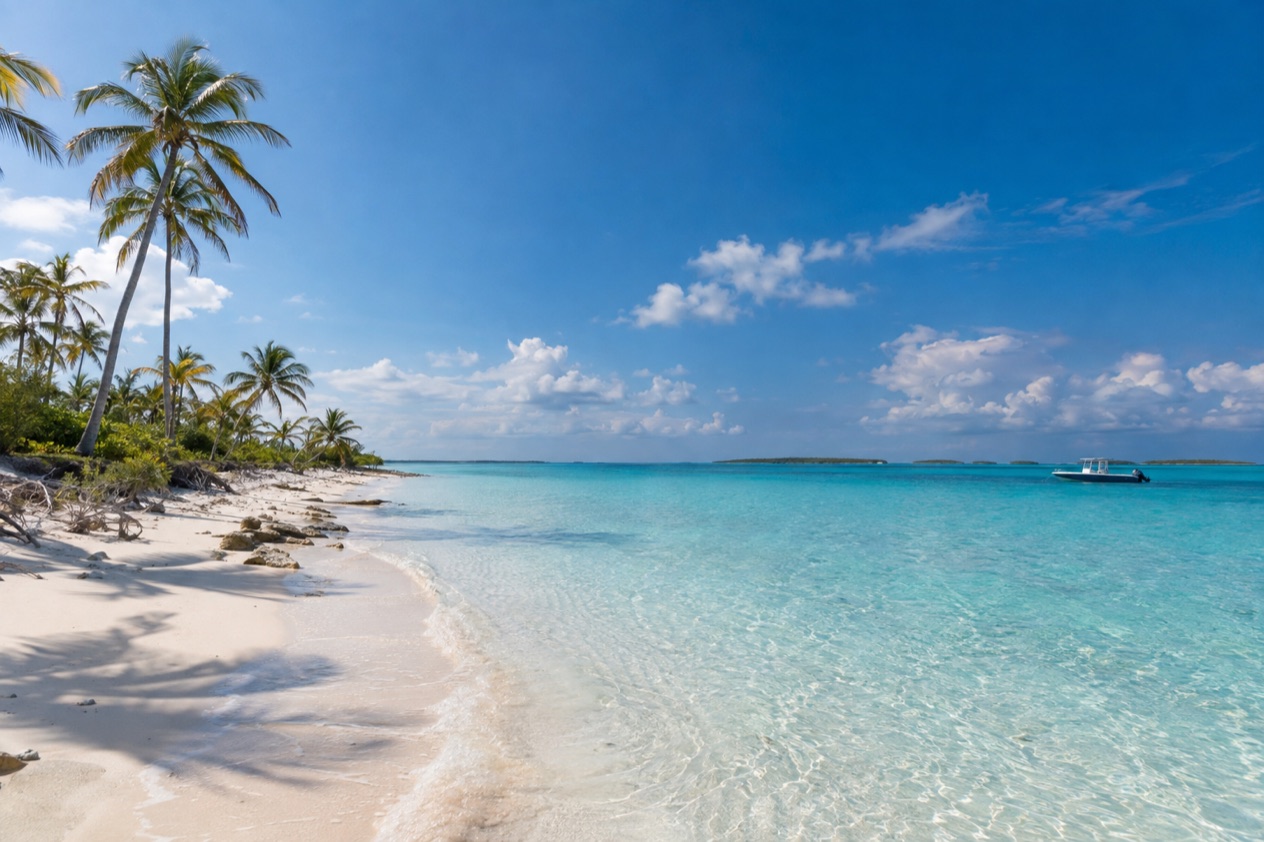
The Bahamas is an island nation in the western Atlantic Ocean, made up of about 700 islands and more than 2,500 cays, with only between 30 and 40 of the islands inhabited. There are no mountains.
The land is low and flat, and the highest point of all is Mount Alvernia on Cat Island, at 206 feet above sea level. What shapes the country is the water around it: pale shallows, deep blue channels, sandbars that appear at low tide and long stretches of empty coast.
The capital and largest city, Nassau, sits on the island of New Providence, and the country’s official language is English. New Providence holds nearly three quarters of the population, so Nassau and the neighboring Paradise Island feel like a different world from the quiet settlements of the islands farther out.
Freeport, on Grand Bahama, is the second-largest city. Beyond those two, life moves to the rhythm of fishing boats, church bells, ferry arrivals and small-town bars.
Because the country is an archipelago, every island has its own character, and a trip here is really a choice among them. Nassau and Paradise Island bring resorts, a harbor, restaurants and a lively evening scene. Harbour Island offers pastel cottages and a village feel. The Exumas are for boats and secluded cays, and the Abacos are for sailors and lighthouses. Andros is for wilderness and reefs.
Bahamian culture is easy to taste and hear. Conch appears as salad, fritters and chowder. Johnnycake and guava duff turn up on family tables. Junkanoo, the parade of costumes, cowbells and brass that fills the streets around Christmas and New Year’s, is the country’s great shared celebration.
On the quieter islands you may hear rake-and-scrape, a folk music built on a saw, a goatskin drum and an accordion. People tend to greet strangers, and a good morning at the start of a conversation is part of the manners.
One more thing shapes how you see the water here. The entire country is a national sanctuary for sharks, and it is illegal to kill them. Swimmers are advised to avoid marinas, where bull sharks often gather.
Where to go in the Bahamas
Nassau and Paradise Island
Nassau, on New Providence, is the city of the Bahamas: a working harbor, pastel colonial buildings, straw markets, rum cake and the Fish Fry at Arawak Cay. It is where most of the country’s energy gathers, and it suits travelers who want restaurants, nightlife, history on foot and a choice of places to stay. The Cable Beach strip on the island’s west side is lined with resorts.
Paradise Island lies across Nassau Harbour and is joined to New Providence by two bridges, the first built in 1966 and the second in the late 1990s. It is best known for the Atlantis resort, with its water park rides, pools, beach, restaurants, walk-in aquarium and casinos. Cabbage Beach runs about 1.3 miles east from Atlantis along the north shore, and the public path to it leads north from Casino Drive along the east side of the RIU resort.
Grand Bahama and Freeport
Grand Bahama is the island for travelers who want a resort stay with room to wander. Freeport, the second-largest city in the country, offers accommodations from family-friendly resorts to romantic all-inclusives and cozy B&Bs, and Port Lucaya has a waterfront of restaurants, shops and live music in the evening. Farther out, the island’s quiet settlements and beaches reward a day of exploring.
West End, the westernmost town, lies 64 miles east of Palm Beach, Florida, which gives the island a front-door feel for travelers coming from the U.S. coast. It suits couples, families and anyone who wants a slower rhythm than Nassau without giving up a full range of places to eat and stay.
The Exumas
The Exumas are a district of more than 365 islands and cays, and they are where the Bahamas looks like its postcards. Great Exuma, the largest island of the district, stretches 37 miles, with George Town as its main settlement. Exuma International Airport sits just a few miles from George Town and handles daily domestic and international flights. On Little Exuma, three small family-owned dining businesses work together to offer unusual meals.
Farther up the chain, Staniel Cay has an airport that serves as an official Port of Entry, with Customs and Immigration. The cays around it are known for sandbars, secluded coves and the famous pigs of Big Major Cay. The Exumas suit boaters, honeymooners and travelers who measure a day by a sandbar and a lunch of grilled fish.
Eleuthera and Harbour Island
Eleuthera is a long, thin island 60 miles east of Nassau, with 210 miles of coastline. You find ocean beaches on one side and a quieter bay shore on the other, with pineapple fields, small villages and limestone cliffs in between. It suits travelers who want to drift from beach to beach and settle into a slower island routine.
Harbour Island sits off Eleuthera’s northeast coast and is one of the oldest settlements in the Bahamas. With a population of 1,861, it is small enough to cross in minutes, and its main village, Dunmore Town, is a grid of pastel clapboard cottages, picket fences and shady lanes. The island is known for its pink-tinged sand beach on the Atlantic side, and the village has a good number of restaurants and bars for its size.
The Abacos
The Abacos are known as the boating capital of the Bahamas, and the chain spans 120 miles, divided into North, Central and South Abaco. The main island, Great Abaco, has Leonard M. Thompson International Airport at Marsh Harbour, the main town and a base for boaters. The Abaco Islands lie about 193 miles east of Miami, and sheltered cays strung along the coast shape the sailing.
On Elbow Cay, Hope Town is built around a red-and-white striped lighthouse and a snug harbor, and Green Turtle Cay has a small settlement of pastel houses that you walk in an hour or two. The Abacos suit sailors, families who love boats and travelers who want a village atmosphere at the end of the day.
Bimini and Andros
Bimini is 50 miles from Florida’s eastern coast and comprises two islands, North Bimini and South Bimini. North Bimini is about 7 miles long and only 700 feet wide, and its main settlement, Alice Town, is a string of shops, restaurants and bars along a road known as the King’s Highway. It suits travelers who want a small-island feel with open water close by on either side.
Andros is the largest island in the Bahamas, much larger than any other single island, at 2,300 square miles, 104 miles long and 40 miles wide at its widest. It is a place of mangroves, creeks and pine forest, and West Side National Park protects 1.5 million acres of wilderness. It suits anglers, birders and nature lovers who prefer wild space to resort comforts.
Things to do in the Bahamas
The strongest experiences here begin at the water’s edge. A day can mean a long beach walk, a boat ride out to a cay, a plate of conch salad by the dock and a sunset over the harbor. The country also holds a good number of cultural and nature experiences, so it rewards travelers who add something beyond the sand.
Eating the Bahamian way
Start with conch. At the Fish Fry on Arawak Cay in Nassau, the cooks serve island favorites such as conch salad, cracked and chopped with lime, peppers and onion, and fried snapper straight from the oil. The shacks stand in a row, each with its own grill and its own regulars. Order a few things, share, and move from stall to stall.
For a different way to eat, the Bahamian ambassadors in the culinary experience often invite visitors into their homes for an authentic Bahamian meal. A People-to-People programme also pairs travelers with volunteer locals who share their love of the islands. Expect stories along with the food, and dishes like peas and rice, baked macaroni, stew fish and guava duff on the table.
Beaches and boats
Beach days differ from island to island. Cabbage Beach on Paradise Island is a long, wide strip beside the resorts, while Harbour Island’s pink sand is a quiet stroll. In the Exumas and the Abacos, a boat is the vehicle of choice, whether you board one for a day among the cays or sail yourself between small harbors. Always keep the sharks in mind and avoid swimming near marinas.
Cruise lines have their own beaches too. Cruise lines use private-island destinations here, including Disney’s Castaway Cay and Lookout Cay at Lighthouse Point, Norwegian’s Great Stirrup Cay, Carnival’s Half Moon Cay and Royal Caribbean’s CocoCay. Access to these is usually limited to passengers of the owning cruise line.
Wildlife and wild places
Andros is the destination for wild country, with a national park of mangroves and pine woods on its west side and creeks where anglers and birders go. Elsewhere the reefs and the shallow water around the cays are home to sea turtles, rays and many fish, and the national shark sanctuary means sharks are protected throughout. You may see wildlife from a boat or from the shore, and sightings are chances, not promises.
Festivals and local culture
Junkanoo is the signature celebration, with early-morning parades of elaborate costumes, goatskin drums, cowbells and horns around Christmas and New Year’s. Between festivals, local life shows in church suppers, regatta days on the boating islands, straw work in the markets of Nassau and music on the porches. Smaller settlements keep their own traditions, so ask where the next local event is.
Planning your island-hopping
The Bahamas Ministry of Tourism website offers downloadable itineraries for planning a trip across the islands. They are designed for different travel styles, from relaxing beach escapes to cultural city experiences and island-hopping adventures. They are a handy starting point when you are deciding how to combine Nassau with an island or two farther out.
When to visit the Bahamas
The dry months from November to April are the pleasant half of the year, with warm days and mild evenings. Grand Bahama describes the same pattern: a warm, dry season from November through April and a hot, rainy one from May through October. The winter feels mild, which makes it a good time to walk Nassau’s streets, take boat trips and spend long afternoons on the beach.
The wet season runs from May to October. Days get hotter, the air grows heavy and rain arrives as showers that can be sudden and heavy. Nights stay warm enough to eat outside, and the sea is at its warmest in the summer months. This is also the part of the year that overlaps with hurricane season.
| Nassau | Average high (°F) | Average low (°F) | Precipitation (inches) | Rain days |
|---|---|---|---|---|
| January | 79.4 | 65.1 | 2.6 | 4.3 |
| April | 83.7 | 69.1 | 2.45 | 5.8 |
| July | 90.8 | 76.4 | 5.77 | 12.4 |
| October | 87.1 | 74.1 | 5.27 | 10.1 |
The Atlantic hurricane season runs from June 1 to November 30, and the Bahamas Ministry of Tourism & Aviation monitors tropical storms and hurricanes in the Atlantic. Travelers are encouraged to check the Bahamas.com hurricane page regularly for storm-related updates. A month outside those dates is outside the official hurricane season, and a month inside it deserves a flexible plan.
Choosing a month is partly about the island and partly about what you want to do. Winter suits sightseeing and a beach trip without the heavy heat, while the shoulder months of spring bring warmer water and a hotter sun. Christmas and New Year’s bring Junkanoo and a festive mood, and the autumn months are the wet, warm tail of the season, with rain days frequent in Nassau.
Getting around the Bahamas
Getting around the Bahamas means planes and boats, because the islands are separated by sea. The country has 20 international airports, plus dozens of smaller public and private airports. Visitors can arrive on commercial and charter flights, or by ferry or cruise line. Each island has its own way in, and the right plan is to match the flight or boat to the island you want.
By air
Several islands have airports that take international flights. On Great Exuma, Exuma International Airport is the main gateway to the Exumas, a few miles from George Town, with daily domestic and international flights. On Great Abaco, Leonard M. Thompson International Airport at Marsh Harbour serves the Abacos. In the Exuma Cays, Staniel Cay Airport is an official Port of Entry with Customs and Immigration.
Smaller airports around the archipelago handle flights between the islands, and charter flights are another way to reach islands with limited service. Landing on a small island often means stepping off the plane right onto a short runway beside the beach.
By sea
Arriving by ferry or cruise line is the sea route into the Bahamas, and a boat is also how many islanders and visitors get from one island to the next. Cruise passengers stop at ports and at the private islands owned by cruise lines, where access is usually limited to passengers of the owning line.
Travelers arriving on their own boat should know that it is illegal to import a firearm or ammunition into the Bahamas without appropriate permission. Tourists on a private boat must declare firearms to customs and leave them aboard.
On the islands
Once you land, the pace changes. On Paradise Island, two bridges link the island to New Providence across Nassau Harbour. On Harbour Island, the village is small enough to cross in minutes, and Eleuthera lies off the Harbour Island shore. In the Abacos and the Exumas, boats are the natural way to reach the cays and the outer settlements.
Good to know before you go
The U.S. State Department rates the Bahamas Level 2, “Exercise increased caution”, and says most crime occurs in Nassau on New Providence and in Freeport on Grand Bahama.
For entry by air, the Bahamas Department of Immigration says travelers must have a passport valid for at least six months, and passport cards are not accepted.
U.S. citizens do not need a Bahamian visa for a stay as a bona fide visitor of up to eight months, but must have a return or onward ticket and proof of anticipated departure. Visitors may be asked for evidence of sufficient funds, and everyone must present a completed Immigration Disembarkation/Embarkation Card.
Hurricane season runs from June to November, so build some flexibility into plans in those months. Respect the shark sanctuary, keep away from marinas when you swim, and leave a little time in each day for the thing the islands do best, which is a slow meal by the water.
Sources
- Bahamas Ministry of Tourism, Getting here (https://www.bahamas.com/getting-here), checked October 10, 2026
- Bahamas Ministry of Tourism, Investments & Aviation (bahamas.com), Map of the islands (https://www.bahamas.com/map), checked October 10, 2026
- Bahamas Ministry of Tourism, Investments & Aviation (bahamas.com), People-to-People program (https://www.bahamas.com/plan-your-trip/people-to-people), checked October 10, 2026
- Wikipedia, The Bahamas (https://en.wikipedia.org/wiki/The_Bahamas), checked October 10, 2026
- Wikipedia, Geography of the Bahamas (https://en.wikipedia.org/wiki/Geography_of_the_Bahamas), checked October 10, 2026
- Wikivoyage, The Bahamas (https://en.wikivoyage.org/wiki/The_Bahamas), checked October 10, 2026
- Bahamas Ministry of Tourism, Investments & Aviation (bahamas.com), Nassau and Paradise Island (New Providence) (https://www.bahamas.com/islands/nassau-paradise-island), checked October 10, 2026
- Wikipedia, Nassau, Bahamas (https://en.wikipedia.org/wiki/Nassau,_Bahamas), checked October 10, 2026
- Wikipedia, Paradise Island (https://en.wikipedia.org/wiki/Paradise_Island), checked October 10, 2026
- Wikivoyage, Paradise Island travel guide (https://en.wikivoyage.org/wiki/Paradise_Island), checked October 10, 2026
- Bahamas Ministry of Tourism, Investments & Aviation (bahamas.com), Freeport and Grand Bahama Island (https://www.bahamas.com/islands/freeport-grand-bahama-island), checked October 10, 2026
- Wikipedia, Grand Bahama (https://en.wikipedia.org/wiki/Grand_Bahama), checked October 10, 2026
- Bahamas Ministry of Tourism, Investments & Aviation (bahamas.com), The Exumas (https://www.bahamas.com/islands/the-exumas), checked October 10, 2026
- Wikipedia, Exuma (https://en.wikipedia.org/wiki/Exuma), checked October 10, 2026
- Bahamas Ministry of Tourism, Investments & Aviation (bahamas.com), Eleuthera and Harbour Island (https://www.bahamas.com/islands/eleuthera-harbour-island), checked October 10, 2026
- Wikipedia, Eleuthera (https://en.wikipedia.org/wiki/Eleuthera), checked October 10, 2026
- Wikipedia, Harbour Island, Bahamas (https://en.wikipedia.org/wiki/Harbour_Island,_Bahamas), checked October 10, 2026
- Wikivoyage, Harbour Island travel guide (https://en.wikivoyage.org/wiki/Harbour_Island), checked October 10, 2026
- Bahamas Ministry of Tourism, Investments & Aviation (bahamas.com), The Abacos (https://www.bahamas.com/islands/abacos), checked October 10, 2026
- Wikipedia, Abaco Islands (https://en.wikipedia.org/wiki/Abaco_Islands), checked October 10, 2026
- Bahamas Ministry of Tourism, Investments & Aviation (bahamas.com), Bimini (https://www.bahamas.com/islands/bimini), checked October 10, 2026
- Wikipedia, Bimini (https://en.wikipedia.org/wiki/Bimini), checked October 10, 2026
- Bahamas Ministry of Tourism, Investments & Aviation (bahamas.com), Andros (https://www.bahamas.com/islands/andros), checked October 10, 2026
- Wikipedia, Andros, Bahamas (https://en.wikipedia.org/wiki/Andros,_Bahamas), checked October 10, 2026
- Bahamas Ministry of Tourism, Investments & Aviation (bahamas.com), Culture (https://www.bahamas.com/experiences/culture), checked October 10, 2026
- Bahamas Ministry of Tourism, Investments & Aviation (bahamas.com), Getting here by cruise (https://www.bahamas.com/getting-here/cruise), checked October 10, 2026
- Bahamas Ministry of Tourism, Investments & Aviation (bahamas.com), Itineraries (https://www.bahamas.com/itineraries), checked October 10, 2026
- NOAA NCEI, GHCN-Daily station BF000078073 (Nassau Airport), normals 1991-2020 computed from the daily record (https://www.ncei.noaa.gov/access/services/data/v1?dataset=daily-summaries&stations=BF000078073), checked October 10, 2026
- NOAA National Hurricane Center, Climatology (https://www.nhc.noaa.gov/climo/), checked October 10, 2026
- Bahamas Ministry of Tourism, Investments & Aviation (bahamas.com), Hurricane and storm information (https://www.bahamas.com/hurricane-storm-information), checked October 10, 2026
- Bahamas Department of Immigration, Entry requirements (https://www.immigration.gov.bs/entry-requirements/), checked October 10, 2026
- Bahamas Department of Immigration, Before your arrival (https://www.immigration.gov.bs/entry-requirements/before-your-arrival/), checked October 10, 2026
- U.S. Department of State, The Bahamas Travel Information, Entry and exit requirements (https://travel.state.gov/), checked October 10, 2026
- U.S. Department of State, The Bahamas Travel Advisory, Level 2 (https://travel.state.gov/), checked October 10, 2026
All our pages
When to go
- Best Time to Visit the Bahamas: Weather, Hurricane Season, Sea Temperatures and Junkanoo
- Bahamas Weather: Seasons, Sea Temperatures and Island-by-Island Differences
- The Bahamas in January: Junkanoo, Island Weather and Crawfish Season
- The Bahamas in February: Weather, Island Choices, Crawfish Season and What to Pack
- The Bahamas in March: Weather, Sea Temperatures, Crawfish Season and Where to Go
- The Bahamas in April: Weather, Sea Temperatures, the Family Island Regatta and Where to Go
- The Bahamas in May: Weather, Sea Temperatures and What to Do Island by Island
- The Bahamas in June: Weather, Warm Seas, Where to Go and What to Do
- The Bahamas in July: Independence Day, Weather and Island Hopping
- The Bahamas in August: Weather, Crawfish Season and Where to Go
- The Bahamas in September: Weather, Island Choices, Crawfish Season and Hurricane Season
- The Bahamas in October: Weather, Warm Seas, Crawfish Season and Where to Go
- The Bahamas in November: Weather, Warm Seas, Crawfish Season and Where to Go
- The Bahamas in December: Junkanoo, Christmas in Nassau, Sea Temperatures and Where to Go
- Bahamas Hurricane Season: Dates, Peak Weeks, Dorian and Whether to Go
Things to do
- Things to Do in the Bahamas: Beaches, Blue Holes, Swimming Pigs and Fish Fry
- 3 Days in the Bahamas: Nassau, Paradise Island and an Out Island Option
- 10 Days in the Bahamas: Itinerary: Nassau, Harbour Island and the Exumas
- 5 Days in the Bahamas: Itinerary with Nassau, Paradise Island and Harbour Island
- 7 Days in the Bahamas: Itinerary with Nassau, Paradise Island and Harbour Island
- Arawak Cay Fish Fry Nassau: Conch Stands, Local Dishes and How to Get There
- Bahamas Ferries: Nassau to Harbour Island and Spanish Wells, Fares, Luggage and the Fleet
- Bahamas National Trust Parks: Exuma Cays, Abaco Parrots, Andros Blue Holes and Park Fees
- Ben's Cave Grand Bahama: Blue Hole Diving, Lucayan National Park and Visitor Rules
- Best Beaches in the Bahamas: Pink Sand, Exuma Crescents and Nassau Favorites
- Blue Holes National Park Andros: Inland Blue Holes, Pine Forest and How to Reach It
- Blue Lagoon Island Bahamas: Dolphin Encounters, Beach Day Package and Getting There
- Boating and Sailing in the Bahamas: Island Hopping, Charters, Fishing and Clearing In
- Cabbage Beach Paradise Island: Public Access, Water Sports and When to Go
- Cape Santa Maria Beach Long Island: Silk Sand, Turquoise Water and Sunsets
- Casinos in the Bahamas: Atlantis, Baha Mar, Bimini and the Rules
- Cat Island Travel Guide: Mount Alvernia, Rake & Scrape and Out Island Life
- Conception Island Bahamas: Stag-Horn Coral Cove, Snorkeling and Getting There
- Bahamas Customs: What You Can Bring: Restricted Goods, Temporary Imports and the Trip Home
- Dean's Blue Hole Long Island: Freediving Records, the Rock Amphitheater and How to Get There
- Bahamas Departure Tax: Airport Fees, Tariff Schedules and the Departure Day in Nassau
- Do You Need a Passport for the Bahamas?: Entry Documents, Visa Rules, Length of Stay and What to Show
- Dolphin Cay Atlantis: Dolphins, Manta Rays, Sea Lions and the Swim Experience
- Downtown Nassau, Nassau: Bay Street, the Queen's Staircase, Fort Fincastle and Where to Eat
- Driving in the Bahamas: License Rules, Left-Side Driving and Road Rules
- Dunmore Town, Harbour Island: Pastel Streets, Pink Sand and Where to Eat
- Bahamas Ecotourism and Wildlife: Flamingos on Inagua, National Parks and Responsible Travel
- Exuma Cays Land and Sea Park: Warderick Wells, Wildlife, Park Rules and Getting There
- Fishing in the Bahamas: Marlin, Bonefish Flats, Bimini and Permits
- Bahamian Food: Conch, the Fish Fry, Breakfast Dishes and Where to Eat
- Fort Charlotte Nassau: History, Living History Show, Hours and Getting There
- Fort Fincastle Nassau: The Queen's Staircase, Paddle-Wheel Fort and Guided Tours
- George Town (Exuma) Travel Guide: Elizabeth Harbour, Stocking Island and Exuma Beaches
- Glass Window Bridge Eleuthera: The Two Seas, Queen's Bath and Getting There
- Gold Rock Beach Grand Bahama: Low-Tide Flats, Lucayan National Park and Picnic Spots
- Golf in the Bahamas: Atlantic-Side Courses, Island by Island and What to Do Off the Course
- Green Turtle Cay Travel Guide: New Plymouth, Golf Carts, Beaches and When to Go
- Hatchet Bay Cave Eleuthera: Underground Cathedrals, Charcoal Graffiti and Guided Visits
- Bahamas Health and Vaccines: Yellow Fever Certificate, Water, Medical Care and Insurance
- Bahamas History and Heritage Sites: Nassau's Forts, the Queen's Staircase, Junkanoo and Island Culture
- Bahamas Honeymoon: Island Hopping, Sandbar Weddings and Where to Stay
- Hope Town and Elbow Cay Travel Guide: Lighthouse, Tahiti Beach, Harbor Dining and Island Life
- Hope Town Lighthouse Abaco: The Candy-Striped Light, Wyannie Malone Museum and Getting Around Elbow Cay
- Inagua Travel Guide: Flamingo Colonies, Inagua National Park and the Far South of the Bahamas
- Bahamas Island Hopping: Ferries, Flights, Mailboats and Island Pairings
- Junkanoo in the Bahamas: Boxing Day Parade, Costumes, Music and Where to Watch
- Junkanoo Beach Nassau: Western Esplanade, Saturday Cookouts and Junkanoo Culture
- What Language Do They Speak in the Bahamas?: English, Bahamian Dialect and Island Conversations
- Lighthouse Beach Eleuthera: Blush-Rose Sand, Two Seas and the Old Lighthouse
- Long Island Travel Guide: Dean's Blue Hole, Cape Santa Maria and Island Life
- Lucaya Travel Guide: Port Lucaya, Diving, Gold Rock Beach and When to Go
- Lucayan National Park Grand Bahama: Caves, Boardwalk Trails and Gold Rock Beach
- Bahamas Mailboats: What They Are, Where They Go and Whether to Take One
- Bahamas Map: Where Are the Islands?: Island Groups, Nassau and Island Hopping
Where to stay
Getting there
- Getting Around the Bahamas: Flights, Ferries, Mailboats and Taxis in Nassau
- Flights to Freeport, Grand Bahama: FPO Airport, Airlines and Arrival Formalities
- Flights to Nassau: Airlines, Arrival at Lynden Pindling Airport and U.S. Preclearance
- Flights to the Bahamas: Airports, Airlines, Nassau Preclearance and Boarding Rules
- Florida to the Bahamas by Ferry and Boat: Baleària Service, Island Ports and Arriving by Sea
- Fort Lauderdale to the Bahamas: Baleària Ferry, Flights, Cruises and Which Islands You Can Reach
- Bahamas Inter-Island Flights: Bahamasair, Other Airlines, Island Airports and Fares
- Miami to Bimini: Ferry, Seaplane and Boat Options, Travel Time and Entry
- Miami to the Bahamas: Flights, Islands and the Ferry Question
- New York to the Bahamas: Flights, Airlines, Entry Rules and the Flight Home
- South Florida to Grand Bahama: The Baleària Ferry, Boating Across and What You Need on Arrival
Practical
- Know Before You Go to the Bahamas: Entry Rules, Money, Getting Around and Local Customs
- The Bahamas vs Jamaica: Beaches, Things to Do, Weather and Getting There
- The Bahamas vs Turks and Caicos: Beaches, Things to Do, Weather and Getting There
- Bahamas Currency: Bahamian Dollar, U.S. Dollars, ATMs and Tipping
- The Exumas vs Eleuthera: Beaches, Things to Do, Weather and Getting There
- Is the Bahamas Safe? Crime Areas, Getting Around, Water and Hurricane Season
- What to Pack for the Bahamas: Clothes, Sun Gear and What Stays Home
Places
- Bahamas Cruises: Private Islands, Departure Ports and Boarding Documents
- Nassau Travel Guide: Fort Fincastle, the Fish Fry, Cable Beach and Getting Around
- The Abacos Travel Guide: Hope Town, Green Turtle Cay, Beaches and When to Go
- The Exumas Travel Guide: Swimming Pigs, Thunderball Grotto, Beaches and Where to Stay
- Bimini Travel Guide: Alice Town, the SS Sapona Wreck, the Bimini Road and Getting There
- Eleuthera Travel Guide: Pink Sand Beaches, Glass Window Bridge, Surfing and Getting Around
- Grand Bahama Travel Guide: Lucayan National Park, Port Lucaya, Diving and Seasons
- Harbour Island Travel Guide: Pink Sand Beach, Dunmore Town and Getting Around
- Andros Travel Guide: Blue Holes, Barrier Reef, Angling and Getting Around
- Paradise Island Travel Guide: Atlantis, Cabbage Beach, Versailles Gardens and When to Go
- Freeport Travel Guide: Lucayan National Park, Port Lucaya, Diving and Stingrays
- Cable Beach Travel Guide: Baha Mar, the Beach, Casino Nights and Best Months