
In the covered market streets of Naha, pork is sliced and simmered, bitter goya is piled in crates, and a sanshin, the three-stringed instrument of the islands, plinks from a doorway. Beyond the city, red-tiled roofs carry stone lion-dogs called shisa, and the coral shows pale beneath the water. The Okinawa Islands are Japan’s subtropical south, a chain with its own kingdom’s history, its own food and its own music, for travelers who want Japan to feel different from the mainland.
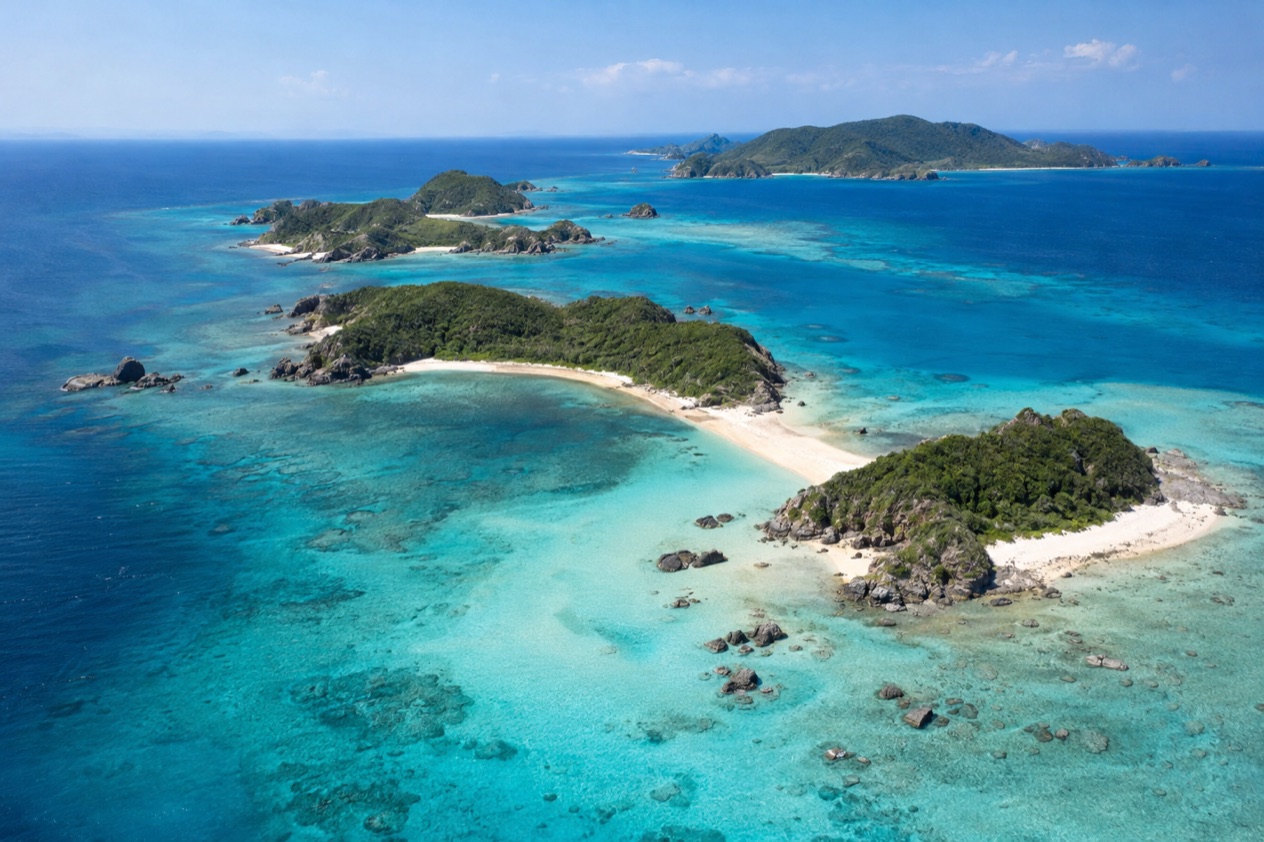
Where is the Okinawa Islands and what is it like?
Okinawa Prefecture is Japan’s subtropical south, stretching between mainland Japan and Taiwan and encompassing the Okinawa, Miyako and Yaeyama island groups. Okinawa Prefecture counts 49 inhabited islands, plus a scatter of uninhabited ones, and Naha, the prefectural capital, is the largest settlement and the gateway to the rest.
The character of the place comes first from its history. Okinawa was an independent kingdom with its own court, language and crafts, and it is the birthplace of karate. You notice this in small things: the lion-dog guardians on rooftops, the dyed textiles called bingata, the glazed pottery of the Tsuboya district in Naha, and a cuisine that owes as much to the sea and the pig as to the rice paddies of the mainland.
The pace follows the climate. This is a chain with a distinctly subtropical climate, and the rhythm of a day tends toward long meals, an awamori (the local distilled spirit) in the evening and music that lingers.
Naha is the city part of the story, home to about a fifth of the main island’s residents. Beyond it, the islands spread out: Miyako, Ishigaki, Kume, Yonaguni, each with its own mood, reached by a short list of flights and ferries.
Who will love it? Travelers who like to eat their way through a place, who want reefs and island roads, and who enjoy a culture that is clearly not the Tokyo or Kyoto of the guidebooks. Who may not? Anyone hoping for a dense web of temples and trains. Outside Naha, distances between islands are crossed by plane or boat, and the trip rewards patience more than a checklist.
What is there to do in the Okinawa Islands?
Major draws include Naha and Shuri Castle, Churaumi Aquarium, Miyako’s Yonaha Maehama Beach, Ishigaki’s Kabira Bay and ferry trips to Taketomi and Iriomote. Together they set Okinawa apart from its neighbors in Japan, because nowhere else in the country mixes a former kingdom’s heritage with a subtropical island chain.
Naha: markets, noodles and island flavors
Naha is where visitors begin. It has Okinawa’s only public rail network, the Okinawa Urban Monorail, known as Yui Rail, which gives the city a spine to build a day around. The food is the draw: Okinawa soba in a pork broth, goya champuru (a stir-fry of bitter melon, tofu and egg), braised pork belly called rafute, and sea grapes, the little green beads called umibudo that pop against the tongue.
Between meals, there is pottery to look at in the Tsuboya lanes, dyed fabrics to browse, and the sweet fried dough of sata andagi to eat from a paper bag. In the evening, izakaya (Japanese pubs) pour awamori and Orion beer, and the music is sometimes live. It suits travelers who like to wander, graze and sit longer than planned.
Okinawa Churaumi Aquarium
Okinawa Churaumi Aquarium is built around the life of the surrounding seas, and it is a reason to head into the main island’s countryside. Its tanks hold the reef species of the Ryukyu waters, and the aquarium has recently welcomed a new female Japanese sawshark as part of an effort to breed the species. Families, divers-to-be and anyone curious about what lives beneath the surface will find a full visit here.
| Site | Open |
|---|---|
| Okinawa Churaumi Aquarium | 08:30 to 18:30, last admission 17:30 |
Miyako Island: sun, reefs and open roads
Miyako Island is a peaceful island getaway, known for sun, beaches, golf, cycling and diving in coral reefs. The island lies southwest of the main island of Okinawa, and the pace is the opposite of Naha’s: days are built around a beach, a bike ride through sugarcane country or a dive boat. It suits couples, divers and travelers who want to slow down.
Miyako is reached only by plane, so a stay here means committing to the island rather than adding it as a stop. Pair it with Naha for a contrast between city eating and reef time.
Ishigaki: Japan’s southernmost city
Ishigaki is the southernmost city in Japan and the political, cultural and economic center of the Yaeyama Islands, home to about 49,000 people. It feels like a real town with a harbor, shops and local food, and it works as a base for the smaller islands of the Yaeyama group. Here the Okinawan culture takes on an even more tropical tone, and the local dishes lean toward the sea.
If Naha is the capital of the chain, Ishigaki is its far frontier. It rewards travelers who like to keep going until the map runs out, and who want an island town with a character of its own.
How many days do you need in the Okinawa Islands?
A long weekend is enough to taste Naha and a stretch of the main island, but a week lets you add one outer island properly. With two or three days, stay around Naha: a day for the markets, the Tsuboya lanes and the evening izakaya, a second for the aquarium and the main island’s countryside, and a third kept loose for whatever the first two days turned up.
This is also the point where it makes sense to think about a flight to Miyako or Ishigaki, as these islands call for at least two nights each to feel worth the journey.
A week suits a pairing: Naha plus one outer island. Miyako is the choice for beaches, cycling, golf and diving, while Ishigaki brings the Yaeyama atmosphere and the chance to build further trips from its harbor. Connections from Naha Airport reach Miyako, Ishigaki, Yonaguni and Kume, so the chain offers more than one version of the same trip.
With ten days or more, you can add a third island and slow the whole trip down. Here the Okinawa Islands reward a loose plan: one island for the sea, one for the town, one for the quiet, and a last night back in Naha with a bowl of soba and a glass of awamori.
Where to stay in the Okinawa Islands
Naha is the most practical base for a first visit, since it is the largest settlement in the chain and the hub from which the other islands are reached. Staying here puts the Yui Rail monorail, the markets and the evening dining within reach of your door. It suits travelers who want to eat well, move between neighborhoods and keep their options open.
On the main island, the countryside beyond Naha suits travelers who want the aquarium and the coast on their doorstep, and who prefer a quieter evening to a city one. The trade-off is that the nightlife and the variety of Naha’s restaurants are farther away, so this base fits those with a plan for the day rather than the night.
On Miyako Island, the stay is about the sea. Resorts and small lodgings gather around the beaches and reefs that make the island’s name, and the days fall into a pattern of diving, cycling, golf or simply lying in the sun. It suits couples and those who want the holiday to be the destination itself, with no need for a city on the side.
Ishigaki is the base for the Yaeyama Islands. As a city of some size, it offers a harbor, restaurants and shops, and it makes sense for travelers who want to hop onward to smaller islands or who prefer a town with local life to a purely resort stay. It rewards those who like to keep a little movement in the trip.
How do you get to the Okinawa Islands and get around?
You arrive by air at Naha Airport, the hub of the chain, and the other islands connect to it through small airports. Direct international flights reach Okinawa from China, South Korea, Singapore, Taiwan and Hong Kong, and the islands also link to the mainland of Japan. Miyako Airport, for instance, has direct flights from Tokyo’s Haneda Airport, Osaka’s Kansai Airport and Nagoya Centrair International Airport.
From Naha Airport, connections are available to the outer islands of Miyako, Ishigaki, Yonaguni and Kume. Miyako is accessible only by plane, with direct flights from Naha Airport, Ishigaki and Tarama, and seasonal direct flights also run to Miyako from the main island of Okinawa. Some islands have ferry connections with Naha, but routes depend on the island.
In Naha, the Okinawa Urban Monorail, Yui Rail, is the only public rail network in the prefecture, so it is the one train line you will ride. Beyond the city, the chain is a matter of planes and boats between islands, and each island then has its own rhythm on the ground. Plan the order of your stops around the flights rather than the other way around.
The practical consequence is that a trip to Okinawa is built from hops. Naha is a major hub, but direct flights to some outer islands may allow an itinerary that does not pass through the capital.
When is the best time to visit the Okinawa Islands?
The months to know about are May, June and September, because they carry the weather that shapes a trip. The rainy season starts early in May and continues until June, though it does not rain every day. September brings a succession of fierce typhoons to Okinawa, and a visit then calls for flexibility with flights and ferries.
Winter is mild rather than cold: in Naha, the average high temperature in January and February is around 68°F. That makes for pleasant days for the markets, the aquarium and the island roads, though it is a month for light layers rather than for the sun-and-reef itinerary that Miyako is known for.
For the beaches and diving that give Miyako its reputation, plan around the rainy season and the typhoon month rather than through them. The other months of the calendar offer more room, and a trip outside May, June and September is simply easier to plan, though the sea and the weather can always change, so keep a day or two of slack on the schedule.
The islands have their own festival calendar, built around eisa, the drum-and-dance tradition of summer evenings, and around local harvest and ancestor customs. Dates move and vary from island to island, so check with the place you are visiting before building a trip around a single event.
Good to know before you go
Pack for a subtropical climate, with light clothing for most of the year and a rain layer for the wet months, and remember that the typhoon month of September can disrupt flights and ferries. Because the outer islands are reached by small airports and boats, build a little slack into the day you fly home. Carry some yen for the markets and small island eateries, where a bowl of soba or a bag of sata andagi is part of the pleasure.
Sources
- Japan National Tourism Organization, the Okinawa Islands (https://www.japan.travel/en/destinations/okinawa/okinawa/), checked October 11, 2026
- Wikipedia, Okinawa Islands (https://en.wikipedia.org/wiki/Okinawa_Islands), checked October 11, 2026
- Wikivoyage, Okinawa Islands (https://en.wikivoyage.org/wiki/Okinawa_Islands), checked October 11, 2026
- Japan National Tourism Organization, Okinawa (https://www.japan.travel/en/destinations/okinawa/okinawa/naha-and-the-main-island/), checked October 11, 2026
- Okinawa Churaumi Aquarium (https://churaumi.okinawa/en/), checked October 11, 2026
- Japan National Tourism Organization, Ishigaki (https://www.japan.travel/en/destinations/okinawa/okinawa/ishigaki-island-and-around/), checked October 11, 2026
- Wikipedia, Ishigaki, Okinawa (https://en.wikipedia.org/wiki/Ishigaki,_Okinawa), checked October 11, 2026
- Japan National Tourism Organization, Miyako Island (https://www.japan.travel/en/destinations/okinawa/okinawa/miyako-island/), checked October 11, 2026
- Wikipedia, Miyako Island (https://en.wikipedia.org/wiki/Miyako_Island), checked October 11, 2026
To plan your stay
- Best Time to Visit Okinawa: Weather by Month, Sea Temperatures, Festivals and Seasons
- Where to Stay in Okinawa: Naha, Chatan, the Aquarium Coast and Beach Resorts
- Okinawa from Tokyo: Flying to Naha, Why No Train Goes There and a First Day on the Island
- Know Before You Go to Okinawa: Entry, Money, Getting Around and Local Etiquette