
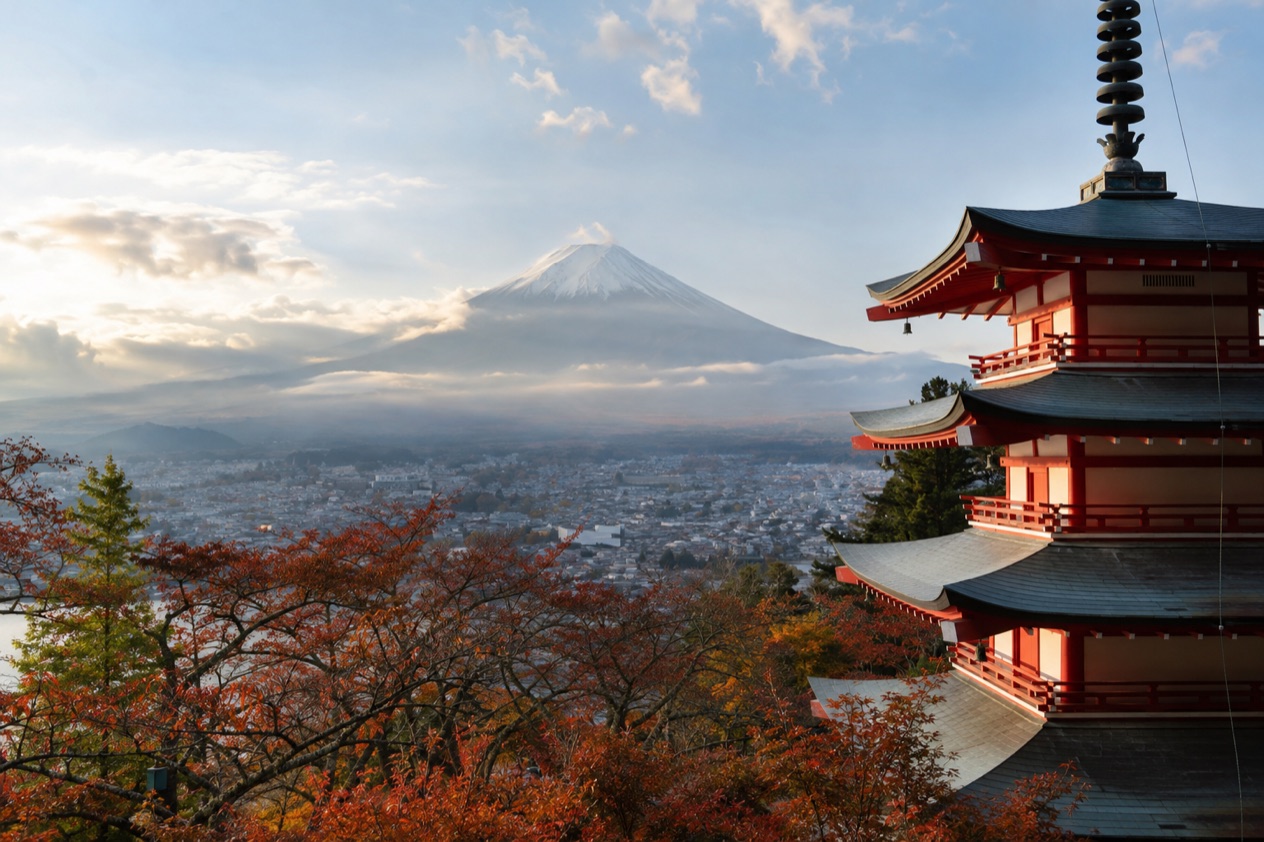
Somewhere in the middle of the trip you are sitting on a tatami floor in a Hakone inn in a borrowed yukata, with your shoes lined up by the entrance and your slippers left at the edge of the mats. The next morning brings a ropeway, a lake cruise and perhaps a glimpse of Mount Fuji. This itinerary links four bases, Tokyo, Hakone, Kyoto and Osaka, with few hotel changes and room to rest between sights, for travelers who prefer a measured pace.
Is 10 Days enough for Japan?
Yes, for a first visit it is enough to see the capital, a hot-spring mountain town and the old cities of Kansai, as long as you accept leaving the rest for another trip. The route here is built around four bases and only three moves between them, which means you unpack rarely and spend your energy on the places themselves rather than on luggage.
Tokyo comes first because it is the capital and, in the words of the Japan National Tourism Organization, the most populous metropolitan area in the world. It sits on Tokyo Bay in the Kanto region, on Honshu.
After the city comes Hakone, in the western part of Kanagawa Prefecture, inside the Fuji-Hakone-Izu National Park and known for its hot springs and its views of Mount Fuji. Then the Kansai region takes over: Kyoto, with Nara as an outing, and Osaka for the final nights.
What the route leaves out is as clear as what it keeps. Hiroshima, with its Peace Memorial Park, the Atomic Bomb Dome (which can only be viewed from the outside) and the floating shrine of Itsukushima on Miyajima Island, deserves its own stay rather than a rushed afternoon. Kanazawa, on the Sea of Japan side of Honshu, with its Edo-period arts and the illuminated Kenrokuen Garden, makes a good second trip, and so do Hokkaido, Kyushu and Okinawa.
Seen this way, the trip is a sampler with a logic. Tokyo shows the present, Hakone the habit of soaking and resting, Kyoto the long history of a city that was the emperor’s residence for over a thousand years, and Osaka a relaxed, food-loving finish.
A traveler who prefers a slower pace can drop a stop without breaking the logic. Cutting Hakone leaves more evenings in Kyoto, and cutting Osaka as a separate base lets you sleep in Kyoto until the end. The sections below on moving between stops and on adapting the route show how each version holds together.
The itinerary stage by stage
Days 1 to 3: Tokyo
Arrive, settle in and keep the first day light. Ginza, an upscale downtown area of high-end restaurants and luxury shops, is a good place for a first stroll and a first dinner, since the streets are lined with places to sit. Plan on sleeping in a central district so that each outing starts from the same familiar station.
On the second day, turn to Roppongi and Akasaka, two Tokyo districts reached from Shibuya Station by a train ride that the Japan National Tourism Organization puts at about ten minutes. In Nihonbashi, next to Ginza, you can finish the day with department-store food halls and a slow dinner.
Tokyo is served by several operators, among them Japan Railways (JR), Tokyo Metro and Toei Subway, and the third day is a good one to get used to them. Leave it open for whatever the first two days made you want more of. Tokyo also lists barrier-free routes in areas such as Shinjuku, Tsukiji and Ueno, which are worth consulting if stairs are a worry.
Days 4 and 5: Hakone
Hakone is the trip’s pause. Spend two nights in a ryokan or hot-spring hotel, where the habits of the place set the rhythm: shoes come off at the entrance, slippers are left off the tatami mats, and a separate pair is often set aside for the bathroom. The first evening is for the baths and the dinner served at the inn.
The Hakone Freepass covers eight kinds of transport in the area, including the Hakone Tozan Train, the Hakone Ropeway and the Hakone Sightseeing Cruise. That makes the second day a chain of rides rather than a series of transfers, with views of Mount Fuji on the days it shows itself. Hakone-Yumoto is known for its many restaurants and gift shops, and it suits a lunch or a last browse for souvenirs.
Hakone has no set order, so you can stop early or go slowly. The move on to Kyoto is made by rail, in the Kansai direction, and the next morning is best kept free of other plans.
Days 6 to 8: Kyoto and Nara
Kyoto Station is served by the Tokaido Shinkansen, and the station building itself houses a full floor of ramen restaurants, an Isetan department store, a theater and a Granvia hotel. That makes it a practical place to arrive, eat and find a taxi or bus before heading to your lodging. Kyoto’s cultural heritage has developed over 1,200 years, and its traditions include machiya townhouses, the Gion Matsuri festival and the hanamachi districts where geishas live and work.
Nijo Castle was built in 1603 by Tokugawa Ieyasu, the first shogun of the Edo period, and it is the clearest window onto the era when power sat in Edo while the emperor stayed in Kyoto. Leave the afternoon open for a machiya-lined street, a tea break and an early dinner.
Spend the second day in Nara, which lies east of Osaka and south of Kyoto and can be reached by train from both. The city has two main stations, JR Nara and Kintetsu Nara.
Nara Park sits at the foot of Mount Wakakusa and is home to tame deer that visitors can approach and feed with crackers sold along the roadside. Return to Kyoto for the evening, and keep the last day as a slow morning and a final dinner.
Days 9 and 10: Osaka
Osaka is described as a charming, relaxed city known for its food, entertainment and nightlife, with some history and culture to discover. Dotonbori and Shinsaibashi are the districts to spend your first evening in, reached from Osaka or Umeda Station on the Midosuji Line to Shinsaibashi Station. Come hungry, because eating is the point.
Use the last day to see the Osaka Bay area, which is reached from Osaka or Umeda stations by the JR Loop Line and the Chuo subway line. Osaka Bay is part of a major port city in the Kansai region. Kansai International Airport and Osaka International Airport (Itami) are both in Osaka Prefecture, which makes this a convenient place to end the trip.
Getting between stops
| Leg | How | Time |
|---|---|---|
| Tokyo to Shin-Osaka | Tokaido-Sanyo shinkansen | About 2 hours 30 minutes |
| Tokyo to Kanazawa (alternative) | Hokuriku Shinkansen | Around 2 hours 30 minutes |
| Shibuya Station to Roppongi and Akasaka | Train | About 10 minutes |
| Kansai International or Itami airport to Nara | Bus and train | About 1 hour 15 minutes |
The three big moves of this itinerary, Tokyo to Hakone, Hakone to Kyoto and Kyoto to Osaka, are all made by rail. Kyoto Station is on the Tokaido Shinkansen, and the Tokaido-Sanyo shinkansen links Tokyo with Shin-Osaka, so the long leg across the country is the one with a published travel time.
Rail in Japan comes in layers. Local trains stop at every station and suit short distances, rapid trains skip smaller stations and carry no supplement, and express trains serve fewer stops and may add a supplement. Trains in general are known for being on time, which lets travelers plan to the minute, and the shinkansen and regional trains share that reputation.
It works on trains, buses and boats, and also in vending machines, convenience stores and some taxis. Regional cards carry different names and characters, yet they can be used throughout Japan, so a card bought in Tokyo still works in Kyoto and Osaka.
Osaka and Tokyo both have several rail operators. Tokyo has JR, Tokyo Metro and Toei Subway, and Osaka has JR, Hankyu Railway, Hanshin Electric Railway and Keihan Railway. A line map that shows which company runs which line helps when a route crosses between them.
Driving is described differently by the U.S. State Department. Traffic moves on the left, road signs are hard to understand without Japanese, highway tolls can be very high and city traffic is often congested. There is virtually no legal roadside parking. This itinerary works without a car, and the places it names are all linked by the rail and bus networks.
What to book before your 10 Days in Japan
The one pass that shapes a day on this route is the Hakone Freepass, which offers unlimited rides on eight kinds of transport in Hakone, among them the Hakone Tozan Train, the Hakone Ropeway and the Hakone Sightseeing Cruise. A version called the Hako Ticket Plus pairs the digital pass with unlimited use of applicable art museums, hot springs and activity facilities, and it is valid for two days or three days.
An IC card is the other item to settle early. It is sold with a deposit, and it covers the trains, buses, boats, vending machines and convenience stores you will meet from Tokyo to Osaka. Choose it before arrival if you can, so the first ride from the airport needs no ticket machine.
Lodging is the third piece. Hakone is the one stop where the type of lodging matters, since a ryokan means tatami rooms, slippers and shoe habits rather than a standard hotel room. For the other stops, a location close to a station keeps each outing simple. Kyoto Station has its own hotel, the Granvia, in the same building as its restaurants and department store.
Adapting the route
A shorter version drops Hakone and gives those nights to Kyoto, which leaves Tokyo, Kyoto with Nara, and Osaka. A longer version adds Kanazawa after Tokyo, since the Hokuriku Shinkansen reaches it from the capital in around two and a half hours. Hiroshima fits best as a separate trip, with its peace sites and Miyajima.
The season changes the feel of each stop. In Tokyo, October brings highs in the low 70s and about ten days with rain, so a light jacket and an umbrella both earn their place.
In April, highs reach the upper 60s, and in July they reach the mid-80s with humidity around three quarters, so a slower day with more indoor stops suits that month.
For a slower trip, keep the same four bases but cut the day plans in half. Choose one sight and one meal per day, and use the evenings for a bath or a walk near your lodging.
Accessible tourism information is available online for Tokyo, and many major destinations have English websites with accessibility details and lodging and restaurant information. Some sites rent wheelchairs, certain hotels offer bathing assistance, and a service that rates station accessibility covers stations across Japan.
Families can keep the same route and lean on the places with animals and food. The deer of Nara Park and the street food of Dotonbori need no explanation for children, while Hakone’s ropeway and cruise turn a day of transport into an outing.
Good to know before you go
Electricity in Japan is 100 volts, so check that your chargers can handle it, and the time zone is Japan Standard Time, nine hours ahead of UTC. Smoking while walking in the street is prohibited and can bring a fine, so smokers should look for a designated outdoor area. In ryokan and homes, shoes come off at the door and slippers come off again on tatami.
| Fee | Amount | Who pays |
|---|---|---|
| IC card deposit | 500 yen | Most IC card buyers, at purchase |
Sources
- U.S. Department of State, Japan travel information, travel and transportation (https://travel.state.gov/content/travel/en/international-travel/International-Travel-Country-Information-Pages/Japan.html), checked October 11, 2026
- Japan National Tourism Organization, trains and buses (https://www.japan.travel/en/guide/how-to-travel-by-train-and-bus-in-japan/), checked October 11, 2026
- Japan National Tourism Organization, traveling by rail (https://www.japan.travel/en/guide/traveling-by-rail/), checked October 11, 2026
- Japan National Tourism Organization, manners, etiquette, shoes, bowing, chopsticks, public behavior (https://www.japan.travel/en/guide/understanding-and-mastering-japanese-manners-and-etiquette/), checked October 11, 2026
- Japan National Tourism Organization, getting around Japan: trains, subways, buses, taxis (https://www.japan.travel/en/plan/getting-around/), checked October 11, 2026
- Japan National Tourism Organization, IC cards, Suica, Pasmo, ICOCA, how to use (https://www.japan.travel/en/plan/ic-card/), checked October 11, 2026
- Japan National Tourism Organization, Tokyo (https://www.japan.travel/en/destinations/kanto/tokyo/), checked October 11, 2026
- Japan National Tourism Organization, Kyoto (https://www.japan.travel/en/destinations/kansai/kyoto/), checked October 11, 2026
- Japan National Tourism Organization, Osaka (https://www.japan.travel/en/destinations/kansai/osaka/), checked October 11, 2026
- Japan National Tourism Organization, Hiroshima (https://www.japan.travel/en/destinations/chugoku/hiroshima/), checked October 11, 2026
- Visit Hiroshima, the official guide (https://visithiroshima.net/), checked October 11, 2026
- Japan National Tourism Organization, Nara (https://www.japan.travel/en/destinations/kansai/nara/), checked October 11, 2026
- Japan National Tourism Organization, Hakone (https://www.japan.travel/en/destinations/kanto/kanagawa/hakone-and-around/), checked October 11, 2026
- Hakone Tourist Information (https://www.hakonenavi.jp/international/en/), checked October 11, 2026
- Japan National Tourism Organization, Kanazawa (https://www.japan.travel/en/destinations/hokuriku-shinetsu/ishikawa/kanazawa-and-around/), checked October 11, 2026
- Kanazawa Tourist Information Guide (https://www.kanazawa-tourism.com/), checked October 11, 2026
- Wikipedia, Kanazawa, Ishikawa (https://en.wikipedia.org/wiki/Kanazawa,_Ishikawa), checked October 11, 2026
- Japan National Tourism Organization, accessibility in transport, hotels, sites (https://www.japan.travel/en/guide/accessibility-in-japan/), checked October 11, 2026
- Japan National Tourism Organization, accessible travel (https://www.japan.travel/en/plan/traveling-with-disability/), checked October 11, 2026
- Wikivoyage, Japan (https://en.wikivoyage.org/wiki/Japan), checked October 11, 2026
- Japan Meteorological Agency (JMA), Normal values 1991-2020, monthly (https://www.data.jma.go.jp/stats/etrn/view/nml_sfc_ym.php?prec_no=44&block_no=47662), station Tokyo, elevation 25 m, checked October 11, 2026
To plan your stay
- Best Time to Visit Japan: Cherry Blossoms, Autumn Colors, Weather and Festivals
- Where to Stay in Japan: Ryokan, Temple Stays, Capsule Hotels and the Best Cities to Base In
- Sending Luggage from the Airport in Japan: Hands-Free Travel, Hotel Delivery and Coin Lockers
- Know Before You Go to Japan: Entry, Money, Etiquette and Getting Around