
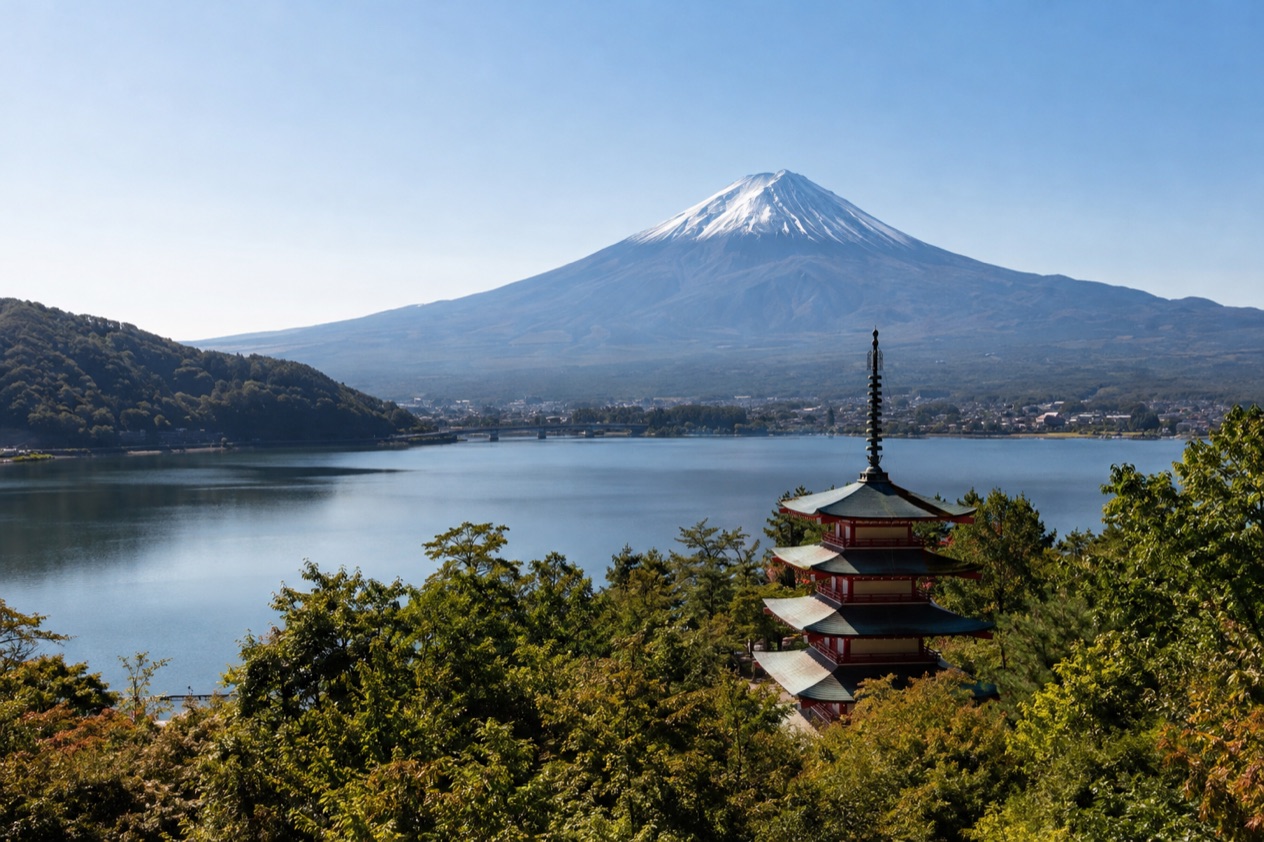
Steam rises from a bowl of ramen on a counter, a bell sounds somewhere behind a temple wall, and the neon of an Osaka canal throws colored streaks across the water. Japan moves between these scenes all the time: wooden shrines and glass towers, quiet gardens and loud food streets, mountain trails and hot spring baths. It suits travelers who like to eat well, wander without a strict plan and let each region show its own character.
What are the best things to do in Japan?
The best things to do in Japan are the ones that tie a place to a taste or a ritual: a temple walk in Kyoto, a night of eating in Osaka, a soak in an onsen, a shrine standing in the water at Miyajima. Here are the essentials, each one developed further on.
- Walk through Kyoto, where machiya townhouses, the hanamachi districts and the Gion Matsuri festival keep a long cultural tradition visible.
- Eat your way through Dotonbori and Shinsaibashi in Osaka, a city known for its food, entertainment and nightlife.
- Soak in an onsen, the natural hot springs that Japan has built whole bathing cultures around.
- Stay a night in a ryokan, sleeping on a futon over tatami and eating a Japanese meal that may arrive in your room.
- Stand in Hiroshima’s Peace Memorial Park, then cross to Miyajima for its deer and its floating shrine.
- Spend time in a Japanese garden, where every bend in the path is designed to change what you see.
- Go north to Hokkaido for outdoor activities and dishes such as Genghis Khan lamb and salmon stew.
- Look at the water at Okinawa Churaumi Aquarium, one of the island’s big draws on Okinawa’s main island.
These choices cover most of what Japan does best: history you can walk through, food that changes with every region, and nature that people have learned to enjoy slowly. You do not have to do all of them. Two or three, done unhurriedly, make a better trip than a long checklist.
Pairing helps. Think in pairs of one thing to see and one thing to taste or soak in, and the days fall into place.
Sights and landmarks in Japan
The landmarks of Japan range from the lantern-lit streets of Kyoto to the glass-and-neon avenues of Tokyo, and each city has its own pace. Tokyo is the capital and the most populous metropolitan area in the world, sitting on Tokyo Bay in the Kanto region on Honshu. Kyoto, in Kansai, feels like a different country altogether.
Kyoto: temples, townhouses and festival streets
Kyoto has a cultural heritage that developed over the past 1,200 years, and it shows in the streets. Machiya, the narrow wooden townhouses with latticed fronts, line old lanes, and the hanamachi districts are where geishas live and work. The Gion Matsuri, the city’s great summer festival, grows out of the same neighborhoods.
Kyoto Station is the usual doorway, since the Tokaido Shinkansen stops there. The station building itself holds a floor of ramen restaurants, an Isetan department store, a theater and a Granvia hotel, so a first bowl of noodles can come before you have left the building.
From there you can build days around the temples and gardens you have read about: Kiyomizu-dera on its hillside, the gold pavilion of Kinkaku-ji, the thousands of torii at Fushimi Inari. Plan for walking, and let one district fill a day rather than crossing the city repeatedly.
Hiroshima: Peace Memorial Park and the Atomic Bomb Dome
Hiroshima’s main landmarks are the Peace Memorial Park and the Atomic Bomb Dome, the ruined building left standing beside the river. The park and its museums are a place for reflection, and visitors move through them slowly and in silence.
Each August 6, a ceremony takes place in which thousands of people write peace messages on lanterns. The lanterns are lit at sunset and floated along the river that passes in front of the Dome. Even outside that date, the riverbank carries the same mood of remembrance.
Prefecture-wide, Hiroshima also gives you the Seto Inland Sea, wooded mountains and clear waters, along with shrines and museums beyond the city. After the park, a plate of Hiroshima’s own okonomiyaki, the layered savory pancake, is the traditional way to end the day.
Tokyo and Osaka: two city styles
In Tokyo, Ginza is the upscale downtown area, with high-end restaurants and luxury shops, and it sits beside Nihonbashi, an older commercial district. Wandering here is mostly about shop windows, department store food halls and tiny counters that serve a single dish well.
Osaka is the more relaxed foil. It is a charming city known for its food, entertainment and nightlife, with some history and culture to discover. From Tokyo, the Tokaido-Sanyo shinkansen runs to Shin-Osaka Station in about two and a half hours, which puts the two cities within reach of one trip.
Okinawa Churaumi Aquarium
On Okinawa’s main island, the Churaumi Aquarium is a landmark of a very different kind, built around the sea that surrounds the island. A new female Japanese sawshark has recently arrived there as part of an effort to breed the species, a reminder that the place works as a research center as well as an attraction.
Okinawa’s capital, Naha, is the largest city on the island and home to about 21% of the main island’s residents. It has Okinawa’s only public rail network, the Okinawa Urban Monorail, known as Yui Rail.
| Site | Open |
|---|---|
| Okinawa Churaumi Aquarium | 08:30 to 18:30 (last admission 17:30) |
Outdoor things to do in Japan
Outdoors in Japan means gardens shaped over centuries, forests used for healing, mountain routes with names that hikers pass along, and sand dunes you might not expect. The country has found many ways to enjoy nature slowly.
Japanese gardens
The gardens are designed to look larger than they are. Paths turn suddenly or change in width, and views are layered so that a small plot seems to go on.
Historically, gardens were also settings for cultural events, with guests invited to poetry gatherings and Noh performances. That history explains why many gardens are built to be seen from a veranda or a teahouse. Take your time, stop at the turns, and look back along the way you came, because the garden is arranged to change.
Forest bathing and mountain walks
Forest bathing, or shinrin-yoku, is the practice of spending time in a forest for its therapeutic effect. As a medicinal practice it originated in Japan in the 1980s. Studies in Japan have linked it to better sleep, mood, concentration and lower stress, which is why a slow forest walk with no destination counts as a real activity here.
For harder walking, the Japan National Tourism Organization lists hiking routes that include the Senjojiki Cirque route to Mount Kiso-Komagatake, Mount Ishizuchi, Mount Daisen, Mount Hakkoda, Mount Unzen, Mount Minobu, Mount Asahi, Mount Tsubakuro, the Ozegahara loop from Hatomachi Pass and Mount Tanigawa. Each is a different corner of the country, so a hike can steer a whole trip.
Cycling, dunes and hot springs
Cyclists have named routes to follow, among them the Biwaichi route, cycling routes in Aomori and the Pacific cycling road. These give a reason to travel by bike through regions that visitors see from a train window.
The Tottori Sand Dunes, Japan’s only desert-like area, are a surprise, and visitors can practice stand-up paddle yoga there. In Nagano, Zenkoji Temple offers zazen meditation sessions led by a monk. An onsen, the natural hot spring and its bathing facilities, rounds off an outdoor day, and the water’s composition and benefits vary from region to region.
Hokkaido
Hokkaido is the northernmost prefecture of Japan, and it is where visitors go for nature, outdoor activities and local food. The island divides into Sapporo and its surroundings, Asahikawa and northern Hokkaido, Hakodate and southern Hokkaido, and Kushiro and eastern Hokkaido.
New Chitose Airport near Sapporo is the way in by air, with direct flights from Tokyo taking about 1 hour 30 minutes. With a region this large, choose one or two areas and spend your time there, since the pleasures are the open landscape and the meals that come from it.
Day trips from Japan
Japan’s day trips tend to start from a base city and end at a single place with its own character.
Nara from Kyoto or Osaka
Nara Prefecture is in the Kansai region, and the city of Nara lies east of Osaka and south of Kyoto, reached by train from both. The city has two main stations, JR Nara Station and Kintetsu Nara Station, and you can arrive at either depending on your line.
The city is known for Todai-ji, a temple built around a huge hall that holds a great Buddha statue. The temple grounds and the park around them give the day its shape. It suits travelers who want old Japan without changing hotels, and it fits easily between a morning arrival and an evening back in the larger city.
Nara’s closest airports are Osaka International Airport (Itami) and Kansai International Airport, both in Osaka Prefecture and about one hour and fifteen minutes away by bus and train. That makes Nara a plausible first or last stop of a trip as well as a day out.
Miyajima from Hiroshima
On Miyajima Island in Hiroshima Prefecture, the iconic Itsukushima Shrine has a red torii gate standing in the sea. The island is also known for its deer, and an excursion from Hiroshima city is a classic pairing with the Peace Memorial Park.
Miyajima rewards a slow wander: the shrine’s walkways, the shops selling local sweets and the grilled seafood snacks. Between the shrine, the deer and the water, the island works well for travelers who want a contrast to the sober mood of the city.
Osaka as an add-on to Kyoto or Tokyo
From Tokyo the Tokaido-Sanyo shinkansen reaches Shin-Osaka, which makes Osaka reachable as an outing for a hungry traveler. Once there, the Midosuji Line from Osaka or Umeda Station takes you to Shinsaibashi Station, the stop for both Shinsaibashi and Dotonbori.
A day spent there is mostly about eating and strolling: shopping arcades in Shinsaibashi, then the canal-side lights of Dotonbori for takoyaki and okonomiyaki. It suits people who prefer a lively city to a temple schedule.
Smaller outings
- Zenkoji Temple in Nagano, where a monk leads zazen meditation sessions in a mountain setting.
- The Tottori Sand Dunes, with stand-up paddle yoga on the dunes.
- Kyoto’s hot spring ryokan, for a night of futons, tatami and a Japanese dinner.
- Sapporo and its surroundings in Hokkaido, as a first taste of the island.
What to eat in Japan
Eating in Japan starts with a simple idea: each region has its own specialties and culinary traditions, with unique dishes.
Kaiseki, sushi and ramen
Kaiseki is the formal, multicourse cuisine of Japan, typically served in ryotei, traditional restaurants. The meal moves in small dishes shaped by the season, each arranged with care. For travelers a kaiseki dinner is the most memorable meal of the trip.
At the other end, ramen is a bowl of noodles in a rich broth, eaten fast and hot at a counter. Sushi sits between the two, from conveyor-belt shops to quiet counters where a chef shapes each piece in front of you. Yakitori, skewered chicken grilled over charcoal, is the standard companion to an evening drink.
Western Japan: Nagoya, Gifu and Hiroshima
Western Japan tends to have a milder climate than the east, which affects local seafood and produce. Nagoya cooks often use Hatcho miso, a dark reddish-brown paste with a distinctive flavor, in dishes like miso-nikomi udon, noodles stewed in a pot of miso broth, and miso-katsu, a breaded pork cutlet under a miso sauce.
In Gifu Prefecture, a local dish called Hoba Miso is made by grilling koji miso on magnolia leaves, so the smell of the leaf mixes into the paste. In Hiroshima, the local okonomiyaki is the dish to look for, built in layers on a hot griddle.
Eastern Japan: Hokkaido and Akita
In Hokkaido, salmon swim up rivers every autumn to spawn, which inspired Ishikarinabe, a salmon and vegetable stew, and Chanchanyaki, salmon and vegetables sauteed with a miso-based sauce. Sheep farming on the vast plains led to Genghis Khan, a hearty dish of grilled lamb and vegetables, and many households on the island own a special perforated pot for cooking it.
In Akita, in the Tohoku region, kiritanponabe is a stew of rice cooked in stick shapes and simmered with chicken and vegetables in dashi broth. It has been passed down through generations and is essential for entertaining guests, which gives you a sense of how food ties to hospitality.
Ryokan meals and Osaka street food
Most ryokan serve typical Japanese meals to their guests, sometimes directly in their rooms. That makes a night in a ryokan a food experience as much as a place to sleep, with course after course arriving at your own pace.
Osaka, by contrast, is where you eat standing or squeezed onto a stool. Dotonbori’s food stalls and counters fill with the smell of grilled batter and sauce, and takoyaki, the octopus balls, are the street snack travelers try. Even Kyoto Station gives you a full floor of ramen restaurants if you arrive hungry.
Things to do in Japan at night
Evenings in Japan are for eating, drinking and soaking, and each city has its own version. Osaka is the clearest case, known for its food, entertainment and nightlife, with Dotonbori’s neon reflecting off the canal.
Osaka after dark
Dotonbori and Shinsaibashi are the two districts where the evening gathers. From Osaka or Umeda Station, the Midosuji Line runs to Shinsaibashi Station, and the arcades and the canal-side promenade are close together from there. The lights, the signs and the steam from the grills give the area its character.
A night here is a loose crawl: a few skewers at one counter, takoyaki at another, then a drink somewhere with a view of the canal. It suits travelers who prefer to follow their noses and appetite rather than a reservation.
Tokyo evenings and the izakaya
In Tokyo, Ginza is an upscale downtown area with high-end restaurants and luxury shops, so evenings there lean toward a polished dinner. For something more casual, an izakaya, a Japanese pub serving small plates with drinks, is the natural place to end the day, often with yakitori and beer.
A bowl of ramen late at night is something of a tradition too, a salty, warm finish after a few drinks. Kyoto Station’s ramen floor offers the same option for travelers coming in on a late train.
Quiet evenings: onsen and ryokan
If you want to slow down, evenings are the time for an onsen. Bathing in a hot spring is generally believed to give a significant boost to wellbeing, and most ryokan have public and private natural hot spring baths. The water differs from region to region, so each bath has its own feel.
At a ryokan, the evening often runs on its own rhythm: a bath, a meal sometimes served in your room, and then a futon laid out on the tatami floor. It is among the most memorable ways to end a day in Japan, and it asks nothing of you except to stay put.
Lanterns on the river
On August 6 in Hiroshima, lanterns carrying peace messages are lit at sunset and floated along the river in front of the Atomic Bomb Dome. It is a solemn evening, and one of the most affecting scenes in the country.
Things to do in Japan with kids
Children in Japan tend to remember animals, water and food, and the country offers all three. The best days mix a big sight with something hands-on, and a few well-chosen stops are better than a packed schedule.
Animals and the aquarium
Okinawa Churaumi Aquarium, on the main island, is the obvious pick for a day built around the sea. Its tanks are the main draw, and the sawshark breeding effort gives the place a research angle. Look at its opening hours before you plan the day, since the last admission comes an hour before closing.
On Miyajima Island, the deer are the star, and the red torii gate standing in the sea makes a good photograph. Children usually find this combination of animals, boats and shrines a lively break from a city itinerary.
Food they can follow
Food can be an adventure for kids. Watching a cook flip okonomiyaki on a griddle, or choosing a plate from a sushi conveyor belt, makes a meal into an event. Ramen counters and the floor of ramen restaurants at Kyoto Station put noodles within reach.
In Hokkaido, the Genghis Khan grilled lamb is cooked in a special perforated pot, which can be fun to watch. In Osaka’s Dotonbori, takoyaki stalls turn the batter balls by hand, which many children enjoy watching.
Slow days and distances
Japan rewards a slow pace, and children usually do better with one main outing a day. Trains connect the main cities, the Tokaido Shinkansen links Kyoto with other major cities, and the Okinawa Urban Monorail runs in Naha. Build in rest time, because long days of walking add up.
A night in a ryokan, with its futons on the tatami and a meal brought to the room, can be a highlight for a family. The hot spring baths are a part of the stay, and the rest of the evening is for sleeping on the floor, which many children find fun.
Good to know before you go
Getting around Japan is mostly by train between cities. The Tokaido Shinkansen serves Kyoto Station, and the Tokaido-Sanyo shinkansen links Tokyo with Shin-Osaka. Within cities, lines such as Osaka’s Midosuji Line and Naha’s Yui Rail carry you to the districts you came for. For Hokkaido, fly into New Chitose Airport near Sapporo.
Regions differ in character, so it pays to pick a few and give each time, rather than touching every corner. Food, gardens, hot springs and temples all reward a slower trip.
Sources
- Japan National Tourism Organization, Japanese gastronomy (https://www.japan.travel/en/gastronomy/), checked October 11, 2026
- Japan National Tourism Organization, eastern Japan cuisine (https://www.japan.travel/en/gastronomy/local-cuisine-eastern-japan/), checked October 11, 2026
- Japan National Tourism Organization, western Japan cuisine (https://www.japan.travel/en/gastronomy/local-cuisine-western-japan/), checked October 11, 2026
- Japan National Tourism Organization, cultural experiences (https://www.japan.travel/en/guide/cultural-experiences/), checked October 11, 2026
- Japan National Tourism Organization, forest bathing (https://www.japan.travel/en/guide/forest-bathing/), checked October 11, 2026
- Japan National Tourism Organization, wellness and onsen (https://www.japan.travel/en/guide/wellness-travel-in-japan/), checked October 11, 2026
- Japan National Tourism Organization, Japanese gardens (https://www.japan.travel/en/see-and-do/japanese-garden/), checked October 11, 2026
- Japan National Tourism Organization, onsen: what it is, etiquette, famous areas (https://www.japan.travel/en/see-and-do/onsen/), checked October 11, 2026
- Japan National Tourism Organization, adventure sports (https://www.japan.travel/en/sports/adventure/), checked October 11, 2026
- Japan National Tourism Organization, Tokyo (https://www.japan.travel/en/destinations/kanto/tokyo/), checked October 11, 2026
- Japan National Tourism Organization, Kyoto (https://www.japan.travel/en/destinations/kansai/kyoto/), checked October 11, 2026
- Japan National Tourism Organization, Osaka (https://www.japan.travel/en/destinations/kansai/osaka/), checked October 11, 2026
- Japan National Tourism Organization, Hokkaido (https://www.japan.travel/en/destinations/hokkaido/hokkaido/), checked October 11, 2026
- Japan National Tourism Organization, Okinawa (https://www.japan.travel/en/destinations/okinawa/okinawa/naha-and-the-main-island/), checked October 11, 2026
- Okinawa Churaumi Aquarium (https://churaumi.okinawa/en/), checked October 11, 2026
- Japan National Tourism Organization, Hiroshima (https://www.japan.travel/en/destinations/chugoku/hiroshima/), checked October 11, 2026
- Japan National Tourism Organization, Nara (https://www.japan.travel/en/destinations/kansai/nara/), checked October 11, 2026
To plan your stay
- Best Time to Visit Japan: Cherry Blossoms, Autumn Colors, Weather and Festivals
- Where to Stay in Japan: Ryokan, Temple Stays, Capsule Hotels and the Best Cities to Base In
- Sending Luggage from the Airport in Japan: Hands-Free Travel, Hotel Delivery and Coin Lockers
- Know Before You Go to Japan: Entry, Money, Etiquette and Getting Around