
A bowl of noodles lands on the counter, steam rises, and the man beside you leans in and slurps without a hint of embarrassment. Down the street, charcoal smoke drifts from a grill where skewers turn, and a market stall hands over a bowl of rice heaped with raw seafood. Eating is one of the main reasons to travel across Japan, and each region, each season and each kind of restaurant has its own table to offer.
What is Japanese food?
Japanese food is a collection of regional cooking traditions, from sushi and wagyu beef to the multicourse meals of kaiseki and the street food of yakitori and ramen, all tied together by habits at the table. Each region has its own specialties, and the same country that serves refined dishes in a formal dining room also grills skewers over charcoal on a side street.
The tradition is recognized well beyond Japan. On December 4, 2013, washoku, the traditional dietary culture of the Japanese, notably for the celebration of New Year, was added to UNESCO’s Intangible Cultural Heritage list. The listing points to something visitors notice quickly: food here is tied to seasons, to occasions and to the place where it is made.
Kaiseki and the ryotei
Kaiseki is the cuisine of the formal, slow-paced meal, and it is typically served in a ryotei, a traditional Japanese restaurant. Dishes arrive in sequence, each small and carefully composed, and what ends up on the plate follows the season and the region.
Inside, the setting matters as much as the plate. In a traditional room with tatami floors, shoes or any type of footwear are always taken off, and the formal way to sit is seiza, kneeling with the legs folded under the thighs and the buttocks resting on the heels. It suits an evening you want to last, with sake from a local brewery in the glass.
Markets and street stalls
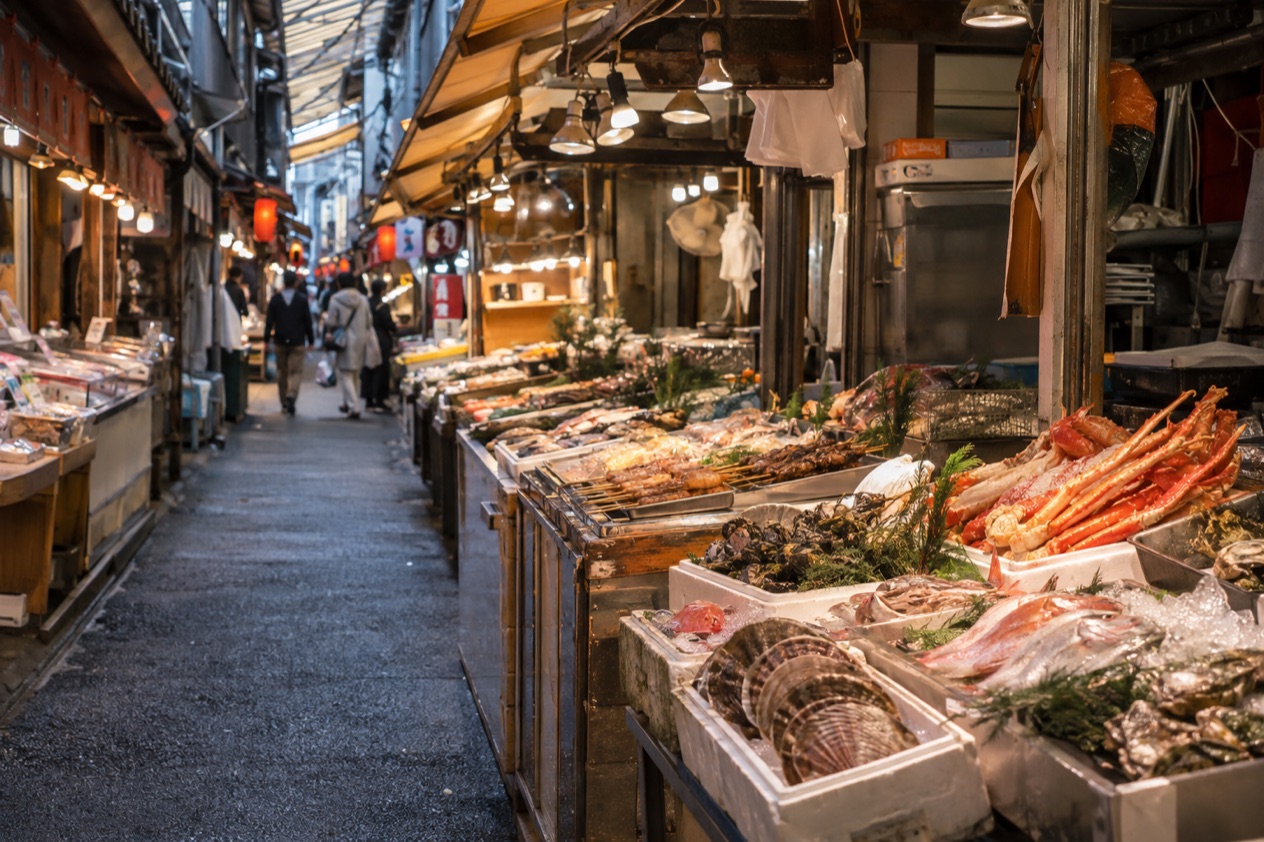
At the other end of the spectrum are the markets and stalls. Typical markets include Kuromon Market, Nishiki Market, Miyagawa Morning Market, Omicho Market, Tsukiji Market and Toyosu Market, each a place to graze on seafood, pickles and snacks while the sellers call out around you.
In Fukuoka the yatai, open-air food stalls, put dinner on the street. Cities such as Utsunomiya, Kobe, Otaru, Sapporo, Nagasaki, Kyoto, Matsusaka and Kitakata are all known for good food, so a day in any of them can be planned around meals. Budget restaurants and street food are part of the same story as the formal dining rooms, not a lesser one.
Eating by region and by season
Western Japan tends to have a milder climate than the east, which shapes the local seafood and produce in each region. Seasons also set the menu.
Namero, a Chiba specialty of raw horse mackerel chopped and mashed with green onion, white sesame and miso, is best from May to June. Ankonabe, a monkfish stew, is a typical winter dish of Ibaraki. In summer, kakigori, shaved ice flavored with syrup or condensed milk, is usually sold and eaten at festivals.
Trains carry their own food culture too. Ekiben, the traditional station boxed meals, let you taste a region from your seat. And for something quieter, the tea ceremony is a culinary-related cultural activity that pairs a bowl of tea with a ritual of its own.
Which dishes should you try?
Start with the dish that belongs to the place you are standing in, because Japan’s best-loved plates are mostly local: gyoza in Utsunomiya, okonomiyaki in Osaka, grilled beef tongue in Sendai, seared bonito in Kochi. The list below runs from noodles to beef to stews, grouped by what arrives in front of you.
Noodles: soba, udon and ramen
Soba, the buckwheat noodle, is the specialty of the mountainous region made up of Niigata and Nagano prefectures, northwest of Tokyo, and in November visitors flock there for freshly made soba and buckwheat dishes. Fukui Prefecture is famous for Echizen Oroshi Soba, served topped with grated daikon radish, which gives the cold noodles a sharp, clean bite.
Udon is the thick wheat noodle, and Kagawa Prefecture is nicknamed the udon prefecture because its residents eat so much of it. In Yamanashi, the prefecture of Mount Fuji, houtou turns udon into a hearty stew cooked in miso soup with squash and other vegetables.
Nagoya cooks its miso-nikomi udon with Hatcho miso, a dark reddish-brown paste with a distinctive flavor. Ramen sits among the street foods the national tourism organization names, a bowl to find in whichever city you land.
Beef, eel and seafood
Kobe beef from Hyogo Prefecture and Matsusaka beef from Mie Prefecture are world-renowned, and wagyu is shipped under area names such as Yonezawa, Omi and Sanda as well. In Sendai, gyutan is beef tongue grilled over hot charcoal, a dish that began there and then spread across the country.
Lake Hamana in Hamamatsu is famous as the birthplace of eel farming, and some restaurants nearby have served eel for over a century. At Omicho Market in Kanazawa, kaisendon is a bowl of rice topped with fresh seafood. Along the Sea of Japan coast, Tottori crab draws visitors in winter, when it is abundant. In Kochi, bonito is eaten daily, and the most famous version is katsuo-no-tataki, the seared bonito.
Fugu, the pufferfish, belongs on the list for the curious. Licensed fugu chefs are assessed stringently every year by the government to make sure their preparation skills are up to standard.
Griddles, dumplings and stews
Osaka is known for okonomiyaki, a savory pancake of cabbage and meat cooked on a griddle, and for takoyaki, dough balls with octopus inside. In Tokyo’s old downtown, monjayaki began as a working-class favorite: a savory mix of flour, sauce and dashi broth that diners cook themselves on a hotplate at the table, eating it with a small metal spatula.
In Utsunomiya, the gyoza capital, competition among restaurants is fierce, so the idea is to try several and pick a favorite. Hokkaido’s autumn salmon run inspires Ishikarinabe, a salmon and vegetable stew, and Chanchanyaki, salmon and vegetables sauteed in a miso-based sauce. The island’s Genghis Khan is grilled lamb and vegetables, and many households own a special perforated pot for it.
Akita has kiritanponabe, rice cooked in stick shapes and simmered with chicken and vegetables in dashi, a dish essential for entertaining guests. Kyoto’s obanzai are home-style simmered and marinated dishes built on local vegetables such as kujo leeks, kamo eggplants, manganji peppers and shogoin radishes.
In Tokyo’s Fukagawa area, fukagawadon puts asari clams cooked in soy sauce and sugar over steaming rice, a dish inherited from a former fishing community. In Gifu, hoba miso is koji miso grilled on magnolia leaves.
How do you order?
You order the way the room invites you to, and the habits around the meal matter more than any script: say a word before you eat, say another when you leave, and match your pace to the place. Meals also follow a rhythm of the day.
| Meal | Typical hours |
|---|---|
| Breakfast | 06:00 to 09:00 |
| Lunch | 12:00 to 14:00 |
| Dinner | 18:00 to 20:00 |
Words and manners at the table
It is customary to say itadakimasu before starting to eat. After the meal, the customary phrase is gochisosama deshita, said to the host and to the restaurant staff when leaving. Short as they are, these two phrases mark the start and the end of a meal everywhere from a ryotei to a counter.
With noodles, the tradition is to bring the bowl close to the mouth and suck in the noodles with chopsticks. The loud slurping noise is considered normal in Japan, so there is no need to eat quietly. Shoes come off before stepping onto tatami, and in a traditional room you sit as the room expects.
Noodle shops, vegetarians and special requests
Vegans and vegetarians can expect a feast of refined dishes in Japan, and a kaiseki meal in particular shows how much can be done with vegetables. At a noodle shop, though, the choice narrows. The only vegetarian-safe item on the menu is typically zarusoba, plain cold noodles, and its dipping sauce usually contains dashi.
That small detail is worth knowing before you sit down, because dashi, the fish-based broth, runs through the cuisine. The same applies to Christmas: for Kentucky Fried Chicken in Japan during the season, you must preorder several weeks in advance or wait in line for hours, a seasonal habit that surprises many visitors.
Izakaya, sake and shochu
Evenings often belong to the izakaya, the pub where small dishes arrive one after another. In Tohoku, many izakaya offer sake pairings with local specialties, as some of Japan’s best sake is made from rice grown there. By legal definition, sake uses just four ingredients: special rice, water, koji and special yeast.
Shochu, a distilled spirit, is produced everywhere in Japan, although its production started in Kyushu. Pour for your neighbor, sip slowly, and let the local bottle guide the order of the small plates that follow.
Good to know before you go
Pace your days around the meal hours, and let the season decide what to eat: autumn salmon in Hokkaido, new soba in November, crab and monkfish in winter, horse mackerel in late spring. A regional specialty is usually best eaten where it is made, and a market morning in Kanazawa, Kyoto or Osaka gives you a first taste of a city before the main meal. Say itadakimasu, slurp your noodles, and leave with gochisosama deshita.
Sources
- Japan National Tourism Organization, Japanese gastronomy (https://www.japan.travel/en/gastronomy/), checked October 11, 2026
- Japan National Tourism Organization, eastern Japan cuisine (https://www.japan.travel/en/gastronomy/local-cuisine-eastern-japan/), checked October 11, 2026
- Japan National Tourism Organization, western Japan cuisine (https://www.japan.travel/en/gastronomy/local-cuisine-western-japan/), checked October 11, 2026
- Wikipedia, Japanese cuisine (https://en.wikipedia.org/wiki/Japanese_cuisine), checked October 11, 2026
- Wikivoyage, Japanese cuisine (https://en.wikivoyage.org/wiki/Japanese_cuisine), checked October 11, 2026
To plan your stay
- Best Time to Visit Japan: Cherry Blossoms, Autumn Colors, Weather and Festivals
- Where to Stay in Japan: Ryokan, Temple Stays, Capsule Hotels and the Best Cities to Base In
- Sending Luggage from the Airport in Japan: Hands-Free Travel, Hotel Delivery and Coin Lockers
- Know Before You Go to Japan: Entry, Money, Etiquette and Getting Around