
At the Talkeetna depot, among the hikers and flightseers waiting on the platform, you sometimes spot someone with a duffel bag and a sack of groceries who is not headed to a hotel at all. They are going home to a cabin the road never reached. The Hurricane Turn is the Alaska Railroad train that serves that backcountry stretch, a flagstop ride from Talkeetna to Hurricane in summer and a monthly run from Anchorage in winter.
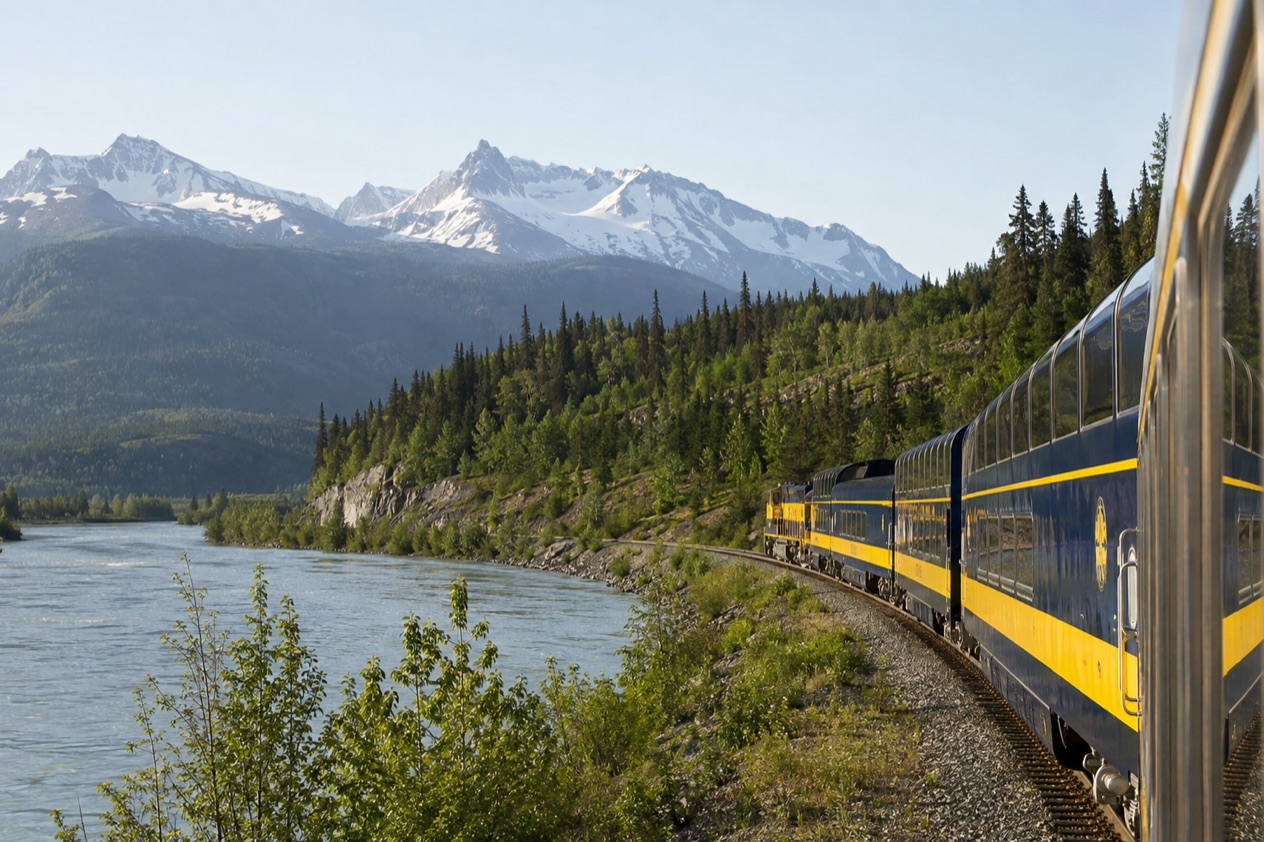
What is the Hurricane Turn train?
The Hurricane Turn is a Alaska Railroad train that runs a backcountry route out of Talkeetna and lets passengers get on or off anywhere along the way, which is what makes it unlike the railroad’s other trains. Most trains in Alaska stop at depots. This one also stops in the woods, wherever someone is standing beside the tracks, because for the people who live out there it works as a bus, a delivery route and a lifeline in one.
The name has nothing to do with storms. It comes from Hurricane, the far end of the route, and the word “turn” describes the out-and-back shape of the trip. The railroad runs a summer version and a winter version, and the two are quite different in route, rhythm and feel.
| Season | From | To | Days | Dates |
|---|---|---|---|---|
| Summer | Talkeetna | Hurricane | Thursday through Monday | May 13 to September 12, 2027 |
| Winter | Anchorage | Hurricane | First Thursday of each month | October to May |
The summer train
The summer train is the one visitors ride. It leaves Talkeetna and heads into country with no road, following the tracks through spruce and birch forest and across the river valleys of this part of Southcentral Alaska. You are riding through the everyday landscape of people who live here, not a showpiece route built for sightseeing, and that gives the trip a different mood from the big tourist trains.
Talkeetna makes a natural starting point. It is the small town that serves as the base for expeditions to Denali, with a historic district of buildings from the early 1900s, and a depot that is a stop for several of the railroad’s trains. Many riders plan a night or two in town around the trip, since flightseeing, rafting and salmon fishing are what bring people here each summer.
The winter train
In winter the Hurricane Turn changes character. It starts in Anchorage, calls at Wasilla and Talkeetna, and then continues on the backcountry route to Hurricane. It runs on the first Thursday of each month from October to May, so it is a monthly event rather than a regular service, and the whole calendar of the cabin communities seems to bend around it.
The winter flagstop area lies south of Hurricane Gulch. Residents of remote cabins there can flag the train down for the return ride south. The winter picture, then, is mostly about neighbors using the railroad to get to town and back, with a few travelers along for the ride.
Where does it go?
Along the way it passes a string of named stops that are more place names than villages, some with only a handful of cabins and some with almost nothing visible from the window.
Summer: Talkeetna to Hurricane
The summer route names six stops between Talkeetna and Hurricane: Chase, Curry, Sherman, Gold Creek, Twin Bridges and Chulitna. Some of these names go back to the railroad’s construction days, when camps and sidings sprang up along the line. Gold Creek in particular carries a bit of that frontier history in its name.
Because of the flagstop service, you are not limited to those names. Passengers can get on or off anywhere along the backcountry route between Talkeetna and Hurricane. For a traveler, that means the map of the trip is looser than a normal timetable suggests. The listed stops are landmarks, and the real stops are wherever riders choose to go.
Winter: Anchorage to Hurricane
The winter run adds the start of the line. After leaving Anchorage, the train stops at Wasilla and Talkeetna, then continues to the same backcountry stops: Chase, Curry, Sherman, Gold Creek, Twin Bridges and Chulitna, ending at Hurricane. Talkeetna is therefore a middle stop in winter rather than the starting point.
Anchorage and Talkeetna are about a 2 hour drive apart, which is useful to know if you are weighing how the monthly winter train fits around the rest of a trip. Winter is also when the Oosik Classic Ski Race brings Talkeetna a burst of activity every March, though that event has no connection to the train schedule.
The stops at a glance
- Chase, Curry and Sherman, the first named stops after Talkeetna on the route.
- Gold Creek, a name that recalls the gold-rush era in Alaska.
- Twin Bridges and Chulitna, the stops near the far end of the line.
- Hurricane, where the route ends and the train turns around.
Whichever season you ride, the point of the trip is the ride itself. There is no famous attraction at the end of the line to check off. What you take home is a long look at forest, river and the occasional cabin from a window, in a part of Alaska that most road travelers never see.
What should you know before you ride?
The main things to know are that you bring your own food, that the summer train runs only some days of the week, and that the winter train is a once-a-month affair. Everything else is a matter of understanding that this train works for the people who live along it first and for visitors second.
Food and what is onboard
No food or beverage services are available for purchase onboard the summer Hurricane Turn Train, so passengers should bring their own. In Talkeetna, that is an easy errand before departure, since the town has a compact center of cafés, a general store and small shops within a few blocks of the depot.
The summer train offers Adventure Class only, with non-smoking cars and wheelchair access. There is no tiered service to choose between, which keeps the ride simple. The other Alaska Railroad trains have their own classes and fares, but the Hurricane Turn is a single-class trip.
Days and seasons
The summer train operates Thursday through Monday from mid-May to mid-September, and in 2027 the dates are May 13 to September 12. That leaves Tuesday and Wednesday without service, so a day-of-the-week check belongs in any plan that includes the ride. The season dates stated for 2027 apply only to that year.
From October to May, the train is limited to the first Thursday of each month. A traveler who comes outside the summer season has one chance a month, and the winter route starts in Anchorage rather than Talkeetna, so the logistics are different from the summer ride.
Riding a train that belongs to the neighbors
Part of the appeal is the human texture. You may share the car with residents carrying supplies, and the pace of the trip follows their needs. A flagstop train is not a tour, and the crew is not performing for an audience. Treat it with the same courtesy you would a local bus in a small town.
Flagstop service also means the trip does not fit into a rigid sightseeing frame. You can get off along the backcountry route, and the train carries on without you. That freedom is the thing that sets the Hurricane Turn apart from the railroad’s longer scenic routes, such as the Denali Star between Anchorage and Fairbanks or the Coastal Classic to Seward.
How it differs from the railroad’s other trains
The Denali Star stops at Talkeetna on its way between Anchorage and Fairbanks, and the Coastal Classic and Glacier Discovery serve other corners of the state. Each has its own season and fares. The Hurricane Turn is the only one in this group built around flagstop service, and it is the one that most clearly serves residents of the backcountry as well as passengers on vacation.
Good to know before you go
Talkeetna rewards a bit of time before or after the train. The core of town is a National Register historic district, the general store is home to the town’s cat mayor, and rafting and kayaking trips leave from here daily. At The West Rib cafe and Pub, the Ice Axe Ale is limited to two glasses unless you buy a pitcher, because it carries 11% alcohol by volume.
Sources
- Alaska Railroad, Hurricane Turn (https://www.alaskarailroad.com/ride-a-train/our-trains/hurricane-turn), checked October 11, 2026
- Alaska Railroad, Train schedules (https://www.alaskarailroad.com/ride-a-train/schedules), checked October 11, 2026
- Alaska Railroad, Train fares (https://www.alaskarailroad.com/ride-a-train/fares), checked October 11, 2026
- Wikipedia, Talkeetna, Alaska (https://en.wikipedia.org/wiki/Talkeetna,_Alaska), checked October 11, 2026
- Wikivoyage, Talkeetna (https://en.wikivoyage.org/wiki/Talkeetna), checked October 11, 2026