
In late June, a baseball game in Fairbanks starts in the evening and carries on through the twilight around midnight, with no one reaching for the stadium lights. That small ritual says a lot about Alaska in summer, when days stretch past bedtime and everything that can run does.
In winter Alaska grows colder and darker.
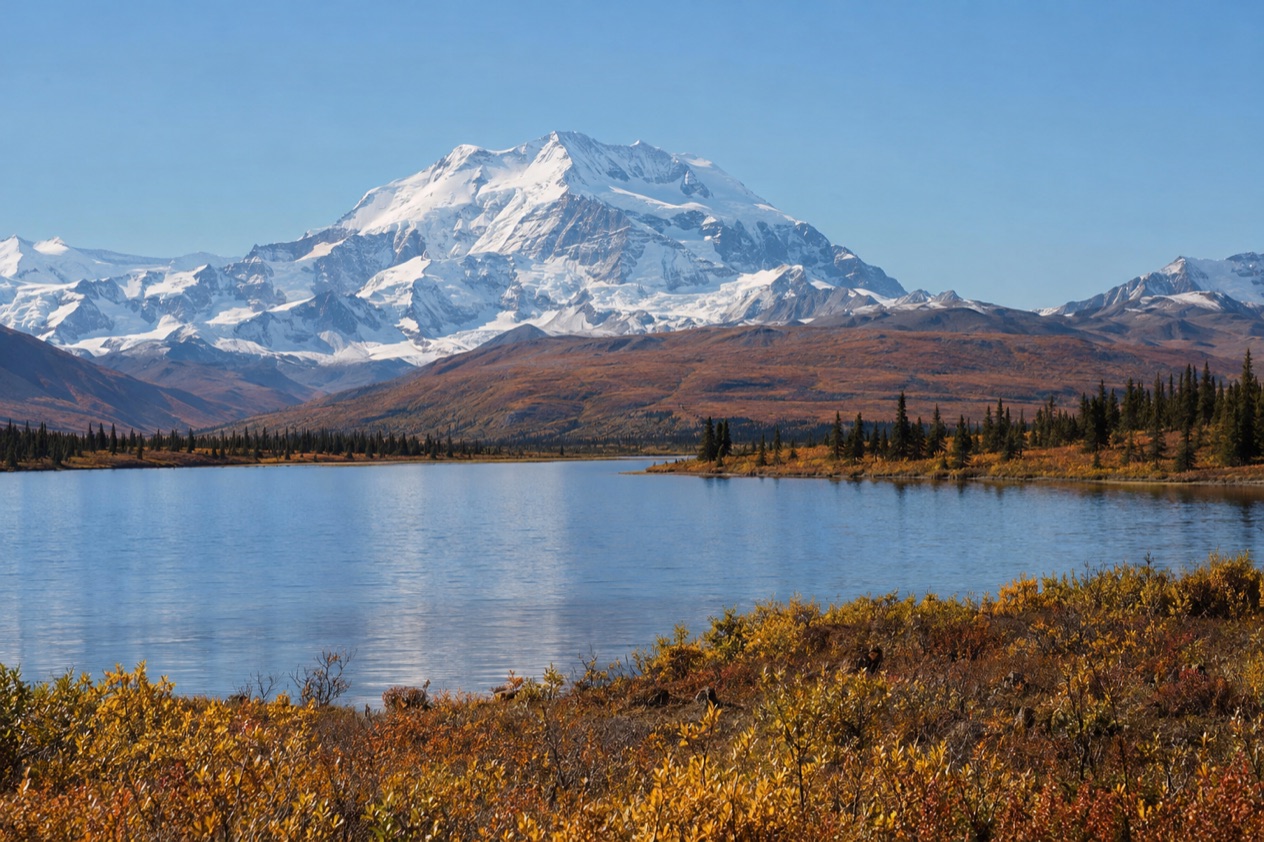
When is the best time to visit Alaska?
For travelers the best time is summer, from the second week of May to mid-September, and the height of it falls from mid-June to mid-July, when the days are warm, dry and very long. In that window temperatures sit in the 60s to low 70s, daylight lasts from 16 to 24 hours depending on where you are, the Alaska cruise season is underway and Denali bus tours have begun.
If your trip is built around Denali, the park road shapes the calendar. Bus tours on the Denali Park Road begin around the middle of May, so a visit before then means seeing the park without that ride.
Cruise travelers have a similar frame, since the Alaska cruise season runs from May through September, with small ships starting as early as mid-April. The Coastal Classic Train between Anchorage, Girdwood and Seward is a summer service too, with daily runs between May 14 and September 12 in 2027.
The northern lights ask for the opposite season. In Fairbanks the aurora can be watched from late August to late April, and the sky simply is not dark enough in the bright months. The fall and spring equinoxes tend to bring stronger activity than midwinter, which makes September and March interesting shoulder choices, though a clear night is still what decides it.
Winter suits travelers who come for snow, cold and dark skies rather than for sightseeing from a boat deck. The shoulder weeks at either end of summer, in May and September, trade a little warmth for quieter streets and softer light. Each kind of trip has its own month, and the sections that follow set them side by side.
Alaska weather by region and season
Alaska is a set of very different climates, with a wet southern coast, a dry and extreme Interior and an Arctic shore on the Beaufort and Chukchi seas, so the right month depends on the place.
| Place | January | April | July | October |
|---|---|---|---|---|
| Anchorage | 22.7°F, 6 h 20 min of daylight | 45.1°F, 14 h 36 min of daylight | 66.2°F, 18 h 32 min of daylight | 42.0°F, 10 h 13 min of daylight |
| Fairbanks | 0.6°F, 5 h 02 min of daylight | 45.6°F, 15 h 03 min of daylight | 72.7°F, 20 h 14 min of daylight | 34.1°F, 9 h 54 min of daylight |
| Juneau | 33.1°F, 7 h 04 min of daylight | 48.7°F, 14 h 19 min of daylight | 64.0°F, 17 h 39 min of daylight | 47.3°F, 10 h 25 min of daylight |
| Ketchikan | 39.7°F, 7 h 41 min of daylight | 49.8°F, 14 h 04 min of daylight | 64.5°F, 16 h 56 min of daylight | 51.1°F, 10 h 36 min of daylight |
| Seward | 31.3°F, 6 h 38 min of daylight | 45.4°F, 14 h 29 min of daylight | 62.2°F, 18 h 10 min of daylight | 45.7°F, 10 h 17 min of daylight |
| Utqiagvik | -5.2°F, no daylight (polar night) | 10.6°F, 16 h 21 min of daylight | 47.7°F, 24 h of daylight (midnight sun) | 25.6°F, 9 h 01 min of daylight |
The Interior has the widest swing. Fairbanks is the warmest of these six places on a July afternoon and by far the coldest in January, when the average low is far below zero and the short day feels like a long dusk. Anchorage sits between the extremes, with a deep-winter chill that is milder than Fairbanks and a summer that is pleasantly cool.
The coast trades extremes for rain. Ketchikan and Juneau stay relatively mild in winter and cool in summer, and both are wet. October is the soggiest month in Ketchikan, with more than 18 inches of precipitation, while Juneau collects over 50 inches in a typical year. Some parts of Southeast Alaska receive far more, and Seward on the Gulf coast also sees its heaviest rain in the fall.
At the top of the state, Utqiagvik, the northernmost city in the United States, lives by light more than temperature. Its polar day lasts 84 days, its polar night 68, and even in July the average afternoon stays cool.
What is there to do in Alaska in each season?
Summer: long days on trains, trails and boats
Summer is when Alaska is open for business. In Anchorage you can hike mountain trails under the midnight sun, and the Anchorage Museum is a rainy-day option in any season. In Fairbanks the Midnight Sun Season runs from April 22 to August 20, and evenings feel like extended afternoons, good for dinner outdoors and late walks.
Denali’s park buses start around the middle of May, and the Coastal Classic Train links Anchorage with Seward on its summer schedule. Northbound it leaves Anchorage early in the morning and reaches Seward before noon, and the return trip leaves in the evening. Seward is a gateway to glacier and wildlife cruises, though sightings of whales and bears are always a matter of chance.
Southeast Alaska in July brings long daylight and a steady chance of showers, so a rain jacket belongs in the daypack in Juneau or Ketchikan. Cruise ships fill the harbors from May through September.
Fall and winter: aurora, snow and quiet
From late August the nights darken again, and the aurora season opens in Fairbanks. In Fairbanks, with clear skies and at least three nights on the ground, seeing it is highly likely, and the best watching hours run roughly from 9 p.m. to 3 a.m. The hours around midnight give the strongest displays, so the evening is for planning a late night.
Fall brings its own colors and snow arrives early in the north, with Fairbanks and Utqiagvik both seeing real snowfall by October. Then winter takes over, with Anchorage at a bearable chill and Fairbanks in a hard freeze. Denali’s park road is mostly a summer story, and private vehicles can reach Teklanika Campground only for a few weeks of the shoulder seasons when conditions allow.
Spring thaw: the shoulder weeks
April is a month of change. Small-ship cruises begin as early as mid-April, and the aurora can still be watched in Fairbanks until late April.
By the second week of May the best-time window opens, and then the park buses, trains and lodges wake up in turn. Spring suits travelers who want quiet trails and cooler air and who accept that some doors will still be shut.
When is Alaska cheapest and least crowded?
The quietest times are outside the summer window, in the weeks before mid-May and after mid-September, and through the cold months from October to April. Rooms and tours are in highest demand during the height of summer, from mid-June to mid-July, when warm and dry weather and the longest days arrive together.
The shoulder weeks on either side of that peak have a different character. In May and again in September the days are still long enough for a full program, the trails are quieter and the light turns softer, but not everything is running. Small-ship cruises start earlier than the main cruise season, and Denali’s buses begin around the middle of May, so a trip timed just after those dates catches the services without the peak weeks.
Winter is the least visited stretch of the year, and for the right traveler it is the most rewarding. Fairbanks in the cold months is built around the aurora, and a stay of several nights gives the sky a fair chance to cooperate. The trade is fewer tours and boats, short days and serious cold in the Interior.
Southeast Alaska offers a quieter-season option of a different kind. In Ketchikan and Juneau the cruise crowds thin once September ends, and what remains is a town of rain, rivers and long evenings indoors. Pack for wet and mild rather than cold and snowy.
Which months should you avoid in Alaska?
No month is bad in itself, but the months from October to April are the ones to skip if an Alaska cruise is essential, because the Alaska cruise season runs from May through September.
The calendar breaks into clear parts. Long daylight runs from spring through summer, with the Midnight Sun Season in Fairbanks lasting from April 22 to August 20. The aurora season in the same city is the mirror image, from August 21 to April 21, and in the bright months the sky does not get dark enough to see it, however strong the display.
Services follow summer. The Coastal Classic Train runs daily in 2027 from May 14 to September 12, cruises sail from May through September, and Denali buses begin around mid-May. Outside those dates there is less on offer, and the winter days are short, with Anchorage getting just over six hours of daylight in January and Fairbanks about five.
In Utqiagvik, the polar night in January means no sunrise at all, an experience for some travelers and a reason to postpone for others. In Southeast Alaska, October is the wettest month of the four in the table, with rain on most days in Juneau and Ketchikan, so anyone who wants clear views of mountains and glaciers should aim for another month.
Festivals and events in Alaska through the year
Winter: the aurora and the Iditarod
The Iditarod Trail Sled Dog Race usually starts in early March, with a ceremonial send-off in downtown Anchorage before the teams head into the wilderness. The streets are packed with snow and spectators, and the dogs bark with excitement.
Winter in the Interior is built around the northern lights rather than a single festival. From late August to late April, Fairbanks has its viewing season, and the equinox months bring stronger activity than midwinter. Evenings are spent outside in the cold, waiting for the sky to open, and the hours around midnight give the best odds.
Summer: the solstice and the midnight sun
The Midnight Sun Game is the best-loved date of the Alaska summer. Fairbanks has hosted the baseball game since 1906, played in the twilight around midnight on June 21, and the sun sets there at 12:47 a.m. at the solstice. The game is played without lights, and the crowd stays until the last out.
The Fourth of July is celebrated across the state with parades and fireworks, and the long evenings of early July suit outdoor gatherings. The days around the solstice are the longest of the year, a natural moment for a late hike near Anchorage or a walk through a small town that is still full of daylight at bedtime.
Fall: harvest, color and Alaska Day
The Alaska State Fair in Palmer usually runs from late August into the Labor Day weekend, a classic harvest fair where the long summer days produce famously large vegetables. It is a good stop for travelers who want to see where Alaskans spend the end of summer.
Alaska Day on October 18 marks the transfer of Alaska from Russia to the United States, and Sitka is where the commemoration is centered. By then the first snow has reached the north, the aurora season is open and the leaves have changed in the Interior. October is a thoughtful, quiet month to be in the state.
Sources
- NOAA NCEI, U.S. Climate Normals 1991-2020, monthly (https://www.ncei.noaa.gov/access/services/data/v1?dataset=normals-monthly-1991-2020&stations=USW00026451), station Anchorage Intl Ap, elevation 120 feet, checked October 11, 2026
- Computed from the date and the latitude of the place (sunrise equation, solar elevation -0.833 degrees), October 11, 2026
- NOAA NCEI, U.S. Climate Normals 1991-2020, monthly (https://www.ncei.noaa.gov/access/services/data/v1?dataset=normals-monthly-1991-2020&stations=USW00026411), station Fairbanks Intl Ap, elevation 432 feet, checked October 11, 2026
- NOAA NCEI, U.S. Climate Normals 1991-2020, monthly (https://www.ncei.noaa.gov/access/services/data/v1?dataset=normals-monthly-1991-2020&stations=USW00025309), station Juneau Intl Ap, elevation 16 feet, checked October 11, 2026
- NOAA NCEI, U.S. Climate Normals 1991-2020, monthly (https://www.ncei.noaa.gov/access/services/data/v1?dataset=normals-monthly-1991-2020&stations=USW00025325), station Ketchikan Intl Ap, elevation 76 feet, checked October 11, 2026
- NOAA NCEI, U.S. Climate Normals 1991-2020, monthly (https://www.ncei.noaa.gov/access/services/data/v1?dataset=normals-monthly-1991-2020&stations=USW00026438), station Seward Ap, elevation 22 feet, checked October 11, 2026
- NOAA NCEI, U.S. Climate Normals 1991-2020, monthly (https://www.ncei.noaa.gov/access/services/data/v1?dataset=normals-monthly-1991-2020&stations=USW00027502), station Barrow Post Rogers Ap, elevation 31 feet, checked October 11, 2026
- Wikipedia, Climate of Alaska (https://en.wikipedia.org/wiki/Climate_of_Alaska), checked October 11, 2026
- Alaska.org, best time (https://www.alaska.org/advice/best-time-to-visit-alaska), checked October 11, 2026
- Wikipedia, Midnight sun (https://en.wikipedia.org/wiki/Midnight_sun), checked October 11, 2026
- Wikipedia, Polar night (https://en.wikipedia.org/wiki/Polar_night), checked October 11, 2026
- University of Alaska Fairbanks Geophysical Institute, Aurora forecast (https://www.gi.alaska.edu/monitors/aurora-forecast), checked October 11, 2026
- Alaska Railroad, Train schedules (https://www.alaskarailroad.com/ride-a-train/schedules), checked October 11, 2026
- National Park Service, Denali National Park & Preserve, plan your visit: directions (https://www.nps.gov/dena/planyourvisit/directions.htm), checked October 11, 2026
- Anchorage Museum (https://www.anchoragemuseum.org/visit/), checked October 11, 2026
- Visit Anchorage, things to do (https://www.anchorage.net/things-to-do/), checked October 11, 2026
- Explore Fairbanks (https://www.explorefairbanks.com/), checked October 11, 2026