
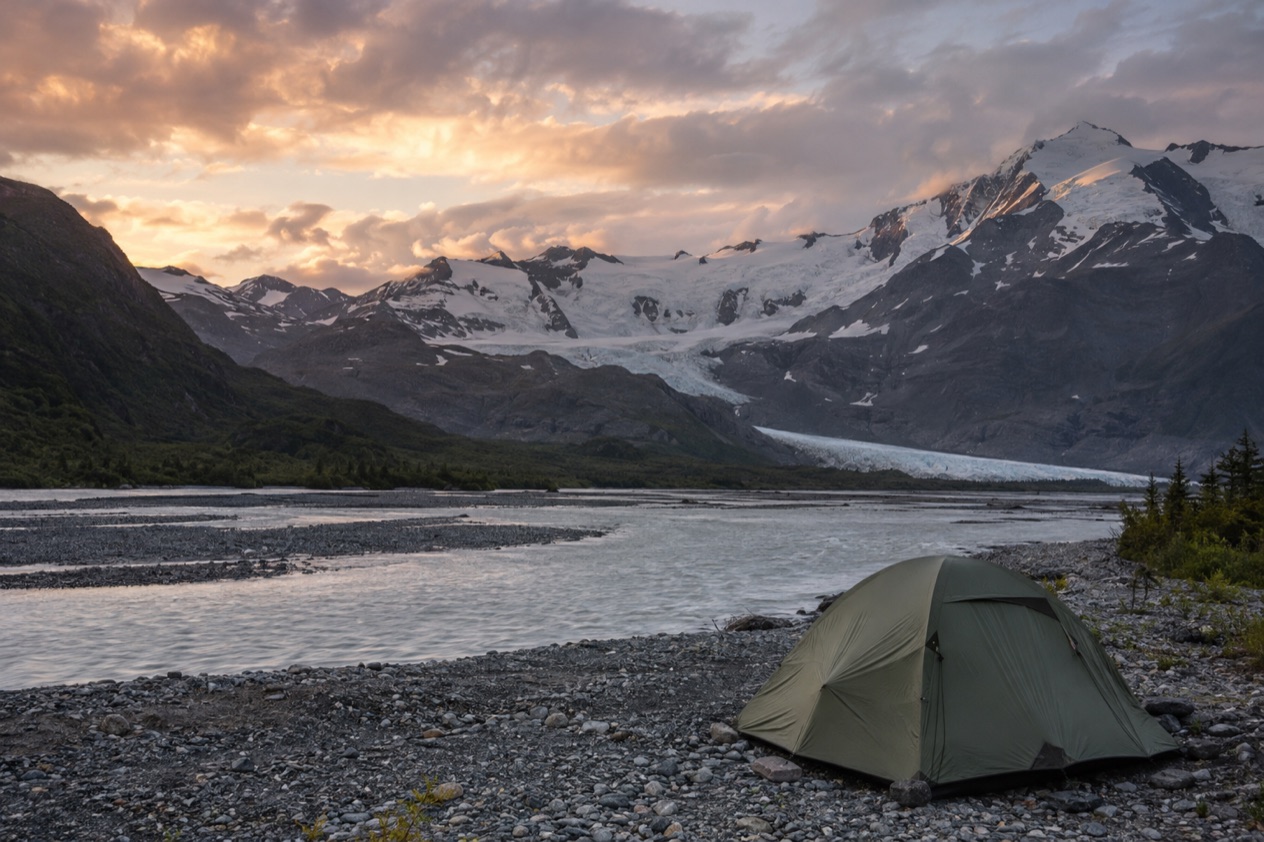
Camping in Alaska means zipping a tent door on a cold, bright evening and hearing a river somewhere close by, with a ridge of mountains standing over the site. Some campers sleep in a numbered site beside a park road, others carry everything on their backs into country with no trail at all. The state offers both, from Denali’s campgrounds to state park cabins and the far backcountry of Wrangell-St. Elias.
Where can you camp in Alaska?
You can camp in national parks, in state parks and in the backcountry, and each of the three gives a different kind of trip. Alaska’s state park system covers three million acres of land and water, the most acreage of any state park system in the country, and the national parks add their own campgrounds and wild country on top of that.
The choice mostly comes down to how much you want to carry and how far you want to be from a road. Some places are reached by car, others only by boat or float plane, and a few have no maintained trails whatsoever.
Denali National Park
Denali has several campgrounds, and they are the classic way to sleep inside the park. Check in and check out are both at 11 am, so a morning can start slowly over coffee and still end with the tent packed.
Wonder Lake Campground is closed through 2026 because of the Pretty Rocks Construction project, so it is not part of a Denali plan for this season. Reservations for Denali campgrounds open as early as December 1 of the year before your visit, which suits people who like to plan a summer trip in the depths of winter.
Winter camping in Denali is free, from roughly late September to early May each year. It is a very different experience from a summer night, quieter and colder, and it appeals to people who already know how to keep warm outdoors.
Alaska State Parks
Alaska State Parks oversees more than 156 park units, from the far north to the tips of Southeast. The Northern Region alone has 16 state parks spanning 400 square miles. Near Anchorage, Chugach State Park holds about 495,000 acres, mostly within the Municipality of Anchorage, and it is one of the four largest state parks in the United States.
On Kodiak, Ft. Abercrombie State Historical Park, Buskin River State Recreation Site and Pasagshak River State Recreation Site sit on the road system. Shuyak Island State Park, Afognak Island State Park and Woody Island State Recreation Site are different: they can only be reached by boat or float plane, which makes arriving part of the adventure.
Wrangell-St. Elias backcountry
The backcountry of Wrangell-St. Elias National Park & Preserve has no maintained trails, so visitors must be skilled at off-trail hiking. This is a place for experienced backpackers who are comfortable reading terrain and making their own route.
The landscape includes river crossings, glacier travel, thick brush, extreme weather, rock fall, mudslides, avalanches and bugs. Satellite phones and satellite messengers are the only way to communicate from the backcountry there, so the quiet is complete.
| Place | Camping detail |
|---|---|
| Denali campgrounds | Sites around $25 to $50 per night |
| Denali in winter | Free, roughly late September to early May |
| Wonder Lake Campground | Closed through 2026 |
| Denali campground check in and out | 11 am |
What kinds of campsites are there?
Alaska offers drive-up campground sites, public use cabins and backcountry camping, so you can sleep in a tent, under a roof or wherever your permit sends you. Each has its own rules, and knowing them beforehand keeps a trip simple.
Campground sites
In Denali, no campground can accommodate an RV over 40 feet long, which matters if you are traveling in something big.
The morning routine is easy to remember because everything happens at 11 am. After that, the day belongs to the park, and you can head out to the bus depot or a trail.
Public use cabins in state parks
Alaska State Parks rents public use cabins, a good option for people who want a roof and a bunk rather than a tent. Most cabins can be reserved up to 90 days out, with the reservation opening at 12:00am on that day. Cabins in Afognak Island State Park and Shuyak Island State Park, along with camping permits in Wood-Tikchik State Park, can be reserved 180 days out.
The cabins come with house rules. Smoking in any form, vaping included, is strictly forbidden in all of them, and nobody may camp, pitch a tent or stay overnight within 300 feet of a public use cabin. Using a cabin or its facilities without a permit is unlawful, and each day of unauthorized use is a separate offense subject to a $50 fine.
Booking online through the reservation system carries a charge of $4.50 per reservation. If you already have an account with Reserve America, it will be migrated to the new reservation system, so you do not need to start over.
Backcountry camping
Backcountry camping in Denali is done by permit, and the permit does the planning for you: it specifies the backcountry unit where you must camp for each night of the trip. Permits are free and required for overnight trips.
All members of the backpacking party must attend a backcountry orientation before the permit is issued. You will also need the permit before you can acquire Camper Bus tickets at the Denali Bus Depot, so the permit comes first in the order of things.
| Type | Reservation or permit detail |
|---|---|
| Most state park cabins | Up to 90 days out, opening at 12:00am |
| Afognak and Shuyak Island cabins, Wood-Tikchik camping permits | 180 days out |
| Online reservation fee | $4.50 per reservation |
| Denali backcountry permit | Free and required |
What should you know before you go?
Before you go, learn how permits, bears and cold water work where you are headed, because each park sets its own rules. A few habits carry across all of Alaska, and the rest belongs to a particular place.
Permits and where to get them
In Denali, from mid-May to late September, backcountry permits are issued in person at the Backcountry Information Center on the Denali Bus Depot campus, no more than one day prior to the start of the trip. In the fall, winter and spring, permits are available at the visitor center.
Cancellations matter for cabins. A cancellation made within 2 days of the arrival date receives no refund or credit. For Kodiak region cabins, a refund requires cancelling at least 15 days before arrival, and anything within 14 calendar days gets nothing back.
Bears and food
All three species of North American bears, black, brown (including grizzly) and polar, flourish in Alaska. Anyone camping in the state must keep all human sources of food secure from bears. In the Denali backcountry, Bear Resistant Food Containers are required from April 15 through September 30.
Dangerous bear situations should be reported to ADF&G using the wildlife encounter form. The department also lends four bear safety videos from its Area Offices in Anchorage, Fairbanks and Juneau, and provides a page about bear resistant containers.
Rivers in Wrangell-St. Elias
Most backcountry routes in Wrangell-St. Elias require numerous creek and river crossings, and bridges and log crossings are virtually non-existent. Alaskan waters are extremely cold, so hikers must be familiar with safe techniques for crossing rivers and streams.
Cross early in the day whenever possible, because water levels may vary drastically with the season, the time of day, temperature and upstream weather. The widest, most braided area is usually where the water is shallowest, and that is the place to cross.
Good to know before you go
Camping in Denali costs roughly $25 to $50 a night, with half off for Senior Pass and Access Pass holders, and winter nights are free. Keep food secured from bears everywhere, plan around the Wonder Lake closure, and bring a satellite messenger for Wrangell-St. Elias, where it is the only way to communicate.
Sources
- National Park Service, Denali National Park & Preserve, plan your visit: campgrounds (https://www.nps.gov/dena/planyourvisit/campgrounds.htm), checked October 11, 2026
- National Park Service, Denali National Park & Preserve, plan your visit: backcountry (https://www.nps.gov/dena/planyourvisit/backcountry.htm), checked October 11, 2026
- Alaska State Parks, public use cabins (https://dnr.alaska.gov/parks/aspcabins/index.htm), checked October 11, 2026
- Alaska State Parks, unit fees (https://dnr.alaska.gov/parks/asp/unitfees.htm), checked October 11, 2026
- Alaska State Parks, Division of Parks and Outdoor Recreation (https://dnr.alaska.gov/parks/), checked October 11, 2026
- National Park Service, Wrangell – St. Elias National Park & Preserve, plan your visit: backcountry (https://www.nps.gov/wrst/planyourvisit/backcountry.htm), checked October 11, 2026
- Alaska Department of Fish and Game, Living with bears (https://www.adfg.alaska.gov/index.cfm?adfg=livingwithbears.main), checked October 11, 2026