
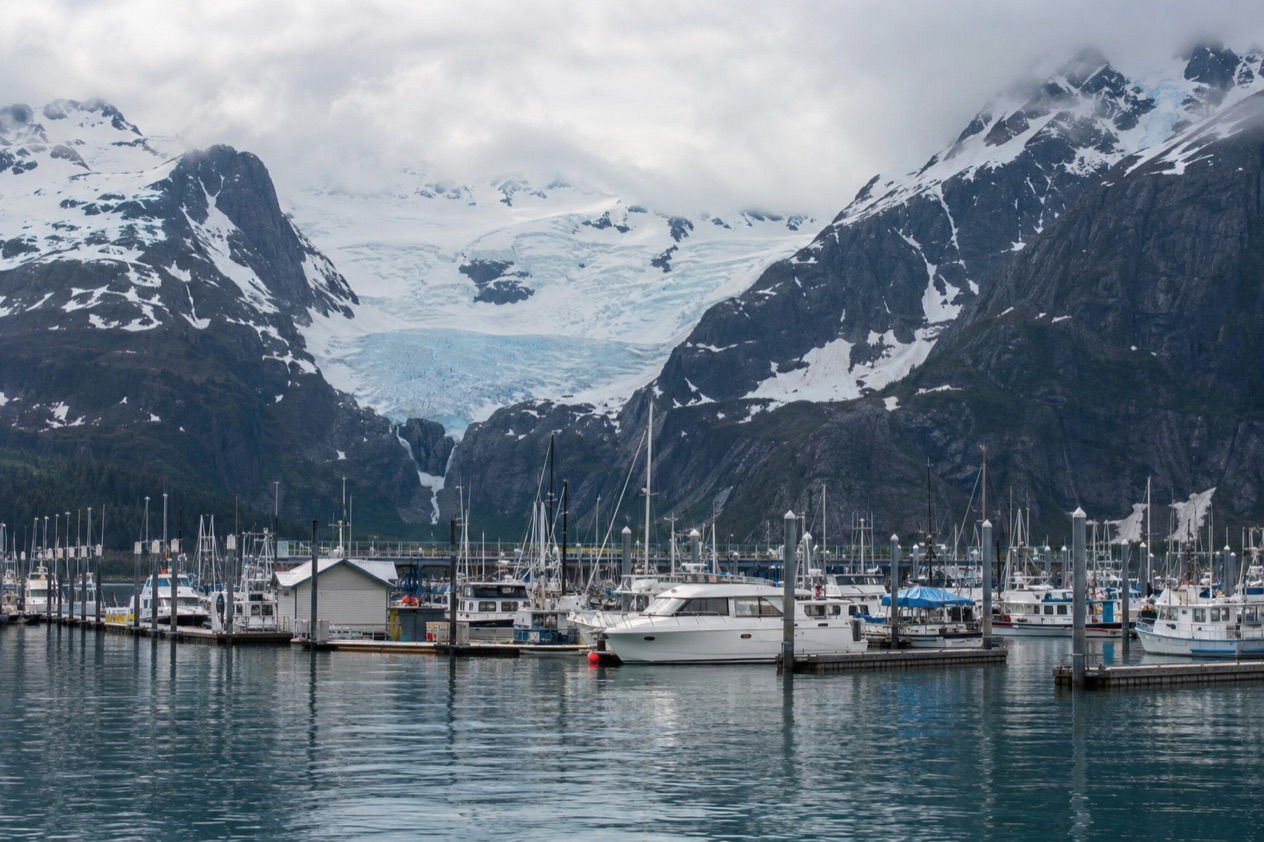
Cars line at the mouth of a mountain, waiting for their turn to slip through a single-lane tunnel, and on the other side the road ends at a harbor ringed by steep, cloud-wrapped walls. Whittier sits at the head of a long arm of water, with docks, a small boat harbor and one enormous building that holds most of the town. It suits travelers who want a gateway to Prince William Sound, its glaciers and its kayaking, more than a place for nightlife or shopping.
Where is Whittier and what is it like?
Whittier is a small port city at the head of Passage Canal, in the Chugach Census Area of Alaska’s Unorganized Borough, about 58 miles southeast of Anchorage. It is a working harbor town on the edge of Prince William Sound, enclosed by mountains and reached by a tunnel through one of them.
The town’s nickname says a lot: The Town Under One Roof. Almost all residents live in a single building, the Begich Towers Condominium, so the place feels less like a grid of streets and more like a harbor with a village stacked into one tower. Boats, docks and the railroad shape the day more than shops or traffic do.
The climate is extremely wet, with an average of about 197 inches of precipitation a year. That means mist hanging on the slopes, rain on the water and waterfalls spilling down the rock walls. The wet is part of the setting, and the green, glacier-carved landscape around the town is a product of it.
Whittier is a port for the Alaska Marine Highway, and the city also operates a seaplane dock, so the water is the town’s real front door. People who love it come for the glaciers, the sound and the sense of being at the end of the road. Those who want restaurants, nightlife or wide streets to wander may find it quiet, and a rainy day here is a day to plan around the boats and trails rather than the town itself.
Nearby, Prince William Sound stretches out to settlements such as Cordova, Chenega and Tatitlek, and Valdez is the sound’s largest port. Whittier is the sound’s closest doorway to Anchorage, which is why so many trips begin here and carry on across the water.
What is there to do in Whittier?
The big reasons to come are on the water, on the trails and at the glaciers. Prince William Sound near Whittier has the world’s largest concentration of tidewater glaciers, and almost everything you do here is a way of getting closer to them.
Glacier cruises on Prince William Sound
A glacier and wildlife cruise is the classic outing, and the Glacier Discovery Train connects with such a cruise at Whittier. The 26 Glacier Cruise offers a no-seasickness guarantee, a detail that appeals to anyone nervous about open water. On the sound you look up at ice faces that end at the water, and you may spot wildlife along the shore.
College Fjord, in the northern part of the sound, holds five tidewater glaciers, five large valley glaciers and dozens of smaller ones. Most are named after East Coast colleges, with women’s colleges on the northwest side and men’s colleges on the southeast side, a naming habit that goes back to the Harriman Expedition of 1899, whose members included a Harvard and an Amherst professor.
Kayaking and jet ski tours
Sea kayaking tours launch right from the docks in Whittier, and kayak drop-offs are available in more remote parts of the sound. Paddling puts you at water level beneath the same mountains the cruise boats pass, at a much slower pace.
Jet ski tours are the faster alternative. They provide dry suits and expert guides who lead visitors to glaciers and scenic viewpoints, which suits travelers who want to cover more water and like a bit of speed with their scenery.
Hiking and Portage Glacier
Whittier has several hiking trails. The short Whittier Creek Trail is one, and the popular Portage Pass Trail offers views of Passage Canal and Portage Glacier. Both make a way to stretch your legs between boat departures.
Portage Glacier lies about 4 miles west of Whittier, beside Portage Lake. In summer a boat ride across the lake is required to view the glacier, and commercial boat tours are available. In winter, if the lake freezes, the area sees foot, bike and ski traffic. The glacier ends in a lake and is retreating, so the view is of ice in the middle of change.
How many days do you need in Whittier?
The big draw is a day on the water, so a single day centered on a glacier cruise is a complete visit for travelers, especially those arriving by train from Anchorage.
A second day could go to the Portage Pass Trail, with its views of Passage Canal and Portage Glacier, or to a jet ski tour toward the ice.
With more time, add Portage Glacier and its lake, either by boat in summer or on foot, bike or skis in winter if the lake freezes. Staying longer also gives you slack for the weather, which matters in a place this wet, since a gray day can be traded for a clearer one.
Beyond Whittier, the Glacier Discovery Train links the town with Girdwood, Portage, Spencer and Grandview, and it stops at some areas accessible only by train, offering day trip options for all ages and energy levels. Those stops make a natural extension for a longer stay. Farther out on the sound, Valdez and Cordova are other ports, reached by the water or other routes.
Where to stay in Whittier
Whittier is compact, so the choice is less about neighborhoods than about how close you want to be to the harbor. The center of town is the Begich Towers Condominium, where almost all residents live, with the docks and boat departures close at hand. Staying in town puts you beside the water, the trails and the departure points for cruises and kayak tours.
The town’s setting, a single harbor with mountains pressed close around it, means the day often begins and ends at the docks. Travelers who come for a morning tour and an evening on the harbor will find the town works well as a base for the sound.
People instead treat Whittier as a day trip from Anchorage, which is about 58 miles away, and sleep elsewhere. Girdwood, the resort town where the Glacier Discovery Train stops briefly before continuing to Whittier, is another place along the route.
Choose Whittier itself if you want an early start on the water, a quiet evening and the feel of a town at the end of the road. Choose a base elsewhere if you want a wider range of places to eat and wander, and plan a day on the sound from there.
How do you get to Whittier and get around?
You reach Whittier by road through the Anton Anderson Memorial Tunnel, by the Glacier Discovery Train, or by water, since the town is a port for the Alaska Marine Highway. The tunnel is on the Portage Glacier Highway, which connects the Seward Highway in Portage to the ferry terminal in Whittier over 11.59 miles through the Chugach National Forest and the tunnel itself.
The tunnel limits motor vehicles to 25 miles per hour, so the passage takes about ten minutes. Tolls are collected from eastbound vehicles, and the amounts are in the table. Pedestrians and bicycles are prohibited in the tunnel, except during the annual Walk to Whittier event in June.
| Vehicle (eastbound) | Toll |
|---|---|
| Regular vehicle or motorcycle | $13 |
| Vehicle pulling a trailer | $22 |
| Small bus or regular RV | $38 |
| Large bus | $137 |
| Oversize vehicle, 10 to 11 feet wide and 14 to 15 feet high | $330 per use |
The Glacier Discovery Train runs from Anchorage to Girdwood, Whittier, Portage, Spencer and Grandview. It follows much of the same route as the Coastal Classic train, with an added turn off the main line to Whittier. At Whittier the train goes through a mountain tunnel and connects with a glacier and wildlife cruise in Prince William Sound.
Once in town, the harbor, docks and trailheads are what you are heading for, and the Whittier Creek Trail starts in the town itself. Portage Glacier, about 4 miles west, is reached by the lake boat in summer. A seaplane dock operated by the city also serves air arrivals.
When is the best time to visit Whittier?
In summer a boat ride across Portage Lake is required to view Portage Glacier, and the Walk to Whittier event, when pedestrians may use the tunnel, takes place in June.
Whittier is extremely wet in any month, with an average of about 197 inches of precipitation a year, so expect rain and cloud whenever you come. Waterproof layers matter more than the date, and a flexible schedule helps if a tour is affected by the weather.
Winter has its own appeal. If Portage Lake freezes, Portage Glacier sees foot, bike and ski traffic, which makes the area a different place from the summer boat-tour scene. Travelers after glacier cruises will want summer, and those who like frozen lakes and quiet may prefer the cold months.
Good to know before you go
Whittier is reached through a single tunnel, and tolls are collected only from eastbound vehicles, so the cost applies on the way in. Vehicles owned by the Alaska Railroad, the Alaska DOT&PF, or emergency and law enforcement services are exempt, while state government agency or school district vehicles pay $11. Expect a wet climate and pack for rain, and remember that the tunnel is closed to pedestrians and bicycles.
Sources
- Alaska.org, dest whittier (https://www.alaska.org/destination/whittier), checked October 11, 2026
- Wikipedia, Whittier, Alaska (https://en.wikipedia.org/wiki/Whittier,_Alaska), checked October 11, 2026
- Wikipedia, Whittier Tunnel (https://en.wikipedia.org/wiki/Whittier_Tunnel), checked October 11, 2026
- Wikipedia, Anton Anderson Memorial Tunnel (https://en.wikipedia.org/wiki/Anton_Anderson_Memorial_Tunnel), checked October 11, 2026
- Alaska Railroad, Glacier Discovery (https://www.alaskarailroad.com/ride-a-train/our-trains/glacier-discovery), checked October 11, 2026
- Wikipedia, Prince William Sound (https://en.wikipedia.org/wiki/Prince_William_Sound), checked October 11, 2026
- Wikipedia, College Fjord (https://en.wikipedia.org/wiki/College_Fjord), checked October 11, 2026
- Wikipedia, Portage Glacier (https://en.wikipedia.org/wiki/Portage_Glacier), checked October 11, 2026
- Wikipedia, Climate of Alaska (https://en.wikipedia.org/wiki/Climate_of_Alaska), checked October 11, 2026