
Somewhere over the Gulf of Alaska, a traveler with a rental-car reservation in one city and a hotel in another starts wondering which airport to fly into and how the rest of the state fits together. Most trips start at Anchorage, and from there the map opens up.
Which are the main airports in Alaska?
The main airports are Ted Stevens Anchorage International, Fairbanks International and Juneau International, with Anchorage by far the largest gateway and the one most itineraries pass through. Each one anchors a different part of the state, and each feels different once you land: Anchorage is a hub with cargo planes parked along its edges, Fairbanks is a compact interior airport, and Juneau sits in a capital city with no road connecting it to the rest of the state’s highway system.
Ted Stevens Anchorage International Airport (ANC)
Ted Stevens Anchorage International sits southwest of downtown Anchorage, about 5 miles away, at 5000 W. International Airport Rd. It is a passenger airport and a giant cargo one at the same time. It is a hub for Alaska Airlines, and also for Atlas Air, FedEx Express, Polar Air Cargo and UPS Airlines, so the planes you see from your window on approach are as likely to be freighters as passenger jets.
Passengers use two terminals. The South Terminal handles domestic flights and the airlines that serve them. The North Terminal is the international one, where Condor arrivals, seasonal charter flights from abroad and military flights come in. Check which terminal your airline uses before you set out, because a mix-up between the two is the classic first-day mistake.
| Terminal | Gates | Serves |
|---|---|---|
| South Terminal (domestic) | 24 | Air Canada, Alaska Airlines, American Airlines, Condor (departures), Delta Air Lines, Discover Airlines (departures), Sun Country Airlines, United Airlines |
| North Terminal (international) | 8 | Condor arrivals, international seasonal charter flights, military flights |
Beside the main field is Lake Hood Seaplane Base, the busiest seaplane base in the world. Even if you never board a floatplane, it explains something about Alaska: here, the airport for a small plane is sometimes a lake. The three long runways at Anchorage, the longest at 12,400 feet, are there for the heavy cargo and passenger jets.
Fairbanks International Airport (FAI)
Fairbanks International is the gateway to Interior Alaska. It keeps its doors open around the clock, which suits a place where flights can arrive at odd hours, and its screening checkpoints open ahead of the first departure of the day, holidays included. The administrative office keeps ordinary weekday business hours.
| Service at FAI | Open |
|---|---|
| Airport | 24 hours a day |
| Passenger screening checkpoints | 2 hours before the first flight each day, including holidays |
| Administrative office | Monday to Friday, 8am to 5pm |
The airport asks people not to enter the terminals unless they are helping unaccompanied minors, passengers with disabilities or others who need assistance. In practice that means saying goodbye to friends outside, and it keeps the building calm for people with connections to make.
Juneau International Airport (JNU)
Juneau International serves the state capital, a city set between mountains and water. Because the capital is not connected to the rest of Alaska by a road network, the airport is one of the ways in and out, along with the Alaska Marine Highway ferries. Airport planning there is an active public process, with a master plan, stakeholder consultations and an airport board that meets in public.
Walkers will like one detail: the EVAR / Airport Dike Trail at the airport is open. It gives you a way to spend a layover or a spare hour outdoors beside the airfield instead of in a terminal chair, with the surrounding mountains in view.
Which towns can you reach by scheduled flights?
Scheduled airline service reaches Anchorage, Fairbanks, Juneau and Sitka, and Alaska Airlines is the carrier that ties most of them to the rest of the country. The airline is headquartered in SeaTac, Washington, has its primary hub at Seattle–Tacoma, and counts Anchorage among its other hubs, which is why so many routes into the state feel like a Seattle connection.
Sitka Rocky Gutierrez Airport
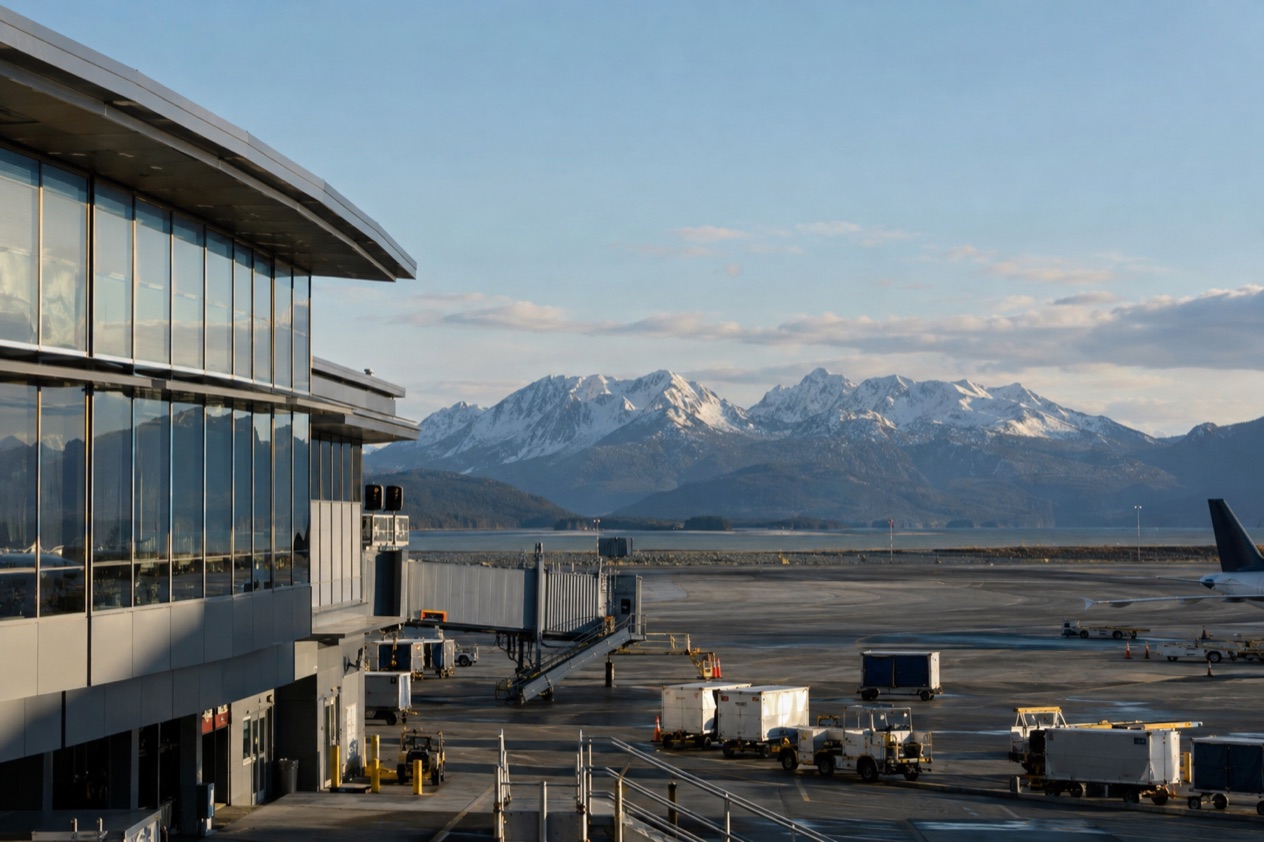
Sitka’s airport is named after a former mayor of the town, Rocky Gutierrez. It has a single terminal with a jetway, and Alaska Airlines operates air service there year-round. For a small coastal town, a jetway is a notable touch: you walk off the plane directly into the terminal, with spruce-covered islands behind the glass.
The setting is the real show. The airport’s one paved runway lies on a causeway that juts off Japonski Island, so the approach and the takeoff have water on both sides. The runway is 7,200 feet long, and the airport sits only a few feet above sea level.
| Sitka airport | Detail |
|---|---|
| Runway | 11/29, asphalt, 7,200 by 150 feet |
| Elevation | 26 feet above mean sea level |
| Terminal | One, with a jetway |
| Airline service | Alaska Airlines |
The airline that links the state
Alaska Airlines began as McGee Airways, whose first service ran between Anchorage and Bristol Bay. Its headquarters were in Anchorage in the 1940s. Today its route map reaches the contiguous states, Hawaii and other countries, and its frequent-flyer program is called Atmos Rewards. The airline belongs to the Oneworld alliance.
For a visitor, that history shows up in small ways. Many Alaskans have a long relationship with the airline, and a boarding area in Anchorage or Sitka can feel like a neighborhood meeting place as much as a transit point.
From Anchorage to farther towns
Beyond the towns above, the bush has long had its own passenger flying. In 1947, flights to Nome and Kotzebue carried some of the first tourists to travel by air in the Alaskan bush, and Celia M. Hunter was one of the first flight attendants on those trips. The route names still stir the imagination, because Nome and Kotzebue sit on the far western edge of the map.
If a town beyond the big airports is on your list, check which carrier actually serves it and in what season, because bush service is separate from the jet network. Treat Anchorage, Fairbanks, Juneau and Sitka as the dependable anchors and the rest as a second layer.
Which have no airport at all?
Many Alaska communities have no road and no airport with a prepared runway, and they depend on bush flying to connect them to the outside world. In Western Alaska, 82% of towns are not connected by roads, and bush flying is essential to get food, mail and medical care there. For those places, the plane is what a highway is elsewhere.
What bush flying means
Bush flying refers to aircraft operations in remote wilderness areas without prepared landing strips or runways. A pilot may land on a gravel bar, a frozen lake, a river or a snowfield. To make that possible, bush planes are equipped with tundra tires, floats or skis, depending on whether the ground is rough, wet, snowy or icy.
This is why you will often hear people in Alaska talk about the kind of landing gear a plane has, a detail that would seem odd anywhere else. Wheels, floats and skis each open a different set of places, and the season can decide which one is on the aircraft.
How it started
The tradition goes back to the 1920s. In 1924, Eielson received a de Havilland 4 to make eight mail runs to McGrath, 280 miles away. That same summer, on August 19, Noel Wien made the first successful bush flight to Livengood, Alaska.
The Livengood trip showed what a plane could do for a mining camp. It could be made in under an hour, whereas the dog sled trail would take several days in winter. In the summer of 1924, Wien made 34 flights to supply the approximately 250 men at the camp, bringing in supplies and services that would otherwise have been slow and costly to haul.
Water runways in the city
You do not have to leave Anchorage to see the idea at work. Lake Hood Seaplane Base lies next to the big airport, and floatplanes there use water as their runway. It is a place to watch small aircraft that serve communities and lakes beyond the road system.
If your plans include a place with no runway, expect to leave from a base like this one or from a small-plane terminal, and expect the flight itself to be part of the trip. The window seat is the point.
Good to know before you go
Travelers flying out of Anchorage are reminded that they may need a Real ID or another acceptable ID to board, so put that in your carry-on with your boarding pass. Fairbanks asks that only people helping passengers who need assistance enter the terminals, which is worth knowing if you are seeing someone off. Bush flights depend on the aircraft’s landing gear and the conditions at the landing spot, so keep your plans flexible on days when a floatplane or ski plane is involved.
Sources
- Ted Stevens Anchorage International Airport (https://www.ancairport.com/), checked October 11, 2026
- Fairbanks International Airport (https://www.dot.alaska.gov/faiiap/), checked October 11, 2026
- Juneau International Airport (https://juneau.org/airport), checked October 11, 2026
- Wikipedia, Sitka Rocky Gutierrez Airport (https://en.wikipedia.org/wiki/Sitka_Rocky_Gutierrez_Airport), checked October 11, 2026
- Wikipedia, Bush flying (https://en.wikipedia.org/wiki/Bush_flying), checked October 11, 2026
- Wikipedia, Alaska Airlines (https://en.wikipedia.org/wiki/Alaska_Airlines), checked October 11, 2026