
A fillet of salmon sits on a rack above smoldering alder chips, its edges darkening to the color of old amber, and the whole fish-camp smell drifts across the dock before you see anything. Plates of battered halibut land on picnic tables, and crab legs arrive in a heap with a small dish of melted butter. Alaska cooks around what comes out of its cold water, and this is a guide to eating it: the fish, the crab, the Native food traditions and the towns where they all turn up on a plate.
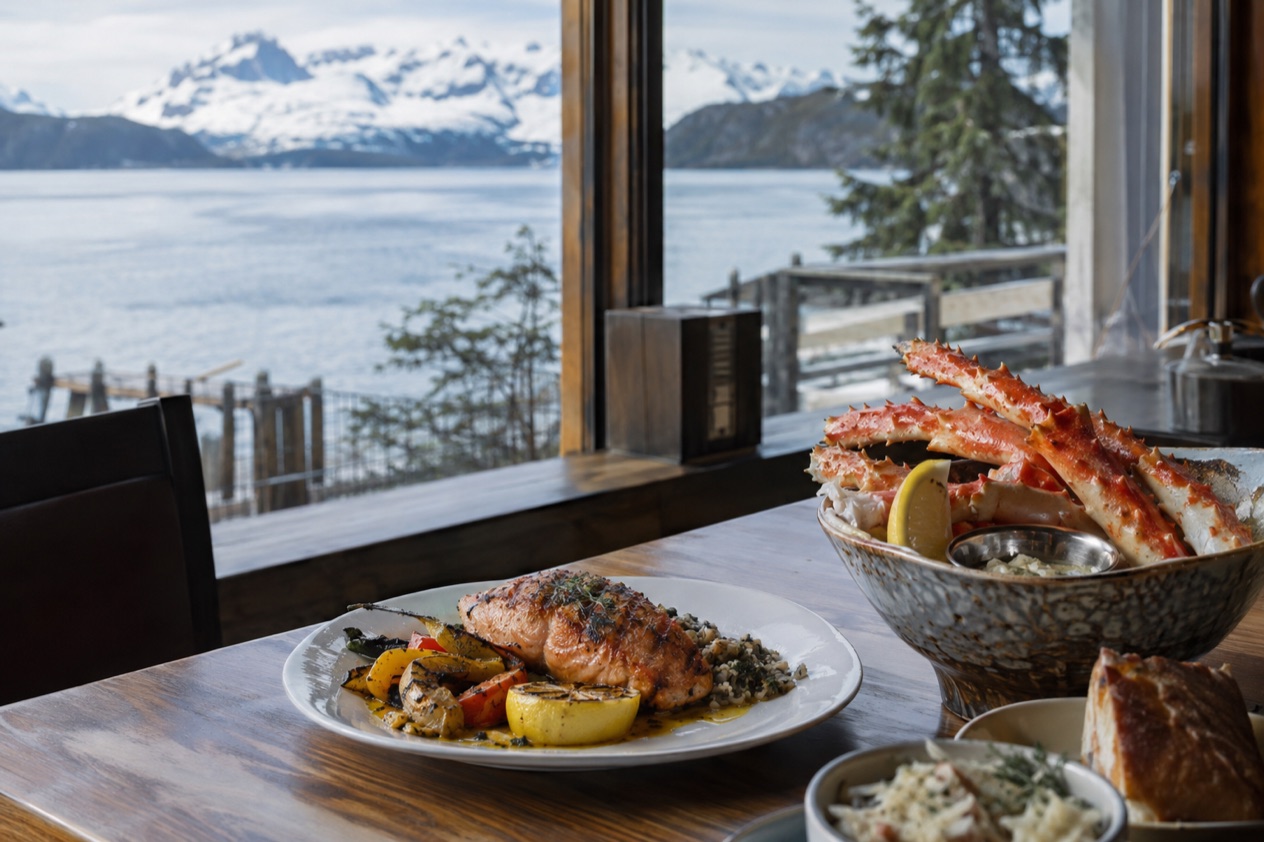
What is Alaska food?
Alaska food is, above all, wild seafood cooked simply, with salmon, halibut and king crab at the center and a supporting cast of game, berries and local sweeteners. It is not a cuisine of elaborate sauces. It is a cuisine of freshness, smoke, salt and butter, shaped by the people who lived here long before restaurants and by fishing crews who still work the water today.
The state is enormous and thinly settled, so what you eat changes with where you stand. A cruise-port town in the Southeast sells smoked salmon from shop counters, a harbor town on the Kenai Peninsula serves halibut at the water’s edge, and Anchorage gathers all of it into one city of menus. Across these places the pattern repeats: the best meals are the ones that start with a boat.
Salmon, the everyday fish
Five species of Pacific salmon matter at the table: chinook, sockeye, coho, pink and chum. Chinook reach north as far as Kotzebue Sound, while chum range from Alaska down to California and also swim the Yukon River. Each has its own character. Chinook are rich and fatty, sockeye are deep red and firm, coho are milder, and pink and chum are often the fish that end up smoked, canned or turned into jerky-style strips.
All of them are born in fresh water, travel to the ocean, and return to spawn and die, which is why a river full of salmon is such a big event for people and animals alike. At Katmai National Park and Preserve, salmon and brown bear habitats are part of the reason the park exists, and visitors can fish for salmon and trout there. For a traveler, the takeaway is simple: ask which species you are eating, because it changes the flavor and the texture.
Halibut and king crab
Pacific halibut is a very large flatfish that lives on or near the bottom of cold water. Anglers generally bring up fish of modest size, but much bigger ones turn up regularly, and the largest sport-caught halibut on record weighed 459 lb and came from Dutch Harbor near Unalaska. On the plate, the meat is white, mild and firm, which is why it holds up so well to beer batter, a hot pan or a grill.
Red king crab, also called Alaskan king crab, is the largest king crab species, and it is named for the color it turns when cooked, not for the burgundy of the living animal. It is most commonly caught in the Bering Sea and Norton Sound.
Native foods and the traditions behind them
Long before any of this was a restaurant menu, Alaska Native peoples built their lives around the same fish, sea mammals, plants and berries. Anchorage lies within Dena’ina Ełnena, the homeland of the Dena’ina Athabascan people, and visitors can learn about Dena’ina culture there. In the Southeast, Sealaska Heritage Institute in Juneau works to advance Tlingit, Haida and Tsimshian cultures, with an ongoing exhibit on the first floor of its Walter Soboleff Building.
The Sealaska Heritage Store in Juneau sells artworks by Southeast Alaska Native artists, a good way to take home something made by hand from the same region whose salmon you have been eating. Smoking, drying and preserving fish are older than any modern kitchen here, and the smoked salmon you buy in a gift shop is a descendant of that practice.
What should you try in Alaska?
Try wild salmon, halibut and king crab first, then add the smaller local specialties that you will not find on a mainland menu: reindeer sausage, birch syrup, fireweed honey, sourdough and a glass of something made in Homer. A good plan is to treat each stop as a chance to eat one thing the place is known for.
Smoked salmon and the fish you eat with your hands
Smoked salmon comes in two broad styles. One is soft and silky, closer to what you would spread on a bagel. The other is dense and dry, cut in strips, made for the trail or a snack in the car. In Ketchikan you can shop Creek Street for local art, smoked salmon and souvenirs, so one stroll along the boardwalk can end with a vacuum-packed fillet for the trip home.
Fresh salmon is a different pleasure. Grilled over alder, baked on a cedar plank or seared in a pan with lemon, it needs almost nothing. If you see two species on the same menu, order the one you know less. The contrast between a richer chinook and a leaner coho tells you more about Alaska’s rivers than any description could.
Halibut, in a basket or on a plate
The classic halibut order is fish and chips: thick white chunks in crisp batter, a pile of fries and a wedge of lemon. It is the dish that most often shows up at a dockside window or a harbor-side diner. The same fish also appears pan-seared, in fish tacos, in chowder and grilled with a butter sauce, so a few halibut meals in a row will not feel repetitive.
Most anglers prefer to fish with bait, especially herring, and the day’s catch is often what ends up on the next table. If you meet a charter guest on the dock holding a bag of fresh fillets, you are looking at the beginning of that supply chain.
Reindeer sausage, sourdough and sweet things
Reindeer sausage is the land-based answer to all that seafood. It is usually grilled and served in a bun with onions, sold from street carts and found at ball games and fairs. Its taste is smoky and savory, a little like a spiced bratwurst.
Sourdough has long been tied to Alaska’s gold-rush image, and you will meet it in pancakes and bread at breakfast spots. Birch syrup, thinner and more savory than maple, and fireweed honey, light and floral, are the sweeteners to look for in gift shops and farmers’ stands. Wild berries, such as blueberries and cranberries, turn up in jams, pies and sauces for meat.
A local drink in Homer
Homer Brewery’s fresh ales are only available in the Homer area, so a pint there is a taste you cannot repeat at home. The Bear Creek Winery in Homer offers free tastings daily and has a small number of luxury rooms to rent.
Where can you eat seafood?
You can eat seafood in nearly every Alaska town on the coast, but a handful of places stand out for the way fish and the water are part of daily life: Homer, Ketchikan, Sitka, Kodiak and Anchorage. In each of them, the plate in front of you has a clear link to what is happening in the harbor.
Homer, the halibut town
Homer claims the title of Halibut Capital of the World, thanks to the large volume of sport and commercial halibut fishing in the area. For a traveler, that means halibut turns up everywhere: in dockside baskets, on restaurant menus and in the hands of anglers coming back to the harbor with coolers.
Most of the effort and harvest in Alaska is concentrated in a few regions. Over 65% of it takes place in Cook Inlet, southeast Alaska, the Kodiak area and near the mouth of Deep Creek in Lower Cook Inlet. Homer sits in that story, which is why the local ale and winery make such a natural pairing with a seafood dinner.
Ketchikan and Sitka in the Southeast
In Ketchikan, Creek Street is the place for smoked salmon, local art and souvenirs, and Saxman Native Village is where visitors can see traditional dances. A seafood lunch and a cultural stop sit close together in the same visit.
Sitka offers sportfishing excursions for salmon, along with the Alaska Raptor Center, where you can see bald eagles, and Sitka National Historical Park. You can also kayak Sitka Sound alongside sea otters or fly fish for the world’s biggest halibut, according to one cruise line’s description.
After a day out, a plate of local fish is the natural finish. The Alaska Marine Highway ferry terminal in Sitka is at 5307 Halibut Point Rd, a name that suits the town.
Anchorage and the Kodiak area
Anchorage is the city where Alaska’s food scene is easiest to sample in one place, with seafood alongside reindeer sausage, craft beer and the festivals that fill the calendar, among them Fur Rondy, the Bear Paw Festival and the Girdwood Forest Fair. The municipality is large, and it sits between Eklutna and Portage, so a meal in town is often paired with a day trip.
The Kodiak area is among the regions with the most halibut effort, and it is a good name to know if your itinerary takes you off the road system. Fish there, as everywhere, goes from boat to kitchen with very little in between.
Cooking your own catch
At Katmai National Park and Preserve, visitors can fish for salmon and trout, and rainbow trout range throughout southwestern and southeast Alaska. Catching your own fish changes how you eat it, and the sight of a fresh fillet is a reminder of why salmon are so tied to the land. Fishing for Pacific halibut is regulated by the International Pacific Halibut Commission, whose members from the United States and Canada meet yearly to set rules for the next season.
Good to know before you go
In Alaska, alcohol may not be sold in the same store as groceries, so a bottle of local wine or beer is a separate stop. An intoxicated person may not remain on the premises of a licensed establishment.
Outside the cities, drivers should remember that many rental car companies prohibit their vehicles on the Dalton, Denali, Steese and Cassiar Highways and the Nabesna and McCarthy Roads.
Sources
- Wikipedia, Alaskan king crab (https://en.wikipedia.org/wiki/Alaskan_king_crab), checked October 11, 2026
- Wikipedia, Pacific halibut (https://en.wikipedia.org/wiki/Pacific_halibut), checked October 11, 2026
- Wikipedia, Pacific salmon (https://en.wikipedia.org/wiki/Pacific_salmon), checked October 11, 2026
- Visit Anchorage (https://www.anchorage.net/), checked October 11, 2026
- Wikivoyage, Alaska (https://en.wikivoyage.org/wiki/Alaska), checked October 11, 2026
- Sealaska Heritage Institute (https://www.sealaskaheritage.org/), checked October 11, 2026
- Holland America Line, Alaska cruises (https://www.hollandamerica.com/en/us/cruise-destinations/alaska-cruises), checked October 11, 2026
- Royal Caribbean, Alaska cruises (https://www.royalcaribbean.com/cruise-destinations/alaska-cruises), checked October 11, 2026
- Alaska Department of Transportation, Alaska Marine Highway System, System map (https://dot.alaska.gov/amhs/map.shtml), checked October 11, 2026
- National Park Service, Katmai National Park & Preserve, plan your visit: basicinfo (https://www.nps.gov/katm/planyourvisit/basicinfo.htm), checked October 11, 2026