
On a bus ride through Denali, someone at the front calls out and every window fills with faces: a brown bear is working along a gravel bar, head down, utterly uninterested in the people watching. Moments like that are why travelers ask how close is too close and what to carry. Staying safe in bear country comes down to securing your food, keeping your distance, carrying bear spray where the park encourages it, and telling someone where you are going.
How do you stay safe around bears in Alaska?
You stay safe by treating every trip as a visit to bear country and by making yourself and your food uninteresting to bears. All three North American species live in Alaska: black bears, brown bears (the grizzly is a brown bear) and polar bears. The rules that follow come from the Alaska Department of Fish and Game (ADF&G) and from the National Park Service, and they reward planning more than bravado.
Keep food and scented items secure
The one rule that applies to everyone in Alaska is that all human sources of food must be kept secure from bears. That means the cooler at a campsite, the snacks in a daypack and the fish scraps from a day on the river. ADF&G maintains a page on bear-resistant containers for exactly this purpose.
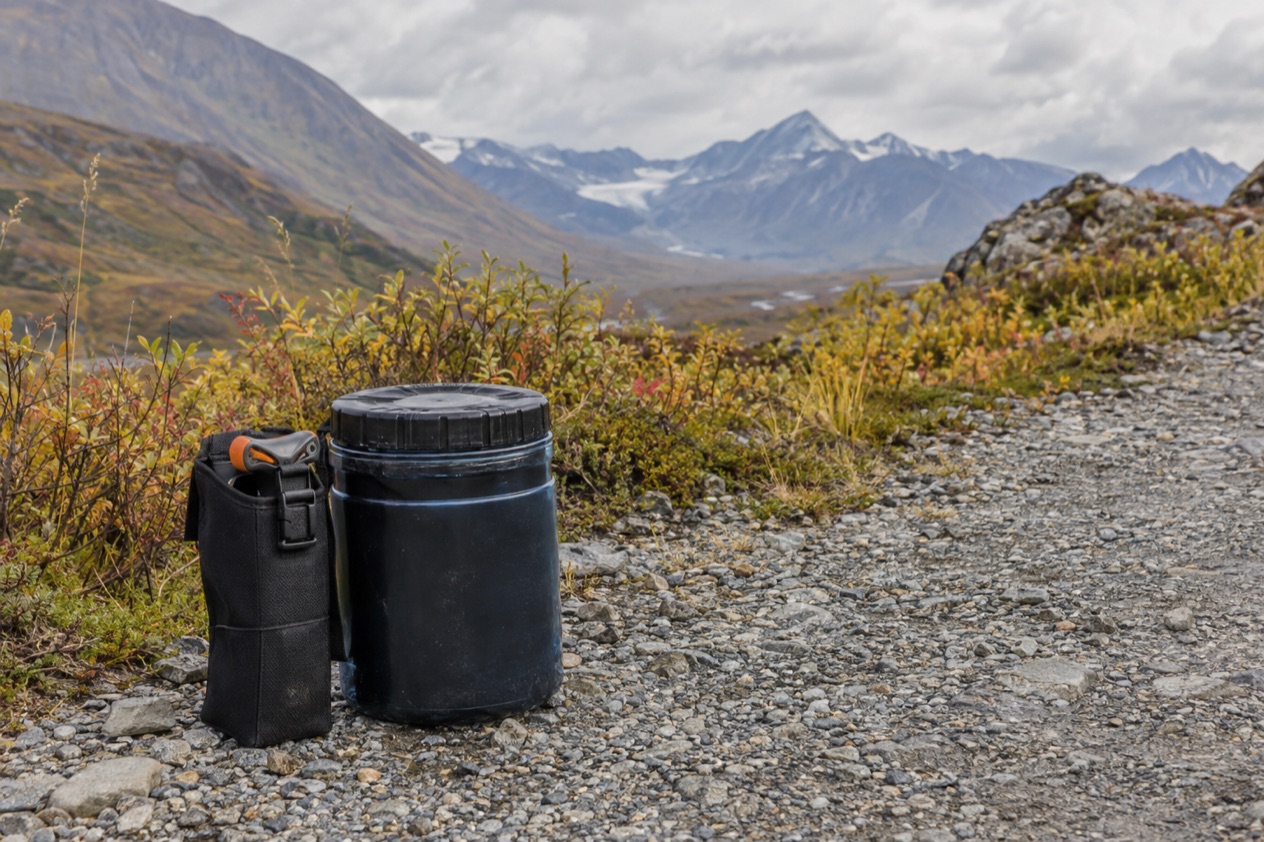
Yukon-Charley Rivers National Preserve shows what this looks like in practice. Bear-resistant food containers are loaned free of charge at the Eagle Visitor Center and at the Fairbanks Alaska Public Lands Information Center, first come, first served, with no reservations. The preserve has steel drums with locking lids and smaller backpacker versions. Canoeists are required to use the steel drums, while the backpacker containers are loaned for hiking, packrafting and kayaking only.
For travelers who do not use a container there, the preserve strongly encourages caching all food and scented items at least 100 feet from camp and hanging them at least 10 feet above the ground. Inedible game parts, fish and food scraps that could draw bears should go at least 300 yards from camp and below the high water level. ADF&G also keeps a page of bear safety advice written for hunters.
Carry bear spray and respect the distances in Denali
Denali spells out its expectations plainly. Bear spray is strongly encouraged for all hikers, and visitors must stay 300 yards from bears at all times. Other animals get a smaller margin of 25 yards, and the park asks you to keep wildlife wild by never feeding or harassing it.
A bear that has found human food is a bear that may return to people, which is why the feeding ban sits beside the distance rule. Photographers with long lenses will find the distance a fair trade, since a bear acting naturally on a hillside is a better picture than one drawn toward a camp.
Plan as if help is far away
Denali’s own safety guidance asks hikers to travel with at least one other person and to make sure someone knows where they are going. In the park, snow can fall nearly any month, hypothermia is always a factor, and falls cause more deaths than any other thing, so layers of wool or synthetic fabric and rain gear belong in the pack along with the spray.
The same thinking runs through Katmai National Park and Preserve, where all of the park is bear country. Visitors are asked to tell a responsible person where they are headed, when they expect to return and how overdue they can be before that person should worry.
Trip planners can be filled out at the King Salmon and Brooks Camp visitor centers, or an itinerary can be emailed to Katmai’s dispatch office. Park staff do not track individual trips, but a detailed itinerary can give rangers valuable information in an emergency.
Strong storms sweep through the Katmai area at any time of year, and weather may delay pick-up from a chartered aircraft for days, so waterproof rain gear and extra food make sense. The park advises against a tight schedule and suggests always having a backup plan. Backcountry travelers there should consider a satellite phone or a satellite-based text messaging device.
What do you do if you meet a bear?
The official guidance centers on distance, never feeding or harassing, bear spray in Denali, and calling for help and reporting afterward. The agencies publish their rules as habits to carry into bear country, and the agency pages and videos are where detailed behavior guidance lives.
Distance and respect
In Denali the rule is 300 yards from a bear, and the park applies it to every visitor at all times. Wildlife must never be fed or harassed, which includes following an animal for a better view. Bear spray is strongly encouraged for every hiker, so it belongs on your hip or pack strap and not buried at the bottom of the bag.
Other parks and agencies publish their own guidance, and a rule of one park stays with that park. Denali’s numbers are the ones that appear in park materials, while Katmai simply states that the whole park is bear country and asks visitors to follow bear safety guidelines.
Calling for help
In an emergency in Denali, dial 9-1-1 and be ready to give your location as Denali National Park. A phone signal exists only within three miles of the park entrance, so a call is not something to count on once you are on the trail. That is one more reason the companion and trip-plan habits matter.
Yukon-Charley Rivers National Preserve has no cell phone service at all, and visitors there must be self-reliant and able to carry out their own extraction and communication. Satellite phones are described as an excellent method of two-way communication, and travelers can consider renting one in Fairbanks before the trip. Air taxis serving the preserve are often unable to fly in bad weather, so extra food and a few spare days are part of the plan.
| Contact | Details | Hours |
|---|---|---|
| Denali National Park ranger by phone | 907 683-9532 | 9 am to 4 pm daily, except major holidays |
Report dangerous situations and learn more
A dangerous bear situation in Alaska should be reported to ADF&G using its wildlife encounter form. Reports help biologists understand where bears and people are coming into conflict, and they are the reason the department keeps a record in the first place.
For preparation before a trip, ADF&G lends four bear safety videos from its offices in Anchorage, Fairbanks and Juneau. A 19-minute DVD titled HEY BEARS!!! How YOU Can Stay Safe in Bear Country is available free for classrooms and youth groups. For polar bear country, safety guidelines come from the U.S. Fish and Wildlife Service.
Where do you see bears?
You may see bears wherever food gathers them: salmon streams on the coast, tundra slopes in Denali, and forested shores in the southeast. Sightings are chances and never promises, and the same distance rules apply when a bear turns up unexpectedly.
Brown bears on salmon rivers and tundra
Alaska’s brown bear population is estimated at a healthy 30,000. In parts of coastal Alaska they feed mostly on spawning salmon that come near shore, and that rich diet helps explain the enormous size of the bears there. Bears are mostly solitary, but they may gather in large numbers where rivers hold spawning salmon, which is why a salmon stream can show you several bears at once.
Inland, Denali offers a different picture. Bears there will wait at the burrows of Arctic ground squirrels, hoping to catch one of the small rodents. Watching a bear dig patiently at a burrow on an open slope, from the required distance, is a very different scene from a river crowded with salmon.
Brown bears are the only bears with a hump of muscle at the top of the shoulder, a good clue for telling them from black bears. They generally weigh from 180 to 1,320 lb, with males outweighing females. Mating season runs from mid-May to early July, shifting later the farther north the bears live, and in winter they prefer to den in a protected spot, though they are not full hibernators.
Black bears from Hyder to the Kenai
The American black bear is the smallest and most widely distributed bear on the continent, and Alaska holds several regional forms. Near Hyder, visitors can see black bears taking dead chum salmon. The Kenai black bear lives on the Kenai Peninsula, and the Dall Island black bear lives on Dall Island in the Alexander Archipelago.
In southeastern Alaska the glacier bear, also called the blue bear, is distinguished by silvery-gray fur with a blue luster. That coloring appears along a portion of the coast, so a black bear is not always black. The Haida Gwaii black bear is found in Haida Gwaii and Alaska.
| Place | Bear | Average adult weight (lb) |
|---|---|---|
| Yukon Flats National Wildlife Refuge | Male black bear | 192 |
| Yukon Flats National Wildlife Refuge | Female black bear | 140 |
| Kuiu Island | Black bear (adult) | 254 |
On Kuiu Island in the southeast, where salmon are readily available, black bears run noticeably heavier than those of the Yukon Flats in the east-central part of the state.
Polar bears and bears near towns
Polar bears, the third species, live in Alaska too, and the U.S. Fish and Wildlife Service provides separate safety guidelines for polar bear country. Closer to Anchorage, a research project tracked nine bears with GPS collars carrying video cameras, and ADF&G’s Anchorage Bears Story Map shows what that data revealed about bears living near a city.
Good to know before you go
Bear country is also weather country, so a rain jacket and warm layers matter as much as the spray. Snow can fall nearly any month in Denali, and storms can hold a chartered plane at Katmai for days.
Poison ivy, oak and sumac do not grow in Denali, but cow parsnip can cause allergic reactions, a small reminder to look at what you brush against. Leave your plans with someone before you head out, and carry extra food if a plane is part of your trip.
Sources
- Alaska Department of Fish and Game, Living with bears (https://www.adfg.alaska.gov/index.cfm?adfg=livingwithbears.main), checked October 11, 2026
- National Park Service, Denali National Park & Preserve, plan your visit: safety (https://www.nps.gov/dena/planyourvisit/safety.htm), checked October 11, 2026
- National Park Service, Katmai National Park & Preserve, plan your visit: safety (https://www.nps.gov/katm/planyourvisit/safety.htm), checked October 11, 2026
- National Park Service, Yukon-Charley Rivers National Preserve, plan your visit: safety (https://www.nps.gov/yuch/planyourvisit/safety.htm), checked October 11, 2026
- Wikipedia, Brown bear (https://en.wikipedia.org/wiki/Brown_bear), checked October 11, 2026
- Wikipedia, American black bear (https://en.wikipedia.org/wiki/American_black_bear), checked October 11, 2026