
For many places in Alaska, a small aircraft is the road. For a great many Alaska places, a small aircraft is the road. Bush planes and air taxis carry people to parks, villages and lakes where no highway goes, and the flight itself is part of the trip.
What is bush flying in Alaska?
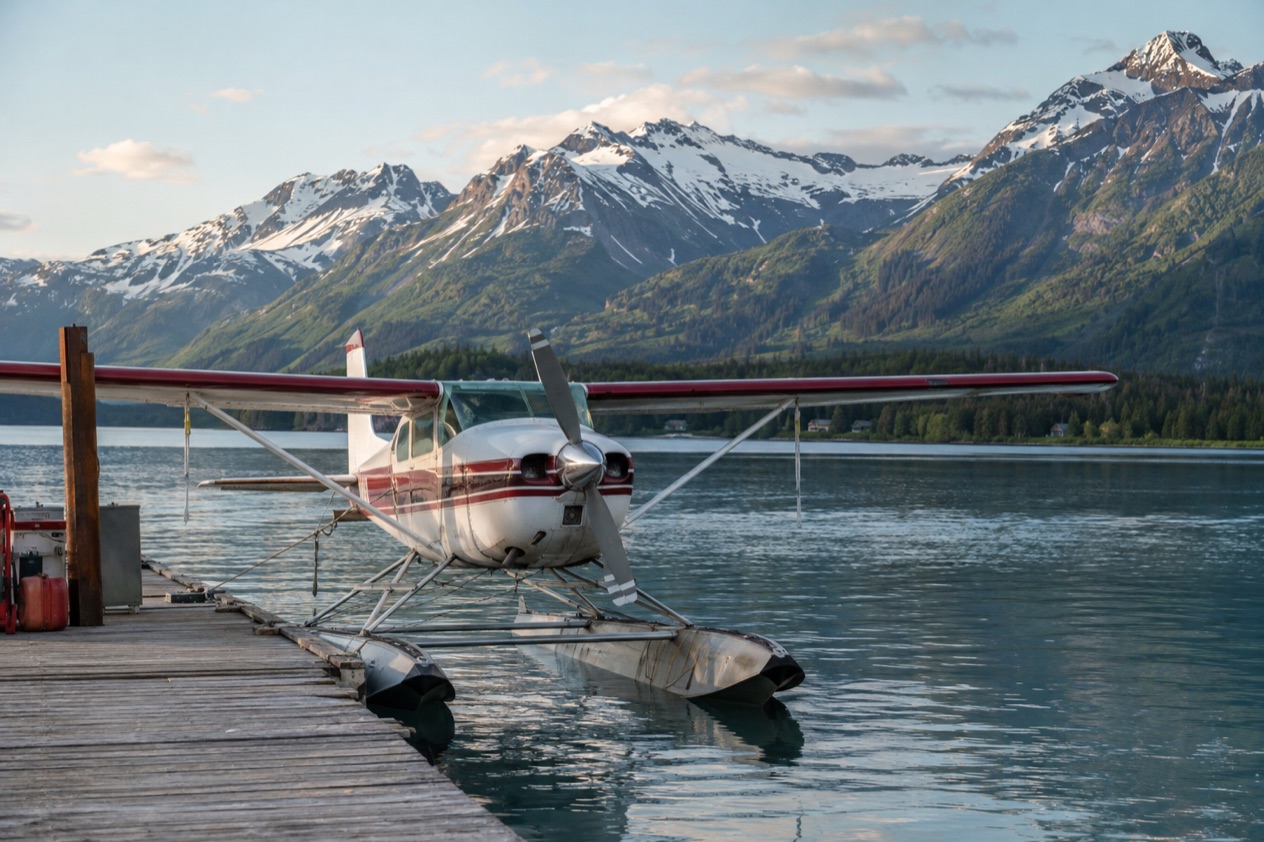
Bush flying is aircraft flying in remote wilderness areas where there are no prepared landing strips or runways. The pilot lands on whatever the country offers: a gravel bar, a stretch of tundra, a lake, a frozen river, a snowfield. That is why the planes look the way they do, and why the flights feel so different from a hop between two airports.
To manage rough ground, bush planes are fitted with tundra tires, floats or skis. Tundra tires let a plane touch down on uneven terrain. Floats turn a lake or river into the runway. Skis do the same job on snow and ice. Which gear a plane wears tells you a lot about the country it flies over.
How it began: mail runs and a mining camp
The story starts in 1924, when Eielson received a de Havilland 4 to make eight mail runs to McGrath, 280 miles away. That same summer, on August 19, Noel Wien made the first successful bush flight, to the mining town of Livengood. It was a small event on a calendar, and it changed how people thought about distance in the territory.
The flight to Livengood showed that a trip made in support of mining operations could take under an hour, where the dog sled trail would take several days in winter. Over the rest of that summer Wien made 34 flights carrying supplies and services to the roughly 250 men at the Livengood camp. Flying stopped being a stunt and became a way to supply a community.
Why it still matters in Western Alaska
The reason is plain geography. In Western Alaska, 82% of towns are not connected by roads, so bush flying is how food, mail and medical care arrive. A traveler boarding a small plane for a park or a village is using the same system that residents depend on every day.
That shapes the experience. In Western Alaska, bush flying is essential to get food, mail and medical care to roadless towns. Visitors who understand this tend to read a flight as part of the community’s working life, not only as an excursion.
From supply flights to sightseeing
Flying for visitors came later. In 1947 Celia M. Hunter became one of the first flight attendants on flights to Nome and Kotzebue, and those were the first tourist trips made by air in the Alaskan bush. The same machines that hauled mail and miners began to carry people who simply wanted to see the country.
Today that idea runs through the air taxi business around the state. A daily flight from Fairbanks reaches Bettles, a gateway community with a park visitor center. Out of the window you may see braided rivers, lakes strung along valleys and mountains that no road crosses.
Where do small planes fly?
Small planes fly wherever the road system stops, which in practice means national parks, river villages and the communities of the Western and Southwest regions. The parks are the clearest example, because the National Park Service describes several of them as places you reach by air or on foot.
Gates of the Arctic from Fairbanks
Gates of the Arctic National Park and Preserve is a wilderness park with no roads or trails into the park lands, so visitors must fly or hike in. Access begins in Fairbanks. Several small airlines there provide daily flights into the gateway communities of Bettles and Anaktuvuk Pass, along with flag stops to Coldfoot.
Most visitors reach the park by air taxi, in small aircraft equipped with floats or tundra tires. Bettles has no road, so the daily flight from Fairbanks is the way in, and the village has a park visitor center. Hiking in is also possible, either from the Dalton Highway or from the village of Anaktuvuk Pass. There are no trails into the park from any location, and river crossings are necessary from both starting points.
Lake Clark and Port Alsworth
Lake Clark National Park and Preserve sits on the Alaska Peninsula in southwest Alaska. It lies southwest of Anchorage and west of Homer, and it is not on the road system. Access is primarily by small aircraft, which makes the plane the usual first step of any visit.
The park’s field office is in Port Alsworth, a community that is itself reached by air. The park was established by the Alaska National Interest Lands Conservation Act, in December 1980. Permits and reservations are required for the park, so the flight is one piece of a larger plan.
Wrangell-St. Elias and the Yakutat flight
Wrangell-St. Elias is a park where roads and aircraft both play a part. The park service lists one-way travel times between its visitor services areas, and most of them are road times. The exception is Yakutat, listed as one day by flying from the visitor center and from Chitina alike.
| Route | One-way travel time |
|---|---|
| Visitor Center to McCarthy Road and Chitina | 1 hour |
| Visitor Center to Kennecott | 4 hours |
| Visitor Center to Nabesna Road, Slana | 1 hour 30 minutes |
| Visitor Center to Nabesna Road, Kendesnii Campground | 2 hours 15 minutes |
| Chitina to Kennecott | 2 hours 45 minutes |
| Visitor Center to Yakutat | 1 day by flying |
| Chitina to Yakutat | 1 day by flying |
Read the table as a sense of scale. Even the road legs inside this one park take hours, and Yakutat is a day away by air. That gives a feel for why small aircraft matter in country this large.
Anchorage and the communities it links
Where do small planes fly? Ravn Alaska, an airline that specialized in serving small communities and was based at Ted Stevens Anchorage International Airport, shows the pattern well. When it introduced scheduled passenger service in May 1983, Convair planes served Valdez, Kenai, Kodiak, Cordova and Homer, while Twin Otter aircraft based in Bethel served many small surrounding communities.
The airline’s later history shows how fragile such routes can be. In November 2020 it resumed service to Dutch Harbor (Unalaska), Homer, Kenai, Sand Point and Valdez through public charters, each market served four days a week from Anchorage. Scheduled authority followed at the end of that month, covering Anchorage, Dutch Harbor, Homer, Kenai, Kodiak and Sand Point.
Talkeetna and the mountain
Talkeetna is a town at the base of Denali, North America’s tallest peak, where the glacier-fed Chulitna, Susitna and Talkeetna Rivers meet. It is about 2.5 hours from Anchorage by car. Where do small planes fly?
The town works to preserve its heritage, a mission carried by the Talkeetna Chamber of Commerce. On the ground it is a place of rivers and mountain views, and a walk through town makes a fitting pause before or after a flight.
What should you know before you book a seat?
Before booking, confirm whether your flight ends in a gateway community or continues into the park. The park service facts for the places above set the frame: what is a gateway, what needs a permit, and what happens once you land.
Match the flight to the destination
A flight to Bettles and a flight into the park are different things. Bettles is a gateway community with a visitor center, reached by the daily flight from Fairbanks. Bettles is a gateway community with a park visitor center, and most visitors access the park by air taxi in small aircraft equipped with floats or tundra tires. Anaktuvuk Pass is the other gateway, and Coldfoot is a flag stop.
At Lake Clark the distinction is the same. The plane brings you to the park, and Port Alsworth is where the field office stands. It helps to think of each trip as a flight plus a plan for the ground, with the plane bringing you only to the start.
Permits, reservations and limited connections
Permits and reservations are required for Lake Clark National Park and Preserve, and internet and cellular access there is limited. The practical meaning is that arrangements are made before you go, and that you should expect to be out of touch once you arrive.
For Gates of the Arctic, the point to keep in mind is that no trails lead into the park from any location. Anyone who plans to walk in from the Dalton Highway or Anaktuvuk Pass faces river crossings. Those who fly in by air taxi skip the approach but arrive in the same trail-free landscape.
Companies come and go
Air service in Alaska shifts over time. Ravn Alaska traces its roots to June 20, 1948, and the founding of Economy Helicopters, yet in February 2024 its CEO, Rob McKinney, announced that 130 employees had been laid off. He cited inflation, labor shortages and unexpected competition on some routes.
The lesson for a traveler is modest. A route that served a town in one period may look different in another, so the name of a carrier on an older map or story is no guarantee of what flies today. Look at which operators are named by the park or the community you are headed to, and build from there.
Good to know before you go
A bush flight rewards a light, flexible plan. Expect little or no cell signal at places like Lake Clark, expect that a park needs permits and reservations before you leave, and remember that in Gates of the Arctic every route, by air or on foot, ends in country with no trails. Bettles has a park visitor center for the last questions, and the plane’s gear, whether floats, skis or tundra tires, tells you how the pilot plans to land.
Sources
- Wikipedia, Bush flying (https://en.wikipedia.org/wiki/Bush_flying), checked October 11, 2026
- Wikipedia, Ravn Alaska (https://en.wikipedia.org/wiki/Ravn_Alaska), checked October 11, 2026
- National Park Service, Lake Clark National Park & Preserve, plan your visit: basicinfo (https://www.nps.gov/lacl/planyourvisit/basicinfo.htm), checked October 11, 2026
- National Park Service, Gates of the Arctic National Park & Preserve, plan your visit: directions (https://www.nps.gov/gaar/planyourvisit/directions.htm), checked October 11, 2026
- National Park Service, Wrangell – St. Elias National Park & Preserve, plan your visit: travel times between visitor services areas (https://www.nps.gov/wrst/planyourvisit/travel-times-between-visitor-services-areas.htm), checked October 11, 2026
- Talkeetna Chamber of Commerce (https://www.talkeetnachamber.org/), checked October 11, 2026