
On the Saturday closest to the summer solstice, downtown Fairbanks closes its streets for a free street fair, and music from three stages drifts along in light that never really fades. Come winter, the same streets go quiet and cold, and people look up instead, waiting for the green glow over the birch and spruce. Fairbanks is the working heart of Alaska’s Interior, a river town with a university, a gold rush past and a taste for extremes, and it suits travelers who come for the sky.
Where is Fairbanks and what is it like?
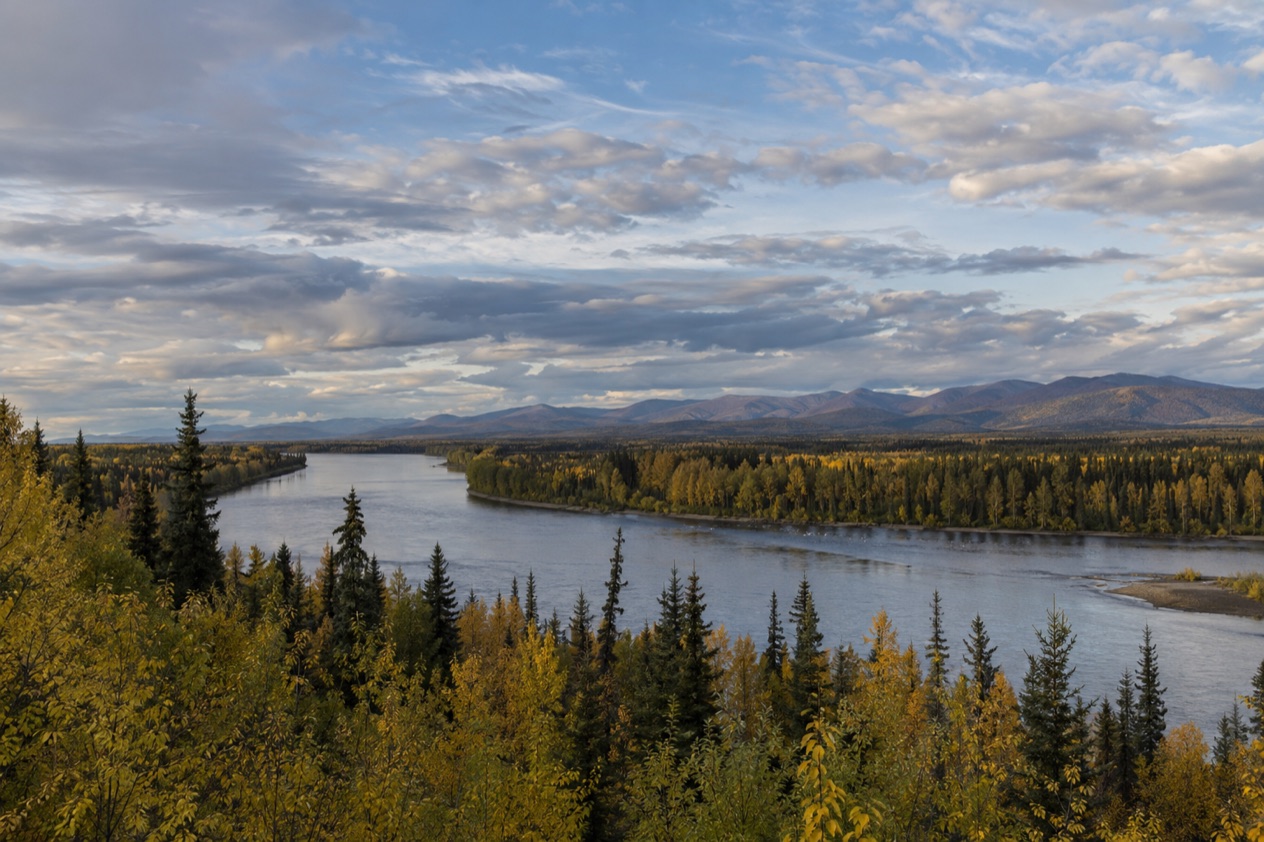
Fairbanks sits in the Interior of Alaska, on the Chena River, in a broad valley between the Alaska Range to the south and the Brooks Range to the north. It is the second-largest city in the state and the gateway to the Interior and Arctic regions, which makes it a natural base for exploring northern Alaska. The Arctic Circle lies 140 miles away by air.
The place feels like a town that has grown up around practical needs. Fort Wainwright and Eielson Air Force Base are part of the local scene, the University of Alaska Fairbanks gives the city a campus life and a museum worth a visit, and the borough around it is a patchwork of birch woods, cabins and small communities.
Nobody comes here for a polished resort. They come for a real northern place with a gold rush story, sternwheelers on the river and a sky that changes completely from one season to the next.
Fairbanks began in August 1901 when E. T. Barnette set up a trading post on the south bank of the Chena, and it was incorporated as a city in November 1903. That frontier streak still shows in the roadhouse-style saloons nearby and in the way people talk about gear, dogs and weather as everyday subjects.
Light defines the rhythm of the year. In June the sun is up from about 3 AM to 12:45 AM and it never gets fully dark, while in winter the sun appears only from about 10:45 AM to 2:45 PM.
Summer is for long evenings and outdoor events, winter for hot springs, ice sculptures and the aurora. Travelers who want beaches, nightlife or a big-city pace may find Fairbanks too quiet. Those who like space, odd traditions and a chance at the northern lights usually fall for it.
What is there to do in Fairbanks?
The big reasons to come are the midnight sun, the aurora, the hot springs and the river, with a museum and a few nearby towns to fill the gaps. What sets Fairbanks apart from its neighbors is that it is the place to see the Interior and the Arctic side of Alaska rather than the coast.
The aurora and the midnight sun
Fairbanks has an aurora season that runs from late August to mid-April, and the northern lights are best seen on cold, clear nights. Around the March equinox, the lights are often cited as especially visible near Chena Hot Springs. The University of Alaska Fairbanks Geophysical Institute publishes an aurora forecast, a handy way to judge a given night. Lights are a chance, never a promise, so a few nights in town improve the odds.
In summer the story reverses. The midnight sun season stretches from April 22 to August 20, and from May 17 to July 27 there are 70 straight days with 24 hours of sunlight.
Evenings feel endless, and the Midnight Sun Baseball Game, played since 1906 and hosted by the Alaska Goldpanners around the solstice, is played under that light. The Midnight Sun Festival adds gold panning, a climbing wall, pony rides and more than 30 live performances.
Chena Hot Springs Resort
About 56 miles northeast of Fairbanks, near the Chena River State Recreation Area, Chena Hot Springs Resort is the classic outing. The natural hot springs are open for soaking year-round, including beneath the aurora. The Aurora Ice Museum holds carved ice sculptures and is open throughout the year.
In winter, an aurora viewing tour takes guests by tracked vehicle to Charlie Dome, with heated yurts and hot drinks. In summer, an electric ATV ride follows Monument Creek Trail. The resort was started by two gold mining brothers, Robert and Thomas Swan, and twelve small cabins were built there in 1911.
| Activity | Price |
|---|---|
| Pool House day pass | $20 adults, $17 children |
| Winter aurora viewing tour | $125 per person |
| Aurora Ice Museum tour | $20 adults, $15 children |
| Summer ATV tour | $95 per rider |
The river, the museum and the town
The Riverboat Discovery runs sternwheel riverboats on the Chena and Tanana rivers, a business founded in 1950 by Jim and Mary Binkley. The larger Discovery III carries up to 900 passengers over four decks.
On the university campus, the University of Alaska Museum of the North covers Alaska Native cultures, natural wonders, wildlife and Arctic dinosaurs. Downtown, simple walking maps are available from Explore Fairbanks.
| Site | Open |
|---|---|
| University of Alaska Museum of the North | Daily, 9 AM to 5:30 PM (admission sales close at 5 PM) |
North Pole and Ester
The town of North Pole is near Fairbanks and leans fully into Christmas, with streets named Santa Claus Lane and Kris Kringle Drive, candy cane street lights, red firetrucks and a gift shop called Santa Claus House, where reindeer stay just outside. Ester began as a gold mining camp, and its historic district is on the National Register of Historic Places. In summer, the Malemute Saloon opens on selected weekends and often has live music from local bands, and a farmers’ market meets on Thursday evenings at Ester Community Park.
How many days do you need in Fairbanks?
A long weekend covers Fairbanks well, and a week lets you add the Interior and the Arctic side of Alaska. The town itself does not need much time, but the things around it are what stretch a stay.
With three days, a rhythm works. One day for the town: the Museum of the North, a walk along the Chena and a riverboat outing. One day for Chena Hot Springs, soaking in the pools and, in the right season, staying for the aurora. One day for North Pole and Ester, which pair neatly with a slower morning. In summer, the late light means evenings stay open for baseball, a festival or a farmers’ market.
In winter, nights matter more than days. The aurora is a chance rather than a certainty, so spreading a stay over several nights improves the odds, and hot springs make cold evenings pleasant. Ice art is on display around Fairbanks from mid-February to the end of March, which gives a late-winter stay another reason.
Lodges in and near Denali serve as basecamps. The Arctic Circle is 196 driving miles north, and small-plane operators such as Warbelow’s Air Ventures serve villages including Beaver, Central, Circle and Manley Hot Springs from Fairbanks. Flightseeing, dog mushing, fishing and wildlife viewing all appear among the local activity categories.
Where to stay in Fairbanks
Fairbanks offers bed and breakfasts, cabins, hostels, hotels and motels, lodges, campgrounds and RV parks, and vacation rentals, so the choice is really about what kind of stay you want. Hotels in town include family-friendly ones with views of snow-capped peaks, and they suit those who want to walk to the river, restaurants and downtown events. Bed and breakfasts are described as charming and nestled amongst birch trees, a good fit for travelers who like a host and a quiet setting. Hostels fit those on a tighter plan.
Outside town, vacation rentals include secluded cabins in the woods, where visitors can reconnect with nature, which pairs well with an aurora trip. Campgrounds and RV parks let you pitch a tent or park an RV and experience wilderness with home comforts.
Lodges form another category. Some are in Denali National Park and Preserve, others are scattered across the Interior and the Arctic, and they work as basecamps for big adventures or for relaxing. The Morris Thompson Cultural and Visitors Center can be reached at (907) 456-5774 for planning help.
How do you get to Fairbanks and get around?
Visitors arrive by air at Fairbanks International Airport, three miles southwest of downtown and open 24 hours a day. It has domestic flights from Chicago, Dallas, Denver, Minneapolis and Seattle-Tacoma, operated by airlines including Alaska Airlines and Horizon Air, American, Delta and United. Air North also runs seasonal charter flights to Dawson City, Canada.
By road, the George Parks Highway (Highway 3) links Anchorage and Fairbanks, a drive of about 7 to 8 hours in summer with stops, passing through Denali National Park. The train from Denali takes about 4 hours.
Getting around the area is covered by the businesses that serve visitors. Fairbanks-based companies help travelers reach remote areas, guide them through town, plan adventures or provide equipment. Downtown is the part you can explore with a simple walking map from Explore Fairbanks. For trips farther out, such as Chena Hot Springs, North Pole or Denali, the distances are real, and air operators serve some villages that have no road connection.
Explore Fairbanks, run by the Fairbanks Convention & Visitors Bureau, lists air transportation options, travel agents and trip planners, and can be reached at (907) 456-5774.
When is the best time to visit Fairbanks?
The warmest month, July, brings average highs in the low 70s and lows in the low 50s, with showers on a handful of days, so afternoons suit time on the river and evenings stay light for hours.
Summer has the most events. The Midnight Sun Festival and the baseball game come near the solstice in June, the World Eskimo-Indian Olympics bring athletes for contests like the high kick, blanket toss and four-man carry, and the Tanana Valley State Fair closes the summer with a Ferris wheel, carnival games and local food.
For the northern lights, the stretch from late August to mid-April is the season, with cold, clear nights working best, and September through mid-April is often given as the prime window. Winter also brings the Yukon Quest Alaska and the Open North American Championship sled dog races, the Winter Solstice Celebration with fireworks in the week of December 21, and ice art from mid-February to the end of March.
| Month | Average high (°F) | Average low (°F) | Precipitation (in) | Days with precipitation | Snowfall (in) |
|---|---|---|---|---|---|
| January | 0.6 | -17.2 | 0.61 | 2.1 | 10.2 |
| July | 72.7 | 53.1 | 2.26 | 5.5 | 0.0 |
Good to know before you go
Fairbanks has banks and ATMs, medical services and places of worship, so the basics are covered in town. Daylight shapes every plan: summer days are very long and winter days short, so the time you travel changes what you do. Outfitters in town can provide equipment for adventures in the Interior, which is useful when the weather turns cold or wet. For questions, the visitor center at (907) 456-5774 is the place to call.
Sources
- Explore Fairbanks (https://www.explorefairbanks.com/), checked October 11, 2026
- Alaska.org, dest fairbanks (https://www.alaska.org/destination/fairbanks), checked October 11, 2026
- Wikivoyage, Fairbanks (https://en.wikivoyage.org/wiki/Fairbanks), checked October 11, 2026
- Wikipedia, Fairbanks, Alaska (https://en.wikipedia.org/wiki/Fairbanks,_Alaska), checked October 11, 2026
- Wikipedia, Fairbanks International Airport (https://en.wikipedia.org/wiki/Fairbanks_International_Airport), checked October 11, 2026
- Wikipedia, Fairbanks North Star Borough, Alaska (https://en.wikipedia.org/wiki/Fairbanks_North_Star_Borough,_Alaska), checked October 11, 2026
- University of Alaska Museum of the North (https://www.uaf.edu/museum/), checked October 11, 2026
- Chena Hot Springs Resort (https://www.chenahotsprings.com/), checked October 11, 2026
- Wikipedia, Chena Hot Springs (https://en.wikipedia.org/wiki/Chena_Hot_Springs), checked October 11, 2026
- Wikipedia, North Pole, Alaska (https://en.wikipedia.org/wiki/North_Pole,_Alaska), checked October 11, 2026
- Wikipedia, Ester, Alaska (https://en.wikipedia.org/wiki/Ester,_Alaska), checked October 11, 2026
- Wikipedia, Fort Wainwright (https://en.wikipedia.org/wiki/Fort_Wainwright), checked October 11, 2026
- Wikipedia, Riverboat Discovery (https://en.wikipedia.org/wiki/Riverboat_Discovery), checked October 11, 2026
- University of Alaska Fairbanks Geophysical Institute (https://www.gi.alaska.edu/), checked October 11, 2026
- Wikivoyage, North Pole (https://en.wikivoyage.org/wiki/North_Pole), checked October 11, 2026
- Wikipedia, Interior Alaska (https://en.wikipedia.org/wiki/Interior_Alaska), checked October 11, 2026
- Wikipedia, Climate of Alaska (https://en.wikipedia.org/wiki/Climate_of_Alaska), checked October 11, 2026
- NOAA NCEI, U.S. Climate Normals 1991-2020, monthly (https://www.ncei.noaa.gov/access/services/data/v1?dataset=normals-monthly-1991-2020&stations=USW00026411), station Fairbanks Intl Ap, elevation 432 feet, checked October 11, 2026
All our pages
When to go
- Best Time to Visit Fairbanks: Midnight Sun, Northern Lights, Weather and Festivals
- Fairbanks in January: Aurora Nights, Deep Cold and Hot Springs
- Fairbanks in February: Ice Art, Aurora Nights and Cold Sunny Days
- Fairbanks in March: Aurora Nights, Ice Art and Winter Weather
- Fairbanks in April: Spring Breakup, Last Aurora Nights, Chena Hot Springs and What to Do
- Fairbanks in May: Weather, Long Light and What to Do
- Fairbanks in June: Midnight Sun Festival, Weather and What to Do
- Fairbanks in July: Long Evenings, Weather and What to Do
- Fairbanks in August: Weather, the First Aurora Nights and Things to Do
- Fairbanks in September: Northern Lights, Fall Weather and What to Do
- Fairbanks in October: Weather, Aurora Nights and What to Do
- Fairbanks in November: Cold Weather, Aurora Season and Things to Do
- Fairbanks in December: Winter Solstice, Northern Lights and Cold-Weather Outings
Things to do
- Things to Do in Fairbanks: Riverboat, Aurora, Chena Hot Springs and Day Trips
- Day Trips from Fairbanks: Denali, Chena Hot Springs, North Pole and Ester
- 3 Days in Fairbanks: Chena River, Museum of the North, Chena Hot Springs and the Northern Lights
Where to stay
- Where to Stay in Fairbanks: Downtown, Birch-Wood Cabins, Chena Hot Springs and Denali Lodges
- Fairbanks Airport to Hotels: Getting to Town, Where to Stay and Arrival Basics
Getting there
- Fairbanks from Anchorage: Denali Star Train, Road Conditions, Flights and Stops Along the Way
- Fairbanks International Airport (FAI): Hours, Airlines and Getting to Town
- Fairbanks to Anchorage: The Denali Star Train, the Parks Highway and Road Conditions
- Fairbanks to the Arctic Circle: The Dalton Highway, Mile 115 and Your Options
- Fairbanks to Denali: The Parks Highway, the Denali Star Train and Planning the Trip