
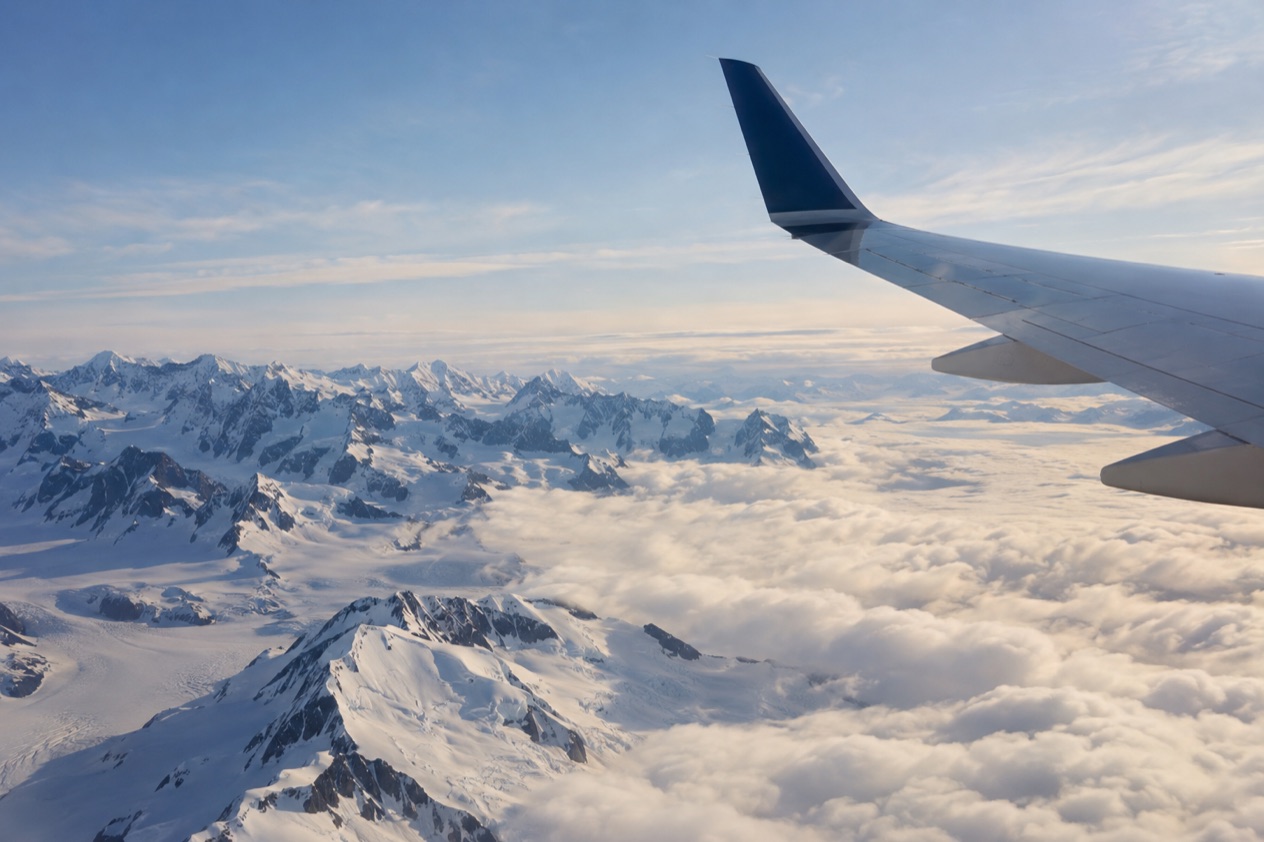
Late on a June evening the sky over the Chugach Mountains is still bright when the plane drops through the clouds, and passengers press toward the windows to look for the water of Cook Inlet and the first snowy ridges. Anchorage is where most Alaska trips begin, and the airport at its edge is the front door. Several major carriers fly into it, a long list of American cities connects to it without a stop, and the terminal you land in depends on who you flew.
Which airlines fly to Anchorage?
Alaska Airlines, Delta Air Lines, United Airlines, American Airlines, Sun Country Airlines and Air Canada all serve Ted Stevens Anchorage International Airport, and Condor and Discover Airlines fly out of it as well. The airport’s South Terminal, the domestic one, handles all of them. Which carrier suits you depends mostly on where you are starting and which loyalty program you already collect miles in.
Alaska Airlines
Anchorage is one of the hubs of Alaska Airlines, and that shows in how the airline is woven into the city. Its roots go back to McGee Airways, whose first service ran between Anchorage and Bristol Bay, and in the 1940s the company’s headquarters sat in Anchorage. Today the headquarters are in SeaTac, Washington, in the Seattle area, and Seattle–Tacoma is the carrier’s primary hub.
The airline connects West Coast cities with Alaska, Hawaii and a long list of destinations across North America and beyond. It belongs to the Oneworld alliance, and its frequent-flyer program is called Atmos Rewards. If you collect miles with Oneworld partners, this is the carrier where those miles are most likely to come into play on an Alaska trip.
A flight on the airline that grew up flying Alaska routes has a certain local flavor. Many passengers on board are residents heading home, fishermen, seasonal workers and hikers with oversized packs, so the cabin feels like the beginning of the trip rather than a generic commute.
Delta, United, American, Sun Country and Air Canada
The other major U.S. network carriers all land at the South Terminal: Delta Air Lines, United Airlines and American Airlines. Sun Country Airlines also uses the terminal, and so does Air Canada, which opens a route through Canada for travelers who start from a Canadian city or who prefer a connection there.
If you live near one of these airlines’ own hubs, the simplest plan is usually to stay with that carrier and connect through its home airport. Travelers who hold elite status or a co-branded credit card often decide this way, because a seat on the airline they already know is worth more than a small difference in schedule.
Condor and Discover Airlines
Condor and Discover Airlines appear on the South Terminal’s list for departures. Condor’s arrivals, on the other hand, are handled in the North Terminal, so a passenger meeting a friend who flew in on Condor should know to go to a different building than the one for a domestic arrival.
That split is a small detail, but it matters on the day. When you are picking someone up or checking where a flight lands, the terminal name on the board is worth a second look before you walk to the wrong end of the airport.
The cargo giants on the same field
Passenger airlines share the airport with some of the largest cargo operators in the country. Atlas Air, FedEx Express, Polar Air Cargo and UPS Airlines all use it as a hub, and the FedEx facility is the largest cargo operation on the field, able to process as many as 13,400 packages per hour with more than 1,200 employees.
As a traveler you will notice this from your window seat, where freighters with familiar logos sit parked along the ramp. Three long runways keep this mix of passengers and cargo moving, and next door is Lake Hood Seaplane Base, the busiest seaplane base in the world. On a clear day the sight of floatplanes lifting off a lake beside a jetliner’s approach is one of the most Alaskan views you can get from an airport.
Which cities fly nonstop to Anchorage?
Nonstop flights reach Anchorage from Atlanta, Chicago O’Hare, Dallas-Ft. Worth, Denver, Houston, Los Angeles, Minneapolis, Newark, Phoenix, Portland, Salt Lake City, San Francisco and Seattle/Tacoma, and in summer there are more. That list puts most of the country within one connection of the city, since each of these airports is a major hub in its own right.
| Region | Nonstop departure cities |
|---|---|
| West Coast and Pacific Northwest | Los Angeles, San Francisco, Portland, Seattle/Tacoma |
| Mountain West and Southwest | Denver, Phoenix, Salt Lake City |
| Midwest and South | Chicago O’Hare, Dallas-Ft. Worth, Houston, Minneapolis, Atlanta |
| Northeast | Newark |
The West Coast routes
Seattle/Tacoma is the gateway most Alaska travelers think of first, since it is Alaska Airlines’ primary hub and a place where so many routes from across the country come together. Portland, San Francisco and Los Angeles add three more nonstop links on the same side of the continent, and Alaska Airlines counts all of them among its own hubs.
For travelers from the Pacific states this is the natural way in. You leave your own city in the morning, perhaps change planes once at a hub, and arrive while the light is still long over the mountains. In summer, when the daylight stretches far into the evening, a late arrival does not feel like a lost day.
Hubs in the middle of the country
Denver, Salt Lake City, Phoenix, Minneapolis, Chicago O’Hare, Dallas-Ft. Worth, Houston and Atlanta all have direct service. These are the big connecting airports of the mainland, so if you live in a smaller city, your trip often means a short flight to one of them and then a nonstop north.
A traveler from the Southeast would look to Atlanta, someone from Texas to Dallas-Ft. Worth or Houston, and a Great Lakes family might choose Chicago or Minneapolis. Choosing the hub nearest your home, and the airline that runs it, keeps the plan simple and the itinerary free of backtracking.
The East Coast and the summer additions
Newark is the nonstop link for the Northeast, which spares New York and New Jersey area travelers a connection in the middle of the continent. Anyone starting further up the coast will probably connect to Newark or to a hub like Chicago.
The airport lists more nonstop cities in summer, in step with the season of the greatest number of visitors. The best time to visit Anchorage runs from May to early September, and it is in those months that the schedule grows. In winter, expect to connect through a larger hub more often than you would in the long days of summer.
International seasonal charter flights also come in during the busy months, and they land at the North Terminal rather than the South. If you are traveling on a charter booked as part of a package, check which building your ticket names.
What happens when you land at Anchorage?
The airport sits southwest of the city center, and in summer, with up to 19½ hours of sunlight and the sun setting just before midnight, an evening arrival still leaves time for a walk once you have dropped your bags.
The South Terminal and the North Terminal
The airport has two terminals and 32 gates between them. The South Terminal is the larger domestic building, with 24 gates for Air Canada, Alaska Airlines, American Airlines, Delta Air Lines, Sun Country Airlines and United Airlines, plus the departures of Condor and Discover Airlines.
The North Terminal has 8 gates and handles the international side: Condor arrivals, all international seasonal charter flights and military flights. Visitors from the Lower 48 never see it, but anyone arriving on a charter or on Condor will walk through its doors, so it is worth knowing which one is yours before you collect a rental car or meet a ride.
From the airport to downtown
People Mover bus Route 40 serves both the North and South terminals and connects to the downtown Transit Center. Buses come every 15 minutes on weekdays, and every 30 minutes in the evenings and on weekends, so a late arrival on a Saturday means a longer wait than a Tuesday afternoon.
The downtown Transit Center is the city’s main bus hub, so from there you can walk to many hotels or continue to another stop. The distance itself is short, and the road into town is a straightforward run past neighborhoods and lakes, with the mountains rising ahead on a clear day.
Onward connections and the railroad
Many Alaska itineraries leave Anchorage by rail, road or small plane, and the Alaska Railroad Depot stands at 411 West 1st Ave in town. Its phone number is +1 907 265-2494, the one to use for any question about a rail departure.
Floatplane flights, which depart from the Lake Hood Seaplane Base beside the main airport, are another way the city launches trips into the backcountry. Watching a floatplane lift off from the lake while your own jet taxis is a memorable first impression of the state.
Good to know before you go
Adults 18 and older need valid identification at the checkpoint, and since REAL ID enforcement began on May 7, 2025, a driver’s license with a star or the word Enhanced, or a passport, is what gets you through. A temporary driver’s license is not accepted, and the list of acceptable IDs can change without notice. Summer in Anchorage brings daytime highs around the upper 60s and cool nights, so a light layer is welcome on arrival.
| Fee | Amount | Who pays |
|---|---|---|
| TSA ConfirmID program | $45 | Travelers without an acceptable form of ID |
Sources
- Ted Stevens Anchorage International Airport (https://www.ancairport.com/), checked October 11, 2026
- Wikipedia, Alaska Airlines (https://en.wikipedia.org/wiki/Alaska_Airlines), checked October 11, 2026
- Wikivoyage, Anchorage (https://en.wikivoyage.org/wiki/Anchorage), checked October 11, 2026
- Transportation Security Administration, REAL ID (https://www.tsa.gov/real-id), checked October 11, 2026
- Transportation Security Administration, acceptable identification (https://www.tsa.gov/travel/security-screening/identification), checked October 11, 2026