
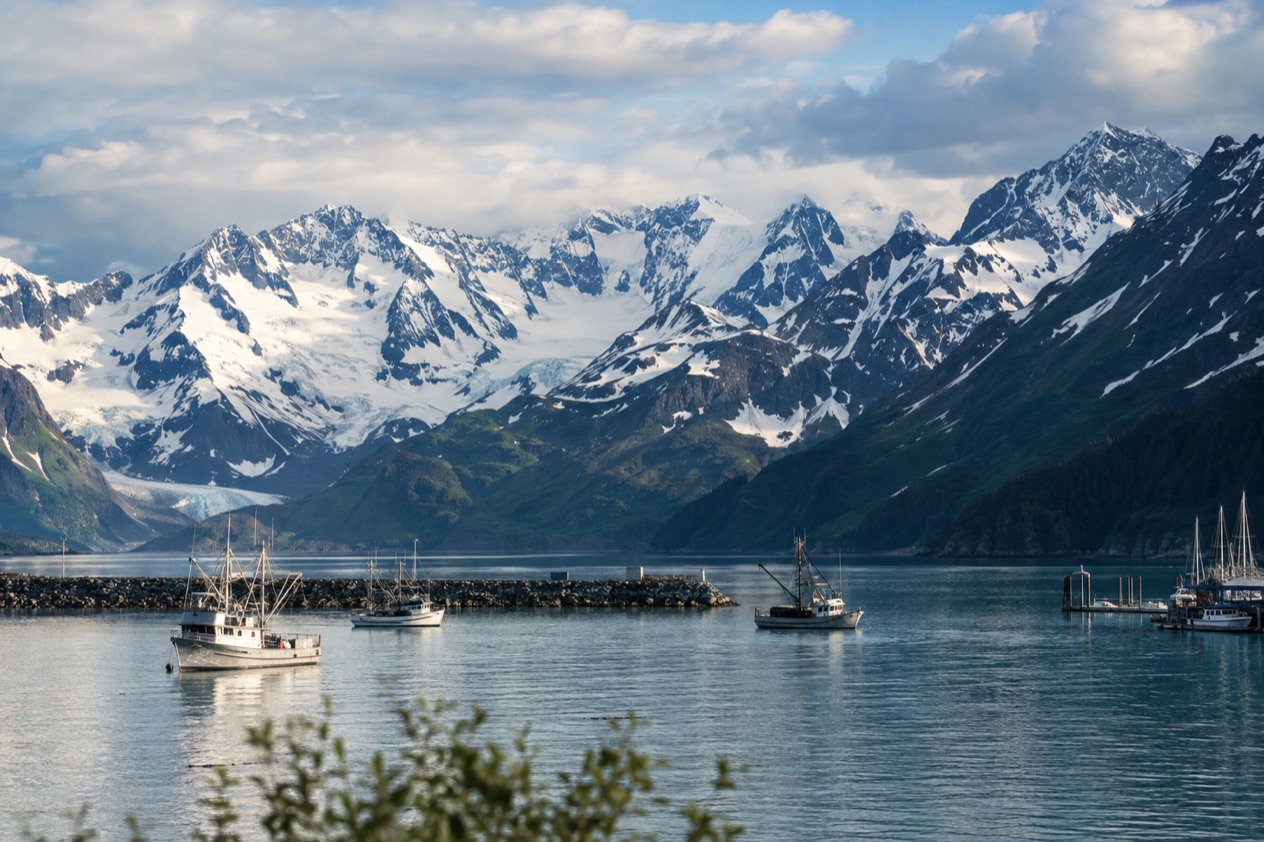
Glaciers hang in the valleys behind town, and the fjord below carries icebergs, otters and tankers in the same view. Valdez is a small port town on Prince William Sound for travelers who come for ice, big scenery and a long road that rewards the effort.
Where is Valdez and what is it like?
Valdez sits at the head of a fjord on Prince William Sound, in Southcentral Alaska, with the Chugach mountains rising behind it. It is a working port first and a tourist town second, which gives it a plain, practical feel. Boats, docks and fish-cleaning stations matter here more than souvenir rows.
Say the name the local way, val-DEEZ, and not like the Spanish surname. People in town notice, and it is the quickest way to sound like you have done your homework.
The town is also the end of the line for the Trans-Alaska Pipeline System, and Valdez is the largest port on the sound. That industrial side sits comfortably next to the glacier excursions and fishing charters, and you may see the pipeline’s story woven into local life as much as the scenery.
The port stays ice-free all year, the northernmost one in North America that does. Yet the town is also known as the snowiest in the country, with more than 300 inches in an average year. Both things are true at once: the water stays open while the streets and rooftops disappear under snow. Winter here is deep and heavy, and the landscape is built around it.
Valdez suits people who like their scenery big and their schedule loose. Anglers, kayakers, photographers, road-trippers and anyone who likes watching boats come in will feel at home.
It suits less well anyone looking for nightlife, a resort strip or a quick stop, because the only road in is the Richardson Highway, which crosses Thompson Pass and runs through Keystone Canyon. Getting here is part of the trip, and the town rewards those who stay a while.
What is there to do in Valdez?
The things to do in Valdez revolve around ice, water and mountains. The tourist industry rests on sightseeing of marine life and glaciers, deep-sea fishing and heli skiing, and what sets Valdez apart from its neighbors on the sound is how many of those glaciers surround the town itself.
Glaciers by sea, land and air
Five glaciers lie near Valdez, and they can be reached by sea, on land and from the air. A boat trip across the sound brings you to the ice fronts, where the cold air comes off the blue walls and the water is dotted with floating chunks. On the water you may also see sea otters, seals and seabirds, though wildlife is always a chance and never a promise.
The same glaciers look different from a small plane or helicopter, which shows how the ice spills out of high icefields into the valleys. Choose by what you want: a boat gives you the sound level view, while the air gives you the scale of the Chugach range.
Kayaking among icebergs at Valdez Glacier Lake
At Valdez Glacier Lake, visitors can kayak among icebergs that have calved from the glacier. The paddle is quiet, with only the dip of the blade and the occasional crackle of ice, and the bergs shift in color from white to deep blue depending on the light and the angle.
It is a different way to meet a glacier than a boat tour, because you are at water level, close enough to see the texture of the ice. Bring warm layers in your mind more than your camera, since the air above a glacier lake feels cold even when the town is mild.
Worthington Glacier on the Richardson Highway
Worthington Glacier is found at milepost 28.7 on the Richardson Highway, east of Valdez. The state recreation site there offers a view of the glacier and is described as one of the few remaining U.S. glaciers you can reach by paved highway. It covers 5,774 acres and was listed as a National Natural Landmark in 1968.
The ice has been steadily retreating for the last 150 years, though not as dramatically as many other glaciers in Alaska. Standing at the viewing area, you look at a river of ice that has shaped the whole valley. The stop fits naturally into the drive over Thompson Pass.
Fishing, marine life and heli skiing
Deep-sea fishing is one of the pillars of Valdez tourism. The sound is the setting, and the harbor is the starting point, with the working fleet adding to the atmosphere. Even if you never drop a line, walking the docks gives you a sense of what the town does for a living.
Heli skiing also supports the local tourist industry. The same snow that buries the town makes the surrounding mountains a draw for skiers who want a helicopter and untracked slopes. It is a specialist pursuit, and it explains why Valdez has a winter identity as strong as its summer one.
How many days do you need in Valdez?
A long weekend is the minimum that makes the trip worthwhile, and a few more days let the town slow down around you. The reason is the road: Valdez is a place you travel to, not a stop you squeeze in, so the stay should be worth the effort of arriving.
In a short stay, you can fit one glacier outing on the water or in the air, a stop at Worthington Glacier on the way in or out, and an evening along the harbor. That covers the main reasons to come and gives you a sense of the town’s rhythm. Add the Visitors Center for local information on what is running.
With more time, add kayaking at Valdez Glacier Lake, a fishing day on the sound, and a slower look at the town and its port. Weather can reshape any plan here, so a spare day is useful for boat trips and flights that depend on the sky. A longer stay also lets you pace yourself between big outings and quieter hours by the water.
If you are building a longer Alaska trip, Valdez links naturally with the Richardson Highway, which connects it to Fairbanks, and with other towns on the sound. Cordova and Whittier are the other main settlements on Prince William Sound, and each has its own ferry link. Treat them as separate trips rather than quick additions, since the sound is wide and the connections shape the timing.
Where to stay in Valdez
Most stays center on the town of Valdez itself, at the head of the fjord, where the harbor, the ferry terminal and the Visitors Center are all part of the same compact place. Staying in town puts you close to the boat departures and the waterfront, and it is the simplest base for glacier trips by sea and air.
The town suits travelers who want to wake up to the water and the mountains, and who prefer to step out and see the boats rather than commute to them. It is a good base for anglers and for anyone who plans to spend most of the stay on the sound.
Beyond town, the Richardson Highway leads toward Worthington Glacier, Thompson Pass and the interior. That corridor is where you pass through on the way in or out, and it is more a place to stop and look than a place to settle. Lodging choices follow the same logic as the rest of the trip: Valdez is a small port, and what you pick should match whether you are here for the water, the ice or the road.
Pair your lodging with the Visitors Center. From there, let the weather and your chosen outings decide how you spend each day.
How do you get to Valdez and get around?
The only road into Valdez is the Richardson Highway, which crosses Thompson Pass and passes through Keystone Canyon. From Anchorage the drive takes 6 to 7 hours, and from Tok it takes approximately 4.5 hours. The road is the main route, and it is also scenery in its own right.
The Richardson Highway runs 368 miles and connects Valdez to Fairbanks. It is marked as Alaska Route 4 from Valdez to Delta Junction and as Alaska Route 2 from there to Fairbanks. It was the first major road built in Alaska, and its southern end is at the Alaska Marine Highway terminal in Valdez. The northern end sits at the Steese Expressway and Airport Way in Fairbanks.
Valdez is also a port of call in the Alaska Marine Highway ferry system, which gives the town a connection by water as well as by road. That link ties it to the broader network of the sound, where other settlements include Cordova, Whittier and the Alaska Native villages of Chenega and Tatitlek.
Once in Valdez, the places you will want to see are the harbor, the town and the excursions that leave from the port. Glaciers can be reached by sea, land and air, so your transport often depends on the outing you choose rather than on a single system. Worthington Glacier lies along the highway, so it is a stop on the road in or out.
When is the best time to visit Valdez?
July is the clearest answer for a classic visit. Highs reach the mid-60s, nights stay in the upper 40s, and no snow falls in town. Rain still comes on about one day in three, so the month is mild rather than dry, and a waterproof layer belongs in the plan. For boat tours, kayaking and the drive in, it is the month when the conditions are most welcoming.
January shows the other face of Valdez. Highs stay in the upper 20s, lows drop to the upper teens, and snow builds up to many feet over the month. Precipitation arrives on more than ten days, mostly as snow. This is the season behind the town’s reputation as the snowiest in the country, and it is also the season that shapes heli skiing and the winter mood of the streets.
Seasons also shape what is open. The Visitors Center keeps longer hours from May 1 to August 31 and shorter hours from September 1 to April 30, so the town itself shifts gear with the calendar. Pick the season by the kind of trip you want: glaciers and water in the warm months, deep snow and mountain skiing in the cold ones.
Good to know before you go
Valdez is a place of heavy snow and open water, so the weather sets the pace of the stay. Allow time for the long road in, and plan around the seasons that matter for the outings you want. The Visitors Center keeps different hours in summer and winter.
| Site | Open |
|---|---|
| Valdez Visitors Center, May 1 to August 31 | Monday to Friday 9AM to 5PM, Saturday and Sunday 10AM to 6PM |
| Valdez Visitors Center, September 1 to April 30 | Monday to Friday 9AM to 4PM |
Sources
- Alaska.org, dest valdez (https://www.alaska.org/destination/valdez), checked October 11, 2026
- Wikivoyage, Valdez (https://en.wikivoyage.org/wiki/Valdez), checked October 11, 2026
- Wikipedia, Valdez, Alaska (https://en.wikipedia.org/wiki/Valdez,_Alaska), checked October 11, 2026
- Wikipedia, Worthington Glacier (https://en.wikipedia.org/wiki/Worthington_Glacier), checked October 11, 2026
- Wikipedia, Richardson Highway (https://en.wikipedia.org/wiki/Richardson_Highway), checked October 11, 2026
- Wikipedia, Prince William Sound (https://en.wikipedia.org/wiki/Prince_William_Sound), checked October 11, 2026
- Wikipedia, Whittier, Alaska (https://en.wikipedia.org/wiki/Whittier,_Alaska), checked October 11, 2026
- Wikipedia, Copper River Highway (https://en.wikipedia.org/wiki/Copper_River_Highway), checked October 11, 2026
- Wikipedia, Climate of Alaska (https://en.wikipedia.org/wiki/Climate_of_Alaska), checked October 11, 2026
- NOAA NCEI, U.S. Climate Normals 1991-2020, monthly (https://www.ncei.noaa.gov/access/services/data/v1?dataset=normals-monthly-1991-2020&stations=USW00026442), station Valdez Wso, elevation 95 feet, checked October 11, 2026
All our pages
When to go
- Best Time to Visit Valdez: Weather by Month, Seasons and Festivals
- Valdez in January: Snow, Short Days and the Road to Worthington Glacier
- Valdez in February: Deep Snow, Short Days and a Fjord Town in Winter
- Valdez in March: Snow, Longer Days, Worthington Glacier and the Northern Lights
- Valdez in April: Spring Snow, Lengthening Days and the Road Over Thompson Pass
- Valdez in May: Weather, Spring Light and What to Do on Prince William Sound
- Valdez in June: Weather, Long Days, Worthington Glacier and Prince William Sound
- Valdez in July: Long Light, Fjord Days and What to Wear
- Valdez in August: Weather, Worthington Glacier and the Richardson Highway
- Valdez in September: Fall Light, Rain, Worthington Glacier and What to Do
- Valdez in October: Snow Arriving, Northern Lights Season and Fjord Days
- Valdez in November: Snow, Short Days, Worthington Glacier and the Northern Lights
- Valdez in December: Deep Snow, Short Days, Worthington Glacier and Northern Lights Chances