
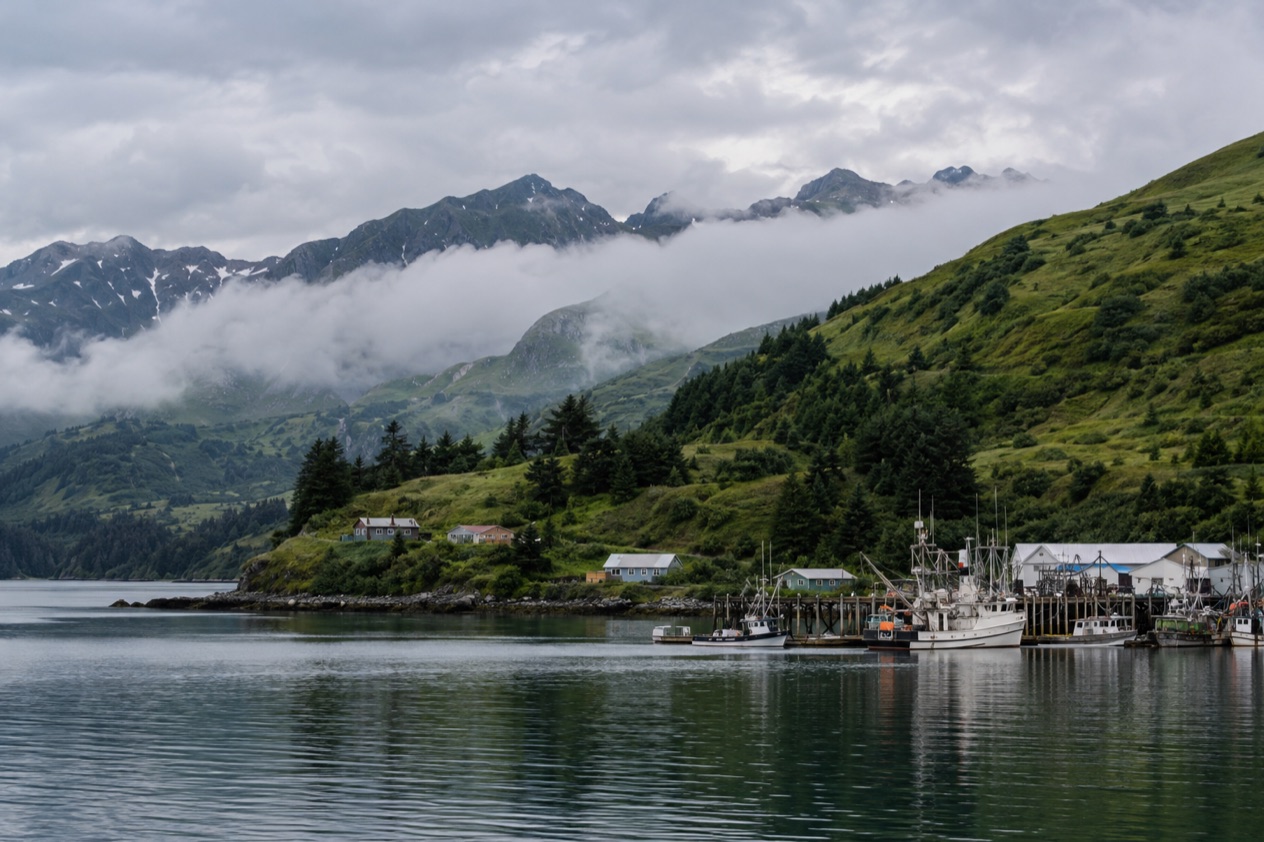
Fishing boats crowd the harbor, gulls argue over the docks, and green hills climb straight from the waterfront into low cloud. Kodiak earns its nickname, the Emerald Isle, with every shower that sweeps across the island.
Where is Kodiak and what is it like?
Kodiak sits on Kodiak Island, in southwestern Alaska, out in the Gulf of Alaska and 250 miles south of Anchorage. The town of Kodiak is the largest community on the island, home to 5,581 people, and it is the one place where the island meets the outside world. Every commercial ferry and every scheduled flight lands here, so even travelers headed for a remote lodge pass through its harbor first.
The mood is that of a fishing port rather than a resort. Boats come and go, nets and crab pots stack up along the docks, and conversations in the cafés tend to turn to weather, tides and salmon.
Kodiak also carries a long layered history, with Alutiiq roots and a Russian past that you can still read in the onion-domed church and in local names. There are no souvenir strips and no sense of being managed, only a town going about its business.
Beyond the town, the island is mostly wild. Nearly two-thirds of Kodiak Island lies inside Kodiak National Wildlife Refuge and has no road access, so the map is a small web of roads around the town and a large blank space of mountains, bays and bear country. That blank space is the point for people who love it.
Kodiak suits travelers who like gray skies and green slopes, who enjoy watching a harbor, and who are content to let a trip be shaped by weather and by planes. Patience is part of the package, and so is the reward of having a big island feel largely your own.
What is there to do in Kodiak?
The big reasons to come are bears, the wildlife refuge, the waterfront and the island’s fishing life. What separates Kodiak from its neighbors on the Alaska map is that bears are the whole story here, rather than one chapter among glaciers, trains and national park buses. The Discover Kodiak Visitors Bureau also publishes a visitors guide you can download to see what is on in the season you choose.
Brown bears
Kodiak Island is promoted as the brown bear viewing capital of the world, and the archipelago holds about 3,500 Kodiak brown bears. They are one of the largest bear subspecies, with big adult males weighing between 600 and 1,400 pounds. Seeing one means going out with a guide, since the bears live mainly in country that roads do not reach.
Floatplane and bush plane companies in Kodiak regularly fly visitors to remote areas and wilderness lodges on the archipelago and the Katmai coast for bear viewing and hikes. July, August and September are the months named for the best chance of seeing a bear, ideally with a knowledgeable guide. Bears are wild animals, so a sighting is a chance and never a promise.
The refuge and the Buskin River
Kodiak National Wildlife Refuge covers a large part of the island, about half of the whole archipelago, and its headquarters sit on the Chiniak Highway right at the access road to the Buskin River State Recreation Site. That makes the Buskin River the natural first outing for anyone who wants to feel the island without chartering a plane.
The recreation site offers camping, picnic areas and fishing for salmon and trout in the river. Salmon runs extend from May through September on most of the archipelago, and a river in the middle of a run is a good place to understand why this island is so rich in bears, birds and fishermen. It suits travelers who like to stand beside moving water and simply watch.
The harbor town
Kodiak’s waterfront is the most reliable thing to do on a gray day. Walk the docks to see the fishing boats and the working gear, stop for coffee or a seafood lunch, and look for the Russian Orthodox church that recalls the island’s past. Fresh salmon, halibut and crab are what the town is built on, and menus tend to show it.
From early May through late September the visitor center also opens on Saturday, with hours extended to match ferry and cruise ship schedules. It is a good place to learn what the week’s weather will allow and what other travelers are planning, which matters on an island where plans bend around the sky.
How many days do you need in Kodiak?
A long weekend is enough to taste Kodiak, and a week lets the island open up. Because flights and weather set the rhythm, an extra day or two of slack is worth more here than another stop on the list.
If a bear flight is the reason for coming, treat it as the centerpiece and keep the rest of the days loose, so a cancelled flight does not cost you the trip.
Salmon streams are worth returning to on a second visit, since a river can look very different from one day to the next. Kodiak rewards the traveler who sits still for a while.
More time also opens the door to the Katmai coast, which Kodiak promotes as part of its bear viewing, and to a stay at a wilderness lodge on the archipelago. These trips go by plane, so they belong to a longer visit, and a single day trip from town is one way to fit one in if the weather cooperates.
Where to stay in Kodiak
Travelers base themselves in the town of Kodiak itself, because every commercial ferry and flight arrives there and the harbor, the restaurants and the visitor center are all in the same place. Staying in town suits anyone who wants to wander on foot in the evening, look at the boats, and make bear or fishing plans with local operators.
A second kind of stay is out on the archipelago. Wilderness lodges on Kodiak Island and on the Katmai coast take guests for bear viewing, hunting and hikes, and floatplanes from Kodiak are how people reach them. This is a different trip from a town visit, built around being in bear country rather than around the harbor, and it suits travelers who want the animals more than the amenities.
For travelers who prefer to sleep outdoors, the Buskin River State Recreation Site offers camping beside the river, with picnic areas and fishing for salmon and trout close by. Its position at the access road to the refuge headquarters on the Chiniak Highway puts the island’s wild side at your tent door.
A simple way to choose is by what you came for. Pick the town for harbor life and flexibility, a lodge for a full bear experience, and the river for a quiet, outdoorsy stay that keeps the focus on salmon and water. Many visits combine a few nights in town with a night or two out at a lodge.
How do you get to Kodiak and get around?
You reach Kodiak by air or by sea. Alaska Airlines offers daily scheduled flights from Anchorage to Kodiak, and the airport, Kodiak Benny Benson State Airport, lies five miles southwest of downtown Kodiak. Local and regional airlines, air taxis and charter floatplanes and helicopters also use the airport, serving both residents and tourists.
The other way in is the Alaska Marine Highway System. The ferry from Whittier to Kodiak takes about 23 hours. The MV Tustumena, which carries 210 passengers, serves Kodiak, Homer, Whittier and the Aleutian Islands as far as Dutch Harbor. The larger MV Kennicott, with room for 748 passengers, runs routes between Kodiak, Homer and Whittier.
All commercial transportation between Kodiak Island’s communities and the outside world goes through the city of Kodiak, whether by ferry or airline. That makes the town both the arrival point and the springboard for everything else you plan, from a bear flight to a lodge stay.
Getting around the island is shaped by its geography. Roads serve the area around the town, including the Chiniak Highway that leads toward the refuge headquarters and the Buskin River site. Beyond them, nearly two-thirds of the island has no road access, and the way to reach the bays and lodges is by floatplane or bush plane from Kodiak.
When is the best time to visit Kodiak?
July, August and September are the best months for bears, according to Kodiak’s tourism bureau, and they line up with the salmon runs that extend from May through September on most of the archipelago. Salmon are a major food source for Kodiak bears, so the streams are where activity gathers. July also brings the island’s mildest weather, with afternoons in the low 60s and showers on a fair share of days.
May and June are the early-season months, with fishing underway and the visitor center keeping its Saturday hours from early May. Bears are also moving about then: males come out of their dens in early April, while sows with new cubs stay in until late June. Spring is a quieter way to see the island, and rain is part of the picture.
Late October is when bears begin to enter their dens, and winter brings a different Kodiak. In January, afternoons stay in the mid-30s, precipitation falls on many days, and snow is part of the month’s weather. It is a season for people who like a fishing town in its off hours, but not the time for bear viewing and not the time to count on the island’s outdoor pleasures.
The visitor center stretches its hours from early May through late September to match ferry and cruise ship arrivals, a sign that this stretch is the town’s busiest. Whatever the month, Kodiak’s weather comes off the Gulf of Alaska, so rain gear belongs in the plan.
Good to know before you go
Kodiak is a place where the season shapes what you can do, so plan your dates around the thing you most want to see. For bears, July to September is the window named by the tourism bureau, and a knowledgeable guide is recommended. Much of the island lies in the wildlife refuge without road access, so plane trips and lodge stays take more planning than a drive.
The Discover Kodiak Visitors Bureau offers a downloadable visitors guide, and the visitor center in town is open on Saturdays from early May through late September. Bring layers and waterproofs for a green island that gets its color from frequent rain.
Sources
- Discover Kodiak Visitors Bureau (https://www.kodiak.org/), checked October 11, 2026
- Wikivoyage, Kodiak (https://en.wikivoyage.org/wiki/Kodiak), checked October 11, 2026
- Wikipedia, Kodiak, Alaska (https://en.wikipedia.org/wiki/Kodiak,_Alaska), checked October 11, 2026
- Wikipedia, Kodiak bear (https://en.wikipedia.org/wiki/Kodiak_bear), checked October 11, 2026
- Wikipedia, Kodiak Island (https://en.wikipedia.org/wiki/Kodiak_Island), checked October 11, 2026
- Wikipedia, Brown bear (https://en.wikipedia.org/wiki/Brown_bear), checked October 11, 2026
- Wikipedia, Alaska Peninsula (https://en.wikipedia.org/wiki/Alaska_Peninsula), checked October 11, 2026
- Wikivoyage, Alaska Peninsula (https://en.wikivoyage.org/wiki/Alaska_Peninsula), checked October 11, 2026
- Wikipedia, Climate of Alaska (https://en.wikipedia.org/wiki/Climate_of_Alaska), checked October 11, 2026
- NOAA NCEI, U.S. Climate Normals 1991-2020, monthly (https://www.ncei.noaa.gov/access/services/data/v1?dataset=normals-monthly-1991-2020&stations=USW00025501), station Kodiak Ap, elevation 80 feet, checked October 11, 2026
All our pages
When to go
- Best Time to Visit Kodiak: Bear Season, Weather by Month and Seasonal Things to Do
- Kodiak in January: Winter Weather, Bears in Their Dens and a Two-Day Plan
- Kodiak in February: Winter Weather, Harbor Days and Island History
- Kodiak in March: Late Winter Weather, Bears Waking, Harbor Life and a Two-Day Plan
- Kodiak in April: Spring Weather, Bears Waking Up and What to Do
- Kodiak in May: Weather, Long Evenings, Crab Festival and What to Do
- Kodiak in June: Weather, Daylight, Bears and What to Do
- Kodiak in July: Weather, Brown Bears, Long Light and What to Do
- Kodiak in August: Weather, Kodiak Bears and What to Do
- Kodiak in September: Weather, Brown Bears and What to Do on the Emerald Isle
- Kodiak in October: Weather, Harbor Life, Island History and a Two-Day Plan
- Kodiak in November: Weather, Bears in Their Dens, Ferries and What to Do
- Kodiak in December: Weather, Winter Harbor Life and a Two-Day Plan
Things to do
- Things to Do in Kodiak: Brown Bears, Fort Abercrombie, Fresh Seafood and Day Trips
- Kodiak Brown Bears: Salmon Season, Frazer River Viewing and Getting to Kodiak Island