
Somewhere between Anchorage and the Inside Passage, a traveler looking at a map usually stops and asks the obvious question: where is the seat of government, and why is it not the big city? The answer is Juneau, a town squeezed between steep mountains and the Gastineau Channel in Southeast Alaska. It has no road to the rest of the state, which is a good part of its character.
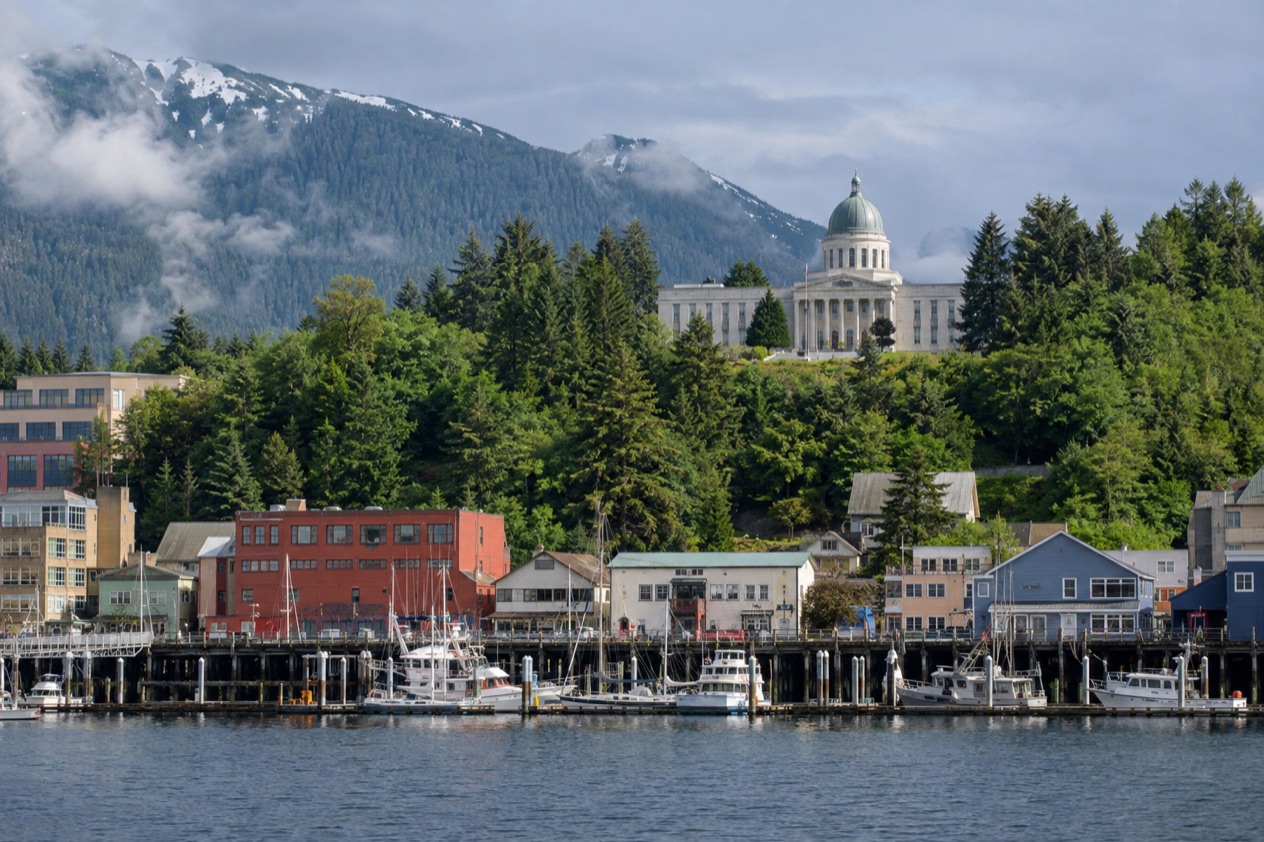
What is the capital of Alaska?
Juneau is the capital of Alaska, set along the Gastineau Channel in Southeast Alaska. It has held the title since 1906, when the government moved over from Sitka. The town began life as a gold camp, and the name on the map today is the result of a small local quarrel: it was first called Harrisburg, after Richard Harris, until he fell out of favor with the locals, who turned their loyalty to his co-founder Joe Juneau.
The gold itself was found in 1880, when Harris and Juneau relied on Tlingit Chief Kowee to guide them to the mouth of Gold Creek. That story still shapes how the town sees itself, a place of miners, officials and fishermen packed along a narrow strip of flat ground beneath the peaks of Mt. Juneau and Mt. Roberts.
The Alaska State Capitol
The Capitol stands in downtown Juneau and began as the Federal and Territorial Building, finished in 1931. It does not look like the domed statehouses of the Lower 48. Inside you find marble columns, a reproduction of the Liberty Bell, and historical photographs and paintings hung along the halls, which makes for a quiet, unhurried visit.
The building is open for self-guided tours Monday through Friday throughout the year. The legislature meets here from January into April or May, in a session that lasts 90 to 121 days. Alaskans elect a governor and a lieutenant governor to four-year terms, and lawmakers sit in a Senate of 20 seats and a House of 40.
| Site | Open |
|---|---|
| Alaska State Capitol (self-guided tours) | Monday through Friday, throughout the year |
Other sights tied to the capital’s story
The Alaska Governor’s Mansion held its first open house for citizens on January 1, 1913, a reminder of how long this town has been the center of public life. In Capital School Park, the Empty Chair Memorial, dedicated in July 2014, remembers the removal of Juneau’s Japanese community during World War II. It is a small, thoughtful stop.
Along the waterfront you will meet Tahku, a life-sized bronze sculpture of a humpback whale. Alaska’s flag has its own link to the place: Benny Benson, a 13-year-old Alaska Native seventh-grader, won the 1927 contest to design it with the Big Dipper and the North Star, and the drafters of the state constitution made it the official state flag in 1959.
Life in the capital beyond the government
Juneau is the largest capital in the country by land area, covering 3,255 square miles, a figure that includes an ice cap and a lot of water. Around 32,000 people live here. Out of town, the Mendenhall Glacier can be seen from the local road system, though its front face has been gradually shrinking in width and height.
Across the channel on Douglas Island, the city runs Eaglecrest, a ski resort. The Treadwell ice rink next to it turns to rollerblading, roller hockey, tennis, basketball and concerts from April to September, when there is no ice. In May through September, cruise ships bring a daily wave of 16,000 people or more into the downtown streets.
Why is the capital not Anchorage?
The capital is Juneau because history put it there first and it never left. Juneau became the seat of government in 1906, when the move from Sitka happened, long before Alaska was a state, and the Capitol itself grew out of a federal building from the territorial era. Anchorage, the state’s biggest city, is a separate place in a separate part of Alaska, about 600 air miles from Juneau.
That distance is part of the answer to the traveler’s puzzle. A flight between the two takes about 90 minutes, and there is no road between them at all. Juneau cannot be reached by land from anywhere on the North American highway system, so the capital lives with an unusual kind of isolation, even though it sits on the mainland.
A capital born from gold and a territory
The origin is the gold rush story. After the 1880 discovery at Gold Creek, a mining camp grew into a town, first called Harrisburg and then Juneau. By 1906 it was important enough that the government of the territory shifted here from Sitka, the place where Alaska changed hands from Russia to the United States in 1867.
Alaska Day, a legal holiday on October 18, commemorates that formal transfer at Fort Sitka. The date is a good reminder that the story of Alaska’s capitals runs through Sitka before it reaches Juneau, and that Anchorage was never part of that early chapter.
A different kind of capital
Juneau is also the only state capital that borders a foreign country. Its landscape is closer to a fjord town than to a city: mountains rise to 3,576 feet at Mt. Juneau and 3,819 feet at Mt. Roberts almost from the edge of downtown, and part of the borough is covered by 928 square miles of ice cap.
The climate follows the setting. Precipitation falls on about 230 days a year, adding up to 62.27 inches at the airport, and snowfall averages 93.2 inches. In January the average high is 35°F and the low 26°F, while July brings a high of 63°F and a low of 51°F. Gray, damp days are normal here, so rain gear belongs in the plan.
| Month | Average high (°F) | Average low (°F) |
|---|---|---|
| January | 35 | 26 |
| July | 63 | 51 |
What Anchorage does have
Anchorage is still the place most people think of first, and it is the reference point for the distance to Juneau. Just south of it, Turnagain Arm has tidal differences of more than 35 feet, one of the largest tides in the world. It is a different Alaska from the rain-soaked, mountain-wrapped capital in the Southeast.
How do you get to the capital?
You reach Juneau by air or by sea, because no road connects it to the rest of Alaska or the contiguous United States. Everything the town uses, from food to building supplies, comes in by plane or boat, and that shapes the feel of the place as much as the mountains do.
By air
Juneau International Airport lies 9 miles by road from downtown. From Seattle the flight is about two hours over roughly 900 air miles, and from Anchorage it is about 90 minutes over roughly 600 air miles. Juneau sits on the Gastineau Channel in the Inside Passage, so the approach runs between mountains and water.
Once you land, downtown and the Capitol are the first stops for most people who come to see the seat of government. The Mendenhall Glacier and the other places on the local road system are reached from the same town.
By ferry and by cruise ship
The Alaska Marine Highway System ferry terminal is in Auke Bay, 13.8 miles from Juneau on Glacier Highway, and ferries run regularly throughout Southeast Alaska. Most other Southeast communities depend on this system. Only Haines, Hyder and Skagway have direct road connections to the contiguous North American road system.
The closest port with a road connection to Juneau is Haines, about a five-hour ride by regular ferry or a two-hour ride on a catamaran ferry. Between May and September, cruise ships also arrive daily, bringing thousands of visitors into town.
| From downtown Juneau to | Distance by road (miles) |
|---|---|
| Juneau International Airport | 9 |
| Auke Bay Ferry Terminal | 14 |
| Echo Cove (north end of Egan Drive) | 43 |
Getting around once you are there
The local road system is short. It ends at Echo Cove, 43 miles from downtown at the north end of Egan Drive, which tells you how small the drivable area is compared with the borough’s 3,255 square miles. Beyond that point you are in country reached only by water or air.
Good to know before you go
Expect rain and plan for it: Juneau has precipitation on most days of the year, and winter brings snow. The Capitol’s self-guided tours run Monday through Friday, so a weekend arrival means you see the exterior and the town first. From Memorial Day through Labor Day, Sunday Mass is held at the Shrine of St. Therese at 1:30PM for those who want it. In summer, downtown can be busy with cruise passengers.
Sources
- Wikipedia, Juneau, Alaska (https://en.wikipedia.org/wiki/Juneau,_Alaska), checked October 11, 2026
- Travel Juneau, Alaska's state capital (https://www.traveljuneau.com/discover-juneau/alaskas-state-capital/), checked October 11, 2026
- Travel Juneau, fast facts (https://www.traveljuneau.com/media/fast-facts/), checked October 11, 2026
- Wikivoyage, Juneau (https://en.wikivoyage.org/wiki/Juneau), checked October 11, 2026
- Wikipedia, Alaska (https://en.wikipedia.org/wiki/Alaska), checked October 11, 2026