
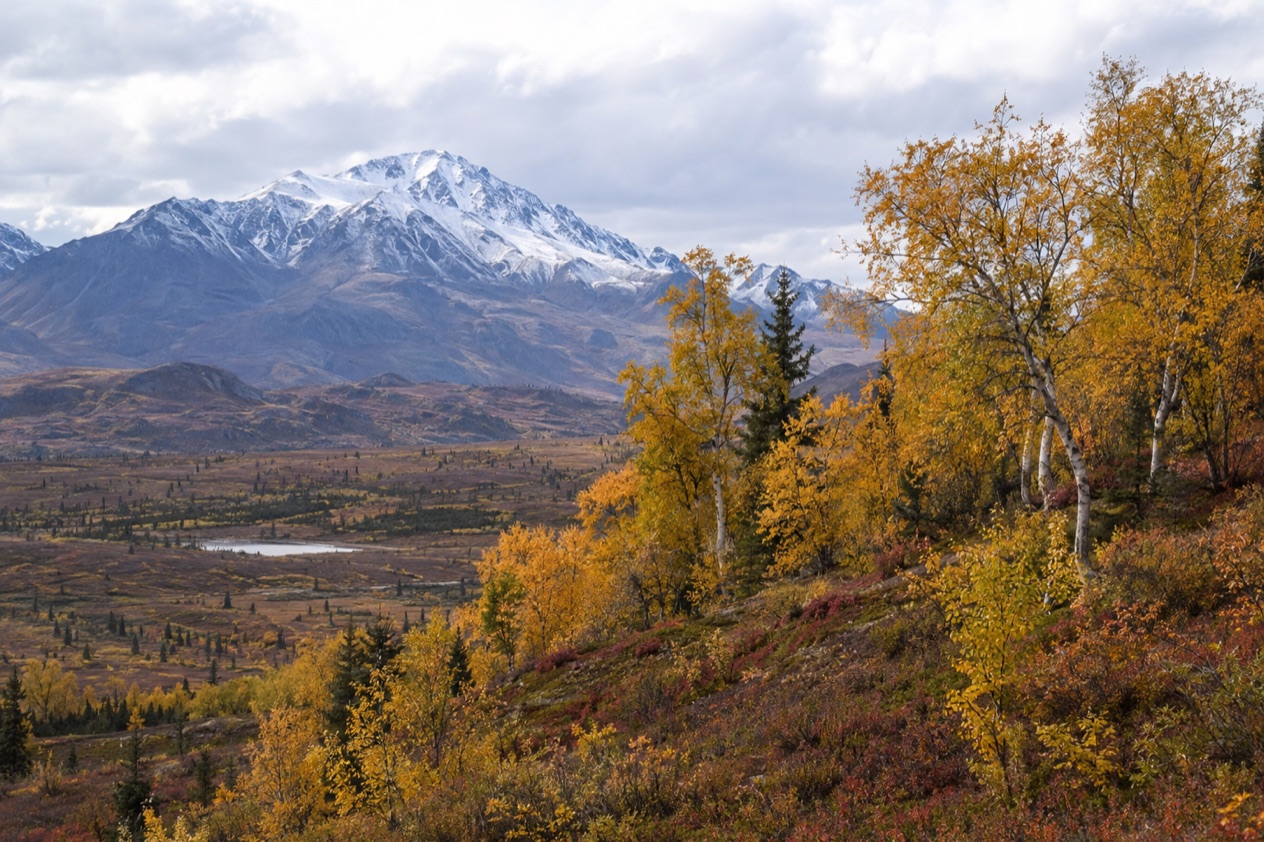
In fall the tundra around Denali turns the color of rust and old brick, and the dark sky over Fairbanks starts to hold the first green glow of the aurora. Bull moose crash through the willows with their antlers cleaned and ready, and far to the southwest, brown bears in Katmai wade into a river full of salmon and eat until they can barely move. Fall in Alaska is the season of crisp mornings and long, dark evenings that finally let the night sky show itself, and it unfolds mostly in Denali, Fairbanks and Katmai.
What is fall like in Alaska?
Fall in Alaska is a brief, colorful season that, in Denali, starts in mid-September and lasts until snow accumulates, typically between late September and late October. It is a time of change rather than a fixed picture. One week the hillsides are gold and red, and a few weeks later the ground is white and the summer crowds are long gone.
The mood is quieter than summer. Mornings are cold enough to see your breath, the evenings turn dark early, and many of the things that define the high season have wound down. What replaces them is a set of experiences that only fall offers: the rut among the moose, the fattening of the bears, and nights dark enough for northern lights.
Fall at Denali
Denali National Park and Preserve is where the season is easiest to read. Once the transit buses stop running on the park road, the landscape feels almost private, and the tundra above the treeline glows in shades of crimson, orange and burnt yellow. The low light of autumn makes the mountains look closer, and the quiet along the road is a big part of the appeal.
The National Park Service defines the season by the snow rather than the calendar. Once it starts piling up, the park road stops being a place to drive and becomes a place for skis and boots. A trip that lines up with the last open days of the road feels like catching the end of a long summer party after most guests have gone home.
Weather depends on where you are
Alaska is too big to have one fall. Southeast Alaska is the wet corner, and Juneau averages over 50 inches of precipitation a year, with some spots in the region receiving far more. Expect rain jackets and gray, moody skies there, with clouds that sit on the mountains and make the forest look deep green and dripping.
Anchorage is drier, with about 16 inches of precipitation a year, and its fall days are often bright and cool. Interior places such as Denali and Fairbanks are where the sharp, clear nights come from. Farther north, snow in Utqiaġvik may fall in any month of the year, so fall there blends quickly into winter.
Valdez is known for its snow, which can reach up to 300 inches in a year, and that gives a hint of how quickly higher and coastal country can turn white once the cold settles in. Pack for a range of conditions, because a day that starts with sun can end with sleet.
What can you do?
In fall you can drive into Denali on a road that is closed to private cars most of the summer, follow the bear contest online or in person, watch for the aurora near Fairbanks, and camp or backpack in a park that has emptied out. The activities are fewer than in summer, but each one is tied to this moment of the year.
Drive the Denali Park Road
After the transit buses stop for the season, the Denali Park Road opens to the Teklanika River at mile 30 for all private vehicle traffic, weather permitting, through October 15. That means you can set your own pace, stopping when the light hits a ridge or when a bull moose appears at the edge of the willows.
The drive suits anyone who likes to travel slowly and stop often, with a thermos and a camera. It is a one-way-out, one-way-back kind of day, and weather decides how far you get. Once snow starts piling up, only the first 3 miles are plowed, from the entrance to Park Headquarters, so the day you choose matters.
At mile 1.4, the Winter Visitor Center serves as the main visitor center from late September through early May and is where visitors can pay the entrance fee. It is a natural first stop before heading out on the road.
Fat Bear Week at Katmai
Every year in late September or early October, Katmai National Park and Preserve hosts Fat Bear Week, a tournament that celebrates how much weight the park’s brown bears have put on for the winter. The park is home to approximately 2,200 Alaska peninsula brown bears, and the contest is organized by the National Park Service and Explore.org. Dates shift from year to year, so the event is best thought of as an early-fall tradition rather than a fixed date.
You do not need to be in Alaska to take part. Live webcams sit at Brooks Falls and along the Brooks River, and anyone can vote online for a favorite. It is a single-elimination bracket: each day two bears face off, and the one with the most votes moves on. To judge the contenders, you can look at before and after photos, watch the livestream and read each bear’s biography.
Only bears seen catching sockeye salmon at the Brooks River qualify, and a stretch of the river with webcams is used to choose them. Armchair travelers get a front-row seat, and anyone planning a future visit to Katmai gets a feel for the place.
Aurora nights around Fairbanks
In Fairbanks, the aurora viewing season runs roughly from August 21 to April 21, which means fall falls squarely inside it. Auroral activity tends to be more intense around the equinox than at the summer or winter solstice, so the chances of seeing a display over Interior Alaska are roughly twice as high then. If the weather is clear and you stay at least three nights, seeing the aurora is highly likely, though it is never a promise.
The viewing sites named for the Fairbanks area include Chena Lakes Recreation Area, Tanana Lakes Recreation Area, Cleary Summit, Ester, Wickersham and Murphy Domes, and Haystack Mountain on the Elliot Highway. There are also turnouts along the Elliot, Steese and Parks Highways and Chena Hot Springs Road, along with Nordale Road and the Ballaine Road turnout near the Goldstream Creek bridge. A full or nearly full moon adds light that can hide dim features, though it can also enhance colors.
In interior Alaska in winter, the best time to watch is typically 9 p.m. to 3 a.m., with the hours around midnight having the highest probability of spectacular displays. If clouds win, live aurora cameras at Poker Flat Research Range, Toolik Field Station, Gakona and Fairbanks let you watch from indoors.
Moose in rut season
The moose is the world’s tallest, largest and heaviest species of deer, and the Alaskan subspecies is the largest of all. Their range includes most of Alaska, and fall is the mating season, in September and October, with energetic fights between males competing for a female. Moose are otherwise solitary animals, so a bull on the move through the willows is a memorable sight for anyone with a long lens.
This is also the time to give them respect. During the fall mating season, bull moose may be aggressive toward humans, and moose may charge when harassed or startled, or when a dog is nearby. Cow moose protect young calves and will attack people who come close. The Anchorage Visitor Centers warn tourists that a moose with its hackles raised is a thing to fear.
Camping and backpacking
Backpacking in Denali is possible year-round with a free backpacking permit, and fall is a season when the trails and the backcountry feel especially open. The Bear Loop of Riley Creek Campground is open year-round, and camping there is free from mid-September to early May. Frost on the tent in the morning and a sky full of stars at night are part of the deal.
If a tent sounds too cold, some year-round accommodations remain open in Healy, a small town 11 miles from the Denali park entrance. It makes a base for days on the road and nights chasing the sky.
What closes?
In fall, the summer machinery of Alaska tourism winds down: the Denali transit buses stop, the park road is plowed only at its beginning once snow arrives, and the scenic trains finish their summer runs. What is left feels more like the real, working Alaska, with fewer services and more room.
The Denali Park Road
Transit bus service along the Denali Park Road ends the second Thursday after the Labor Day holiday each year. After that, private vehicles can go as far as the Teklanika River at mile 30, weather permitting, through October 15. Once snow starts piling up, the National Park Service plows only the first 3 miles, from the entrance to Park Headquarters.
The change is dramatic. In summer, the road is a corridor of buses carrying people deep into the park. In spring the pattern reverses: the road opens to Savage River at mile 15 and then to Teklanika sometime in April or early May, depending on snow, and on May 20 the buses start again.
Trains
The Alaska Railroad’s summer trains are seasonal, and the dates in its schedules fall after the fall season. Dates given for 2027 are listed in the table. In the meantime, the Aurora Winter Train has baggage service available only in Anchorage and Fairbanks.
| Train | Runs |
|---|---|
| Coastal Classic (Anchorage, Girdwood, Seward) | Daily, May 14 to September 12, 2027 |
| Denali Star | May 12 to September 16, 2027 |
| Glacier Discovery (full route) | May 29 to September 12, 2027 |
| Hurricane Turn (Talkeetna to Hurricane) | Thursday through Monday, May 13 to September 12, 2027 |
The summer Hurricane Turn Train has no dining service, and passengers are encouraged to bring food onboard. On the Coastal Classic, baggage services are available only in Anchorage and Seward, and on the Glacier Discovery only in Anchorage.
Roads, trailheads and campgrounds
Not everything closes. The Bear Loop of Riley Creek Campground stays open all year, and the Winter Visitor Center takes over as the main visitor center from late September through early May. Riley Creek Campground at the park entrance is also free to camp through mid-May in spring.
Some places, though, wait for the thaw. What closes? Fall travelers should plan around what stays open rather than expecting the summer menu.
Good to know before you go
Fall in Alaska rewards flexibility, because snow, wind and cloud can change a plan in a day, and the season for each service is different. Entrance fees at Denali are paid at the Winter Visitor Center, and a free permit covers backpacking.
Sources
- National Park Service, Denali National Park & Preserve, plan your visit: shoulder season (https://www.nps.gov/dena/planyourvisit/shoulder-season.htm), checked October 11, 2026
- Wikipedia, Fat Bear Week (https://en.wikipedia.org/wiki/Fat_Bear_Week), checked October 11, 2026
- University of Alaska Fairbanks Geophysical Institute, Aurora forecast (https://www.gi.alaska.edu/monitors/aurora-forecast), checked October 11, 2026
- Wikipedia, Moose (https://en.wikipedia.org/wiki/Moose), checked October 11, 2026
- Wikipedia, Climate of Alaska (https://en.wikipedia.org/wiki/Climate_of_Alaska), checked October 11, 2026
- Alaska Railroad, Train schedules (https://www.alaskarailroad.com/ride-a-train/schedules), checked October 11, 2026