
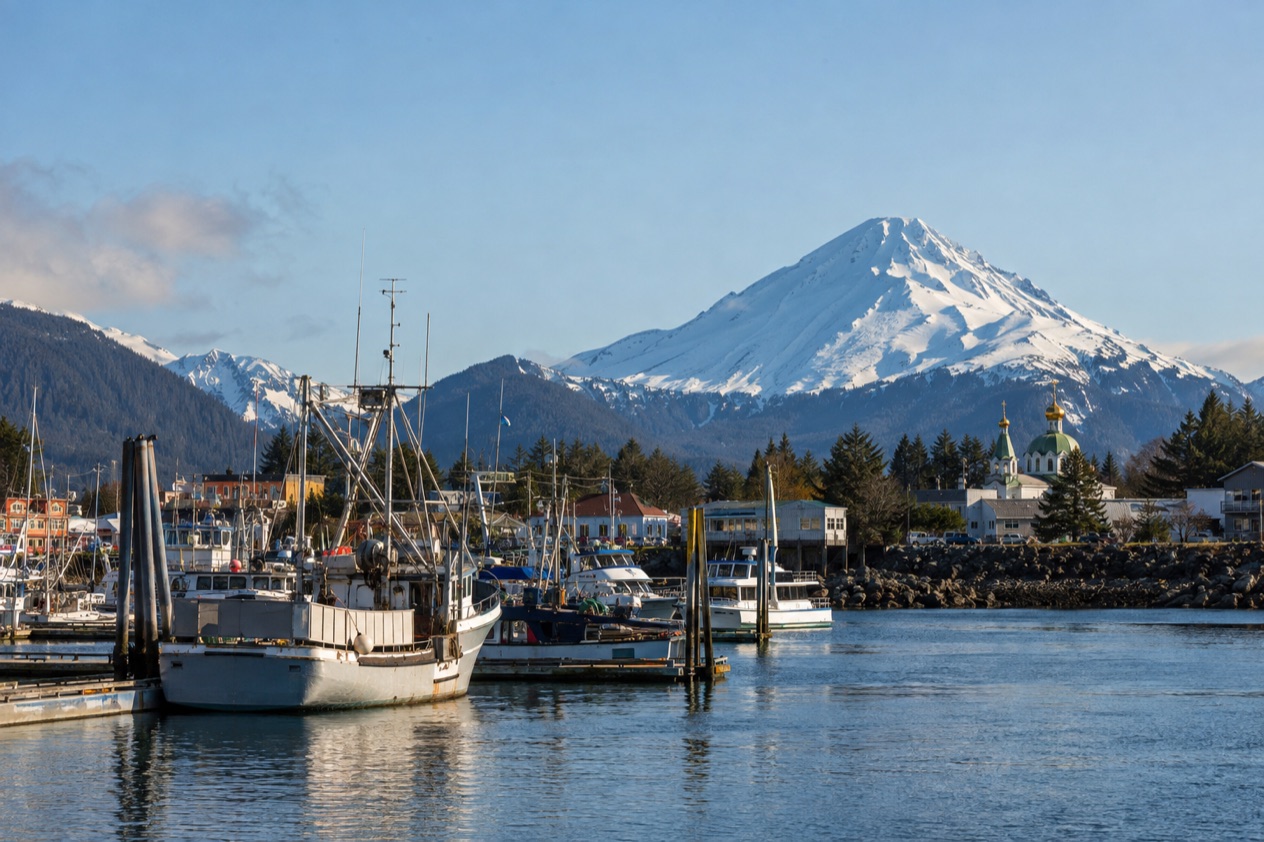
On a gray morning in Sitka, fishing boats rock in the harbor, gulls complain overhead, and the onion dome of St. Michael’s Cathedral rises above the shop fronts on Lincoln Street. Mist hangs on the spruce-covered mountains behind town, and the air smells of salt, wet cedar and diesel. Sitka is a small Southeast Alaska town on an island, a place of Tlingit and Russian history, forest paths and a working waterfront, for travelers who like their destinations layered and unhurried.
Where is Sitka and what is it like?
Sitka sits on Baranof Island in Southeast Alaska, facing Sitka Sound and the Pacific Ocean, and it can be reached only by air and by sea. No highway links it to the rest of the continent, and that single fact shapes the whole feel of the place. Kruzof Island lies across the sound, and Baranof Island wraps around the water to the south and the northeast, so the town looks out on a sheltered, island-dotted bay rather than an open horizon.
Among the cities of Southeast Alaska, Sitka is one of the three largest, alongside Juneau and Ketchikan, yet it still has the scale of a town where people greet each other on the sidewalk. The 2020 census counted 8,458 residents.
The center is compact and layered with history: Tlingit homeland first, then the capital of Russian America, then part of the United States. Twenty-two buildings and sites in town appear in the National Register of Historic Places, and you notice them simply by walking around.
The pace is slow and the weather sets the tone. Sitka has a humid maritime climate with heavy precipitation, so the rhythm of a day bends around showers, low cloud and the moments when the mountains suddenly appear. Travelers who love museums, forest walks, birds and the working life of a fishing harbor tend to fall for it. Those who want nightlife, big resorts or guaranteed sunshine may find it quiet and damp.
It is also a place with a strong sense of its own story. The Tlingit people have lived along this coast and across much of the Alexander Archipelago for a very long time, and that presence is visible in totem poles, in names on the map and in the cultural objects still used for ceremony.
Russian Orthodox heritage sits beside it, in a church, a bishop’s house and a calendar of local observances. The result is a small town with an unusually deep past.
What is there to do in Sitka?
It differs from its neighbors in being a place to linger on culture and trails rather than a stop built around one big attraction.
Sitka National Historical Park
The park, at 106 Metlakatla Street, preserves a landscape that drew Tlingit, Russians and Americans, and sometimes brought them into conflict. It includes the site of a significant battle that prepared the way for the American purchase of Alaska from Russia. Visitors come for the wooded pathways, which cover two miles and pass many replica totem poles, along with totem poles obtained from Haida and Tlingit communities.
The setting is as much the point as the carvings. A temperate rain forest of towering spruce and hemlock presses in on both sides, tidelands hold sea stars and crabs, and Kaasdahéen (Indian River) runs through the grounds. During spawning season you can see salmon swimming up the river, and the forest and estuary are also rich in berries and otters.
Inside the visitor center, many of the artifacts on display are owned by Tlingit clans and are still used for ceremonial purposes, which gives the cases a living quality. Kids of all ages can become Junior Rangers here, in what is Alaska’s oldest national park unit. The story of how the totem pole collection came to be is an unusual one, and well worth asking about.
The Russian Bishop’s House
At 501 Lincoln Street stands a house built in 1841 to 1843 as the home and administrative center of Ivan Veniaminov, the first Bishop of Alaska. It is a National Historic Landmark and now a unit of Sitka National Historical Park, run by the National Park Service. Parts of it served as a schoolhouse before the National Park Service restored it.
Museum exhibits on the ground floor show Russian activities in Alaska, and the furnished second floor lets you see how the bishop’s household lived. It pairs naturally with a stroll to the nearby cathedral and the harbor, and it is an easy anchor for a rainy part of the day.
Alaska Raptor Center and Fortress of the Bear
The Alaska Raptor Center is a sanctuary in the Tongass National Forest, just outside the center of town. It admits injured birds each year and releases others back to the wild, and visitors can support its work by volunteering, donating, adopting a raptor, attending the annual gala or shopping. It suits anyone who wants to see birds of prey up close in a forest setting.
Fortress of the Bear is the other animal stop in town. It is open daily from 9AM to 5PM in summer, and on Friday and Saturday from 10AM to 3PM in winter. Both places work well on days when low cloud makes the mountains disappear.
| Site | Open |
|---|---|
| Fortress of the Bear, summer | Daily, 9AM–5PM |
| Fortress of the Bear, winter | Friday–Saturday, 10AM–3PM |
How many days do you need in Sitka?
Two full days cover the essentials in Sitka, and three let you slow down to the town’s pace. The main sights are close together, so a short stay does not feel rushed, and the weather often decides which hours you spend indoors and which outdoors.
With two days, give one to Sitka National Historical Park and the Russian Bishop’s House. The second day can go to the Alaska Raptor Center, Fortress of the Bear and a walk around the harbor and the cathedral.
A third day suits wandering with no plan. Browse the shops on the main street, sit with coffee while a shower passes, and take in the town’s other historic buildings, some of the twenty-two listed on the National Register. If the Alaska Day Festival is on, that week alone can fill extra time with a reenactment ceremony and interpretive programs.
With more time, Sitka Sound is the natural next step. It is a sheltered body of water with a long history, once a major center of the maritime fur trade, and the islands around it reward anyone who wants to look at the coast from a boat. Because Sitka is reached only by air and sea, a longer stay also gives you slack if a flight or sailing shifts around.
Where to stay in Sitka
The downtown area is where travelers want to be. It suits anyone who likes to step out in a break between showers and be at a museum or a café in minutes.
The area near Sitka National Historical Park suits travelers who care most about the forest and the totem pole trail. Staying close means an early walk among the spruce before the day gets going, and a return to the river for a second look at the salmon in season. The park sits at 106 Metlakatla Street, on the edge of the town’s historic core.
Cruise passengers who arrive at Old Sitka Dock ride a free shuttle bus to Harrigan Centennial Hall in downtown Sitka, which puts them at the center of town for the day. Those who stay overnight tend to be a different kind of visitor, people who want evenings when the harbor lights come on and the streets go quiet. That quiet is part of what Sitka offers, and a room downtown puts you right in it.
The Alaska Raptor Center lies in the Tongass National Forest, so a stay on that side of town gives a greener, more wooded setting. For anyone drawn to birds and trails more than to shops and restaurants, it is a fitting base. Whatever area you choose, the town is small enough that nothing is far.
How do you get to Sitka and get around?
You reach Sitka by air or by sea, since the town is on Baranof Island and has no road connection to the mainland. Sitka Rocky Gutierrez Airport, named for a former mayor, has a single terminal with a jetway, and Alaska Airlines operates air service there year-round. The single paved runway sits on a causeway that juts off Japonski Island, so the landing itself is part of the arrival.
Alaska Marine Highway ferries provide year-round service for passengers and vehicles to Sitka. That makes the ferry the route for anyone bringing a vehicle, and a scenic way to arrive for those who want to see the coast from the water. Cruise ships use Old Sitka Dock, from which a free shuttle bus runs to Harrigan Centennial Hall in downtown Sitka in about 15 minutes.
Once in town, much of Sitka can be explored on foot, because the historic sights cluster around the center. The Ride, the local bus, runs three lines called Green, Red and Blue, Monday to Friday from 6:30AM to 6:30PM. It does not run on New Year’s Day, Memorial Day, Labor Day, Alaska Day, Thanksgiving Day or Christmas Day.
| Service | Runs | Does not run |
|---|---|---|
| The Ride bus (Green, Red, Blue lines) | Monday–Friday, 6:30AM–6:30PM | New Year’s Day, Memorial Day, Labor Day, Alaska Day, Thanksgiving Day, Christmas Day |
When is the best time to visit Sitka?
Summer is the most comfortable season, with July the clearest example: afternoons reach about 60°F and nights stay near the low 50s. Rain still falls on a good share of days, but July is among the drier months, and the showers tend to be passing ones. August is the warmest month on average, and the long summer days suit the trails and the park.
Winter is for travelers who do not mind gray and wet. January afternoons stay in the low 40s and nights hover just above freezing, with rain on more than half the days. The town is quiet then, and Fortress of the Bear keeps shorter winter hours, open Friday and Saturday only.
The big event of the calendar is the Alaska Day Festival, a week-long celebration with a reenactment ceremony of the signing of the Alaska purchase and interpretive programs. The first recorded festival was held in 1949, so it has deep roots in town.
Alaska Day is also one of the days the local bus does not run, which is worth knowing if you are in town that week. Bring rain gear and layers whatever the month.
| Month | Average high (°F) | Average low (°F) | Precipitation (in) | Days with precipitation |
|---|---|---|---|---|
| January | 40.5 | 32.4 | 8.22 | 15.4 |
| July | 60.4 | 52.5 | 4.62 | 11.4 |
Good to know before you go
Rain gear and layered clothing make sense at any time of year in Sitka, because the maritime climate brings heavy precipitation and a small temperature range between seasons. Weather forecasts are available from the National Weather Service. Some services keep seasonal schedules, so Fortress of the Bear, for instance, shortens its hours in winter, and the local bus does not run on weekends or on a handful of holidays.
Sources
- Greater Sitka Chamber of Commerce (https://www.sitkachamber.com/), checked October 11, 2026
- Wikivoyage, Sitka (https://en.wikivoyage.org/wiki/Sitka), checked October 11, 2026
- Wikipedia, Sitka, Alaska (https://en.wikipedia.org/wiki/Sitka,_Alaska), checked October 11, 2026
- Wikipedia, Sitka National Historical Park (https://en.wikipedia.org/wiki/Sitka_National_Historical_Park), checked October 11, 2026
- Wikipedia, Sitka Rocky Gutierrez Airport (https://en.wikipedia.org/wiki/Sitka_Rocky_Gutierrez_Airport), checked October 11, 2026
- Wikipedia, Sitka Sound (https://en.wikipedia.org/wiki/Sitka_Sound), checked October 11, 2026
- National Park Service, Sitka National Historical Park, plan your visit (https://www.nps.gov/sitk/planyourvisit/index.htm), checked October 11, 2026
- Alaska Raptor Center, Sitka (https://www.alaskaraptor.org/), checked October 11, 2026
- Wikipedia, Russian Bishop%27s House (https://en.wikipedia.org/wiki/Russian_Bishop%27s_House), checked October 11, 2026
- Wikipedia, Tlingit (https://en.wikipedia.org/wiki/Tlingit), checked October 11, 2026
- Wikipedia, Southeast Alaska (https://en.wikipedia.org/wiki/Southeast_Alaska), checked October 11, 2026
- Wikipedia, Climate of Alaska (https://en.wikipedia.org/wiki/Climate_of_Alaska), checked October 11, 2026
- NOAA NCEI, U.S. Climate Normals 1991-2020, monthly (https://www.ncei.noaa.gov/access/services/data/v1?dataset=normals-monthly-1991-2020&stations=USW00025333), station Sitka Airport, elevation 14 feet, checked October 11, 2026
All our pages
When to go
- Best Time to Visit Sitka: Weather, Alaska Day and What to Do by Season
- Sitka in January: Rain, Short Days, Totem Park Walks and the Russian Bishop's House
- Sitka in February: Weather, Tlingit Heritage and What to Do
- Sitka in March: Weather, Russian Bishop's House, Totem Park and a Two-Day Plan
- Sitka in April: Weather, Totem Park Walks and What to Do
- Sitka in May: Weather, Totem Park Walks and Things to Do
- Sitka in June: Long Daylight, Totem Poles, Russian History and Rain Gear
- Sitka in July: Weather, Totem Park Trails, the Russian Bishop's House and a Two-Day Plan
- Sitka in August: Weather, Totem Park, Sitka Sound and What to Do
- Sitka in September: Weather, Historic Sites and the Raptor Center
- Sitka in October: Rain Forest Trails, Totem Poles, Salmon Streams and Short Days
- Sitka in November: Rain, Russian-Era History, Raptors and Totem Poles
- Sitka in December: Weather, Short Days and Historic Park Walks
Things to do
- Things to Do in Sitka: Russian History, Totem Parks, Wildlife and Fresh Seafood
- Day Trips from Sitka: Totem Park, the Russian Bishop's House, the Raptor Center and Sitka Sound
- 3 Days in Sitka: Totem Poles, the Russian Bishop's House, Raptors and Alaska Day
- Sitka National Historical Park: Totem Poles, Russian Bishop's House, Rainforest Trails and the Indian River