
On a cold October evening in Anchorage, the summer trains have already been put away, and talk turns to how to reach Fairbanks for the northern lights without driving. The Alaska Railroad has an answer in the Aurora Winter Train, a weekend service that connects the two cities and calls at the small towns between them. It is the railroad’s cold-season run, and it is built around the same weekends when the dark skies of the Interior come back.
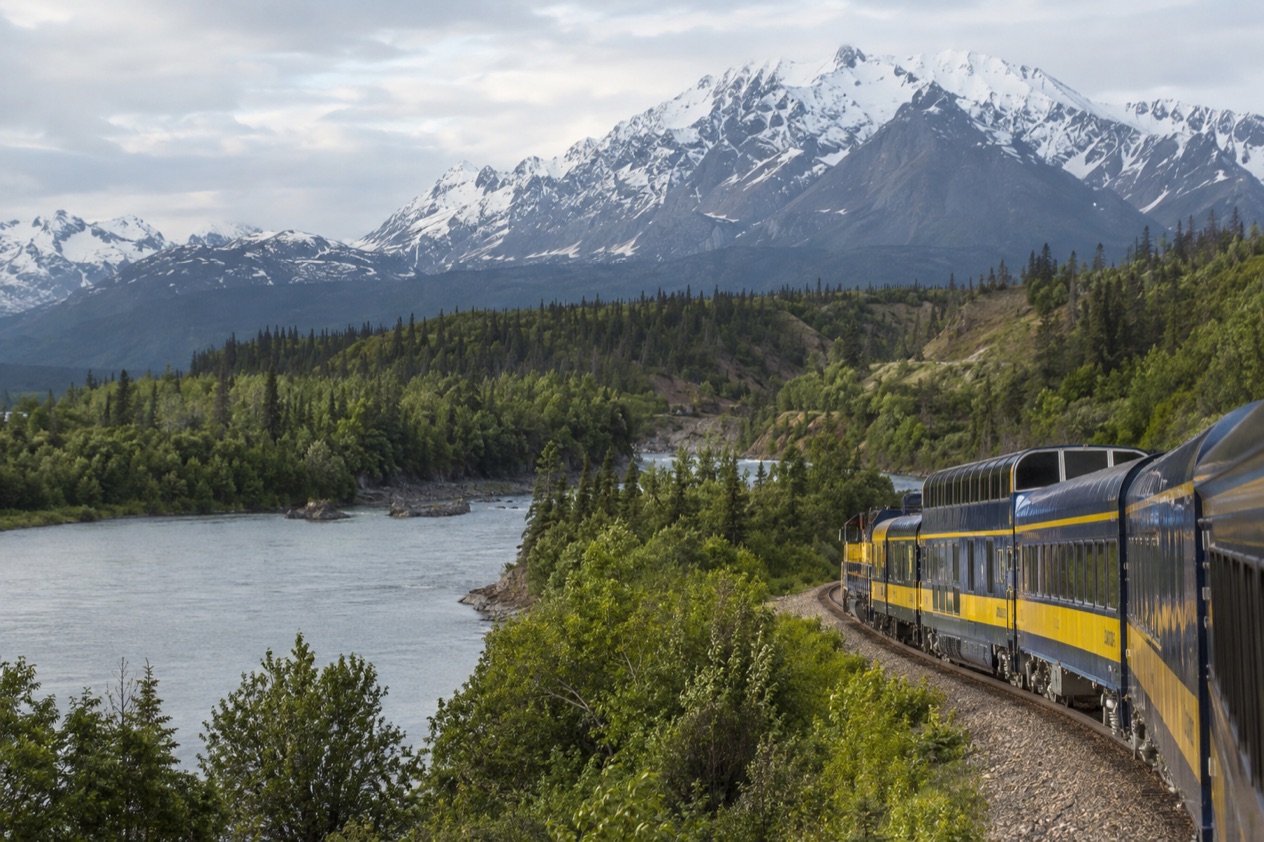
Where does the Aurora Winter train go?
The Aurora Winter Train runs between Anchorage and Fairbanks, with stops at Wasilla, Talkeetna, Hurricane, Healy and Nenana. Those are the same railroad towns the summer trains know, but in winter they look different: roofs under snow, woodsmoke over the depots, and platforms where travelers in heavy boots wait beside neighbors collecting a parcel.
The direction depends on the day. On Saturday the train makes the northbound journey from Anchorage to Fairbanks, and on Sunday it returns from Fairbanks to Anchorage. A weekend trip therefore has a natural shape: go up on Saturday, spend the evening in Fairbanks, and ride back on Sunday.
The towns along the line
Wasilla is the first named stop after Anchorage, a town that sits at the edge of the Mat-Su Valley. Talkeetna comes next, a village with a small main street of cafés, shops and a river nearby, and a place many people associate with views of Denali and with flightseeing in the warm months. Hurricane is the stop that gives the route its sense of remoteness, a name on a timetable more than a town.
Farther along, Healy is the stop for the area around Denali National Park, and Nenana is a river town on the way into Fairbanks. The train stops as needed at Healy and Nenana before arriving in Fairbanks, so those two calls depend on who is getting on or off.
Flagstop service in the backcountry
One feature sets this train apart from a plain city-to-city ride. It provides flagstop service along a 50-mile stretch of roadless backcountry south of Hurricane Gulch. A flagstop means the train can pick up riders at places without a regular station, which is how cabin owners and people heading into the woods have long used the railroad in this part of the state.
For a visitor the point is simpler: that stretch of track runs through country with no highway beside it, so what you see from the window is the winter landscape itself. Spruce, frozen creeks and open snowy ground are what you may see there, and the train moves through it at its own pace.
Arriving in Fairbanks
Fairbanks is where the line ends and where the aurora is the draw. Many of them are reached by road from town, and they include Chena Lakes Recreation Area, Cleary Summit and Ester.
Taking the train north on Saturday puts you in Fairbanks for the evening, which fits the hours when the sky is most likely to be active. Taking it south on Sunday ends the trip in Anchorage.
When does it run?
The Aurora Winter Train operates on weekends from mid-September to mid-May. With today being mid-October, the season is already underway, and it carries on through the dark months and into spring.
There are also select mid-week departures in addition to the weekend service. The weekend remains the backbone of the schedule, with the Saturday run to Fairbanks and the Sunday run back to Anchorage. The train’s schedule may vary depending on the number of stops, since the flagstop service and the calls at Healy and Nenana depend on who is traveling.
The summer trains are a different service
The railroad’s summer trains run on their own calendars. The Denali Star Train, which also links Anchorage and Fairbanks, operates from May 12 to September 16, 2027.
The Hurricane Turn Summer Train runs Thursday through Monday from May 13 to September 12, 2027, between Talkeetna and Hurricane. The Coastal Classic runs daily from May 14 to September 12, 2027, and the Glacier Discovery Train runs its full route from May 29 to September 12, 2027. None of those is a winter option, so a trip planned for the cold months leans on the Aurora Winter Train alone.
The aurora calendar in Fairbanks
The aurora viewing season in Fairbanks runs roughly from August 21 to April 21. Between April 22 and August 20 the sky does not get dark enough to see the aurora, even when the display is spectacular. The train’s season sits comfortably inside the viewing season for most of its months, though the last weeks before mid-May fall after the sky has grown too bright.
Activity tends to be more intense around the fall and spring equinoxes than around the winter solstice, so the statistical likelihood of seeing aurora over Interior Alaska is roughly twice as high at the equinox. If the weather is clear and you stay at least three nights, it is highly likely that you will see the aurora. A single weekend is a chance, not a promise.
The hours that matter, and the moon
In Interior Alaska in winter, the best time to watch is typically between 9 p.m. and 3 a.m. The few hours centered on midnight carry the highest probability of spectacular displays. That shapes the Saturday evening: dinner in Fairbanks, then a late stretch outdoors.
A full or nearly full moon adds light that may hide dim auroral features, though moonlight can also bring out colors by activating the cone cells in your eyes. For viewing spots, the recommended places around Fairbanks include Tanana Lakes Recreation Area, Wickersham and Murphy Domes, Haystack Mountain on the Elliot Highway, Nordale Road, and the Ballaine Road turnout near Goldstream Creek. Turnouts along the Elliot, Steese and Parks Highways and Chena Hot Springs Road are also on the list.
What should you know before you book?
The main things to know are how the schedule behaves, how much luggage you can bring and what cannot ride in the passenger cars. The timetable is flexible by design, and the baggage rules are generous for a winter trip with bulky clothing.
A schedule that moves with the stops
Because the train’s schedule may vary depending on the number of stops, think of times as a framework rather than a fixed promise. A day with passengers waiting at flagstops or at Healy and Nenana is a different day from one with few. Plan the Fairbanks evening with that in mind, and do not tie it to a tight reservation right at arrival.
It also helps to remember that the Sunday return starts in Fairbanks. If you want a late night under the sky on Saturday, the next day’s ride gives you somewhere to rest.
Baggage on a winter trip
Winter travel means parkas, boots and layers, and the Aurora Winter Train is friendly to that. Each passenger may check up to four pieces of luggage, more than the two pieces allowed on the Alaska Railroad’s other services. The weight limit for each checked bag is 50 pounds.
Bikes, excess bags, oversized bags and overweight bags are charged $20.00 per item. Luggage storage is not available at any Alaska Railroad station, so a bag you want to leave behind cannot be left at a depot while you explore a town.
Animals, firearms and weapons
All animals must travel in the baggage car, in a kennel the passenger provides, with a fee of the same amount per kennel. Only service animals are permitted in passenger cars.
Firearms are not allowed inside passenger coaches or depots. They may be transported in the baggage car only if they are unloaded, stored in a locking hard-sided case, and have the bolt action removed or a trigger locking guard applied. Concealed weapons are not allowed onboard any Alaska Railroad train or in any depot.
Good to know before you go
A trip on this train is really a trip to Fairbanks, so plan the nights there as carefully as the ride. Bring warm layers for standing outside after dark, and leave room in the day for the sky to cooperate or not.
The aurora depends on clear weather, and the later hours of the evening are when it is most likely to show. Stay flexible, keep the Sunday departure in mind, and let the train’s own rhythm set the pace of the weekend.
Sources
- Alaska Railroad, Aurora Winter (https://www.alaskarailroad.com/ride-a-train/our-trains/aurora-winter), checked October 11, 2026
- Alaska Railroad, Train schedules (https://www.alaskarailroad.com/ride-a-train/schedules), checked October 11, 2026
- Alaska Railroad, Train fares (https://www.alaskarailroad.com/ride-a-train/fares), checked October 11, 2026
- Alaska Railroad, Baggage policy (https://www.alaskarailroad.com/ride-a-train/baggage), checked October 11, 2026
- University of Alaska Fairbanks Geophysical Institute, Aurora forecast (https://www.gi.alaska.edu/monitors/aurora-forecast), checked October 11, 2026