
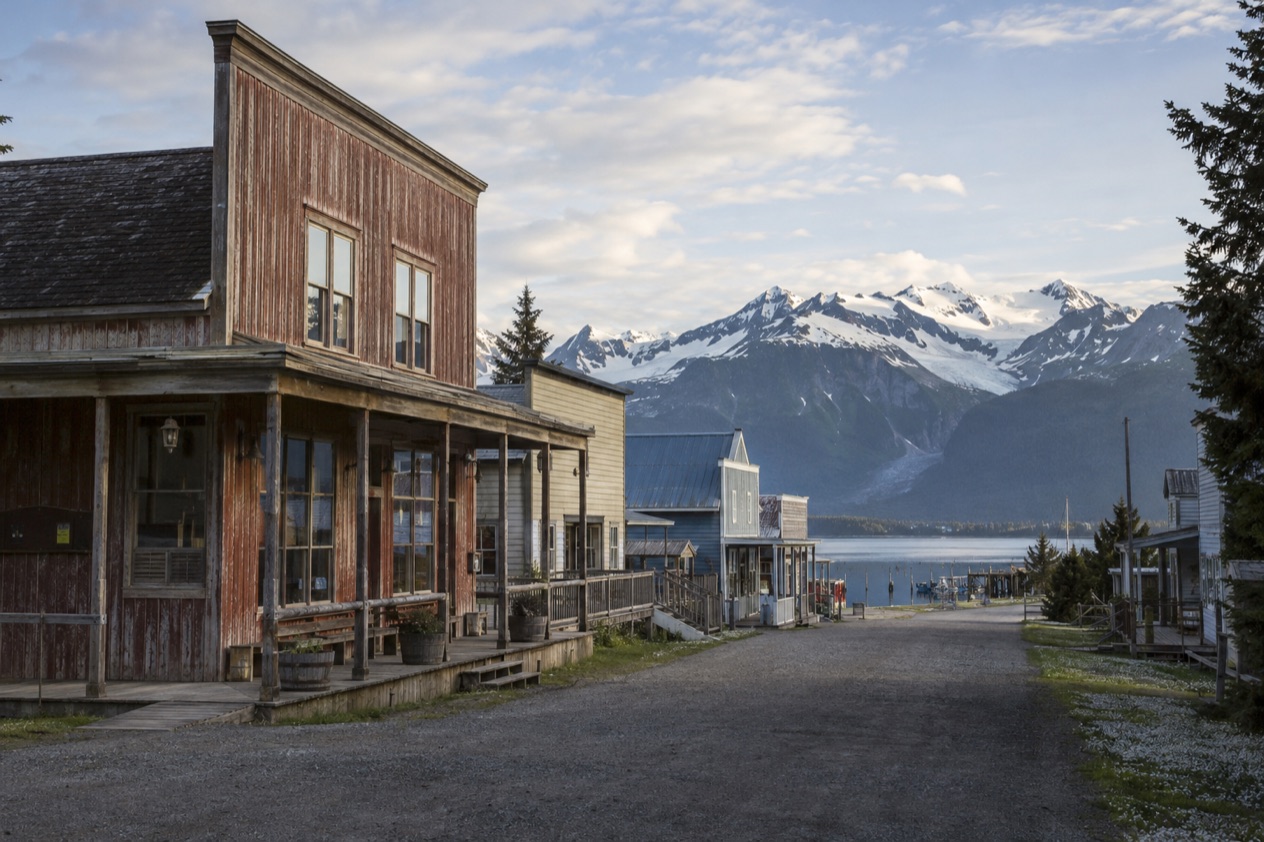
Every October 18, Sitka marks Alaska Day, the anniversary of the afternoon when Russian flags came down and American ones went up over the old capital of New Archangel. Standing in that town, or at Earthquake Park in Anchorage, or at the foot of the Chilkoot Trail, you start to see that Alaska’s past is written right on the ground. It runs from Indigenous homelands to Russian America, the gold rush, the railroad, statehood and a great earthquake.
What is the history of Alaska?
Alaska’s history is the story of Indigenous homelands that became a Russian colony, then a U.S. purchase, a gold rush frontier, a territory and finally the 49th state. Each chapter left something you can still walk through, which is why the past feels so close in towns like Sitka, Skagway and Seward.
From Russian America to the Alaska Purchase
Before the United States arrived, the main Russian settlement was Novoarkhangelsk, today’s Sitka. The treaty of sale was signed in Washington, D.C., on March 30, 1867, and the United States paid $7.2 million. Critics at the time mocked the deal as Seward’s Folly, after the Secretary of State who pushed it.
The formal handover took place in Sitka on October 18, 1867, the day American sovereignty became legally effective. The land that changed hands was vast, adding 586,412 square miles to the country. The town itself was small, with 116 log cabins and 968 residents. Far out in the Pribilof Islands, St. Paul counted 100 homes and 283 people.
A curious detail survives in local lore: because of the change of calendars, residents lived through two Fridays in a row. Alaska Day is now a holiday for all state workers, and Sitka is the place where it feels most like a town celebration.
Gold rush, railroad and the capital moves
Sitka became the first capital of Alaska Territory after the purchase. Under the Second Organic Act of 1912, the territorial capital was Juneau, and Juneau stayed the capital when Alaska became a state. The Klondike Gold Rush of the late 1890s then pushed thousands north, and most prospectors came through the ports of Dyea and Skagway.
Many took the Chilkoot Trail from Dyea, and around 22,000 prospectors used it. The White Pass trail from Skagway earned the nickname Dead Horse Trail, because so many horses died on it.
Canadian authorities required each person entering Yukon Territory to bring a year’s supply of food, typically around 1,150 pounds. Another route ran by water from Seattle to St. Michael at the Yukon River delta and then upriver by boat to Dawson. It was 4,700 miles long and expensive.
Work on the Alaska Railroad began in 1902, and by 1914 it connected Seward to Fairbanks. That line still shapes how Alaska’s interior is linked together today.
Statehood and the 1964 earthquake
Statehood came step by step. Delegates met at the University of Alaska in Fairbanks for the Constitutional Convention in 1955, and Alaskans voted to pass the constitution in 1956.President Eisenhower signed the Statehood Act on July 7, 1958.
In a special election on August 26, 1958, 40,452 Alaskans voted for immediate admission and 8,010 against. Alaska became the 49th state on January 3, 1959. Just a few years later, the 1964 earthquake, which lasted four minutes and thirty-eight seconds, reshaped parts of the coast, and its marks are still visible in several places covered below.
| Event | Date |
|---|---|
| Alaska Purchase treaty signed | March 30, 1867 |
| Transfer ceremony in Sitka (Alaska Day) | October 18, 1867 |
| Statehood Act signed | July 7, 1958 |
| Alaska becomes the 49th state | January 3, 1959 |
| Alaska Native Claims Settlement Act signed | December 18, 1971 |
Who lived in Alaska first?
Alaska’s Indigenous peoples lived here first, and they still do. Alaska Natives include many cultural and language groups: Iñupiat, Aleut, Yupik, Eyak, Tlingit, Haida, Tsimshian and various Northern Athabaskan peoples.
Peoples and their present-day life
The groups are spread across very different regions, and their languages and customs differ accordingly. Russian Orthodox congregations, many made up mostly of Alaska Natives, are a lasting trace of the Russian era. Onion-domed churches in small communities are a reminder that Russian America left a living faith as well as buildings.
Subsistence remains a living practice. In Utqiaġvik in 2005, more than 91 percent of the Iñupiat households interviewed still took part in the local subsistence economy, compared with about 33 percent of non-Iñupiat households. Under the Marine Mammal Protection Act of 1972, Alaska Natives reserve the right to harvest whales and other marine mammals.
The Native Claims Settlement Act
President Nixon signed the Alaska Native Claims Settlement Act on December 18, 1971, the largest land claims settlement in United States history. Alaska Natives retained up to 44 million acres and were paid $963 million. They had three years from passage to make their land selections.
The act transferred titles to twelve regional corporations and over 200 village corporations. Most Alaska Natives are enrolled in federally recognized tribes that belong to the 13 Alaska Native Regional Corporations, which manage land and financial claims. Except for the Tsimshian, Alaska Natives no longer hold reservations, though they control some lands.
A changing coast
The Shishmaref, Kivalina, Shaktoolik and Newtok tribes are among America’s first climate refugees, driven by melting sea ice and increased wildfires. For a traveler, this is a reminder that Alaska’s history is not only about the past: communities are still deciding how to live on a shifting landscape.
Which historic sites can you visit?
The sites that tell Alaska’s story best are in Sitka, Skagway, Dyea, Seward, Anchorage and along Turnagain Arm, each tied to a chapter described above.
Sitka, Skagway and the Chilkoot Trail
Sitka is where the 1867 handover happened, and it is the town where Alaska Day is observed on October 18. Walking its streets, you are in the former Novoarkhangelsk, the place Russian America was run from. The Russian Orthodox heritage is part of the town’s character.
Skagway and Dyea were the gateways of the Klondike Gold Rush. The Chilkoot Trail starts from Dyea and was climbed by thousands of prospectors, and steps cut into the ice at Chilkoot Pass could be used for a daily fee. The White Pass trail begins from Skagway and carries the Dead Horse Trail name. Seeing these places helps you picture the sheer weight of the supplies each person had to haul.
Earthquake Park, Girdwood, Portage and Seward Highway
In Anchorage, the Turnagain neighborhood lost 75 houses in a landslide during the 1964 earthquake, and the destroyed area became Earthquake Park. It is a quiet place to understand the scale of what happened, since the earthquake and tsunamis caused about 139 deaths.
Along Turnagain Arm, Girdwood was destroyed by subsidence and tidal action and relocated inland, while Portage was destroyed and abandoned.The largest tsunami wave, about 220 feet, was recorded in Shoup Bay, near Valdez.
The Alaska Railroad and the capitals
The Alaska Railroad, begun in 1902, linked Seward to Fairbanks by 1914. Seward and Fairbanks are the two ends of that old line, and Fairbanks also hosted the 1955 Constitutional Convention at the University of Alaska. Juneau, the territorial and then state capital, completes the political story that began in Sitka.
Good to know before you go
Dates matter on a history trip: Alaska Day on October 18 is a holiday for all state workers, so Sitka is at its liveliest around then, while state offices are closed. The Chilkoot and White Pass routes carry real history of hardship, so treat them as places with a past.
Anchorage’s Earthquake Park, the Seward Highway and Turnagain Arm can be seen in a single outing around the city.
Sources
- Wikipedia, History of Alaska (https://en.wikipedia.org/wiki/History_of_Alaska), checked October 11, 2026
- Wikipedia, Alaska Purchase (https://en.wikipedia.org/wiki/Alaska_Purchase), checked October 11, 2026
- Wikipedia, Klondike Gold Rush (https://en.wikipedia.org/wiki/Klondike_Gold_Rush), checked October 11, 2026
- Wikipedia, Alaska Natives (https://en.wikipedia.org/wiki/Alaska_Natives), checked October 11, 2026
- Wikipedia, Alaska Native Claims Settlement Act (https://en.wikipedia.org/wiki/Alaska_Native_Claims_Settlement_Act), checked October 11, 2026
- Wikipedia, Alaska Statehood Act (https://en.wikipedia.org/wiki/Alaska_Statehood_Act), checked October 11, 2026
- Wikipedia, 1964 Alaska earthquake (https://en.wikipedia.org/wiki/1964_Alaska_earthquake), checked October 11, 2026