
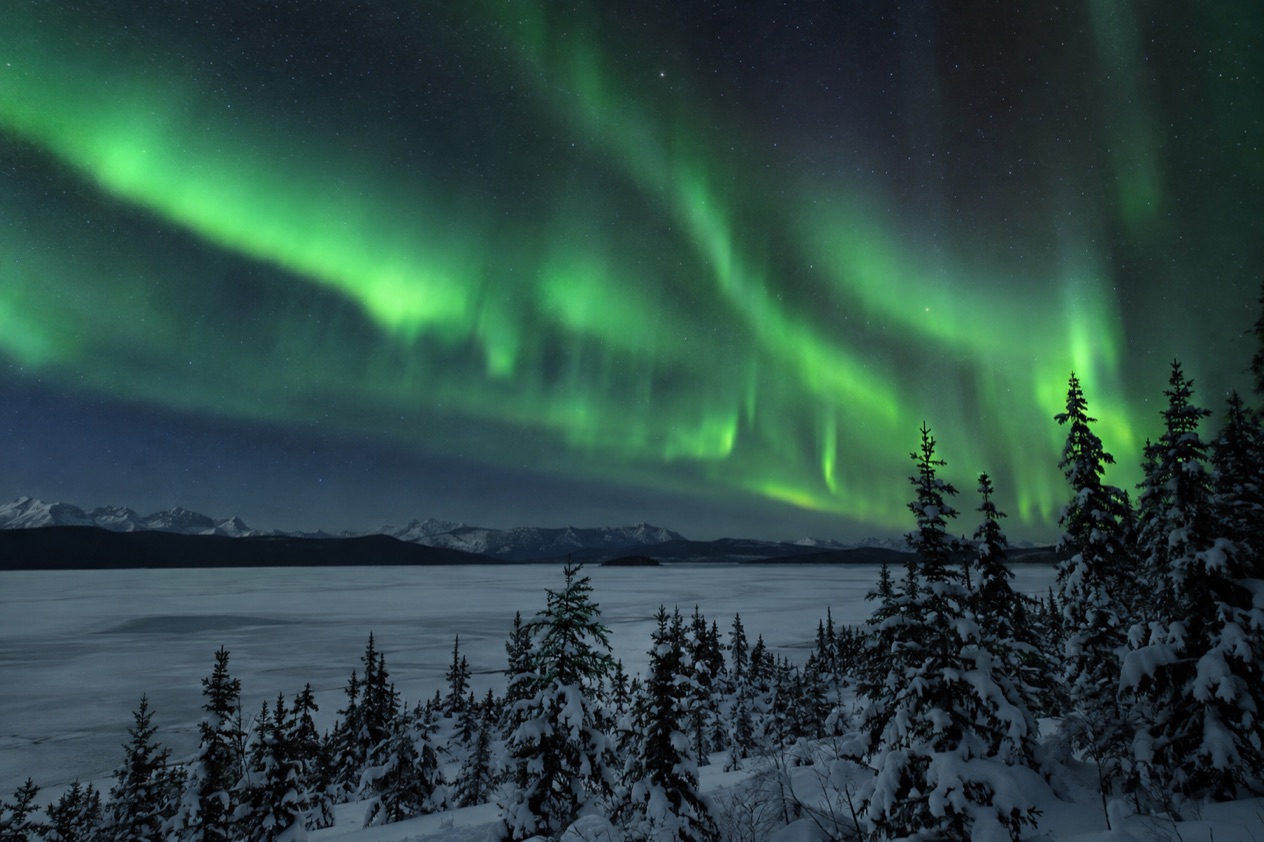
A faint green arc settles over a ridge of black spruce, hangs there for a while, then thickens and begins to move, folding into curtains that ripple across the sky. The snow squeaks underfoot, your breath hangs in front of you, and everyone around you has gone quiet. Alaska sits under the oval where the northern lights are most likely to appear, and from Fairbanks to Anchorage they return each year once the nights grow dark again in late summer and stay into spring.
Where can you see the northern lights in Alaska?
You can see them from most of the state, but the places that have built a routine around the lights are Fairbanks, Chena Hot Springs and Anchorage. The northern lights oval, the zone with the highest probability of seeing them, covers most of Alaska, so the real question is less about a magic spot than about darkness, clear sky and a little patience.
What you are looking at is charged particles from the sun colliding with gas in the upper atmosphere, far above the clouds. The most common color is a brilliant yellow-green, and on stronger nights the display can add red, blue and purple. To the naked eye a faint aurora can look like a pale, moving cloud, while a strong one has color and speed you can follow without a camera.
Fairbanks and the viewing spots around it
Fairbanks is famous for aurora viewing, and there are many tours and sites that cater to people who come for the lights. The city sits at about the latitude where, if the weather is clear and you stay for at least three nights, seeing the aurora is highly likely. That three-night idea is worth building a trip around, because a single evening can easily be lost to cloud.
Local favorites for watching include Chena Lakes Recreation Area, Tanana Lakes Recreation Area, Cleary Summit and the small community of Ester. Higher ground gives wide views, and the list also takes in Wickersham and Murphy Domes and Haystack Mountain on the Elliot Highway. Turnouts along the Elliot, Steese and Parks Highways, on Chena Hot Springs Road and Nordale Road, and the Ballaine Road turnout near the Goldstream Creek bridge are other places people stop to look up.
The idea behind most of these places is the same: get away from streetlights and find a wide piece of sky. Pick somewhere before dark, so you are not hunting for a pullout at the moment the sky starts to glow.
Chena Hot Springs
Chena Hot Springs is a resort with its own aurora viewing season, running from late August to mid-April. Guests can watch from the property, and the lodge also runs a winter aurora viewing tour. It suits people who want the lights to be part of a longer stay rather than a late-night errand from town.
| Tour | Price per person | Duration | Minimum age |
|---|---|---|---|
| Winter aurora viewing tour at Chena Hot Springs | $125 | 5 hours | 2 years |
The long outing means you are out in the dark for the stretch of the night when displays are most likely, with time to wait out a quiet spell. Even on a night when the sky is slow to start, the setting of a hot-springs resort in the Interior gives the wait a good deal of charm.
Anchorage
Anchorage is one of the best bases for chasing the aurora, with many prime locations easily reached from the city. There are plenty of Anchorage guides with an eye for the lights, and they can help increase your odds of seeing them. Having a guide who watches the sky and knows where to go on a given night is a real advantage if you are new to this.
The city’s mild winter temperatures keep everyone comfortable while viewing, which matters when you are standing still for a long time looking up. It makes Anchorage a natural choice for travelers who want a city hotel and restaurants to come back to, with the lights as an evening outing.
When is the aurora season?
The aurora season runs from late summer into spring, from the time the sky gets dark again until it stops getting dark enough. The lights are there all year in principle, but you can only see them when the sky is dark, and Alaska’s summer light erases them.
| Period | Dates |
|---|---|
| Aurora season in Fairbanks | August 21 to April 21 |
| Aurora viewing season at Chena Hot Springs | Late August to mid-April |
| Northern lights over Anchorage | Mid-August through April |
| Best chances in Alaska, when it is dark after 6 p.m. | Late September to late March |
| Midnight Sun Season in Fairbanks | April 22 to August 20 |
Fall and spring: the equinox months
Auroral activity tends to be more intense around the fall and spring equinoxes than around the solstices. Over Interior Alaska the statistical likelihood of seeing the lights is roughly twice as high at the equinox as at the winter solstice. Geomagnetic storms that ignite auroras may also occur more often in the months around the equinoxes.
For a traveler, that makes early fall appealing: the nights are dark enough again but the deep cold of midwinter has not arrived. Spring offers the same logic in reverse, as the season winds down toward its final weeks.
Midwinter: long nights and Fairbanks celebrations
In the dark heart of winter you have the longest stretch of night to work with, and the lights compete with nothing. Fairbanks adds events that give a trip some daytime texture. The Winter Solstice Celebration in Downtown Fairbanks takes place during the week of December 21, with fireworks that cannot be seen in the summertime.
Later in the season, ice art sculptures are displayed around Fairbanks from mid-February to the end of March. The World Ice Art Championships, held late February through March, features over 80 ice sculptures by international carvers. The International Ice Art Classic adds ice slides and an ice playground, which makes it a good daytime stop for families.
Denali Winterfest runs from the end of February to the beginning of March, with dog sledding, a 5K race, snowshoeing, hiking and park ranger programs. Pairing these days with late-evening sky watching gives a winter trip a natural rhythm.
Summer: the sky stays too bright
In Fairbanks, the sky does not get dark enough to see the aurora in the summer, even if the display is spectacular. The city has a stretch of 24-hour daylight, from May 17 to July 27, and the light lingers long on either side. A summer visit is a trip for hiking, rivers and long evenings, not for the lights.
The Arctic Circle lies 196 driving miles north of Fairbanks, and Denali, North America’s highest peak, rises 20,310 feet. Those are summer reasons to come, and they sit well with a later trip for the aurora, when the same Interior looks entirely different.
How do you improve your chances?
You improve your chances by combining the right season, a dark and open sky, the right hours of the night and a few forecasts. None of it guarantees a show, since the lights are a natural display that comes and goes on its own schedule, but each step tilts the odds toward you.
Choose the right hours of the night
In Interior Alaska in winter, the best time to watch is typically from evening into the small hours, and the three or four hours centered around midnight have the highest probability of spectacular displays. Another source puts the peak in the late evening, between 10 and 11 p.m. Together the advice is the same: plan to be out late and stay out.
That means a long evening of waiting, so dinner, a warm layer to return to and a place to sit make a real difference. The lights often flare, fade and return, and the people who see the most are usually the ones who did not go back inside at the first quiet spell.
Use the forecasts
The University of Alaska Fairbanks Geophysical Institute provides an Aurora Forecast on its website for viewing the northern lights in Alaska. It also offers webcam and current weather conditions, and magnetometer data that shows how magnetic Alaska is on a given night. Cloud cover is the usual spoiler, so a webcam can tell you quickly whether the sky is open.
A forecast is a guide, not a promise. Use it to decide whether to head out, and when you are already out, keep looking at the sky in every direction, because a display can start faintly over a dark ridge.
Get away from city light
To avoid light pollution, areas at least about 19 miles from cities are preferred for viewing. In practice that means the highway turnouts, domes and recreation areas around Fairbanks, or a lodge set well outside town. Even a modest distance from streetlights lets fainter features come out, and faint features are often how a big display begins.
Choose a place with a wide, open view, since the aurora can stretch across a large part of the sky. If you are staying in a city, a guided outing can take you to that kind of dark place without you having to find it yourself.
Mind the moon and the solar cycle
When the moon is full or close to full, the added light may prevent you from seeing dim auroral features. Moonlight can also enhance colors by activating the cone cells in your eyes, so a bright moon is not simply a drawback. It changes how the sky looks rather than ruling it out.
The sun runs on an 11-year cycle, and auroral activity tends to peak slightly after the solar maximum, by around one year. Large geomagnetic storms, which can bring auroras to lower latitudes, are most common at the peak or during the three years after it. During such storms the aurora can rarely be seen as far south as the southern states of the U.S., though in Alaska you do not need a storm to see it.
Stay several nights if you can, because that gives the weather, the moon and the sun several chances to line up.
Good to know before you go
Winter nights in the Interior call for patience and warm layers, and a hot spring makes a fine way to end an evening. At Chena Hot Springs, a day pass to the Pool House and a tour of the Aurora Ice Museum are priced separately from the aurora tour.
| Fee | Amount | Who pays |
|---|---|---|
| Pool House day pass at Chena Hot Springs | $20 | Adults |
| Pool House day pass at Chena Hot Springs | $17 | Children |
| Aurora Ice Museum Tour (45 minutes, ages 6 and up) | $20 | Adults |
| Aurora Ice Museum Tour (45 minutes, ages 6 and up) | $15 | Children |
Sources
- University of Alaska Fairbanks Geophysical Institute, Aurora forecast (https://www.gi.alaska.edu/monitors/aurora-forecast), checked October 11, 2026
- Wikivoyage, Northern lights (https://en.wikivoyage.org/wiki/Northern_lights), checked October 11, 2026
- Wikipedia, Aurora (https://en.wikipedia.org/wiki/Aurora), checked October 11, 2026
- Visit Anchorage, northern lights viewing (https://www.anchorage.net/winter/things-to-do/northern-lights-viewing/), checked October 11, 2026
- Explore Fairbanks, winter events (https://www.explorefairbanks.com/events/winter-events/), checked October 11, 2026
- Chena Hot Springs Resort, activities (https://www.chenahotsprings.com/activities), checked October 11, 2026