
In Anchorage a moose can stand calmly between houses while the Chugach Mountains turn pink behind it, and the downtown streets fill with people heading to a museum, a brewery or a floatplane. In Fairbanks the pace slows to a river town’s, with birch trees, a gold rush past and, in the right season, the sky itself as the evening’s entertainment.
Which is better, Anchorage or Fairbanks?
Anchorage is better for travelers who want mountains, museums, boat trips and flightseeing within reach of a big airport, while Fairbanks is better for those who come for the northern lights, round-the-clock summer light and the feel of Interior Alaska. Neither is the wrong choice. They simply point you in different directions.
| Category | Anchorage | Fairbanks |
|---|---|---|
| Scenery | The Chugach Mountains at the edge of town, the head of Cook Inlet, glaciers to view | The Chena River, birch woods, the Interior and the gateway to the Arctic |
| Vibe | An urban enclave surrounded by wilderness, 291,247 residents in 2020 | A smaller river town, 32,515 residents in the city in 2020, Alaska’s second-largest city with its borough |
| Things to do | Hiking, museums, flightseeing, whale and puffin cruises, Alaska Native culture, winter festivals | Aurora viewing, dog mushing, hot springs, gold rush history, ice art, summer solstice events |
| Wildlife | Moose in the city, bears by air, whales, puffins and otters by boat | Wildlife viewing tours, lodges in and near Denali National Park and Preserve |
| Weather | Mild summers, cold and snowy winters | Daylight swings from endless summer light to a few hours in winter |
| Getting there | Main airport hub of the region, nonstop flights from many major cities | Fairbanks International Airport, close to the center of town |
| Best for | A base for mountains, museums and day trips | Aurora seasons, the midnight sun and the road north |
Think of the table as two different kinds of trip. Fairbanks gives you a stronger sense of having arrived somewhere remote, with the Arctic Circle within reach and a sky that does most of the talking.
A June visit to Fairbanks and a February visit to Fairbanks feel like two different destinations.
Scenery and wildlife
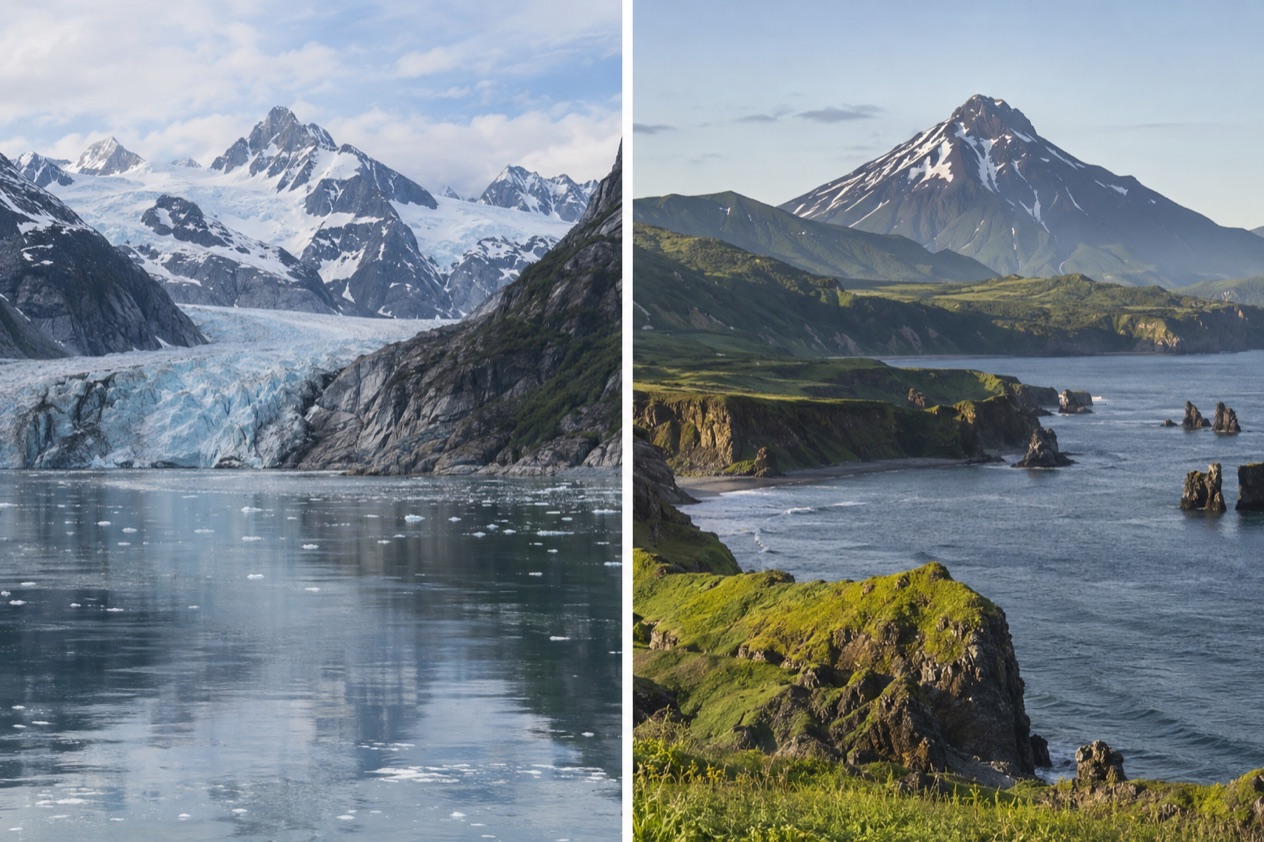
Anchorage sits at the head of Cook Inlet in Southcentral Alaska, and its scenery is the mountains. The Chugach range rises over the city, and the state park that bears its name holds roughly 495,000 acres, one of the four largest state parks in the country. Glacier viewing is part of the Anchorage menu, and the water around the city is turquoise enough that visitors paddle it through a vast state park.
Wildlife in Anchorage can be startlingly close. Moose wander the city itself, and from town you can fly out to see bears fishing, or take day cruises in search of whales, puffins and otters. Millions of birds pass through on their annual migrations, and salmon fill nearby rivers and streams through the summer. Guides also run tours to look for wolves and caribou in Denali National Park, and for polar bears above the Arctic Circle.
Fairbanks looks different. It is a town of the Interior, with the Chena River winding through it and birch trees around the bed and breakfasts. Downtown sits 140 miles south of the Arctic Circle by air, and that closeness shapes everything about the light. The Interior and Arctic regions spread out beyond the city, and lodges scattered across them, some within Denali National Park and Preserve, serve as basecamps for wildlife viewing.
The sky is Fairbanks’s other landscape. In summer the daylight runs on and on, with no true darkness in June.
When the nights return in late August, the northern lights become the main event, and the town is described as one of the best places in Alaska to see them. As with all wildlife and sky shows, they are a chance rather than a promise, and a clear, dark night is what you hope for.
Who wins? For sheer variety within a short reach of the city, Anchorage takes it: mountains, glaciers, water, moose on the street and boats that go looking for whales. For the sky, and for the sense of standing at the doorway of the Arctic, Fairbanks takes it. If your idea of Alaska is mountains and animals, start in Anchorage. If it is light and darkness and the aurora, start in Fairbanks.
Things to do
Anchorage’s list of things to do reads like a menu of Alaska itself. Hikers head into Chugach State Park, whose western boundary is seven miles east of downtown, and in summer the long evenings leave plenty of light for mountain trails.
At Eklutna Lake, the Lakeside Trail runs 12.7 miles along the shore and carries on to the moraines at the foot of Eklutna Glacier. In summer you can travel it on foot, by mountain bike, ATV or horseback, and the trail is largely flat.
Museums are the other half of Anchorage. The Anchorage Museum, in walkable downtown, opened in 1968 and has been named one of Condé Nast Traveler’s top museums in the country, with art, history, science and Alaska Native cultures under one roof. The Alaska Native Heritage Center presents all of Alaska’s Native peoples, and the city itself stands on the homelands of the Dena’ina Athabascan people, so the stories you hear around town start there.
Winter brings its own program. Dog sledding in Anchorage typically runs from October through March, and summer dog sledding is available too. Fur Rondy, the city’s oldest and largest winter festival, began in 1936 as a sporting event and still delivers oddities like the Outhouse Races, in which teams steer outhouses on skis.
The Iditarod’s ceremonial start traditionally falls on the first Saturday of March, from Fourth Avenue at D Street to Campbell Creek Science Center. A ski resort sits 40 minutes from downtown, and flightseeing tours over the Chugach and the Alaska Range depart from Anchorage year-round by floatplane, fixed wing or helicopter.
Fairbanks builds its calendar around light and tradition. The Midnight Sun Festival is a free, 12-hour street fair held downtown on the Saturday closest to June 21, and the Midnight Sun Baseball Game has been played under the solstice light since 1906. The World Eskimo-Indian Olympics bring Indigenous athletes together for games such as the high kick, the blanket toss and the four-man carry, and the Tanana Valley State Fair closes out the summer with a Ferris wheel and local delicacies.
Winter in Fairbanks means aurora viewing, dog mushing, hot springs and, from mid-February to the end of March, ice art sculptures around town. The Winter Solstice Celebration takes over downtown during the week of December 21, with fireworks that can only be seen in the dark of that season. The town of North Pole, close to Fairbanks, adds an Alaskan-style side trip, and gold rush history, fishing and flightseeing complete the Fairbanks list.
The University of Alaska Museum of the North sits on the UAF campus and gives you a rainy-day or cold-day stop.
| Site | Open |
|---|---|
| University of Alaska Museum of the North, Fairbanks | Daily, 9 AM to 5:30 PM, admission sales close at 5 PM |
About 56 miles northeast of Fairbanks, Chena Hot Springs Resort sits in the wilderness near the Chena River State Recreation Area. Its hot springs are open for soaking year-round, including beneath the aurora, and in winter an aurora viewing tour takes guests by tracked vehicle to Charlie Dome, where heated yurts and hot drinks are provided. The resort was founded more than a century ago by two gold mining brothers, and its first twelve cabins went up in 1911.
| Chena Hot Springs offer | Price |
|---|---|
| Pool House day pass, adult | $20 |
| Pool House day pass, child | $17 |
| Winter aurora viewing tour, per person, 5 hours, riders at least 2 years old | $125 |
Weather and the best time to go
Anchorage’s best season runs from May to early September, when the days are long and mild. July afternoons are comfortable for a light jacket or a sweater, and a shower is more likely than a downpour. January is a different city, cold and snowy, with short days that make the lit-up downtown and the winter festivals the main attraction.
| Anchorage (airport) | January | July |
|---|---|---|
| Average high (°F) | 22.7 | 66.2 |
| Average low (°F) | 11.0 | 52.9 |
| Precipitation (inches) | 0.75 | 1.82 |
| Days with precipitation | 2.7 | 5.1 |
| Snowfall (inches) | 12.4 | 0.0 |
July is mild enough for hiking and eating outside in the evening, with more days of showers but no snow. The swing between those two months is the swing between a winter-sports town and a summer-trail town.
Fairbanks’s daylight changes dramatically with the seasons. The Midnight Sun Season runs from April 22 to August 20, and in June the sun is up from 3 AM to 12:45 AM, so it never gets fully dark. In winter the reverse holds, with the sun rising late in the morning and setting in mid-afternoon, which makes the dark sky and the aurora the draw rather than the daylight.
| Light and sky | Anchorage | Fairbanks |
|---|---|---|
| Summer daylight | Up to 19½ hours, with the sun setting just before midnight | 70 straight days of 24 hours of sunlight, May 17 to July 27 |
| Aurora season | Late September through mid-April | August 21 to April 21 |
If the aurora is your goal, the two towns overlap through the dark months, and Fairbanks’s season starts earlier in the fall. If long, bright days are your goal, Fairbanks gives you summer nights that never get fully dark, while Anchorage gives you evenings that stretch very late. Neither town guarantees a clear sky, so a few nights in place gives you better odds than a single one.
For a first trip built around hiking, wildlife cruises and flightseeing, aim for the Anchorage season of May to early September. For the aurora, aim for the dark months, with Chena Hot Springs and its tour as one option. For events, the Midnight Sun Festival in June, the Tanana Valley State Fair at summer’s end, Fur Rondy and the Iditarod start in winter each give you a reason to pick a month.
Getting there and getting around
Anchorage is the region’s main airport hub, served by Ted Stevens Anchorage International Airport, and more than 240 flights land there each day. Nonstop flights arrive from many major cities, including Seattle, Denver, Chicago, Minneapolis, Los Angeles and Phoenix. People plan at least three days in town, which gives you time to combine the city with a day out on the water, in the air or on a trail.
Fairbanks International Airport, owned by the State of Alaska, is three miles southwest of the central business district, so the town is close to where you land. Domestic flights come in from Chicago, Dallas, Denver, Minneapolis and Seattle-Tacoma, operated by airlines including Alaska Airlines and Horizon Air, American, Delta and United. Fairbanks also has air options for traveling around the Interior and beyond.
Once in Anchorage, downtown is walkable, and the Anchorage Museum sits right in it. Chugach State Park begins just east of the city, and communities such as Eagle River, Chugiak, Girdwood and the village of Eklutna sit within minutes of the park. Girdwood and Portage, in South Anchorage, have two resorts or lodges. Flightseeing tours by floatplane, fixed wing or helicopter leave from the city, and the Official Anchorage Visitor Guide is free.
In Fairbanks, simple downtown walking maps are available from Explore Fairbanks, and the town serves as the base for the rest of the Interior. Local businesses help visitors reach remote areas, guide them through town, plan adventures or supply equipment. Chena Hot Springs is about 56 miles away, and the lodges near Denali National Park and Preserve and across the Interior and Arctic regions serve as basecamps for longer stays.
The two towns work differently as starting points. Anchorage is the region’s main airport hub and a base for the surrounding mountains and water. Fairbanks offers a smaller airport, a smaller town and a closer link to the Interior and Arctic, with guides and outfitters ready to take you beyond the road system.
Who should choose which
Choose Anchorage if you want a base with many flights, a strong museum scene, hiking in a large state park near town and boats and planes that go looking for whales, bears and glaciers. It suits first-time visitors who want a wide taste of Southcentral Alaska, and anyone who likes to pair a day outdoors with an evening in a real city. Winter visitors get Fur Rondy, the Iditarod start, dog sledding and skiing, all within reach of the city.
Choose Fairbanks if the northern lights come first, or if you want the full strangeness of the summer light. It suits travelers who like a smaller town, hot springs, dog mushing, ice art and gold rush history, and those who want to head toward the Interior and the Arctic. The festivals, from the solstice baseball game to the World Eskimo-Indian Olympics, give the town a character different from Anchorage’s.
Combining them makes sense if you have the time, because the two places give you almost opposite halves of Alaska. Anchorage covers the mountains, the water and the museums, while Fairbanks covers the sky, the Interior and the Arctic. Starting in Anchorage and finishing in Fairbanks lets you move from coastal mountains to river country, and the long list of lodges and tour operators on both sides gives you plenty of ways to build the route.
If you can only visit one, let the season decide. For May to early September, with the trails and boats at their fullest, Anchorage is the broader choice. For the dark months and the aurora, or for the unbroken light of the solstice, Fairbanks is the more distinctive one.
Good to know before you go
Planning resources are free on both sides: the Official Anchorage Visitor Guide includes a directory of businesses across Southcentral Alaska, and Explore Fairbanks can be reached at (907) 456-5774 for trip planning around the Interior. Moose live in Anchorage itself. Aurora and wildlife viewing both depend on conditions, so build in a few nights rather than counting on a single evening.
Sources
- Visit Anchorage (https://www.anchorage.net/), checked October 11, 2026
- Alaska.org, dest anchorage (https://www.alaska.org/destination/anchorage), checked October 11, 2026
- Wikivoyage, Anchorage (https://en.wikivoyage.org/wiki/Anchorage), checked October 11, 2026
- Wikipedia, Anchorage, Alaska (https://en.wikipedia.org/wiki/Anchorage,_Alaska), checked October 11, 2026
- Wikipedia, Anchorage Museum (https://en.wikipedia.org/wiki/Anchorage_Museum), checked October 11, 2026
- Alaska Native Heritage Center (https://www.alaskanative.net/visit), checked October 11, 2026
- Wikipedia, Chugach State Park (https://en.wikipedia.org/wiki/Chugach_State_Park), checked October 11, 2026
- Alaska State Parks, Chugach region (https://dnr.alaska.gov/parks/aspunits/chugach/chugachindex.htm), checked October 11, 2026
- Explore Fairbanks (https://www.explorefairbanks.com/), checked October 11, 2026
- Alaska.org, dest fairbanks (https://www.alaska.org/destination/fairbanks), checked October 11, 2026
- Wikivoyage, Fairbanks (https://en.wikivoyage.org/wiki/Fairbanks), checked October 11, 2026
- Wikipedia, Fairbanks, Alaska (https://en.wikipedia.org/wiki/Fairbanks,_Alaska), checked October 11, 2026
- Wikipedia, Fairbanks International Airport (https://en.wikipedia.org/wiki/Fairbanks_International_Airport), checked October 11, 2026
- Wikipedia, Fairbanks North Star Borough, Alaska (https://en.wikipedia.org/wiki/Fairbanks_North_Star_Borough,_Alaska), checked October 11, 2026
- University of Alaska Museum of the North (https://www.uaf.edu/museum/), checked October 11, 2026
- Chena Hot Springs Resort (https://www.chenahotsprings.com/), checked October 11, 2026
- Wikipedia, Chena Hot Springs (https://en.wikipedia.org/wiki/Chena_Hot_Springs), checked October 11, 2026
- NOAA NCEI, U.S. Climate Normals 1991-2020, monthly (https://www.ncei.noaa.gov/access/services/data/v1?dataset=normals-monthly-1991-2020&stations=USW00026451), station Anchorage Intl Ap, elevation 120 feet, checked October 11, 2026
To plan your stay
- Best Time to Visit Anchorage: Long Summer Days, Northern Lights, Weather by Month and Festivals
- Things to Do in Anchorage: Museums, Alaska Native Heritage, Chugach Trails and Day Trips
- Where to Stay in Anchorage: Downtown, Eagle River, Girdwood and Lodging Types
- Anchorage from the Lower 48: Flights, Roads, Ferries and Trains Once You Arrive