
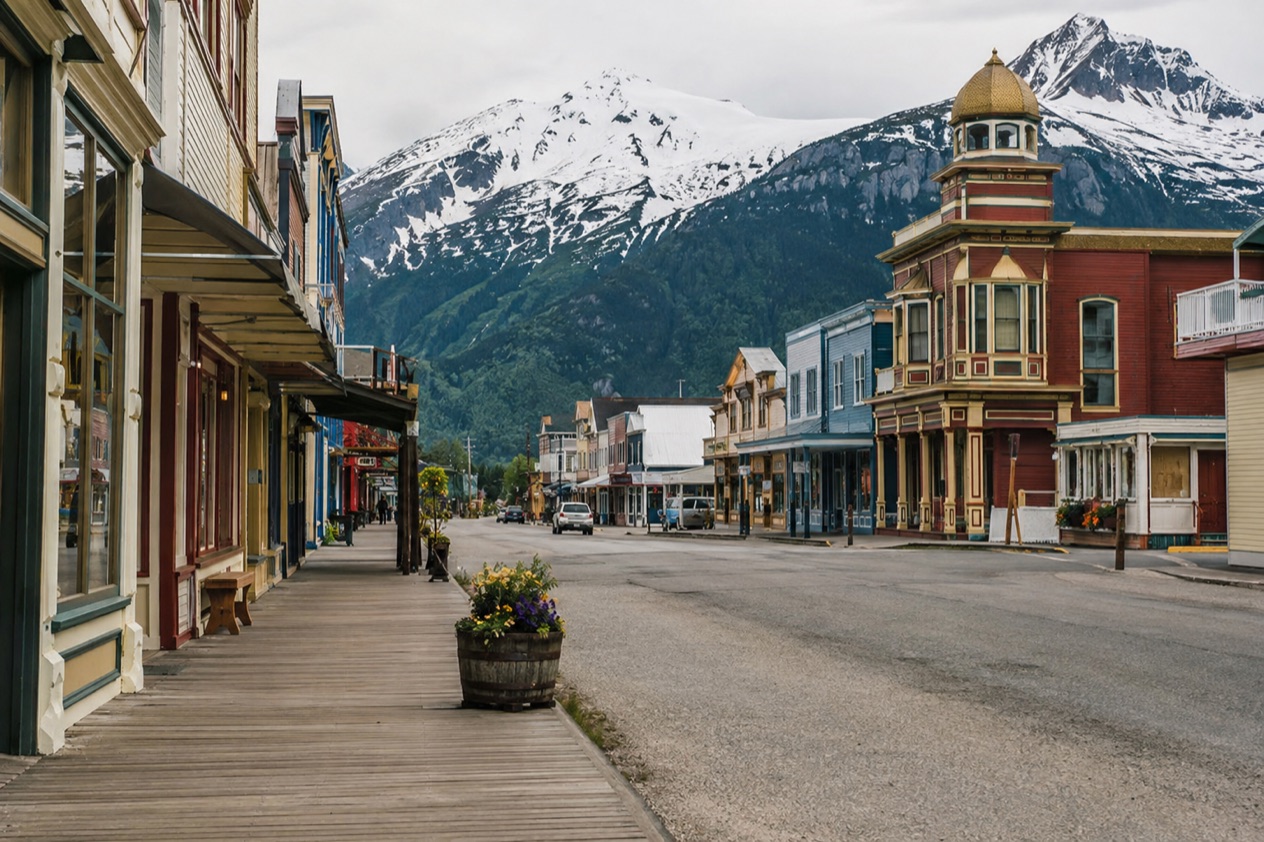
Walk down Broadway in Skagway and the boardwalks, false-front buildings and the restored rail depot look much as they did when prospectors poured through on their way to the Klondike. A narrow-gauge train waits at the port, and a theater company is getting ready to recite the ballads of Robert Service. This is a small Southeast Alaska town built around its gold rush past, for travelers who like history, railways and mountain trails.
Where is Skagway and what is it like?
Skagway is a town in Southeastern Alaska with a population of less than a thousand, a small place at the northern end of the Alaska Marine Highway ferry network. It sits at the port where the White Pass and Yukon Route railroad begins, and the only road out to the rest of the continent is Highway 98, which runs to Whitehorse in the Yukon by way of Carcross.
Its character comes from the gold rush. Most prospectors headed for the Klondike came through the ports of Dyea and Skagway, and the town still has a historic district of about 100 buildings from that era.
Many of them are part of Klondike Gold Rush National Historical Park, so a walk along the boardwalks is also a walk through a national park. The tone is that of a living museum: saloons with stories, a rail depot with a past, and a main street where history is the main attraction.
The town also changes with the seasons. Its population doubles in the summer tourist season, and Skagway is a popular stop for cruise ships, so tourism is a big part of its business.
Travelers who like a lively main street with shops and tours will feel at home. Anyone looking for solitude on the boardwalks in high season may prefer the trails outside town, where the Dyea valley and the mountain routes of the gold rush give the place another, quieter side.
What is there to do in Skagway?
The big reasons to come are the gold rush history, the railway, the trails of Dyea and the town’s shops and stage. Skagway lets you explore on your own without a guide, and it also has a variety of commercial tours for those who prefer one.
The Klondike Gold Rush National Historical Park
A visit starts at the park’s visitor center, in the restored rail depot at 2nd and Broadway, finished in December 1898. There you learn about programs and tours and can watch the film Gold Fever: Race to the Klondike in the theater. Rangers also give short conversations on topics they care about, held in the theater or outside, and the topics change from day to day.
Four National Park Service museums in Skagway cover the gold rush story, and a self-guided walking tour of park buildings in the historic district gives you a route along the boardwalks. The park no longer offers ranger-led walking tours, so the self-guided route is the way to see the buildings. Junior rangers can plan their activities and earn badges at the Pantheon Saloon further up Broadway, which makes the park a natural fit for families with children.
The White Pass and Yukon Route Railway
This narrow-gauge line began as part of the area’s mining past and is an International Historic Civil Engineering Landmark. Today it runs purely for the tourist trade in the summer months, starting at the port of Skagway. The active track runs to Carcross, and the line was reopened between Skagway and White Pass in 1988 for passengers only.
The railroad resumed operations in May 2023 after a pause that began in July 2020. It is a way to see the mountain country that the prospectors crossed on foot, and the White Pass trail they used was nicknamed Dead Horse Trail because so many horses died on it.
Dyea and the Chilkoot Trail
Dyea is a former boom town, now a ghost town and a campground and a natural area that belongs to the park, about 15 minutes from Skagway. It is where the Chilkoot Trail begins. Around 22,000 prospectors used that route during the gold rush, and today it is a 33-mile trail that ends at Bennett, British Columbia.
Hikers must get a trail permit and an orientation at the Chilkoot Trail Center before setting out, and no more than 50 backpackers may start the trail each day. The official hiking season, when rangers and a trail crew are on duty, usually runs from late May to early September, with peak demand from June through August.
Shopping and an evening at the theater
Skagway promotes itself as having the best shopping in Alaska, and the historic main street is lined with stores in old gold rush buildings. In the evening, theatrical renditions of the ballads of Robert Service are performed in town, suitable for the whole family. Skagway differs from its Southeast neighbors Juneau, Sitka and Ketchikan by being so small and so focused on one story, the rush north to the Klondike.
How many days do you need in Skagway?
A long weekend is enough to see the town and its main attractions, and a few more days let you add a trail or a trip up the valley. The town is small, so the historic district is easy to fold into a single day on foot, with the rest of the time given to the railway and the surrounding country.
In a short stay, begin at the visitor center, watch the film and check the day’s ranger talk. Then follow the self-guided walking tour of park buildings in the historic district, stopping at the park’s museums as you go. A railway excursion fits into another part of the stay, and an evening can end with the Robert Service ballads on stage.
With more time, Dyea is the obvious addition. You can wander the ghost town and the campground, or look at the start of the Chilkoot Trail, the route those 22,000 prospectors followed. Hiking the full trail to Bennett is a multi-day undertaking with its own permit system, so it suits a separate trip rather than a quick add-on.
Highway 98 is another option for a longer stay, since it leads to Carcross and on to Whitehorse in the Yukon. The railway also covers the first part of that route up to Carcross.
Where to stay in Skagway
Almost everything in Skagway is concentrated in the historic downtown, and staying there puts you within reach of Broadway, the park visitor center in the old rail depot, the museums, the shops and the port where the railway starts. It suits travelers who want to walk to their sightseeing and spend their evenings among the old buildings and the theater.
The second base is Dyea, the former boom town about 15 minutes from Skagway. It has a campground, and it is the place for anyone whose plans center on the Chilkoot Trail.
Because the town’s population doubles in the summer tourist season and cruise ships call here, the summer months are when the town is at its busiest, while a quieter pace returns outside that season. The park advises visitors planning a trip between October and May to read about visiting in winter, a reminder that the rhythm of the place changes with the calendar.
The choice comes down to what you want from the trip. Downtown suits history, shopping and the railway, and Dyea suits hikers and campers who want to be near the trail. Either way, the town is small enough that nothing is far from anything else.
How do you get to Skagway and get around?
Skagway can be reached by sea or by road. It is the northern terminus of the Alaska Marine Highway System ferry network, and it is a popular stop for cruise ships. By road, Highway 98 is the only road access to the rest of the continent, and it travels to Whitehorse, Yukon, via Carcross, Yukon.
The White Pass and Yukon Route Railway starts at the port and connects Skagway with the mountains. The railroad was originally 107 miles long, running from Skagway to Whitehorse, and the currently active track runs 67.5 miles from Skagway to Carcross.
Once in town, the historic district is a place to explore on your own. The park visitor center, the museums and the main street are all part of the same compact core, and the self-guided walking tour of park buildings is just .64 mile long. Dyea, the start of the Chilkoot Trail, is about 15 minutes from Skagway.
The Skagway Convention and Visitors Bureau is the official visitor department for the town, and M & M Tours is the only tour brokerage contracted by the Municipality of Skagway. Commercial tours of many kinds are available, so travelers who prefer not to go alone have options.
When is the best time to visit Skagway?
Summer is the main season, and the months that matter most are those when the railway runs and the Chilkoot Trail is staffed. The railroad operates for the tourist trade in the summer months, and the trail’s official hiking season usually runs from late May to early September, with peak demand from June through August. July is the month to have in mind: afternoons reach the mid-60s and nights hold near 52°F, with showers on only a handful of days.
The crowds follow the same calendar. Skagway’s population doubles in the summer tourist season and cruise ships stop here, so the main street is at its busiest in those months. Those who prefer quiet may be happier at the edges of the season, though the railway and trail seasons set the limits of what is open.
Winter is a different town. In January, highs are around 31°F and lows near 22°F, and precipitation falls on about six days, as rain or snow. The park suggests that anyone planning a visit between October and May read about visiting during the winter first, and the railway excursions are a summer-month affair. Winter suits those who want the historic town without the summer bustle.
| Month | Average high (°F) | Average low (°F) | Precipitation (inches) | Days with precipitation |
|---|---|---|---|---|
| January | 30.7 | 22.2 | 2.17 | 5.8 |
| July | 64.5 | 52.0 | 1.38 | 4.6 |
Good to know before you go
Skagway is a small town of less than a thousand people, so planning around its seasons matters more than anything else. The railway runs in the summer months, and the Chilkoot Trail requires a permit and an orientation at the Chilkoot Trail Center before you start. The park visitor center in the old rail depot is the place to begin, with its film, its programs and its daily ranger talks.
Sources
- Skagway Convention and Visitors Bureau (https://www.skagway.com/), checked October 11, 2026
- Skagway, things to do (https://www.skagway.com/things-to-do), checked October 11, 2026
- Wikivoyage, Skagway (https://en.wikivoyage.org/wiki/Skagway), checked October 11, 2026
- Wikipedia, Skagway, Alaska (https://en.wikipedia.org/wiki/Skagway,_Alaska), checked October 11, 2026
- National Park Service, Klondike Gold Rush National Historical Park (Skagway), plan your visit (https://www.nps.gov/klgo/planyourvisit/index.htm), checked October 11, 2026
- White Pass and Yukon Route Railway, Skagway (https://www.wpyr.com/), checked October 11, 2026
- Wikipedia, White Pass and Yukon Route (https://en.wikipedia.org/wiki/White_Pass_and_Yukon_Route), checked October 11, 2026
- Wikipedia, Chilkoot Trail (https://en.wikipedia.org/wiki/Chilkoot_Trail), checked October 11, 2026
- Wikipedia, Klondike Gold Rush (https://en.wikipedia.org/wiki/Klondike_Gold_Rush), checked October 11, 2026
- Wikipedia, Southeast Alaska (https://en.wikipedia.org/wiki/Southeast_Alaska), checked October 11, 2026
- Wikipedia, Climate of Alaska (https://en.wikipedia.org/wiki/Climate_of_Alaska), checked October 11, 2026
- NOAA NCEI, U.S. Climate Normals 1991-2020, monthly (https://www.ncei.noaa.gov/access/services/data/v1?dataset=normals-monthly-1991-2020&stations=USW00025335), station Skagway Ap, elevation 20 feet, checked October 11, 2026
All our pages
When to go
- Best Time to Visit Skagway: Summer Trains, Chilkoot Trail Season, Weather and Quiet Months
- Skagway in January: Winter Weather, Gold Rush History and a Quiet Town
- Skagway in February: Weather, Winter Light and What to Do
- Skagway in March: Weather, Gold Rush History and a Quiet Boardwalk Town
- Skagway in April: Weather, Gold Rush History and What to Do
- Skagway in May: Weather, Gold Rush History and What to Do
- Skagway in June: Weather, Gold Rush History and the Chilkoot Trail
- Skagway in July: Weather, Gold Rush History and Train Rides
- Skagway in August: Weather, Gold Rush History, the White Pass Railroad and a Two-Day Plan
- Skagway in September: Weather, Klondike History and What to Do
- Skagway in October: Weather, Gold Rush History and a Quiet Main Street
- Skagway in November: Weather, Short Days and What to Do in a Quiet Gold Rush Town
- Skagway in December: Short Days, Gold Rush Streets and What to Wear
Things to do
- Things to Do in Skagway: Gold Rush History, the White Pass Railway and Dyea
- Day Trips from Skagway: White Pass Railway, Dyea and the Chilkoot Trail, Carcross and Haines