
In Alaska, a floatplane lifts off a quiet lake and the whole country below seems to be spruce, braided rivers and ice. In Iceland, steam drifts off a field of hot ground while a geyser gathers itself and throws a column of water into the wind.
Both places are about glaciers, volcanoes and big weather, yet they feel very different once you are standing in them. This comparison helps American travelers decide which one fits the trip they are dreaming about.
Which is better, Alaska or Iceland?
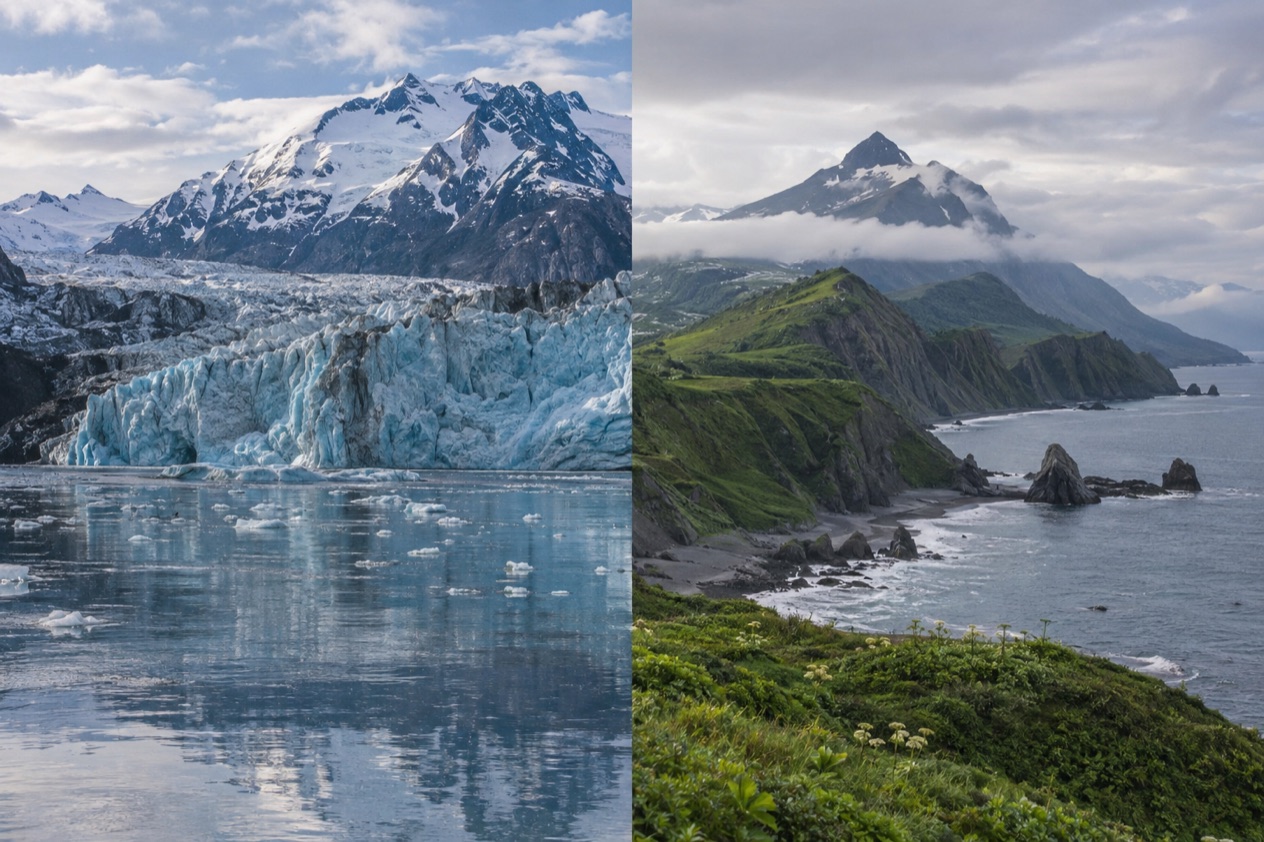
Alaska suits travelers who want scale, wilderness and wildlife on a continental canvas, while Iceland suits those who want a compact island where volcanic drama, hot springs and small towns sit close together. Neither is better in the abstract. It comes down to whether you picture yourself in a vast national park or on a landscape that is still being built by the earth beneath it.
Alaska is a U.S. state, so the trip feels like a domestic adventure with the sense of a far frontier. Iceland is a small country with its own language, its own parliament and a long literary tradition. That difference shapes the mood of everything from dinner to the way you plan your days.
| Category | Alaska | Iceland |
|---|---|---|
| Scenery | Towering mountains, tidewater glaciers, rainforest and tundra | Geysers, lava fields, glacial rivers and a volcanic plateau |
| Vibe | Frontier, spacious, wild | Compact, geothermal, island culture |
| Things to do | National parks, glacier and boat trips, train rides, small-town life | Geothermal sights, glacier country, Reykjavík, drives between lowland towns |
| Wildlife | Bears, moose and whales are chances in the wild | Seabirds and whales are chances along the coast |
| Weather | Varies by region, from rainy Southeast to the Arctic | Temperate for its latitude, warmed by the Gulf Stream |
| Getting there | Air, sea or the Alaska Highway through Canada, with many places off the road system | An island reached across the Atlantic |
| Best for | Wilderness seekers, train and boat travelers, wildlife watchers | Geology fans, short getaways, hot spring lovers |
Scenery and wildlife
Alaska’s scenery works on a grand scale. Denali rises to 20,310 feet and is the highest mountain in North America, and it dominates a park that feels like a country of its own.
In Southeast Alaska, Glacier Bay National Park and Preserve covers more than three million acres, and no roads lead to it, so the ice and fjords feel set apart from everyday life. Tongass National Forest, the largest national forest in the United States, wraps the coastal rainforest in green.
Wildlife is part of Alaska’s identity. Visitors may see moose near a lake, caribou on open tundra, bears in a river valley or whales from a boat, though none of it is ever guaranteed. The light adds to the feeling: in the far northern towns summer days stretch into one long evening, and in Fairbanks the sun sets at 12:47 a.m. at the summer solstice.
Iceland’s scenery is more intimate and more restless. The island sits on a rift between tectonic plates, so geysers, steaming vents and frequent volcanic eruptions are part of its character. The interior is a volcanic plateau of sand and lava fields, mountains and glaciers, and glacial rivers cross the lowlands on their way to the sea. The effect is of moving between very different landscapes in a short span of time.
Iceland’s wildlife is quieter than Alaska’s big-animal show. Seabirds crowd the coastal cliffs, puffins are a possible sight, and whales may surface offshore. The pleasures here lean toward steaming ground, black sand, waterfalls and the odd feeling of walking on a young planet.
Who wins? For sheer scale and the chance of seeing large animals in wild country, Alaska takes it. For variety packed into a small area and the thrill of an active volcanic island, Iceland does. If forced to pick one, choose Alaska for grandeur and Iceland for geology.
Things to do
Alaska’s days revolve around its parks, its water and its small towns. In Denali, the Denali Park Road runs 92 miles from the George Parks Highway to Kantishna, and private vehicles can drive only the first 15 miles, up to Savage River Bridge.
Beyond that point the park reveals itself on its own terms, with mountains, rivers and wide tundra stretching ahead. Glacier Bay offers a different kind of day, built around ice, fjords and the sea.
Boat trips, glacier viewing and rail journeys are all part of the Alaska picture, along with the Alaska Marine Highway, which links Southeast communities that have no road between them. Fairbanks adds a quirky tradition of its own: the Midnight Sun Game, a baseball contest played in the twilight around midnight on June 21 and contested since 1906. Salmon, seafood and hearty small-town fare round out the table.
Iceland’s things to do cluster around its natural wonders. At the geyser field, Strokkur erupts every 8 to 10 minutes, so you do not have to wait long for a show, while Geysir, the oldest known geyser, does not erupt often. Beyond the geysers, there are waterfalls, lava fields, black sand and glacial rivers to stop for, and lowland towns where a bowl of lamb soup or fresh fish feels exactly right after a day outside.
Reykjavík is the capital and largest city, home to about 35% of the country’s residents. It gives the trip a cultural counterweight, with cafés, museums, harbor walks and a lively evening scene. Add Iceland’s long tradition of settlement and storytelling, which stretches back to the Althing, founded in 930, and the island offers history alongside its geology.
In short, Alaska is built for days spent in big wild places with a boat, a train or a plane getting you there. Iceland is built for days of sights strung along the lowlands and a city to come home to. Both reward travelers who like to be outdoors, but they ask for different rhythms.
Weather and the best time to go
Alaska has no single climate, and that is the first thing to understand. Juneau averages over 50 inches of precipitation a year, and some areas of Southeast Alaska receive as much as 275 inches, so rain gear belongs in any Southeast plan. Valdez gets up to 300 inches of snow annually, a reminder of how heavy winter can be on the coast.
Farther into the Arctic the story is light rather than rain. Utqiaġvik is the northernmost city in the United States, and its polar day lasts 84 days, while its polar night lasts 68 days. Midnight sun is a summer phenomenon that occurs north of the Arctic Circle, when the Sun stays visible at local midnight. Fairbanks sits south of the Arctic Circle and still has sunsets that slip past midnight in midsummer.
Iceland’s weather is gentler than its latitude suggests. The island lies just south of the Arctic Circle but is warmed by the Gulf Stream, which gives it a temperate climate. That does not mean calm weather. Wind, rain and sudden changes of light are part of the experience, and a good jacket matters whichever season you choose.
For choosing when to go, think about what you want to see. In Alaska, the long days of the northern summer give the most hours outdoors, while winter brings snow and short days to the interior and coast. In Iceland, the season you pick changes how much light you have for driving between sights and how much of the interior feels within reach. The glaciers and geysers are there whenever you arrive.
The practical takeaway is that Alaska rewards research by region, because Southeast, the interior and the Arctic behave like different places. Iceland is easier to treat as a single destination, with its temperate climate as the common thread. Whichever you choose, flexible plans handle weather better than tight ones.
Getting there and getting around
Alaska is by far the largest U.S. state at 586,000 square miles, yet it is sparsely populated, and distances shape every itinerary. Travelers from the contiguous states can drive to Alaska via the Alaska Highway through Canada, which is paved and maintained year-round. Many places within the state, though, are not reached by road at all.
Juneau, the state capital, is not connected by road to the rest of the North American highway system. In Southeast Alaska only Haines, Hyder and Skagway have direct road connections to it, and other communities rely on the Alaska Marine Highway. Glacier Bay has no roads leading to it and is most easily reached by air or sea. Planning in Alaska is often about matching the right mode of travel to each place.
Driving yourself comes with fine print. Many rental car companies prohibit their vehicles on the Dalton, Denali, Steese and Cassiar Highways and the Nabesna and McCarthy Roads, and insurance may not cover damage there. In Denali, private vehicles stop at Savage River Bridge, so the deeper park is a matter of the park’s own arrangements.
Iceland is an island, so every trip begins with a flight or a sea crossing of the Atlantic. Once there, the shape of the country guides you: Reykjavík holds a large share of the population, and the lowlands carry the glacial rivers toward the coast while the volcanic interior stays largely wild. The country’s small population, roughly 395,000 people, gives it a compact, easily grasped feel.
The contrast in planning is clear. Alaska asks you to stitch together planes, boats, trains and highways across enormous distances. Iceland asks you to choose a base and decide how much of the lowlands to take in.
Who should choose which
Choose Alaska if you want mountains on a monumental scale, a national park where the road simply ends, and the chance to see large wildlife in open country. It suits people who enjoy planning around water, rail and air, who like small towns with frontier character, and who are drawn to the idea of light that stretches the summer day. It also suits travelers who want a domestic trip with an outsized sense of adventure.
Choose Iceland if you are drawn to geysers, lava fields, glacial rivers and the feeling of a landscape still being shaped by volcanoes. It suits travelers who want a lot of variety in a small country, a capital city to anchor the trip and a culture that has been telling its own stories since the settlement began in 874. A shorter vacation often fits Iceland comfortably.
Can you combine them? Yes, though as two separate journeys rather than one tight itinerary, since each deserves time to unfold. A traveler who loves glaciers and volcanoes can treat Iceland as a first taste of northern landscapes and Alaska as the deeper, wilder follow-up, or the other way around. Doing one now and the other on a later trip lets each place keep its own character.
Good to know before you go
Alaska observes all federal holidays except Columbus Day and adds Seward’s Day on the last Monday in March and Alaska Day on October 18. Daylight shifts dramatically with the seasons and the latitude, so check how much light your chosen place gets at the time you travel. For both destinations, treat wildlife and weather as chances, not promises, and build in time to adjust.
Sources
- Wikipedia, Alaska (https://en.wikipedia.org/wiki/Alaska), checked October 11, 2026
- Wikivoyage, Alaska (https://en.wikivoyage.org/wiki/Alaska), checked October 11, 2026
- Wikipedia, Climate of Alaska (https://en.wikipedia.org/wiki/Climate_of_Alaska), checked October 11, 2026
- Wikipedia, Midnight sun (https://en.wikipedia.org/wiki/Midnight_sun), checked October 11, 2026
- Wikipedia, Denali National Park and Preserve (https://en.wikipedia.org/wiki/Denali_National_Park_and_Preserve), checked October 11, 2026
- Wikipedia, Glacier Bay National Park and Preserve (https://en.wikipedia.org/wiki/Glacier_Bay_National_Park_and_Preserve), checked October 11, 2026
- Wikipedia, Iceland (https://en.wikipedia.org/wiki/Iceland), checked October 11, 2026