
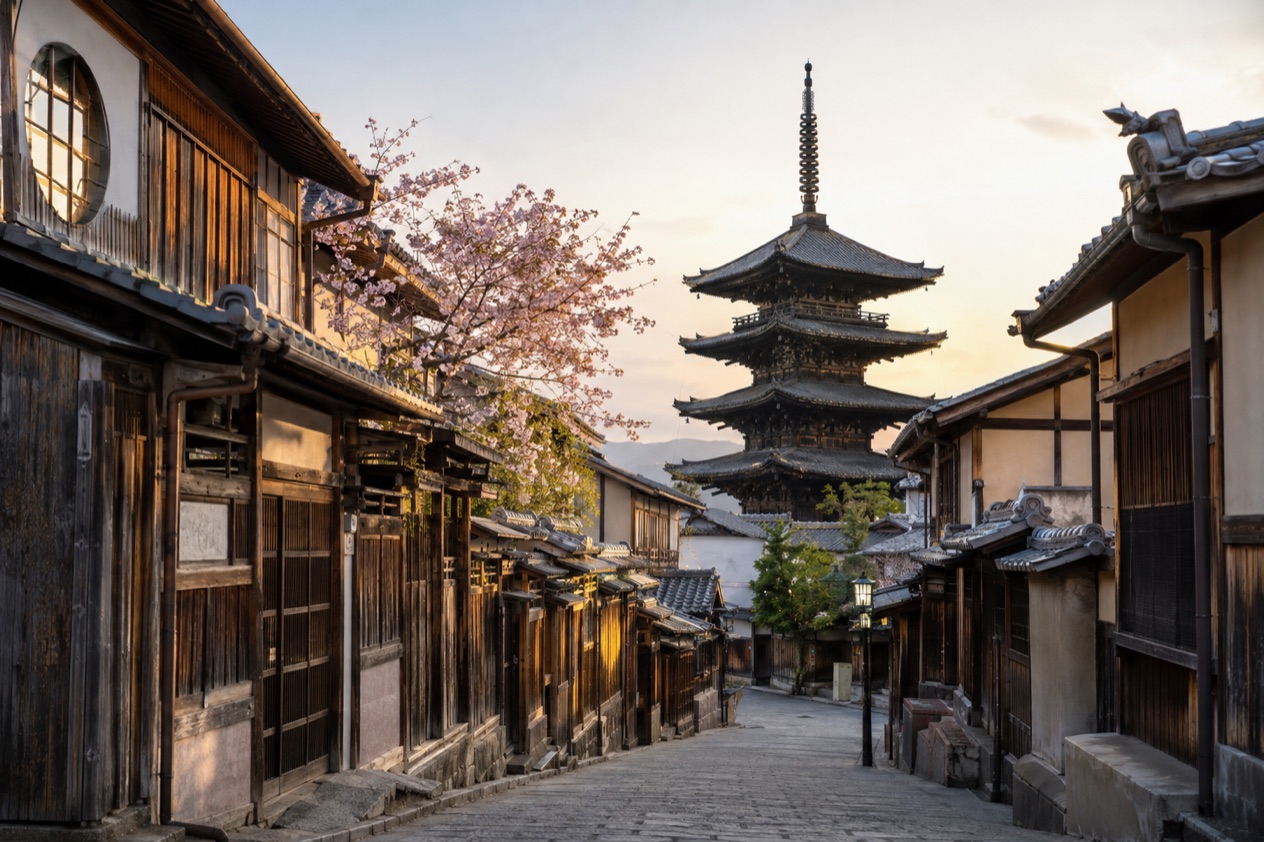
In Kyoto, the day often starts with the soft knock of wooden sandals on a lantern-lit lane in Gion, and ends with the smell of grilled tea sweets drifting from a machiya townhouse. Temple bells, raked gravel, maple branches over a stone path: the city keeps its old rhythms close to the surface. It is a place for travelers who like to walk, look slowly and eat well, and who want Japan’s long history in streets they can actually wander.
Where is Kyoto and what is it like?
Kyoto is a city in the Kansai region of Japan, split into five main areas: Central, Eastern, Northern, Southern and Western Kyoto. The wider Kyoto area stretches much farther, from the farm country of Keihoku in the north to the sandbar of Amanohashidate and the fishing village of Ine near the Sea of Japan.
The city served as Japan’s capital and the emperor’s residence for over a thousand years, from 794 to 1869, and that long span is the reason it feels the way it does. Its heritage has developed over some 1,200 years, and it shows in the machiya townhouses, in the hanamachi districts where geisha live and work, and in the Gion Matsuri, the festival at the heart of the city’s calendar. Fourteen UNESCO World Cultural Heritage sites stand within the city itself, with three more nearby.
Kyoto is a city of temples, gardens, tea houses and craft, more than of skyscrapers and nightlife. Travelers who love history, food, photography and slow wandering tend to fall for it. Those who prefer beaches, big-city energy or a single dramatic landmark may find it quieter in spirit than they expected, with its pleasures spread across many small places rather than gathered in one.
The city also has a modern side. The Kyoto International Manga Museum lets visitors see modern manga, and Kyoto Station holds a full floor of ramen restaurants, an Isetan department store and a theater, a very different mood from the lanes of Higashiyama.
What is there to do in Kyoto?
Kyoto’s big reasons to come are its temples and shrines, its castle and palace, its food and drink, and the hands-on cultural experiences that let you try something rather than just look. What sets it apart from its Kansai neighbors is how much of the old capital remains, spread across districts that each have their own character.
Temples, shrines and gardens
Kiyomizu-dera, founded over 1,250 years ago, is part of the Historic Monuments of Ancient Kyoto UNESCO World Heritage Site, as is Rokuon-ji, the temple better known as Kinkaku-ji. Fushimi Inari Taisha, established in 711 AD, sits at the base of Mount Inari in Fushimi-ku, and a guided tour of the shrine by DMO Kyoto is among the featured activities in the city.
The Japan National Tourism Organization recommends visiting shrines at less crowded times, such as early morning or late evening when they are illuminated. In Arashiyama, the Bamboo Grove, also called the Sagano Bamboo Forest, is a notable stop, and a rickshaw tour is available in Eastern and Western Kyoto City. Up in the Ohara area, ancient temples, famous gardens and spacious hot springs sit in a rural setting, while the Takao area has three mountains known as the Sanbi, with temples and lush greenery.
Castles and palaces
Nijo Castle, a flatland castle in central Kyoto, was built in 1603 by Tokugawa Ieyasu, the first shogun of the Edo period. Its nightingale floors make a bird-like sound underfoot, an old security system meant to alert guards to intruders. The castle is surrounded by a landscaped garden and an orchard of ornamental plum trees and many maples that take on exceptional colors in autumn.
Kyoto Gosho, the old imperial palace, has stood unoccupied since 1868, when Kyoto lost its status as capital to Tokyo. It is also where the Aoi Matsuri procession begins each May.
Food, sake and tea
In southern Kyoto, Fushimi is one of Japan’s three main sake brewing areas, and visitors can taste traditional sake there. Uji, also in the south, is the place to drink Japanese tea. For something casual, the ramen floor at Kyoto Station gathers a whole row of restaurants under one roof.
Hands-on experiences
At Myokakuji Temple, a samurai experience includes sword fighting taught by a professional actor. In Central Kyoto you can turn your name into kanji and carve a Japanese stamp, and in Eastern Kyoto a kimono rental at Kyokomachi lets you walk the old streets in traditional dress.
How many days do you need in Kyoto?
A long weekend gives you the headline sights, and a week lets Kyoto unfold at the pace it suits. With a few days you can pair one Eastern Kyoto day (Kiyomizu-dera and Gion) with a day for Fushimi Inari and another for Arashiyama, adding Nijo Castle and the palace area if a fourth day is available.
A shorter stay means choosing. Temples and shrines are the heart of the city, and each one rewards time spent wandering its gardens and grounds, so packing in too many leaves little room to enjoy them. Pick one or two anchors per day and let evenings drift through Gion, where the hanamachi traditions live on.
With more time, the surrounding area opens up. Ohara offers temples, gardens and hot springs in a rural setting, and the Takao area brings the Sanbi mountains with their temples and greenery. In the south, Fushimi’s sake brewing district and the tea town of Uji make a good food-focused day.
A longer stay can also reach farther north. Keihoku and Miyama show the natural side of the region, and Keihoku has farm stays for travelers who want to get close to nature and agriculture. Near the Sea of Japan, the sandbar Amanohashidate and the boat houses of the Ine fishing village are the farthest outings in the area.
Where to stay in Kyoto
Kyoto’s five main areas each suit a different kind of trip, and the best base depends on what you want your mornings and evenings to feel like. Around Kyoto Station, you are tied directly to the Tokaido Shinkansen line, which makes it the ideal starting point for exploring the city and connecting to major cities across Japan. The station building itself holds an Isetan department store, a theater, a floor of ramen restaurants and a Granvia hotel, and Kyoto Tower stands a few steps from the main entrance.
Central Kyoto puts you near Nijo Castle, the old palace and the grid of streets laid out long ago, and suits travelers who like to explore on foot from a central point. Eastern Kyoto brings you closer to Kiyomizu-dera and Gion, where machiya townhouses and hanamachi districts give the evenings their atmosphere.
Western Kyoto, around Arashiyama, suits those who want the bamboo grove and its surroundings at hand. Southern Kyoto puts you near Fushimi Inari and the sake district. For a slower, rural stay, the Keihoku area has farm stays, and Ohara combines temples, gardens and hot springs.
How do you get to Kyoto and get around?
Travelers arrive by rail, because Kyoto Station is served by the Tokaido Shinkansen line. From Tokyo Station, the most direct shinkansen takes about 2 hours and 20 minutes. By air, the figures given from Haneda Airport to Kyoto are 20 minutes, and from Narita Airport one hour.
Once in the city, Kyoto City buses and the subway provide access to Kiyomizu-dera Temple, Gion and Ginkaku-ji Temple. Kyoto City also runs a Sightseeing Limited Express Bus for visitors, the Kyoto Okazaki Loop Bus, and a sightseeing route called Raku Bus.
Holders of the JR-WEST RAIL PASS can use the Subway & Bus 1-Day Pass in Kyoto.
When is the best time to visit Kyoto?
April and October are the months that suit travelers. In April, highs reach the upper 60s with lows in the upper 40s and about 9 days with rain, so spring days are mild and often bright. October is warmer, with highs in the mid-70s and lows in the upper 50s, and the maples around Nijo Castle take on exceptional colors in autumn.
July is the hot month, with highs near 90°F, humidity around 69 percent and rain on roughly 11 days, so sightseeing means soaking heat and sudden showers. January is the cold end of the year, with highs in the upper 40s, lows below freezing at night in some spells, and snow or sleet falling on many days.
The festival calendar adds its own pull. The Aoi Matsuri on May 15 sends a procession of 500 people in courtly Heian attire from Kyoto Imperial Palace to two historic shrines. On August 16, the Gozan Okuribi bonfires light five mountains around Kyoto to send off ancestral spirits during Obon. The Jidai Matsuri on October 22 brings a parade of roughly 2,000 participants in period garb through over 1,000 years of Kyoto’s history, and the Gion Matsuri is among the traditions that define the city.
Good to know before you go
Kyoto’s rainy stretch and humid summer shape what you carry, and a light rain layer is useful in most months. Shrines and temples are at their calmest early or late in the day, when some are illuminated. Wooden floors, tatami rooms and temple halls mean shoes often come off, so slip-on footwear is a comfortable choice for a day of sightseeing.
Sources
- Japan National Tourism Organization, Kyoto (https://www.japan.travel/en/destinations/kansai/kyoto/), checked October 11, 2026
- Kyoto City Official Travel Guide, activities (https://kyoto.travel/en/activities), checked October 11, 2026
- Kyoto City Official Travel Guide, areas (https://kyoto.travel/en/areas), checked October 11, 2026
- Kyoto City Transportation Bureau, bus and subway guide (https://www2.city.kyoto.lg.jp/kotsu/webguide/en/), checked October 11, 2026
- Kyoto City Official Travel Guide, discover Kyoto (https://kyoto.travel/en/discover), checked October 11, 2026
- Kyoto City Official Travel Guide, festivals and events (https://kyoto.travel/en/events), checked October 11, 2026
- Fushimi Inari Taisha, official site (https://inari.jp/en/), checked October 11, 2026
- Wikipedia, Fushimi Inari-taisha (https://en.wikipedia.org/wiki/Fushimi_Inari-taisha), checked October 11, 2026
- Wikipedia, Kinkaku-ji (https://en.wikipedia.org/wiki/Kinkaku-ji), checked October 11, 2026
- Kiyomizu-dera Temple, official site (https://www.kiyomizudera.or.jp/en/), checked October 11, 2026
- Wikipedia, Kiyomizu-dera (https://en.wikipedia.org/wiki/Kiyomizu-dera), checked October 11, 2026
- Wikipedia, Arashiyama (https://en.wikipedia.org/wiki/Arashiyama), checked October 11, 2026
- Wikipedia, Nijō Castle (https://en.wikipedia.org/wiki/Nij%C5%8D_Castle), checked October 11, 2026
- Japan Meteorological Agency (JMA), Normal values 1991-2020, monthly (https://www.data.jma.go.jp/stats/etrn/view/nml_sfc_ym.php?prec_no=61&block_no=47759), station Kyoto, elevation 41 m, checked October 11, 2026
All our pages
When to go
- Best Time to Visit Kyoto: Cherry Blossoms, Autumn Leaves, Weather by Month and Festivals
- Kyoto in January: New Year Shrine Visits, Winter Weather and Temples to See
- Kyoto in February: Setsubun, Plum Blossoms, Winter Weather and What to Do
- Kyoto in March: Early Cherry Blossoms, Spring Weather and What to Do
- Kyoto in April: Cherry Blossom, Weather and a Two-Day Plan
- Kyoto in May: Aoi Matsuri, Weather, Temple Gardens and a Two-Day Plan
- Kyoto in June: Rainy-Season Weather, Temple Gardens and a Two-Day Plan
- Kyoto in July: Gion Matsuri, Hot Weather and a Two-Day Plan
- Kyoto in August: Obon Bonfires, Summer Heat, Weather and What to Do
- Kyoto in September: Weather, Moon-Viewing Season, Temples and a Two-Day Plan
- Kyoto in October: Weather, Autumn Festivals and What to Do
- Kyoto in November: Autumn Leaves, Shichi-go-san and a Two-Day Plan
- Kyoto in December: Late Maple Leaves, Winter Weather and What to Do
Things to do
- Things to Do in Kyoto: Temples, Gardens, Food and Day Trips
- Day Trips from Kyoto: Nara, Himeji, Kobe, Uji and Osaka
- 3 Days in Kyoto: Temples, Arashiyama, Fushimi Inari and Where to Stay
- Geisha in Kyoto: The Five Districts, Ochaya Evenings and Henshin Dress-Up
- Kyoto Imperial Palace: History, Main Halls, Tours and When to Go
- Kimono Rental in Kyoto: Where to Wear It, What to See and the Best Seasons
- Kyoto Railway Museum: Roundhouse, Historic Trains and Visitor Guide
- Kyoto Ryokan: Tatami Rooms, Kaiseki Dinners and Where to Stay
- The Kyoto Station area, Kyoto: Station Building, Kyoto Tower, Temples and Ramen
- Tea Ceremony in Kyoto: Chanoyu Traditions, What to Expect and When to Go
- Kyoto Tower: Views, Hours, Getting There and When to Go
Where to stay
- Where to Stay in Kyoto: Kyoto Station, Central and Eastern Districts, and Ryokan Stays
- Where to Stay in Arashiyama: Station Side, Togetsukyo Bridge, Bamboo Grove and a Kyoto Station Base
- Where to Stay in Gion: Gion Kobu, Gion Higashi, Higashiyama and Kyoto Station
- Where to Stay in Kawaramachi: Shijo Kawaramachi, Kyoto Station, Nijo Castle and the Kamo River
- Where to Stay in Kyoto Station: Station Building, Kyoto Tower Side, Honganji Temples and Central Kyoto
Getting there
- Kyoto from Tokyo: Shinkansen Trains, Nozomi vs. Hikari and Kodama, and a First Day in Kyoto
- Getting Around Kyoto by Bus and Subway: Two Subway Lines, City Buses and the Passes
- Kansai Airport to Kyoto: The Haruka Limited Express, the Terminals and Arriving at Kyoto Station
- Kyoto to Himeji: Rail Routes, the Kansai Area Pass and What Awaits at the Castle
- Kyoto to Hiroshima: Shinkansen Options, Rail Passes and What to Expect
- Kyoto to Kanazawa: Hokuriku Shinkansen, the Area Pass and What Awaits in Kanazawa
- Kyoto to Kobe: Train Routes, Shinkansen Stations and Where You Arrive
- Kyoto to Nara: JR Nara Line, Kansai Area Pass and Kintetsu Options
- Kyoto to Osaka: Hankyu and Keihan Lines, the Shinkansen Link and Airport Connections
- Kyoto to Takayama: The Hida Train, the Nagoya Connection and the Takayama Line
- Kyoto to Tokyo: Tokaido Shinkansen Trains, Your Options and What to Know