
Step out of the station and the first vermilion gate is already in front of you, with the main hall just beyond and the forested slope of Mount Inari rising behind it. Stone foxes sit on pedestals with keys and jewels in their mouths, incense drifts across the courtyards, and the paths leave the buildings behind and climb into tunnels of orange. It is a shrine you walk through rather than look at, and the length of the walk is up to you.
Is visiting Fushimi Inari Shrine worth it?
Yes, for almost anyone who likes to walk and to see something that cannot be reduced to a single photograph: first-time visitors to Kyoto, photographers, families with children who enjoy a trail with a purpose, and travelers who want a shrine that does not close its doors at dusk. The gates are the draw, but the real experience is the slow change as the trail climbs away from the crowds and the forest closes in.
What sets it apart is that the shrine extends beyond its main compound across Mount Inari. The entire peak of Inariyama counts as the shrine’s precinct, so there is no single hall to reach and no fixed end to the visit.
Many of Kyoto’s famous sites are gardens, halls and castles that you move through in a set order. Here you choose your own turning point, and the path rewards whichever one you pick.
It is also a working place of worship, not a museum. Fushimi Inari Taisha is the head shrine of the Inari shrines found across Japan.
Businesses still donate gates here, and you will see people stopping at small altars along the way to pray for good fortune in trade and in the rice harvest. Watching that is part of the visit.
What to see at Fushimi Inari Shrine
The shrine begins at the foot of the mountain and gets quieter and more wooded as you climb. Every part has its own character, so it helps to know what each stretch is for before you set out.
The main shrine and the lower grounds
The main shrine building is designated an Important Cultural Property, and it holds five shrines in one complex: a lower, a middle and an upper shrine, plus the auxiliary Tanaka Shrine and Shino-Okami Shrine. Inari Okami was enshrined here in the Nara Period, and the shrine was formally founded in 711 by the Hata clan.
Look for the fox statues, which are considered messengers of Inari. Many hold a key or a sheaf of grain in their mouths, and you will find them flanking the gates and halls.
The ema, wooden prayer plaques, often show a fox face, and visitors write wishes on them and hang them up in rows. This is the part of the shrine where most of the ritual activity happens, so it is worth a slow look before you start climbing.
Senbon Torii, the thousand gates
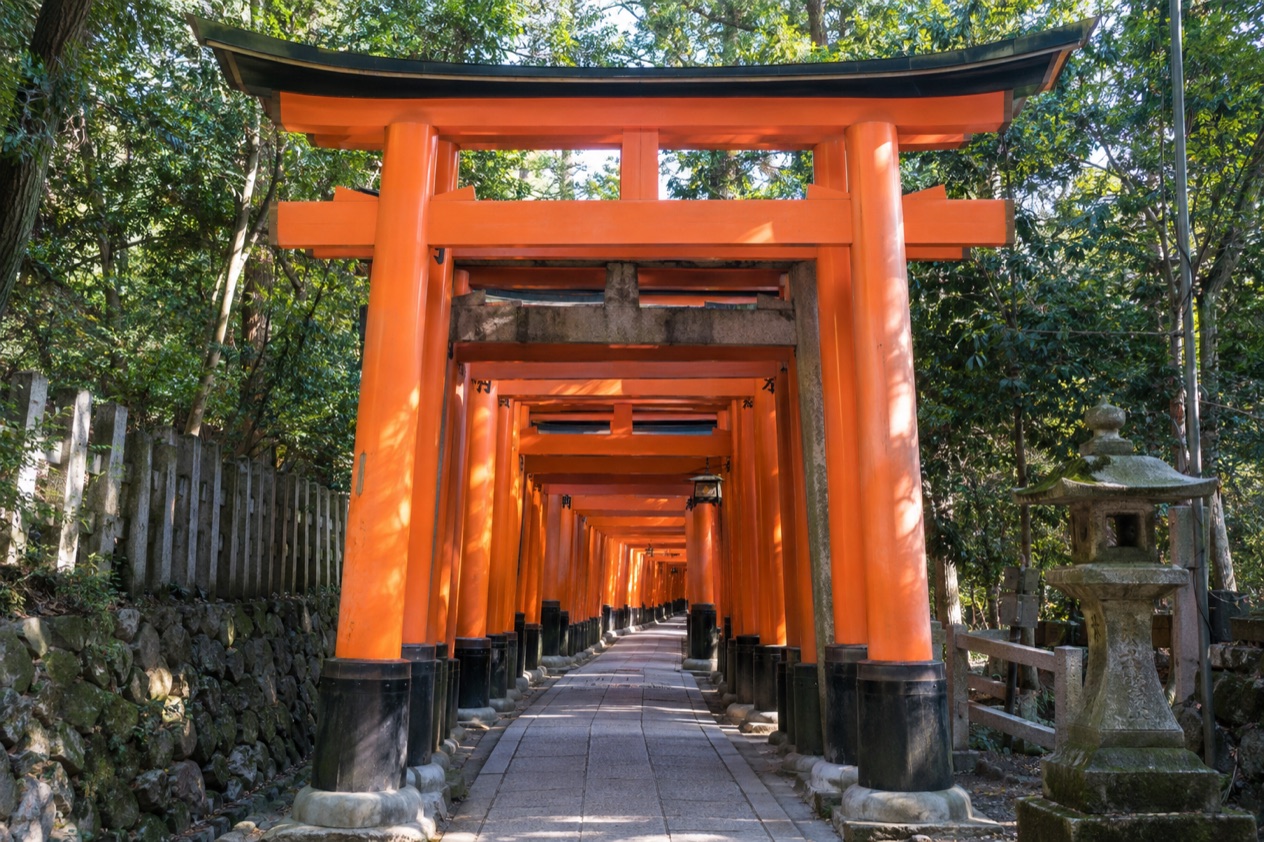
Roughly 800 of them stand along the main path, set so close together that the light turns the ground a dim, glowing red. The name means thousand torii, and the effect is of walking inside a long lacquered tunnel.
Each of the roughly 10,000 gates across the mountain was donated by a Japanese business. Turn around and look at the back of a gate, where black characters give the donor’s name and the date. Reading a few of them as you walk gives the trail a human scale, and you notice how the older gates fade to a deeper, darker orange while newer ones are bright.
The trail up Mount Inari
Past the first gates, the trails spread across the mountain for 2.5 miles, and walking up takes approximately 2 hours. Inariyama is 233 meters high and is one of the southernmost of the 36 Higashiyama mountains. The gates continue most of the way, broken by clearings with small shrines, stone lanterns and stacked fox figures, and by little tea houses where the path opens out.
You do not have to do the full loop. Visitors walk until the crowd thins, then turn back, and the upper slopes feel noticeably more like a forest shrine than a sightseeing stop. Along the way you pass the small altars and moss-covered stones where worshipers leave offerings, and the sound of the city fades behind you.
Hours, tickets and rules
The shrine never closes, and it costs nothing to enter. That is unusual for a major Kyoto sight, and it means you can fit it around the rest of your day rather than arranging the day around it. The approach and the main hall are lit all night, so a walk after dinner is as much a part of the shrine as a morning visit.
| Site | Open |
|---|---|
| Fushimi Inari Taisha | Open 24 hours, approach and main hall illuminated all night |
Walk as a visitor to a place of worship would, and treat the small altars and offerings along the trail as part of the shrine rather than as props.
How to get to Fushimi Inari Shrine
The shrine sits in Fushimi-ku, Kyoto, at the base of Mount Inari, and two railways stop within reach of its gates. Two rail lines offer straightforward access to the shrine.
From Kyoto Station on the JR Nara Line
Kyoto Station is the base for travelers, since it is served by the Tokaido Shinkansen and connects to the rest of the country. From there, the JR Nara Line reaches Inari Station in a five-minute ride, and the shrine is just outside the station. You step off the train and the first gate is right there.
Kyoto Station itself is worth a glance on the way, with a full floor of ramen restaurants, an Isetan department store and a theater in the building, and Kyoto Tower standing a few steps from the main entrance. A bowl of ramen before or after the shrine fits easily into the day.
On the Keihan Main Line
The Keihan Electric Railway Main Line stops at Fushimi-Inari Station, a short walk from the shrine. This is the other way in, and the choice between the two stations depends mostly on where in Kyoto you are starting. Either way you arrive at the foot of the mountain and the walk to the first gate is brief.
Because the shrine is open around the clock, there is no schedule to match once you arrive. You decide how far to go, and you can return to either station afterward.
When to visit Fushimi Inari Shrine
Early morning or late evening, when the shrine is lit, are the times Japan’s tourism organization recommends for Kyoto’s shrines, and they suit Fushimi Inari well. With the approach and main hall illuminated all night, the lower shrine grounds take on a different look after dark.
The biggest crowds come at the Japanese New Year. Over three days the shrine draws 2.69 million worshipers, the most in western Japan, as people come for the first prayers of the year. January in Kyoto is cold, with highs in the high 40s and lows in the mid-30s, and snow or sleet falls on many days, so the mountain trail can be a winter walk in earnest.
In April the highs reach the upper 60s and the lows the upper 40s, with showers on around nine days and plenty of sun, which makes the climb comfortable. October is generally mild in Kyoto, though conditions can vary.
July is the hot, humid month, with highs near 90 and lows in the mid-70s. Rain falls on about twelve days, and the forest trail feels close and damp, so the climb is a different effort than in spring or fall. In July, Kyoto is hot and humid, making the climb more demanding than in spring or fall.
Tips for your visit
Plan for about 2 hours if you want to walk up the mountain, and less if you turn back at a clearing partway. The trails cover 2.5 miles, and the ascent is the long part.
Because the whole mountain is part of the shrine’s precinct, the climb is a visit to the shrine itself, not a detour from it. Stop at the small altars and watch how others pray: a bow, a coin, a clap, a pause. Photographing the gates is part of the day, and the back of each torii, with its donor’s name, is as interesting as the front.
The shrine pairs naturally with Kyoto Station, only five minutes away by train, where a ramen meal or a look at the building closes the outing.
With children or anyone who prefers a shorter outing, the lower grounds and the first stretch of gates give you the shrine’s character without the full climb. The trails are the stretch that takes real time, and nothing obliges you to finish them.
Good to know before you go
There is nothing to pay at the gate, so the cost of the visit is the train ride and whatever you spend at the tea houses and food stalls near the entrance. The paths are outdoors on a wooded mountainside, so check the day’s conditions before setting out.
Dress for the weather, take your time on the steps, and treat the altars you pass as the working shrines they are.
Sources
- Fushimi Inari Taisha, official site (https://inari.jp/en/), checked October 11, 2026
- Wikipedia, Fushimi Inari-taisha (https://en.wikipedia.org/wiki/Fushimi_Inari-taisha), checked October 11, 2026
- Japan National Tourism Organization, Kyoto (https://www.japan.travel/en/destinations/kansai/kyoto/), checked October 11, 2026
- Japan Meteorological Agency (JMA), Normal values 1991-2020, monthly (https://www.data.jma.go.jp/stats/etrn/view/nml_sfc_ym.php?prec_no=61&block_no=47759), station Kyoto, elevation 41 m, checked October 11, 2026
To plan your stay
- Best Time to Visit Japan: Cherry Blossoms, Autumn Colors, Weather and Festivals
- Where to Stay in Japan: Ryokan, Temple Stays, Capsule Hotels and the Best Cities to Base In
- Sending Luggage from the Airport in Japan: Hands-Free Travel, Hotel Delivery and Coin Lockers
- Know Before You Go to Japan: Entry, Money, Etiquette and Getting Around