
You step out of the daylight into a long wooden hall, and the first thing you take in is gold: row upon row of standing figures, each with a halo of arms, receding down the building until the eye gives up counting. Sanjusangendo is a Buddhist temple in Kyoto’s Higashiyama district, and the visit is built around one extraordinary room. It suits anyone who likes sculpture, temple history or a place where the sheer repetition of faces becomes the experience.
Is visiting Sanjusangendo worth it?
Yes, for travelers who care about sculpture and want to stand in front of something that cannot be photographed into insignificance: the hall holds 1001 standing Thousand-armed Kannon statues, and the temple’s whole point is to be seen in person. If your idea of Kyoto is gardens and tea houses, this is a different kind of stop, one room, one idea, pursued to an astonishing degree.
What separates it from the other temples of Higashiyama is that you are not looking at a single image on an altar or a landscape arranged around a pond. You are looking at an army.
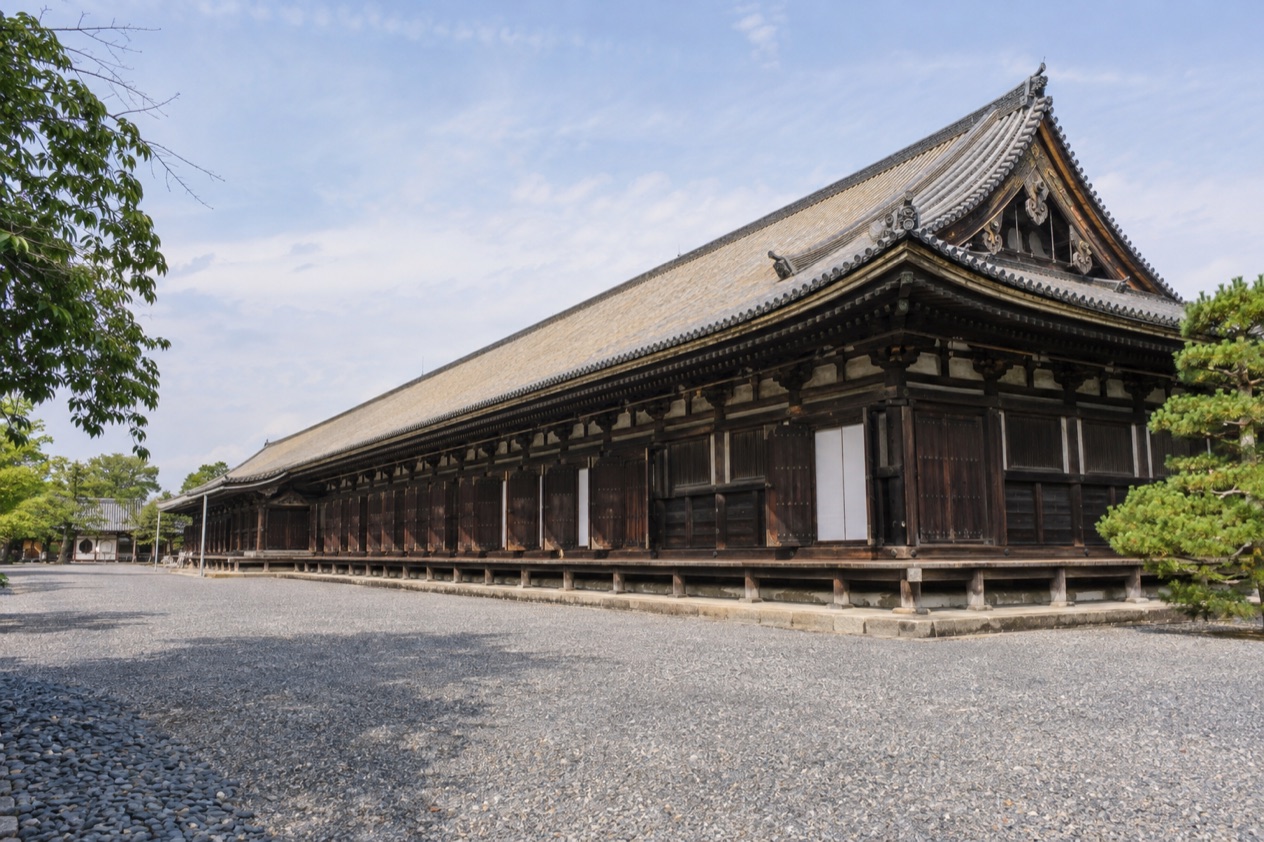
The Kannon stand in ranks on both sides of a great seated central figure, and behind and in front of them stand fierce guardian deities, including the wind god Fujin and the thunder god Raijin. The building itself, a National Treasure, is the other half of the story. Its extreme length is the reason the temple has its name and the reason the statues can be lined up the way they are.
It also has a living side that many Kyoto sights lack. The temple has a tradition of archery on its veranda and a January rite for headaches, so the building is more than a museum of sculpture. Guided tours are offered year-round for those who want the history in depth, and the temple’s founding for a cloistered emperor gives the visit a link to the court life that shaped Kyoto over more than a thousand years as capital.
What to see at Sanjusangendo
The main hall and its great length
The hondo, the main hall, stretches 120 meters from end to end, and the temple’s name refers to the thirty-three bays between its pillars. It dates from 1266 and is designated a National Treasure of Japan. The temple itself was founded in 1164 by Taira no Kiyomori for the cloistered Emperor Go-Shirakawa, a patron whose name still sits at the origin of the place.
The experience of the building is mostly about perspective. Standing at one end, you look down a corridor of wooden pillars and gilded figures that seems to narrow to a point. Walking the length, you notice how the light changes from bay to bay, and how the dark wood sets off the gold. Take it slowly and look at the hall as architecture before you start on the statues.
The thousand Kannon
One thousand life-size statues of the Thousand-armed Kannon stand on the right and left of the central figure, arranged in 10 rows and 50 columns. They are made of Japanese cypress clad in gold leaf, and the whole group is designated National Treasures, most dating to the Heian and Kamakura periods. Kannon is the bodhisattva of compassion, and the many arms are a way of showing the capacity to help many beings at once.
Look closely rather than only at the mass. From a distance the figures seem identical, but up close each has its own face and its own set of raised hands holding small objects. The pleasure of the hall is moving from the effect of the crowd to the individual statue and back again.
The seated central Kannon
At the center sits the principal image, a big seated Thousand-armed Kannon created by the Kamakura sculptor Tankei and a National Treasure in its own right. It anchors the hall: the thousand standing figures read as an assembly gathered around it. Its scale and calm set the tone for everything else in the room.
Spend a little time here before walking on. The standing statues draw the eye by their number, while this figure rewards the opposite approach, a long look at a single carved face and the many arms spreading behind it like a gilded fan.
The guardian deities, Fujin and Raijin
Around the Kannon stand 28 statues of guardian deities, and among them the best known are Fujin and Raijin, the gods of wind and thunder. Where the Kannon are serene, the guardians are all muscle, grimaces and movement, with flying garments and exaggerated expressions. They are National Treasures like the rest of the collection.
They make a good counterpoint to the calm of the Kannon, and they are often what people remember most. Look at how the sculptors gave each figure its own pose and personality, so that the line of guardians reads almost like a cast of characters.
The west veranda and the archery tradition
Along the west veranda, a modern version of the Toshiya, the Festival of the Great Target, is held, drawing roughly 2,000 participants from throughout Japan. The target is 120 meters away, matching the length of the hall. The festival was initially male-dominated, but in recent times it has shifted to being mainly women dressed in traditional kimonos.
Even when no event is on, the long veranda helps you picture the tradition: an archer at one end, a target at the other, the whole length of the building between them. It connects the sculpture hall to the temple’s life outside the statues.
When to visit Sanjusangendo
The Japan National Tourism Organization recommends visiting Kyoto’s shrines at less crowded times, such as early morning or late evening when they are illuminated, which is general advice for the city rather than a statement about this hall’s schedule.
January brings the Rite of the Willow, held on the second Sunday of the month, when worshippers are touched on the head with a sacred willow branch to cure and prevent headaches. It is among the most distinctive moments in the temple’s calendar.
The month itself is cold, with highs in the upper 40s and lows in the mid-30s, and snow or sleet falls on many days, so dress for it.
April is milder, with highs near 68 degrees and about nine days with some rain, a comfortable temperature for walking between sights. October is similar in feel, with highs in the mid-70s and lows in the upper 50s, and rain on about eight days. A hall interior is useful when showers arrive, since much of the visit happens under a roof.
July is the hot, humid month, with highs near 90 degrees, lows in the mid-70s and rain on a dozen days. Being inside a long wooden hall is a reasonable way to spend part of such a day, though the walk to and from the temple will still be warm. Whatever the month, Kyoto’s long cultural history, more than a thousand years as capital, means there is rarely a season without some festival nearby, and the Gion Matsuri belongs to the city’s traditions.
Tips for your visit
Come with an unhurried attitude, because this is a place where the effect builds as you walk. Guided tours are offered year-round, giving an in-depth look at the temple’s history, and they are a good choice if you want the story behind the statues, the sculptors and the founding.
Dress for the weather of the month, since part of the visit involves moving between buildings and along the veranda. In winter that means warm layers, in summer light clothing and something to drink, and in the rainy spells of spring and autumn a compact umbrella. Comfortable shoes are useful in any season, as Kyoto sightseeing involves a lot of walking.
Travelers arrive from Kyoto Station, which is served by the Tokaido Shinkansen and is the hub for exploring the city and connecting to other major cities. The station building has a full floor of ramen restaurants, an Isetan department store, a theater and a Granvia hotel, and Kyoto Tower, over 130 meters tall, stands a few steps from the main entrance. A bowl of ramen at the station is an easy way to bookend the visit.
Combine the hall with other sights of the city. Nijo Castle in central Kyoto was built in 1603 by Tokugawa Ieyasu, the first shogun of the Edo period, and its nightingale floors make a bird-like sound when walked on, an old security system meant to alert guards of intruders. It pairs well with Sanjusangendo because the two show very different sides of Kyoto: courtly Buddhism on one hand, shogunal power on the other.
If you are traveling with others, think about the pacing. A hall of statues rewards patience, and some companions may want to look at details while others walk straight through. Agree to meet at the central figure, and let each person take the length of the hall at their own speed.
Good to know before you go
Kyoto has a heritage that has developed over the past 1,200 years, with machiya townhouses, the Gion Matsuri festival and hanamachi districts where geishas live and work, and Sanjusangendo fits into that wider picture as one of the city’s great temple sights. Rain can fall in any month, with the heaviest totals in the summer, so a light rain jacket is a sensible companion. Carry some cash for small purchases around the temple and the station, and keep to the usual habits of a temple visit: a quiet voice and respect for the statues.
Sources
- Wikipedia, Sanjūsangen-dō (https://en.wikipedia.org/wiki/Sanj%C5%ABsangen-d%C5%8D), checked October 11, 2026
- Japan National Tourism Organization, Kyoto (https://www.japan.travel/en/destinations/kansai/kyoto/), checked October 11, 2026
- Japan Meteorological Agency (JMA), Normal values 1991-2020, monthly (https://www.data.jma.go.jp/stats/etrn/view/nml_sfc_ym.php?prec_no=61&block_no=47759), station Kyoto, elevation 41 m, checked October 11, 2026
To plan your stay
- Best Time to Visit Japan: Cherry Blossoms, Autumn Colors, Weather and Festivals
- Where to Stay in Japan: Ryokan, Temple Stays, Capsule Hotels and the Best Cities to Base In
- Sending Luggage from the Airport in Japan: Hands-Free Travel, Hotel Delivery and Coin Lockers
- Know Before You Go to Japan: Entry, Money, Etiquette and Getting Around