
You step through the gate and the twenty-first century falls away: wooden storefronts line a dirt-colored street, a bridge arches over a small canal, and somebody in a samurai topknot strides past carrying a sword. Toei Kyoto Studio Park is a working film studio that doubles as a theme park, set in Ukyo-ku in Kyoto. It suits anyone who has watched a period drama or an anime and wants to stand inside the set.
Is visiting Toei Kyoto Studio Park worth it?
Yes, if you like stories, costumes and the feeling of walking through a stage, and especially if you are curious about how Japanese period films get made. The park is built around jidaigeki, the samurai and Edo-era dramas that Toei Company has produced for decades, along with works by Toei Animation.
It is not a ride park. You come to wander, to pose for photographs and to watch a bit of theater come to life.
What sets it apart from the temples, shrines and castles that fill most Kyoto itineraries is that nothing here is preserved as history. It is made for the camera, and that is the whole charm.
A film studio has stood on this site since 1926, and Toei took it over in 1951, so the streets have served real productions long before visitors were invited in. Visitors are occasionally able to watch the filming of TV shows and movies, though that is a bonus and never a promise.
The studio park shows the past as Japanese cinema imagines it, with costumed actors, themed restaurants and traditional-style buildings. Seeing both gives you the building and the legend.
Fans of anime get an extra reason to come, because the park also holds a giant Evangelion figure. For travelers who only want quiet gardens, it may feel too playful, but for families and film lovers it is a change of pace.
What to see at Toei Kyoto Studio Park
The Edo period village
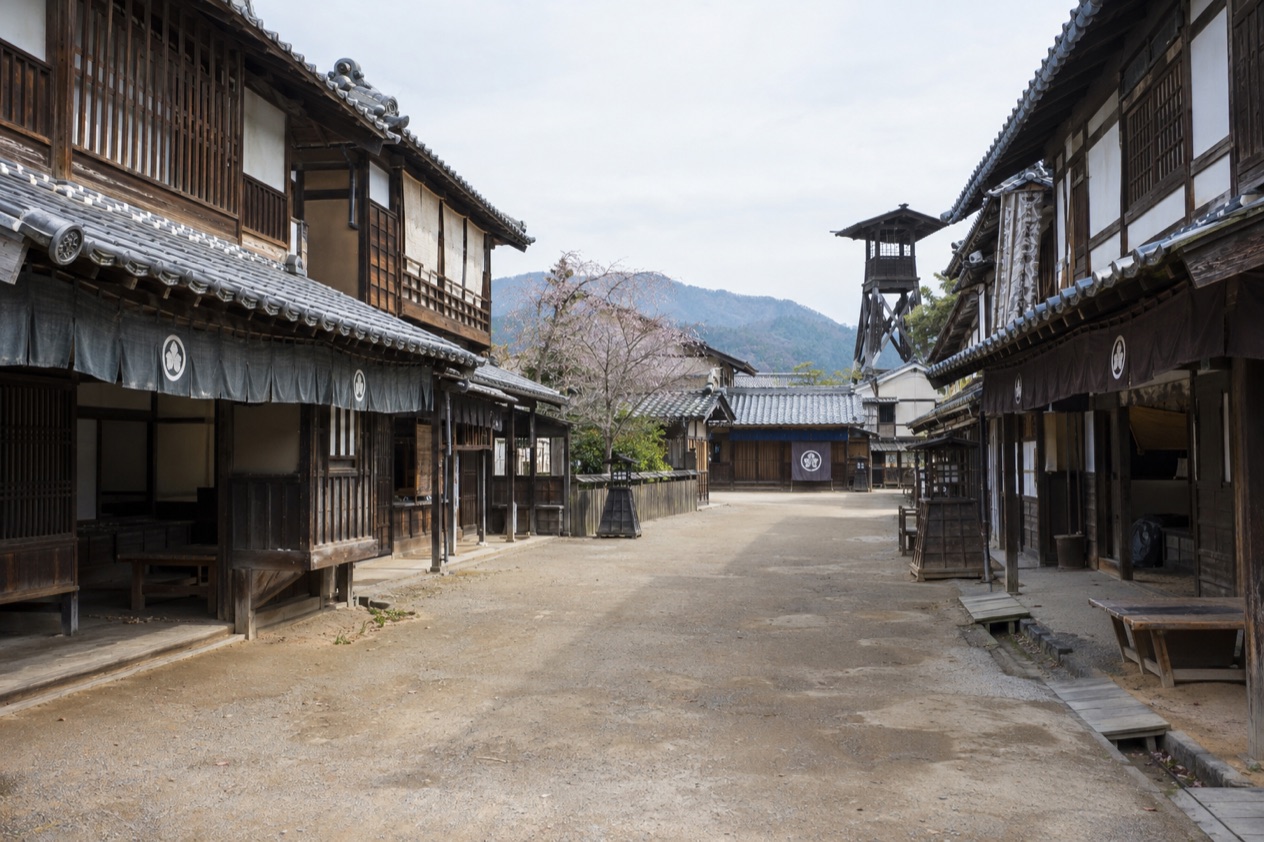
The core of the park is a replica of an Edo period village, with streets of wooden shopfronts, inns, bridges and gates that look just right on screen. Costumed actors move through the lanes, and the setting is the same kind of backdrop that has framed samurai stories for generations. Stand at a corner and you can see how a camera would frame the scene: no modern wires, no signs, just rooflines and lantern light.
Take your time with the details. Look at how the wood is weathered to seem centuries old, how the shop curtains hang, how the street surface is shaped. Photography is half the fun here, and the village rewards slow walking more than rushing from one corner to the next.
Costumed actors and period costume rental
Guests can rent kimono and period costumes in the park, which turns a stroll into a small performance of your own. Dressed as a townsperson or a warrior, you walk the same lanes as the actors, and the setting makes every snapshot look like a still from a film. It is a favorite with friends and families who want a keepsake that feels earned.
The costumed actors who patrol the village add to the mood. They bring the sets to life with the posture and gestures of the screen, so the street feels less like a museum and more like a scene waiting for the director to call action.
Evangelion Kyoto Base
Opened in 2020, Evangelion Kyoto Base draws on the anime franchise Neon Genesis Evangelion. Its main attraction is a 15-meter statue of the upper body of EVA-01, the purple giant robot that fans know well. The contrast is striking: a futuristic machine rising above a park devoted to the Edo period.
Even if you have never watched the series, the statue makes for a memorable photograph. For fans it is the reason to come, a chance to stand in front of one of anime’s most recognized figures in a setting that celebrates Japanese screen culture across eras.
Themed restaurants and adult-oriented attractions
Themed restaurants fit the village setting, so a meal can feel like part of the show. The park has also added two adult-oriented attractions, a traditional gambling dice game area and a simulated historical interrogation exhibit, and both are only for those aged 18 years and over. After renovations the park was rebranded as Usumasa Kyoto Village, a name you may see alongside the original.
Hours, tickets and rules
Opening hours and admission prices are not given for Toei Kyoto Studio Park here, so the table lists only what is firmly known about the park. It is run by Toei Kyoto Studio Co., Ltd., and it has operated as a theme park since the autumn of 1975, when more than 70,000 people came in the first three days.
| Site | Opened as a theme park | Operator |
|---|---|---|
| Toei Kyoto Studio Park | November 1, 1975 | Toei Kyoto Studio Co., Ltd. |
| Evangelion Kyoto Base | 2020 | Toei Kyoto Studio Park |
The one rule stated for the park concerns its two adult-oriented attractions, the traditional gambling dice game area and the simulated historical interrogation exhibit, which are only for visitors aged 18 and over. Costume and kimono rental is available in the park.
When to visit Toei Kyoto Studio Park
Kyoto’s own advice for visiting shrines is to go at less crowded times, early morning or late evening, and that applies to temples rather than this park, so plan around the weather instead. Much of the village is outdoors, which means the climate shapes your day.
October, the month of this writing, is comfortable for walking: highs reach the low 70s and lows fall to the upper 50s, with rain on roughly eight days and a good amount of sunshine. April is similar in feel, with highs in the upper 60s and showers on a bit over nine days, so a light layer and a small umbrella are enough.
July is hot and damp, with highs near 90°F, humid air and rain on more than eleven days, so an outdoor village can feel heavy at midday. January is cold, with highs in the upper 40s and lows below freezing point, and Kyoto can see snow or sleet on many days. Costume rental is more comfortable in the milder months, when a kimono is easy to wear without overheating.
| Month | Avg high (°F) | Avg low (°F) | Precipitation (in) | Days with rain |
|---|---|---|---|---|
| January | 48.4 | 34.7 | 2.10 | 6.4 |
| April | 68.2 | 48.6 | 4.61 | 9.4 |
| July | 89.6 | 74.5 | 8.80 | 11.6 |
| October | 74.1 | 57.9 | 5.64 | 8.2 |
Tips for your visit
Wear shoes that suit walking on outdoor streets, and dress for the weather, because the village is mostly open air. In the warm months, think of water and a hat. In winter, add layers, since January in Kyoto averages cold days. If you plan to rent a kimono, consider what you will wear underneath and how it will feel in the season.
The studio park pairs naturally with Kyoto’s historic sights for contrast. Nijo Castle, built in 1603 by Tokugawa Ieyasu, the first shogun of the Edo period, has nightingale floors that chirp underfoot, an old security system against intruders. Visiting the real castle and the film village in the same trip lets you compare the actual Edo period with its screen version.
Kyoto Station, served by the Tokaido Shinkansen, is a useful base for the city, with a floor of ramen restaurants, an Isetan department store and Kyoto Tower a few steps from the main entrance. Families with children who love anime or costumes will find the park easy to enjoy together, and adults can use the age-restricted attractions after the younger ones have had their fun.
Good to know before you go
Kyoto has a cultural heritage built up over 1,200 years, and it served as Japan’s capital for over a thousand years, so a film village makes a lighthearted counterpoint to the more solemn sights. Carry some yen, as the park combines restaurants, rentals and attractions. Because much of the visit is outdoors, rain gear helps in the wetter months, especially in July.
Sources
- Wikipedia, Toei Kyoto Studio Park (https://en.wikipedia.org/wiki/Toei_Kyoto_Studio_Park), checked October 11, 2026
- Japan National Tourism Organization, Kyoto (https://www.japan.travel/en/destinations/kansai/kyoto/), checked October 11, 2026
- Japan Meteorological Agency (JMA), Normal values 1991-2020, monthly (https://www.data.jma.go.jp/stats/etrn/view/nml_sfc_ym.php?prec_no=61&block_no=47759), station Kyoto, elevation 41 m, checked October 11, 2026
To plan your stay
- Best Time to Visit Japan: Cherry Blossoms, Autumn Colors, Weather and Festivals
- Where to Stay in Japan: Ryokan, Temple Stays, Capsule Hotels and the Best Cities to Base In
- Sending Luggage from the Airport in Japan: Hands-Free Travel, Hotel Delivery and Coin Lockers
- Know Before You Go to Japan: Entry, Money, Etiquette and Getting Around