
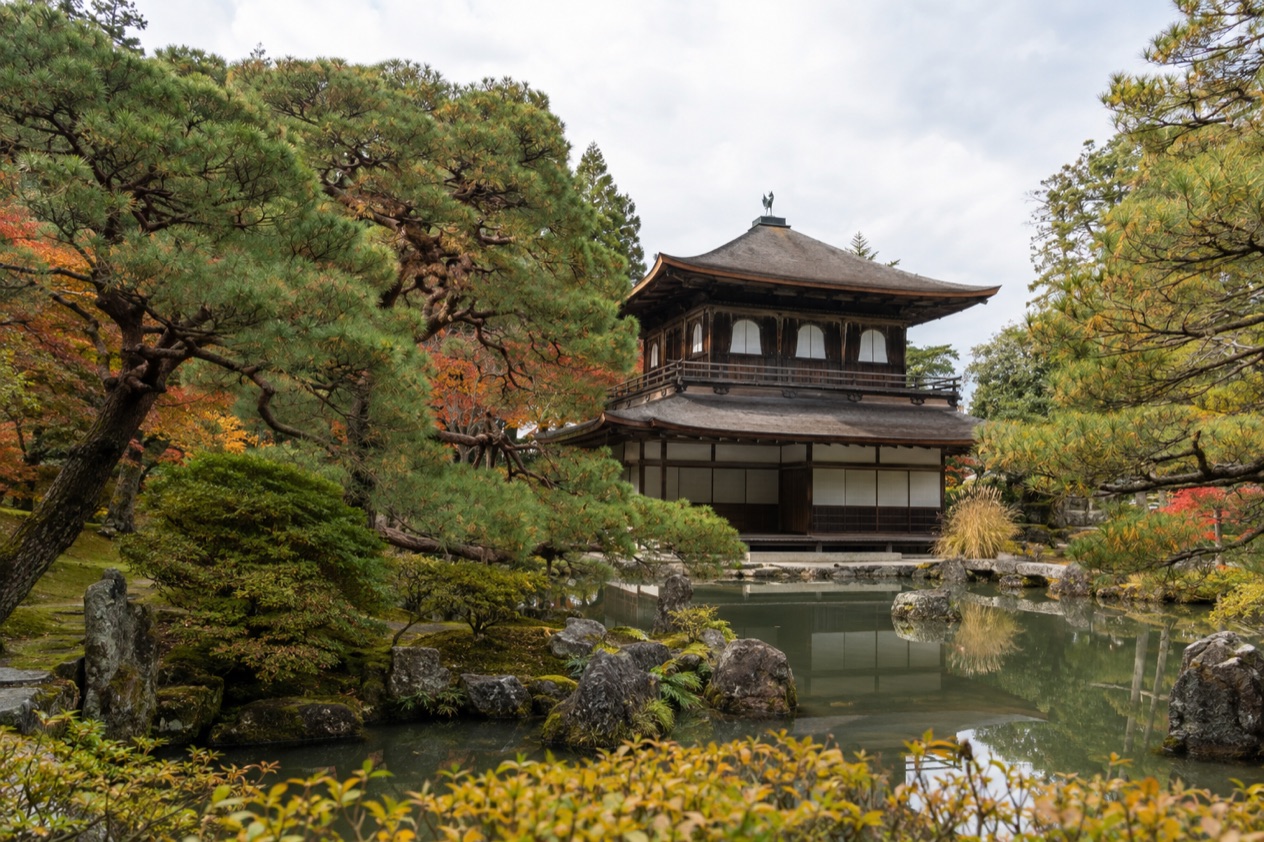
The first thing you notice at Ginkaku-ji is the sound of footsteps on gravel and then the dark, weathered wood of the Kannon-den rising beside a garden pond. In front of it lies a sculpted bed of pale sand, raked into ridges, with a cone of sand standing in the middle. It is a Zen temple in Kyoto where the garden does most of the talking, and a visit here is about slow looking, not about ticking off a monument.
Is visiting Ginkaku-ji worth it?
Yes, if you like gardens, wooden architecture and the kind of place where you stop to look at moss, raked sand and the reflection of a roof in water. It suits travelers who are building a Kyoto itinerary around temples and want one stop that is about restraint and detail instead of scale. It asks little of you except attention.
Kinkaku-ji is the Golden Pavilion and is covered in gold leaf. Ginkaku-ji is called the Silver Pavilion, yet there is still no silver foil on it.
What you see is plain, dark, aged wood, and the name works more as a mood than a description. That understatement is the point of the place. The temple was founded by Ashikaga Yoshimasa, and it carries the taste of a man who preferred subtle beauty to display.
The garden and temple complex are open to the public, and the temple belongs to the Historic Monuments of Ancient Kyoto World Heritage Site. That puts it in the company of the other great sites of a city whose cultural heritage has been developing for twelve hundred years. If your Kyoto days are already full of big halls and gilded rooms, Ginkaku-ji is the counterweight, a visit that rewards patience and a willingness to look at small things for a while.
It is less rewarding if you want a spectacle or a building you can walk through room by room. The experience is outdoors, a matter of paths, views and light, and it changes noticeably with the season and the weather. Rain, in particular, does not ruin it. Wet moss and dark wood often look better than they do on a bright day.
What to see at Ginkaku-ji
The Kannon-den, the Silver Pavilion itself
The two-storied Kannon-den, also called the Kannon hall, is the main structure of the temple and the building everyone means when they say the Silver Pavilion. The upper story is the part that draws the eye, with its slightly weathered, modest look.
Take your time with the reflection. On a still day the pavilion doubles in the pond, and a few minutes of standing at the water’s edge show more than any quick photograph. Look at the roofline and the plain, unlacquered surfaces. The lack of ornament is deliberate, and it is what separates this building from its gold-covered cousin.
The sand garden and its Mount Fuji cone
The sand garden is the second great sight. Its surface is combed into regular lines, and a carefully formed pile of sand is said to symbolize Mount Fuji. The raking is done by hand and the shapes hold their edges, so the garden looks more like a drawing than like something dug from the ground.
Look at how the pale sand catches daylight and throws it back at the wooden pavilion. Visitors say the garden seems made to be seen in changing light, with the ridges deepening in shadow as clouds pass. It is a good place to compare the stillness of dry landscape with the movement of the pond just beside it.
The moss garden and the paths through the grounds
Beyond the pavilion and the sand, the temple grounds are a garden of paths, trees, stones and moss. This is where the visit slows down. Moss is the main texture, a soft green carpet under maples and pines, and it is at its richest after rain, when the colors deepen and the ground seems to glow.
Pause at the points where the path opens and the pavilion reappears through the branches. The garden is arranged so that the same building is seen from different angles, each time with a new frame of leaves or water. That is a habit of Japanese garden design, and Ginkaku-ji is a clear lesson in it.
The story behind the name
The founder, Ashikaga Yoshimasa, shaped the place as a retreat, and the temple carries his sense of refined restraint. The Silver Pavilion name is often explained as a pairing with the Golden Pavilion, though the pavilion here was never coated in silver. The foil simply was not applied, and the building has stayed as it is.
That gap between name and appearance is worth holding in mind as you walk. You are not looking for something shiny. You are looking at how a plain building, a pond and a pile of sand can carry the idea of silver without any metal at all.
Hours, tickets and rules
The garden and the temple complex of Ginkaku-ji are open to the public, and a visit means walking the grounds, seeing the Kannon-den from outside and passing the sand garden. The plan for the day is simple, a walk through a garden with a few places to stop and look.
As part of the Historic Monuments of Ancient Kyoto World Heritage Site, Ginkaku-ji sits among a group of temples, shrines and castles that Kyoto presents as its cultural core. That status explains the care taken with the garden, from the raked sand to the trimmed trees, and it is a reason to move through the grounds with a light step.
A temple like this is a living religious site as well as a sight, and visitors tend to behave accordingly, walking along the paths, keeping voices low and letting others take their photographs. Beyond the fact that the complex is open to the public, there is nothing further to set down here on hours or admission, and the walk itself is the experience.
When to visit Ginkaku-ji
Kyoto’s tourism authorities recommend visiting temples and shrines at less crowded times, such as early morning or late evening when some are illuminated, and that advice is worth bearing in mind for a garden temple where space and stillness are part of the pleasure. Planning around the hours when the grounds feel more open helps the sand garden and the pond read as they are meant to.
The season shapes the visit more than any other factor. The climate in Kyoto swings from cold, snowy January days to hot, humid July afternoons, and each month gives the garden a different face.
| Month | Average high (°F) | Average low (°F) | Precipitation (inches) | Days with precipitation | Sunshine (hours) |
|---|---|---|---|---|---|
| January | 48.4 | 34.7 | 2.10 | 6.4 | 124 |
| April | 68.2 | 48.6 | 4.61 | 9.4 | 177 |
| July | 89.6 | 74.5 | 8.80 | 11.6 | 143 |
| October | 74.1 | 57.9 | 5.64 | 8.2 | 156 |
January is cold, with snow or sleet on many days, and the garden takes on a stark look that suits the dark wood and pale sand. Dress warmly, since you will be outdoors the whole time. April is mild, and the greens of the trees and moss are fresh, though rain is more frequent than in winter.
July is hot and humid, with the heaviest rain of the four months, so the visit is a matter of stopping often and letting the moss and water do the cooling for the eye. October is warm in the afternoon and cooler in the morning, a comfortable temperature for a long garden walk, with showers on some days. In every season, rain gives the moss its best color.
Tips for your visit
Bring shoes that suit walking on gravel and garden paths, and a layer for the weather. In the colder months a warm coat matters, in July a hat and water, and in any month a light rain jacket is useful in Kyoto, where rain comes on a good share of days in spring, summer and autumn.
Treat Ginkaku-ji as a slow stop. The pond, the sand garden and the moss reward lingering, and you will see more by standing still at a few points than by moving quickly through all of them. If you have a camera, look for the places where branches, water and the Kannon-den line up in one frame.
In the rest of Kyoto there is plenty to pair with it. Nijo Castle in central Kyoto was built by Tokugawa Ieyasu, the first shogun of the Edo period, and its nightingale floors chirp underfoot as an old alarm against intruders, which makes a vivid contrast with the plain temple garden. Kyoto Station, served by the Tokaido Shinkansen, is where many itineraries begin, and its building holds a full floor of ramen restaurants for a meal before or after a temple day.
Kyoto’s traditions are close to hand in other districts, from machiya townhouses to the Gion Matsuri festival and the hanamachi districts where geishas live and work. Together with Ginkaku-ji they make a day that moves from quiet garden to living city, with the temple as the part that asks you to slow down.
Good to know before you go
Ginkaku-ji is a working temple and a garden, so dress comfortably for walking outdoors and move at the pace of the paths. Rain is a regular part of Kyoto’s year, heaviest in the summer months, and a wet visit suits the moss and the pond well. Carry what you need for the weather, keep your belongings close as you would in any busy sightseeing spot, and leave room in the day for the garden to take its time.
Sources
- Wikipedia, Ginkaku-ji (https://en.wikipedia.org/wiki/Ginkaku-ji), checked October 11, 2026
- Japan National Tourism Organization, Kyoto (https://www.japan.travel/en/destinations/kansai/kyoto/), checked October 11, 2026
- Japan Meteorological Agency (JMA), Normal values 1991-2020, monthly (https://www.data.jma.go.jp/stats/etrn/view/nml_sfc_ym.php?prec_no=61&block_no=47759), station Kyoto, elevation 41 m, checked October 11, 2026
To plan your stay
- Best Time to Visit Japan: Cherry Blossoms, Autumn Colors, Weather and Festivals
- Where to Stay in Japan: Ryokan, Temple Stays, Capsule Hotels and the Best Cities to Base In
- Sending Luggage from the Airport in Japan: Hands-Free Travel, Hotel Delivery and Coin Lockers
- Know Before You Go to Japan: Entry, Money, Etiquette and Getting Around