
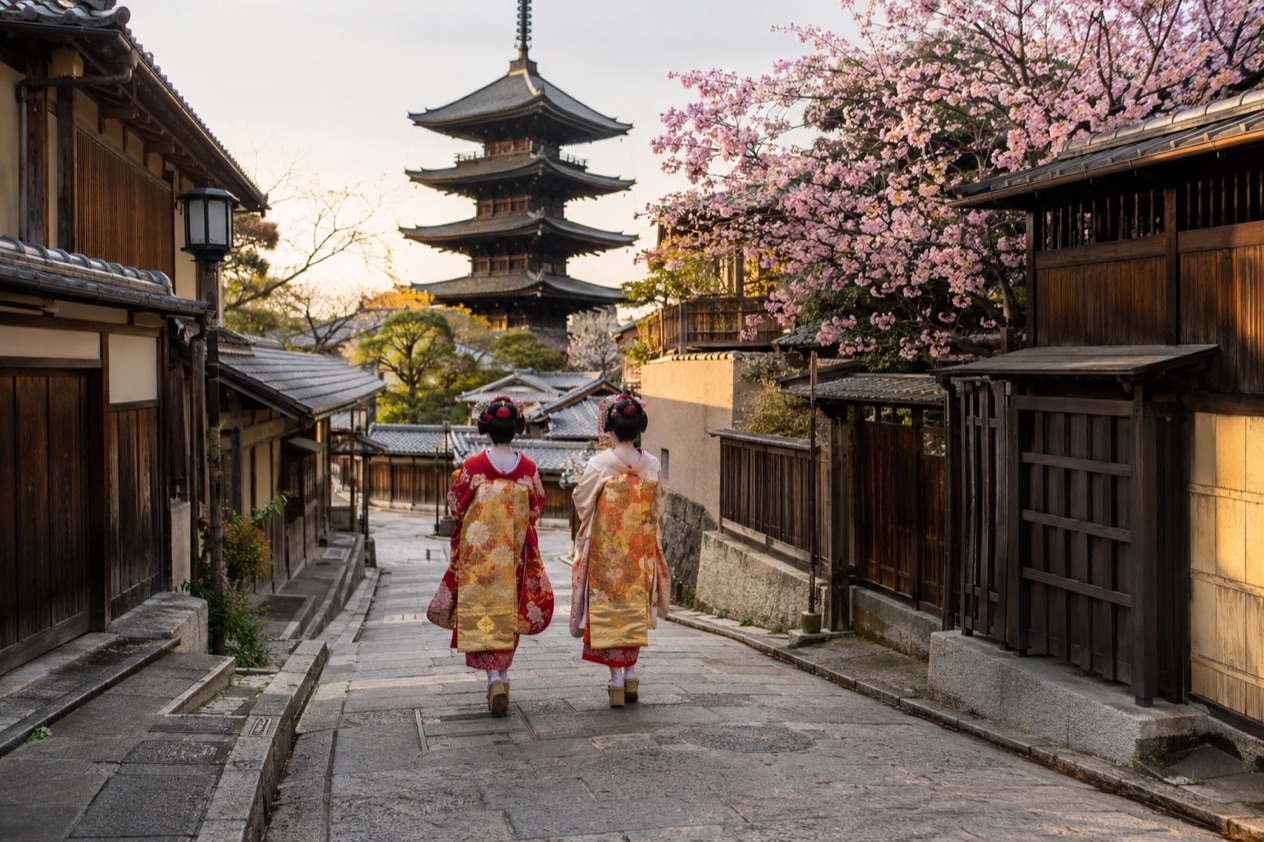
Walk into Gion at dusk and the first thing you notice is the sound of wooden sandals on stone, then a flash of a white collar and an elaborate obi disappearing through a narrow doorway. Lanterns glow along rows of dark wooden façades, and you start to wonder who is behind them. Geisha in Kyoto, who are known locally as geiko, belong to a living profession with its own districts, houses and calendar, and a visit here is mostly about looking, learning and understanding what you are seeing.
Is visiting geisha in Kyoto worth it?
Yes, if you enjoy culture, architecture and the slow pleasure of wandering old streets, and you are happy to see a tradition from the outside rather than from inside a private party. Geisha are performing artists trained in dance, music and singing, and they are also skilled conversationalists and hosts.
Their main work happens at ozashiki, parties usually held in a teahouse called an ochaya, often for a wealthy clientele. That is a closed world, so most travelers meet it through its setting: the lanes, the teahouse fronts, the stage performances and the festivals where geisha also appear.
What sets Kyoto apart from other places in Japan with geisha is the depth of the tradition. Kyoto’s cultural heritage has developed over the past 1,200 years, and its hanamachi districts, where geisha live and work, sit alongside machiya townhouses and the Gion Matsuri festival as part of the city’s identity.
Gion is also the only district where the kyo-mai style of dance is taught, and only to geisha, by the Inoue school. So the dance you might see on a Kyoto stage has a lineage you will not find elsewhere.
One caution shapes the whole experience. Most of the geisha and maiko you spot around Kyoto are actually visitors who pay to be dressed up for the day, a practice called henshin.
It is part of the scenery now, and it can be fun in its own right, but it helps to know the difference. Learning a few details, such as the kimono, the hair and the places where real geiko work, turns a casual stroll into something much richer.
What to see at geisha in Kyoto
The geisha world of Kyoto is spread across five districts known as Gokagai. They are Gion Kobu, Gion Higashi, Ponto-cho, Miyagawa-cho and Kamishichiken. Each has its own character, its own teahouses and its own rhythm, and seeing even two of them gives you a sense of how varied the tradition is.
Gion Kobu and Gion Higashi
Gion is the name most travelers know, and it is made up of two separate districts, Gion Kobu and Gion Higashi. The streets are lined with ochaya, the teahouses where geisha usually entertain guests, and with restaurants and inns where they may also appear. Look at the details: the lattice windows, the small lanterns, the name plates beside the doors, and the way the buildings keep their narrow wooden fronts.
Gion’s special place in the arts is easy to miss on a walk. It is the only district where the kyo-mai dance is taught, solely to geisha, by the Inoue school. That means every performance of this style you may see on stage carries a tradition that belongs to this neighborhood alone. Keep your eyes on the footwork and the folding fans, which are the signature of the style.
Ponto-cho and Miyagawa-cho
Ponto-cho and Miyagawa-cho are two more of the five districts, and each rewards a wander. Ponto-cho is a narrow lane of restaurants and teahouses, and it is a good place to appreciate how a hanamachi works as a small community, with eating, entertaining and living all tucked close together.
Miyagawa-cho has the same wooden architecture and the same sense that a doorway might lead to a private party. As you walk, notice the okiya, the lodging houses where geisha are registered. Every geisha must belong to one, though not all of them live there day to day, so a quiet façade can still be the home base of someone you will never see on the street.
Kamishichiken
Kamishichiken is the fifth of the Gokagai, and it gives you another view of the same traditions in a different setting. Like the other districts, it is a place where geisha live and work, and its teahouses and lodging houses follow the same pattern: private entertainment behind modest doors, with performing arts as the heart of the training.
Seeing it after Gion helps you compare. You begin to read the signs yourself, from the doorway lanterns to the plaques, and to understand that geisha are not a single institution but a network of districts, each with its own houses and its own people.
Geisha beer garden and henshin studios
A different kind of encounter is the geisha beer garden at the Gion Shinmonso ryokan in Gion. It is a way to meet the tradition in a more casual setting than a teahouse party, and it gives you a taste of the hospitality that geisha are trained in.
Then there is henshin, where visitors pay a fee to be dressed up as a maiko or geisha for the day. If you try it, you will see why the street scene looks as it does. If you do not, you can still enjoy the photographs the people around you are taking, and you will know that most of the kimono you spot on the lanes belong to fellow travelers.
When to visit geisha in Kyoto
Time of day matters more than the calendar. Geisha entertain in the evening, at ozashiki in teahouses, so dusk is when the lanterns come on and the districts feel most alive. For the streets themselves, Japan’s national tourism organization recommends visiting Kyoto’s shrines at less crowded times such as early morning or late evening when they are illuminated, and the same idea works for the lanes around them.
Spring and autumn
April brings a mild average high in the upper 60s and a low near 49°F, with about nine days of rain, so a light layer and an umbrella cover most evenings. Sunshine is generous, around 177 hours over the month, which makes long strolls through Gion pleasant. Spring is also the season when many travelers plan their Kyoto trips, so expect the districts to feel lively.
October is a comfortable month for an evening walk. Highs average in the mid-70s and lows in the upper 50s, and rain falls on about eight days. That means you can stay out after dark in a light jacket, which suits the district best, since this is when the lanterns, the teahouse doors and the occasional hurried figure in kimono set the mood.
Summer and winter
July is hot and humid, with highs near 90°F, lows in the mid-70s and rain on around twelve days. It is also the month of Gion Matsuri, the festival that belongs to Kyoto’s traditions and to Gion in particular. Evening walks are still possible, but you will want to drink often and pace yourself.
January is cold, with highs near 48°F and lows in the mid-30s. Snow or sleet falls on many days, though total snowfall stays modest. A coat and good shoes make the lanes feel atmospheric, and the dark wooden façades look striking in cold, damp air. Shorter days mean the lanterns come on early, so you can see the districts after a mid-afternoon start.
| Month | Average high (°F) | Average low (°F) | Rain days | Precipitation (in) |
|---|---|---|---|---|
| January | 48.4 | 34.7 | 6.4 | 2.10 |
| April | 68.2 | 48.6 | 9.4 | 4.61 |
| July | 89.6 | 74.5 | 11.6 | 8.80 |
| October | 74.1 | 57.9 | 8.2 | 5.64 |
Tips for your visit
Comfortable shoes are the first thing to pack, because the districts are best explored on foot and the lanes are often paved with stone. Bring a layer that suits the month, and a small umbrella in April, July or October, when rain falls on eight to twelve days of the month. A camera is useful, but it is worth remembering that the lanes are also where people live and work.
Reading what you see
A few facts make the walk richer. In Kyoto, geisha are also called geiko. They usually entertain at an ochaya, but may also appear at their okiya, at restaurants or at inns. Their fees are described with the terms ohana and hanadai, both meaning flower fees, rather than a flat hourly rate. Knowing this helps you see the district as a working network, not a stage set.
Remember too that most of the geisha and maiko you pass on the street are visitors in rented dress, part of the henshin practice. That is not a problem, and it can be good fun to join in, but the real geiko are performing artists with years of training in dance, music and song, and you will most likely meet them on stage or at a festival.
Combining it with the rest of Kyoto
Kyoto Station is served by the Tokaido Shinkansen line, which makes it a starting point for exploring the city and connecting to other major cities. The station building houses a full floor of ramen restaurants, an Isetan department store, a theater and a Granvia hotel, and Kyoto Tower stands a few steps from the main entrance, visible across the city. Those are useful landmarks if you are arriving by train.
In central Kyoto, Nijo Castle makes a good pairing with a geisha district walk, since it shows another side of the city’s long history as the seat of the emperor. It was built in 1603 by Tokugawa Ieyasu, the first shogun of the Edo period, and it has nightingale floors that chirp like birds when walked on, an old security system meant to warn guards of intruders. Pair a castle visit by day with a district walk at dusk and you have covered two very different centuries of Kyoto.
Good to know before you go
Think of this as a walk through living neighborhoods rather than a ticketed attraction. The lanes are residential and professional spaces, so quiet voices and a respectful distance suit the setting, and the ozashiki parties inside the teahouses are private events.
Rain is common in every season the climate figures cover, so a compact umbrella earns its place in a bag. Kyoto’s long history as Japan’s capital, over a thousand years, is part of why these districts feel so rooted, and it gives the evening stroll a sense of continuity.
Sources
- Wikipedia, Geisha (https://en.wikipedia.org/wiki/Geisha), checked October 11, 2026
- Japan National Tourism Organization, Kyoto (https://www.japan.travel/en/destinations/kansai/kyoto/), checked October 11, 2026
- Japan Meteorological Agency (JMA), Normal values 1991-2020, monthly (https://www.data.jma.go.jp/stats/etrn/view/nml_sfc_ym.php?prec_no=61&block_no=47759), station Kyoto, elevation 41 m, checked October 11, 2026
To plan your stay
- Best Time to Visit Kyoto: Cherry Blossoms, Autumn Leaves, Weather by Month and Festivals
- Where to Stay in Kyoto: Kyoto Station, Central and Eastern Districts, and Ryokan Stays
- Kyoto from Tokyo: Shinkansen Trains, Nozomi vs. Hikari and Kodama, and a First Day in Kyoto
- Know Before You Go to Kyoto: Entry, Money, Getting Around and Local Etiquette