
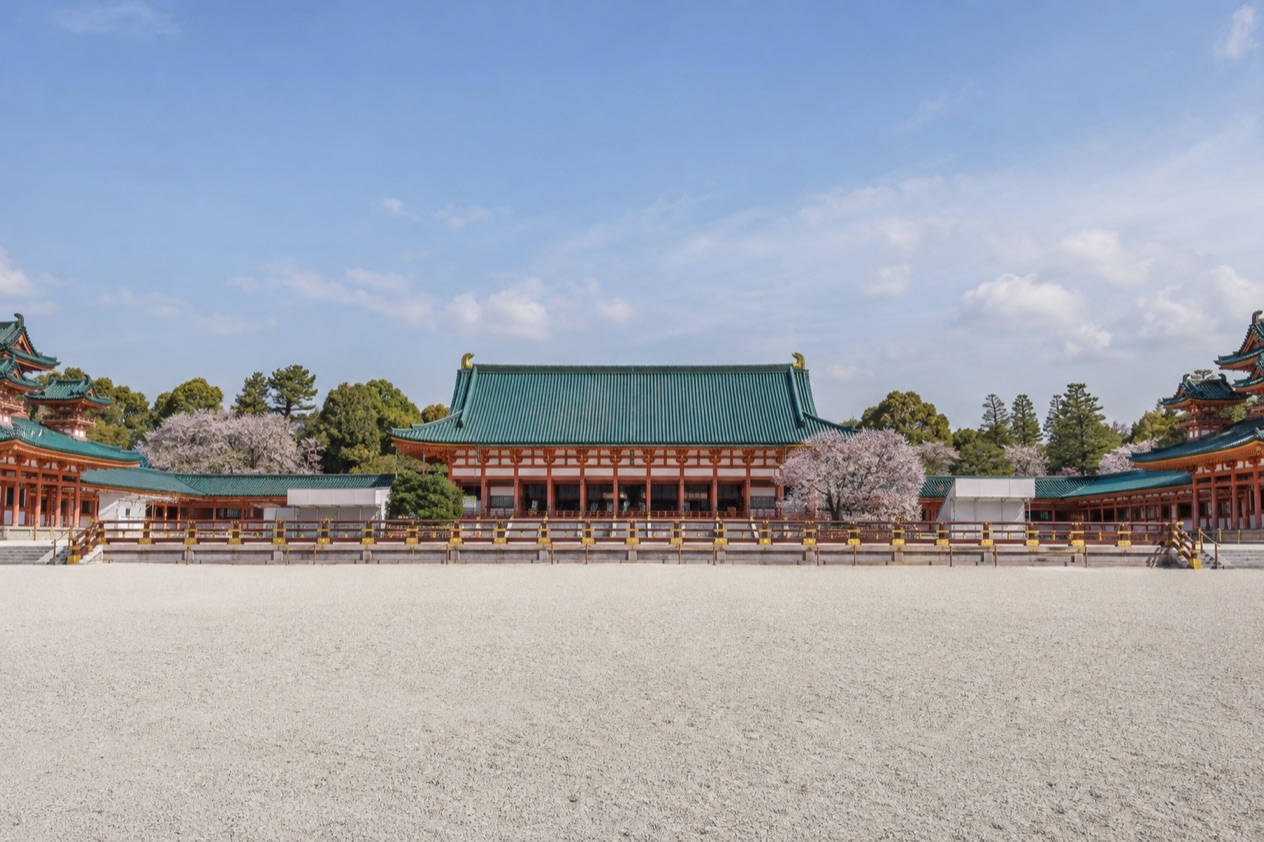
You come to Heian Shrine across a wide open approach, and the first thing in view is a torii gate so large it seems to belong to the sky more than to the street. Beyond it, vermilion pillars and green-tiled roofs frame a broad courtyard of pale gravel. It is a shrine built to recall an imperial palace, with a pond garden behind it, and it makes a quiet-minded visit in the Sakyo-ku part of Kyoto.
Is visiting Heian Shrine worth it?
Yes, particularly if you like places that show you an idea of the past as much as the past itself, and if you want a garden to walk through in the same visit as a major shrine. The buildings are a reproduction of the Heian Palace at five-eighths of the original size, built in Okazaki, so you are looking at a scaled memory of the court that once ruled from Kyoto. That makes the shrine easy to read at a glance: the gate, the courtyard and the halls are laid out like a stage set for the imperial city.
What sets it apart from the temples and castles around Kyoto is the mix. Nijo Castle, built by Tokugawa Ieyasu, the first shogun of the Edo period, speaks for the warrior government, and its nightingale floors chirp underfoot as an old alarm against intruders.
Heian Shrine speaks instead for the emperor’s court, and it does so in bright vermilion rather than weathered wood. A large garden sits behind the halls, and festivals, weddings and concerts keep the grounds in use rather than preserved behind ropes.
It also suits a mixed group. Someone who wants architecture gets the palace-style halls, someone who wants green space gets the ponds, and children get the chance to feed fish and turtles.
Film fans may recognize the grounds too, since parts of Lost in Translation were shot here. If you only have time for a single shrine and want it to feel different from the cedar-shaded sanctuaries elsewhere in the city, this is a strong choice.
Kyoto’s heritage has developed over twelve hundred years, and the city’s traditions run from machiya townhouses to the Gion Matsuri festival and the hanamachi districts where geishas live and work. Against that backdrop Heian Shrine adds a chapter about the imperial capital itself, a role Kyoto held for more than a thousand years.
What to see at Heian Shrine
The torii gate and the palace-style halls
The torii gate is the shrine’s signature, counted among the largest in Japan. Walk toward it and you feel the scale change, because the gate frames the entire approach and makes the people beneath it look small. It is a good place to slow down before you cross into the grounds, and to notice how the bright vermilion stands out against the sky.
Inside, the main halls follow the look of the Heian Palace, the old seat of the court, rebuilt at five-eighths of the original scale. Look for the wide, open courtyard, the white gravel underfoot, the sweeping green roofs and the red-lacquered pillars. Notice also how the proportions feel both grand and slightly compact, as you would expect from a reproduction made smaller than the building it honors.
Pause at the main hall to watch worshippers bow, clap and make their offerings, since the shrine is a place of prayer and not only a monument. Visitors who want to see the architecture clearly tend to look up at the roof edges and the layered eaves, where the palace style is easiest to read.
The garden and its ponds
Behind the halls, a Japanese-style garden fills about half the shrine’s land, roughly 355,900 square feet. It is laid out as a walk around ponds, with paths, bridges and plantings that change with the season, so the same circuit looks different in spring, summer and autumn. The water in the ponds comes from the Lake Biwa Canal, a reminder that Kyoto’s gardens have long been tied to the engineering that brought water into the city.
Visitors may feed the fish and turtles in the ponds with food sold around the water. It is the part of the visit children usually remember best, and adults tend to linger there too, watching the carp crowd the edge and the turtles line up on the stones. Stay on the paths and let the garden set your pace, because it rewards a slow loop more than a quick pass.
Festivals, weddings and concerts
The shrine holds an annual festival in early April in memory of Emperor Kanmu, and the Reitaisai festival falls on April 15th. April is therefore the month when the grounds feel most ceremonial, with rites that give the palace-style halls their purpose. If you can arrange your trip around those dates, you see the shrine doing what it was built to do.
Heian Shrine is also used for traditional Japanese weddings and for concerts. On an ordinary day you may spot a wedding party in formal dress crossing the gravel, a sight that adds color and a human scale to the courtyard. Concerts turn the same open space into a stage, and the large gate and halls make a striking backdrop.
Okazaki Park next door
Okazaki Park is adjacent to the shrine and offers cultural learning opportunities, which makes it a natural extension of the visit for anyone who wants more context after the halls and the garden. It gives the outing a second half, a place to continue the day among museums and open space instead of heading straight back into the city.
Treat it as an add-on rather than a separate trip. After the garden’s quiet loop, the park lets you change gears and look at Kyoto’s cultural side from a different angle, which pairs well with the shrine’s imperial theme.
When to visit Heian Shrine
For the shrine itself, April is the month with a date attached: the early April festival for Emperor Kanmu and the Reitaisai on April 15th. The weather that month is mild, with afternoons around the high 60s and cool mornings, and rain arrives on a little over nine days, usually as passing showers rather than a washout. It is a comfortable month to be outdoors in the garden.
October, the month you are reading in, is another comfortable time to walk the grounds. Afternoons are warm without being heavy, evenings are cool enough for a light layer, and about eight days bring rain. The garden is the part of the visit that most depends on the weather, so a dry spell makes the pond circuit especially pleasant.
July is a different experience. It is hot and humid, with rain on nearly twelve days and the heaviest rainfall of the four months in the table. You can still visit, but the garden loop is best taken slowly and with an umbrella handy. January is cold, and snow or sleet falls on many days, though only a couple of inches pile up over the whole month, so the courtyard can look quite different from its summer self.
| Month | Average high (°F) | Average low (°F) | Rain days | Precipitation (in) | Sunshine (hours) |
|---|---|---|---|---|---|
| January | 48.4 | 34.7 | 6.4 | 2.10 | 124 |
| April | 68.2 | 48.6 | 9.4 | 4.61 | 177 |
| July | 89.6 | 74.5 | 11.6 | 8.80 | 143 |
| October | 74.1 | 57.9 | 8.2 | 5.64 | 156 |
As for the time of day, the Japan National Tourism Organization recommends visiting Kyoto’s shrines at less crowded times, such as early morning or late evening when they are illuminated. Applied here, that means planning your arrival toward the edges of the day if you want the courtyard and the garden with fewer people around you.
Tips for your visit
Start at the torii gate and let the approach set the scene, then cross the courtyard to the halls before you head into the garden. Doing it in that order follows the way the shrine was designed, from monumental gate to ceremonial center to quiet water, and it keeps the garden as a calm finish rather than a detour.
Bring a little extra patience for the pond area if you travel with children, because feeding the fish and turtles is the highlight for many of them. In wet months such as July, an umbrella is more useful than a hat, and in January a warm coat matters more than anything else you pack.
Pair the shrine with Okazaki Park, which sits right next to it and adds cultural learning to the outing. That combination fills a good part of a day without any need to cross the city, and it suits a traveler who wants a single neighborhood explored well rather than several skimmed.
If you are staying near Kyoto Station, remember that it is served by the Tokaido Shinkansen and houses a full floor of ramen restaurants, an Isetan department store, a theater and a Granvia hotel. That makes it a handy place to end the day with a bowl of noodles after the shrine. Kyoto Tower stands a few steps from the station’s main entrance, over 130 meters tall and visible across the city.
For another side of Kyoto on a different day, Nijo Castle in central Kyoto makes a useful contrast. Its builder, Tokugawa Ieyasu, belonged to the warrior world, and its nightingale floors give a very different sense of the past from the court atmosphere of Heian Shrine. Seeing both helps you understand how imperial and shogunal Kyoto differ.
Good to know before you go
The shrine is a working place of worship, used for weddings and ceremonies, so it helps to keep your voice low near the halls and to watch where a wedding party is walking. Dress for the season, since the temperature and rainfall differ a lot between summer and winter, and the garden is where you spend most of your time outdoors.
Bring an umbrella in the wetter months, particularly July, and a warm layer from late autumn through winter. Take your time in the garden, because it is the part of the visit that rewards a slower pace, and leave room afterward for Okazaki Park next door.
Sources
- Wikipedia, Heian Shrine (https://en.wikipedia.org/wiki/Heian_Shrine), checked October 11, 2026
- Japan National Tourism Organization, Kyoto (https://www.japan.travel/en/destinations/kansai/kyoto/), checked October 11, 2026
- Japan Meteorological Agency (JMA), Normal values 1991-2020, monthly (https://www.data.jma.go.jp/stats/etrn/view/nml_sfc_ym.php?prec_no=61&block_no=47759), station Kyoto, elevation 41 m, checked October 11, 2026
To plan your stay
- Best Time to Visit Japan: Cherry Blossoms, Autumn Colors, Weather and Festivals
- Where to Stay in Japan: Ryokan, Temple Stays, Capsule Hotels and the Best Cities to Base In
- Sending Luggage from the Airport in Japan: Hands-Free Travel, Hotel Delivery and Coin Lockers
- Know Before You Go to Japan: Entry, Money, Etiquette and Getting Around