
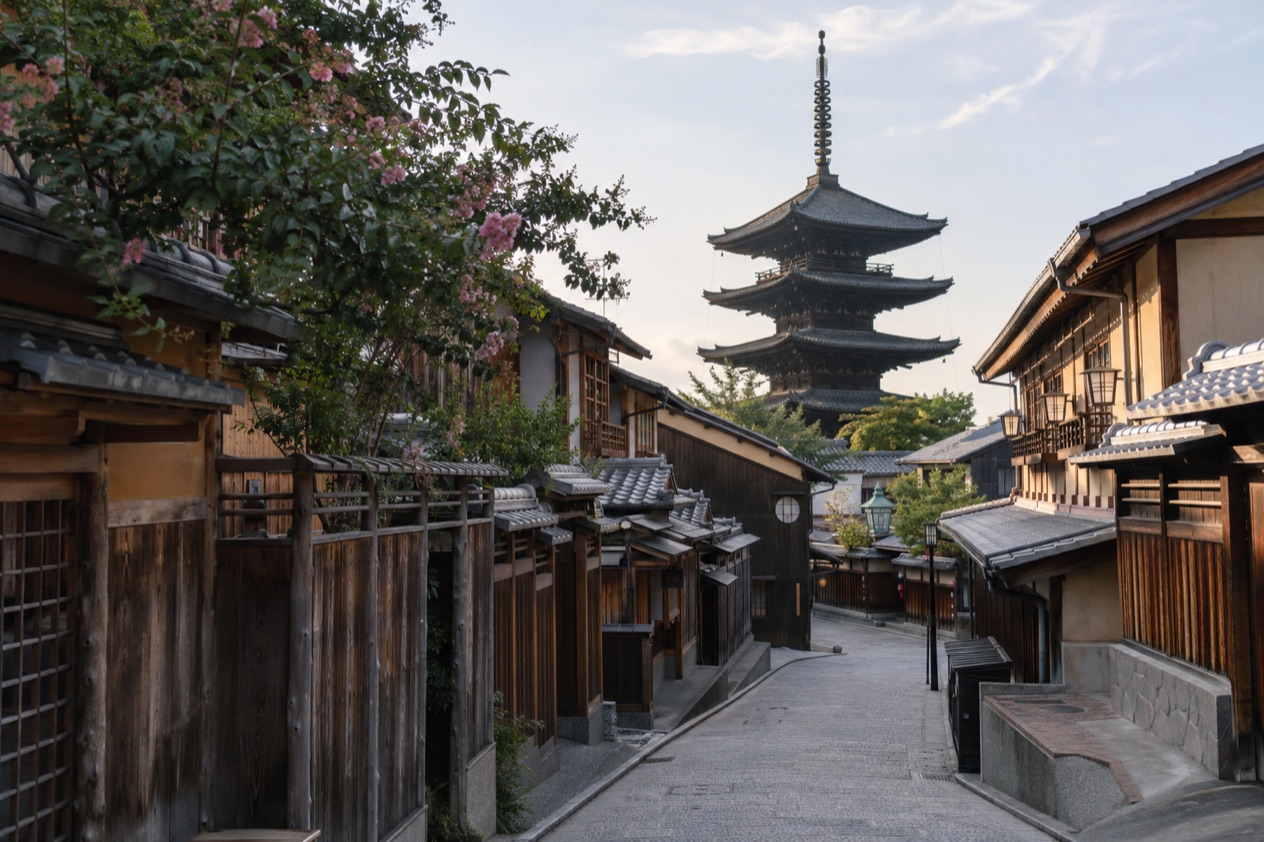
Wooden sandals clack on the stone paving of Ninenzaka, and the lanes fill with the smell of grilled rice crackers and sweet bean paste. Above the tiled roofs, the hillside temples catch the light. Higashiyama is the eastern edge of Kyoto, where old streets, shrines and teahouses run up against the mountains, and it suits anyone who wants to spend a day on foot among them.
What is Higashiyama like?
Higashiyama is the part of Kyoto that sits east of the Kamo River, a ward whose name means “east mountain” and which lies between the river and the wooded range that gives it that name. Its character comes from that position: the flat city ends, the ground starts to rise, and temples appear one after another along the foothills. The ward was created in 1929, split off from another Kyoto ward, and it has the smallest population of all the wards in the city.
Two parts of it have protected status so that traditional buildings are kept in their old style: Gion, the entertainment district in front of Yasaka Shrine, and the area around the stone-paved lanes of Ninenzaka and Sannenzaka that climb toward Kiyomizu Temple. Gion belongs to the hanamachi tradition, the districts where geisha live and work, and it sits within a Kyoto that also takes pride in its machiya townhouses and in the Gion Matsuri festival.
Walkers who like to move between temple gates, craft shops and tea rooms will feel at home here. So will anyone curious about Kyoto’s long history as the seat of the emperor. The ward also holds museums, so a rainy afternoon has somewhere to go. Higashiyama rewards a slow pace, with a lane to turn into every few steps.
Things to do in Higashiyama
Kiyomizu Temple and its love stones
It stands on the hillside above the lanes, and the walk up through the old streets is part of the experience.
It is a fine place to watch other visitors as much as the buildings. Couples, school groups and friends daring each other to cross with eyes shut give the grounds a lively, slightly giddy mood. Kyoto’s tourism advice is to visit shrines and temples early in the morning or late in the evening when they are lit, so plan around those hours if you can.
Ninenzaka and Sannenzaka
These two stone-paved roads lead up to Kiyomizu and are protected so that their traditional buildings stay in the old style. Wooden fronts, lattice windows and small shops line both sides, and the slope makes you slow down whether you mean to or not. Expect to browse sweets, ceramics and small gifts as you climb.
They are best treated as a walk rather than a destination. Pair them with the temple at the top, then drift back down by a different lane. Comfortable shoes matter on the stone.
Gion and Yasaka Shrine
Gion spreads out in front of Yasaka Shrine and is the entertainment district of the ward, with the same protection for its traditional buildings. It is the Kyoto of teahouses and wooden façades, and the neighborhood tied most closely to the geisha tradition. The shrine itself is a natural pause between the streets and the hills.
Gion fits an evening stroll when lanterns glow, and it also works for a daytime wander among the old-style buildings. Treat it as a living neighborhood: people work and live here, so keep voices low and give the lanes room.
Temples and museums across the ward
Beyond Kiyomizu, the ward holds Tofuku-ji, Kennin-ji, Kodai-ji and Sanjusangen-do, each with its own grounds and character. Two museums sit here as well: the Kyoto National Museum and the Namikawa Cloisonne Museum, the second devoted to the enamel art of cloisonne.
A good day mixes one big temple with one smaller one and a museum stop, so the walking never feels like a checklist. Nearby, Nanzen-ji lies close to Keage Station, and Ginkakuji sits at the end of the city bus route that runs through the district.
Eating and drinking in Higashiyama
Eating here follows the rhythm of walking. Along the lanes toward Kiyomizu, small shops sell sweets and snacks meant to be eaten on the move, from grilled rice crackers to bean-paste confections and matcha treats. Kyoto’s tea tradition is strong, and a tea room with a view of a tiled roof is a natural break between temples.
In and around Gion, the dining leans toward the formal and the traditional. Kaiseki, the multi-course meal built from seasonal ingredients, is the Kyoto specialty and it appeals to those who want a long, quiet dinner. Smaller izakaya, the casual Japanese pubs, serve skewers, simmered dishes and local drinks in a more relaxed setting.
Kyoto cooking has a reputation for gentle flavors, tofu and pickles, and vegetable dishes served with care. Order what is in season and let the staff guide you. For something quick after a day on the hillside, the ramen floor at Kyoto Station is a short train or bus ride away, with a whole level given over to ramen restaurants.
Cafés scattered through the ward suit a pause with coffee or tea and something sweet. Pick a seat by a window onto a lane, and the neighborhood passes by as you eat.
Staying in Higashiyama
Higashiyama suits travelers who want to wake up among temples and old streets rather than beside a station. Lodging here tends toward the traditional: small inns and guesthouses in old-style buildings, in keeping with the protected streets, alongside more conventional hotels on the edges of the ward. Staying here means you are already in the sights when the day starts.
The mood after dark is calm in the hillside lanes and livelier near Gion, where the entertainment district keeps its own evening rhythm. The ward has the lowest population of any in Kyoto, and much of its character is residential and quiet away from the main routes.
Compared with the area around Kyoto Station, which has the Shinkansen, a department store and a large hotel in the station building, Higashiyama trades convenience of transit for atmosphere. The station is the place to arrive and connect to cities across Japan. The ward is where you settle in and walk.
Central Kyoto, across the river, holds Nijo Castle, built in 1603 by Tokugawa Ieyasu, with its nightingale floors that chirp underfoot. It is a different base, more city than hillside. Choose Higashiyama if the temples and lanes are the reason you came.
Getting to Higashiyama
Higashiyama lies across the Kamo River from the rest of the city, and several lines reach it. Keihan Railway serves the entire eastern side of Kyoto. It links the area to northern Kyoto at Demachiyanagi Station, where you can walk to Shimogamo Shrine or change to the Eizan Railway as far as Kurama. Heading south, it runs toward Hirakata and Osaka, with connections to Uji at Chushojima Station.
Kyoto’s municipal subway also helps. On the Tozai Line, Higashiyama Station, north of Gion, and Keage Station, near Nanzen-ji, are both convenient for reaching the district. These two stops put you at different ends of the ward, so pick the one nearest the sights you want first.
City buses are the third option. Kyoto City Bus route 100 runs from Kyoto Station to Ginkakuji, stopping only at major attractions in Higashiyama. Kyoto Station itself is served by the Tokaido Shinkansen, so travelers arriving from other cities can step off the bullet train and continue by bus.
Once you are in the ward, walking is how most of it unfolds, since the sights sit along lanes that climb gently from the river toward the hills. The ground rises from the lowest point of the ward up to its highest, so expect some slopes between temples.
Good to know before you go
Higashiyama’s protected lanes are living neighborhoods, so keep your voice down and stay on the street rather than stepping into private doorways. Temples reward an early start or a late visit when lit, which is the advice Kyoto itself gives for enjoying its shrines at calmer times. Wear shoes that handle stone paving and slopes, and carry a light rain layer, since a wet afternoon is a good moment for the museums.
Sources
- Wikipedia, Higashiyama-ku, Kyoto (https://en.wikipedia.org/wiki/Higashiyama-ku,_Kyoto), checked October 11, 2026
- Wikivoyage, Kyoto/Higashiyama (https://en.wikivoyage.org/wiki/Kyoto/Higashiyama), checked October 11, 2026
- Japan National Tourism Organization, Kyoto (https://www.japan.travel/en/destinations/kansai/kyoto/), checked October 11, 2026
To plan your stay
- Best Time to Visit Japan: Cherry Blossoms, Autumn Colors, Weather and Festivals
- Where to Stay in Japan: Ryokan, Temple Stays, Capsule Hotels and the Best Cities to Base In
- Sending Luggage from the Airport in Japan: Hands-Free Travel, Hotel Delivery and Coin Lockers
- Know Before You Go to Japan: Entry, Money, Etiquette and Getting Around