
The approach to Kodai-ji is a slow climb through the Higashiyama hillside, and then the temple opens onto raked gravel, moss and old pines. It is a Zen temple of the Rinzai school, set in Kyoto’s Higashiyama-ku, and it asks to be seen at walking pace. The visit is a mix of garden, history and one very modern surprise, and it suits anyone who wants Kyoto’s temple world told through a single widow’s story.
Is visiting Kodai-ji worth it?
Yes, especially for travelers who like gardens, tea culture and the human stories behind Kyoto’s temples, and who would rather linger over one site than tick off five. Kodai-ji belongs to the Kenninji branch of the Rinzai school of Japanese Zen, and it was established and completed in 1606. Its precincts were designated a National Historic Site in 1966, and the gardens, designed by Kobori Enshu, are a nationally designated Place of Scenic Beauty.
What sets it apart from other temples around Higashiyama is the way it combines three things in one compound. There is a garden laid out by one of the best-known landscape designers of his era, a mausoleum whose interior glows with Momoyama-style decoration, and a priest-like android that delivers sermons.
Most temples give you one of these. Kodai-ji gives you a landscape to walk, a small, richly worked building to look into, and a conversation between old Buddhism and new technology.
It also has a quieter emotional register than many Kyoto sites. The temple was founded in memory of Toyotomi Hideyoshi, and the story of his widow, who spent her later years here, runs through the buildings.
You come away with a sense of a particular household and a particular moment in Japanese history, not only a pleasant garden. Pair it with a walk through the surrounding streets of Higashiyama and the day has a shape: a climb, a pause, a descent.
If you are short on time in Kyoto, Kodai-ji is a good choice when you want a place to sit, look and think. Kyoto has a cultural heritage that has developed over the past 1,200 years, and a temple like this one lets you feel a single thread of it rather than a blur of many. It is less suited to someone who wants a long list of grand halls, because the original structures that remain are few and small in scale.
What to see at Kodai-ji
The temple’s surviving original buildings are few, and that is part of its character. The only structures remaining from the original construction are the Kaisan-do, the mausoleum known as the Otamaya, and two chashitsu teahouses. Around them stretch the gardens, and in the treasury are objects that carry the temple’s history.
The Kobori Enshu gardens
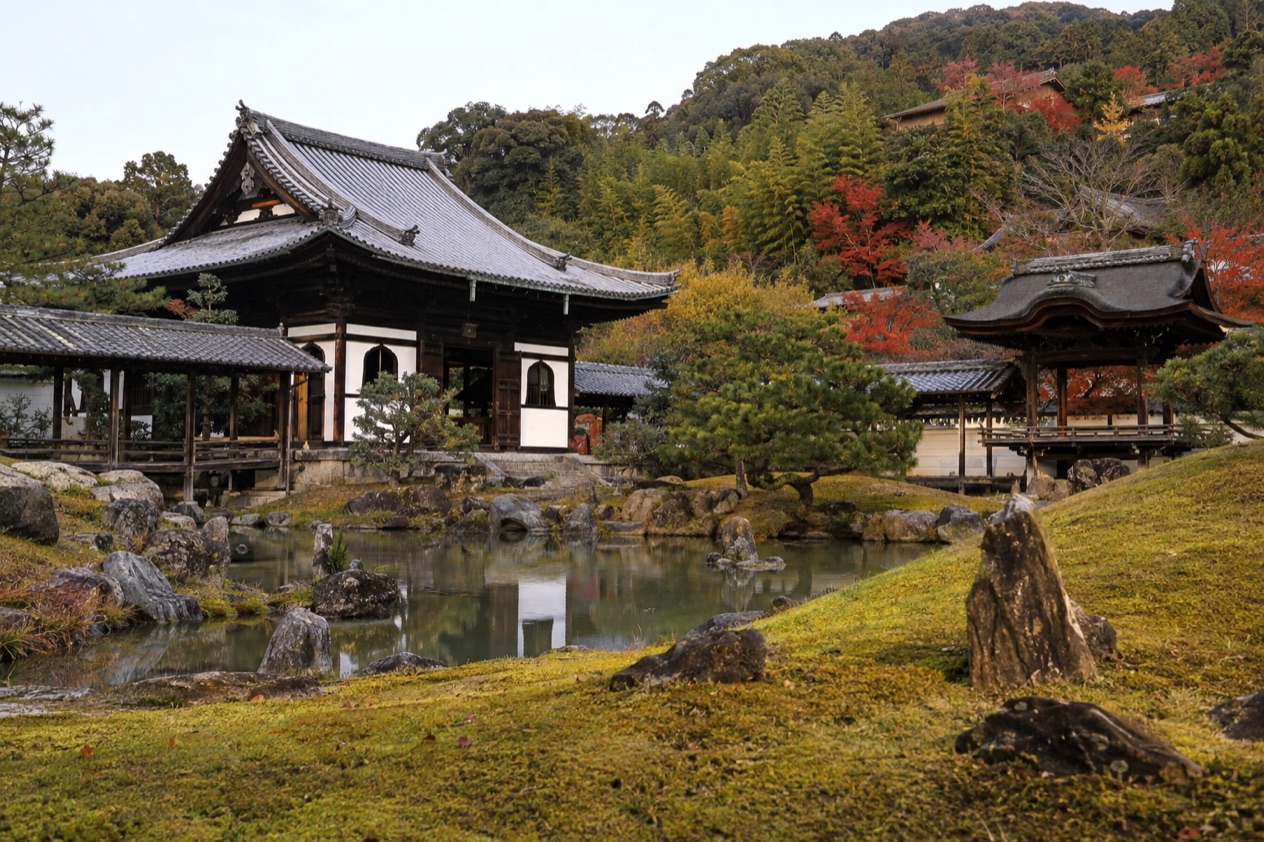
The gardens are the reason people come. They were designed by Kobori Enshu, a name linked in Japanese culture with tea and with garden design, and they are a nationally designated Place of Scenic Beauty. Expect the elements that define a Zen landscape: stone, gravel, moss, carefully shaped trees and a layout that changes as you move through it.
Look at how the view is framed rather than at any single feature. A pine, a stone edge and a patch of raked ground are arranged so that each step reveals a new composition. In autumn the maples add red to the greens, and in spring the new leaves soften the whole scene. Take a bench or a veranda edge if one is open to you and let your eye settle.
The Otamaya mausoleum and its lacquerware
The Otamaya is the mausoleum, and it is among the most interesting pieces of the compound. Its interior decoration uses Momoyama-style lacquerware, called Kodaiji lacquerware, noted for its use of maki-e, the technique in which designs are drawn in lacquer and dusted with gold or other powders. The Otamaya is also one of the objects designated as Important Cultural Assets.
The style belongs to the Momoyama period, a time of confident, decorative taste, and the lacquer work shows it in delicate plant motifs and glints of gold. The building itself is modest in size, so look closely at details rather than expecting a grand hall. It is one of the few original structures left, which makes it a direct link to the temple’s earliest days.
Kaisan-do and the teahouses
The Kaisan-do, the founder’s hall, and the two chashitsu teahouses are the other original structures. A chashitsu is a building made for the tea ceremony, and these two sit within the garden setting, which is how tea architecture is meant to be read: as part of a landscape, not apart from it.
Notice the proportions and the materials, the way the rooflines stay low and the walls are plain. These are buildings designed to make you slow down. Given the link between Kobori Enshu and the garden, it is natural to imagine tea being served in a setting like this, with the view from the teahouse as part of the experience.
Mindar, the android priest
The newest attraction is Mindar, an android that has given sermons on the Heart Sutra at Kodai-ji since 2019. It is an unexpected sight in a Zen temple, and it speaks to a long Buddhist habit of using whatever means are at hand to communicate the teachings. Visitors find it a thought-provoking contrast with the old wooden halls and the garden.
The treasury
The treasury holds a portrait of Toyotomi Hideyoshi that is registered as an Important Cultural Asset, along with a bronze bell bearing an inscription that dates it to 1606, the year the temple was completed. The temple also possesses other Important Cultural Assets, including the Sanmon gate. Seeing the portrait gives a face to the name behind the temple’s founding.
When to visit Kodai-ji
Kyoto’s own guidance is to visit shrines and temples at less crowded times, such as early morning or late evening when they are illuminated, and that is a useful starting point for any temple in the city. For the weather itself, each season gives the gardens a different mood.
Spring and autumn
April brings highs in the upper 60s and lows near 49°F, with about nine days of measurable rain, which means mild afternoons for walking with the occasional shower. The gardens are green and fresh, and a light layer is enough. October is slightly warmer, with highs in the mid-70s and lows near 58°F, and the weather suits long outdoor visits.
October has about eight rainy days, so a thin rain jacket is worth carrying. These two seasons are when visitors choose to come to Kyoto, so expect company on the paths. Seasonal light on moss, pine and maple is the draw, and the garden is the kind of place where a change in weather only adds to the scene.
Summer
July is hot and humid, with highs near 90°F, lows around 75°F and humidity near 69 percent. About twelve days bring at least a little rain, and the month is the wettest of the four in the table. A garden visit in July is a matter of pacing yourself, pausing in shade, and expecting damp air.
Winter
January is cold, with highs near 48°F and lows around 35°F, and snow or sleet falls on many days through the month. A cold, gray garden has its own appeal, with bare branches and a hush over the gravel, but you will want warm layers and sturdy shoes. Sunshine is limited, so light can be soft and flat.
| Month | Average high (°F) | Average low (°F) | Precipitation (in) | Rain days |
|---|---|---|---|---|
| January | 48.4 | 34.7 | 2.10 | 6.4 |
| April | 68.2 | 48.6 | 4.61 | 9.4 |
| July | 89.6 | 74.5 | 8.80 | 11.6 |
| October | 74.1 | 57.9 | 5.64 | 8.2 |
Tips for your visit
Plan Kodai-ji as a slow stop in a day of walking, not a quick photo break. The grounds are a garden first, so comfortable shoes and a willingness to wander at your own pace matter more than any equipment. Bring a layer for the season and something for rain in the wetter months.
Combining it with the rest of Higashiyama
Kodai-ji sits in Higashiyama-ku, in the Shimogawara neighborhood, an area of old streets and temples that suits a day on foot. Kyoto is known for machiya townhouses, the Gion Matsuri festival and hanamachi districts where geishas live and work, and the Higashiyama streets give a sense of that world. Use the temple as the calm center of a walk that also includes wandering the lanes.
If you want to add another historic site in the city, Nijo Castle in central Kyoto was built in 1603 by Tokugawa Ieyasu, the first shogun of the Edo period. It is nearly contemporary with Kodai-ji, which was completed in 1606, so the two together tell a story of the same turn in Japanese history, from different sides. Its nightingale floors, which make a bird-like sound when walked on, are a memorable detail.
Getting your bearings from Kyoto Station
Kyoto Station is served by the Tokaido Shinkansen line and is a starting point for exploring the city. The station building houses a full floor of ramen restaurants, an Isetan department store, a theater and a Granvia hotel, so it is a place to eat before or after a day out. Kyoto Tower stands a few steps from the main entrance and is visible across the city.
Families and slower visitors
Children who like stories may enjoy the tale of a family and a castle, and Mindar usually draws curiosity from all ages. Think of the visit as a series of pauses: a garden to look at, a building to peer into, a robot to listen to. For anyone who tires on slopes or steps, the better plan is to go at an unhurried pace and keep the day light around it.
Good to know before you go
A temple like Kodai-ji is a place of practice as well as a sight, so quiet voices and respectful dress fit the setting, and shoes come off wherever a hall asks for it. Carry some yen for small purchases. Rain can arrive in any month in the table, and July is the wettest, so an umbrella is a sensible companion in summer.
Sources
- Wikipedia, Kōdai-ji (https://en.wikipedia.org/wiki/K%C5%8Ddai-ji), checked October 11, 2026
- Japan National Tourism Organization, Kyoto (https://www.japan.travel/en/destinations/kansai/kyoto/), checked October 11, 2026
- Japan Meteorological Agency (JMA), Normal values 1991-2020, monthly (https://www.data.jma.go.jp/stats/etrn/view/nml_sfc_ym.php?prec_no=61&block_no=47759), station Kyoto, elevation 41 m, checked October 11, 2026
To plan your stay
- Best Time to Visit Japan: Cherry Blossoms, Autumn Colors, Weather and Festivals
- Where to Stay in Japan: Ryokan, Temple Stays, Capsule Hotels and the Best Cities to Base In
- Sending Luggage from the Airport in Japan: Hands-Free Travel, Hotel Delivery and Coin Lockers
- Know Before You Go to Japan: Entry, Money, Etiquette and Getting Around